Small Newspapers May Be Able To Prolong Death Longer Than Large Counterparts
by Leena Rao on July 7, 2009

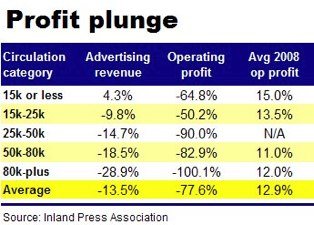
More bad news for large newspapers. According to the latest stats from the Inland Press Association, larger newspapers with higher circulations are suffering more than their smaller siblings. Newspaper veteran Alan Mutter reports that the bigger the newspapers are, the more their profits decreased over the past five years. Since 2004, operating profits on average fell just over 100% at newspapers with circulation higher than 80,000. That’s right. Taken all together, their losses wiped out their profits.

The Inland Press surveyed 120 papers across the country.  Newspapers with circulations of less than 15,000 fared better, with ad revenues actually eking out a 4.3% increase over the same period. But operating profits still fell by nearly 65%.  This drop isn’t nearly as staggering as the plummet of profits for newspapers with an 80,000-plus circulation, but it’s not a cause for celebration either. Newspapers with 50,000-80,000 in circulation saw profits fall 83%, with newspapers with circulations of 25,000 to 50,000 seeing a 90 percent drop in profit.

Another sign of hope: small papers still have a hold on classifieds.  Average classified sales for small papers have actually gone up, at a time when they have been declining for most papers. Inland cites an example of a daily newspaper with a circulation of less than 15,000, which posted a 210.4% increase in classified revenue from 2004 to 2008. But it didn’t do much good.  The paper’s profits were down by almost 30%.

All in all, newspapers on average reported a 13.5% drop in ad sales between 2004 and 2008, which confirms yet once again the dismal state of the industry. Curiously, the study says that the largest newspapers reported an average profit margin of 12% in 2008, which is remarkably high for publishers whose profits have virtually disappeared. Mutter points out that a 12% profit margin is more than double Wal-Mart’s margins in 2008.

Apparently, Inland Press says the reason profit margins could still average 12% is because data was collected from a variety of publications, some of which had healthy margins and some of which has terrible losses. We’re not sure which, if any, large newspapers had healthy margins. Also, the data that was volunteered by publishers was released on condition of anonymity. Seems like a bit of a paradox in these times.

Perhaps their are just averaging the profit margins across newspapers on a percentage basis, while taking absolute profits and losses into account when calculating the overall declines.  Large percentage gains at small newspapers would then have an over-sized weighting.  No matter how rosy a picture the newspaper association tries to paint, the fact remains that there are still serious (perhaps mortal) declines at all newspapers.  And while death may be slower for the little guys, it’s still imminent.

Advertisement

Comments rss icon

  • I don’t think “prolong death” is quite the wording you’re looking for.

    • What Leena fails to realize... - July 8th, 2009 at 7:40 am PDT

      Leena:

      If newspapers die, you personally are screwed.

      Do you know why?

      Because the blog reporter pay scale is going to go way way down–at the same exact moment the talent pool available to your boss goes way way UP.

      That means you, Leena, will most likely see your pay rate DECREASE. And you, Leena, will not have any leverage or ability to–what is that Lacy term, “Brand” yourself because your bosses will simply replace you with someone with better writing skills, greater experience, and less hassle at a cheaper price.

      You, MG Hammer, Sarah Judith Miller Lacy, and all the others will be in fore a firestorm o’ trouble.

      All while the fat man dances a jig…

  • Really interesting data.

    Are the smaller papers going after different advertisers (e.g., more local/small businesses)? I wonder if the advertising category mix is driving some of these results.

    (Typeo “perhaps they’re.”)

    • The reason smaller newspapers are doing well is becasue the larger newspapers are going the way of the Dodo. If you want to know what is going on in your community, the regional national networked newspaper (who have cut the staff to the bare bones) will not have anything. It seems as thought 99% of the news stories come from AP staff writers.

      Where as the local newspapers only have local stories plus they are usually free. (Mine comes in the mail every Saturday).

      You can get the AP stories for free on the web where as the local stories – the local newspapers.

      • I would also think that classified and advertisements will be more relevent to local people, who would actually use those services. A national chain can’t advertise locally because they might not have actual stores there, so local papers are more real, more real than blogs.

  • The only thing “prolonging” deaths of smaller newspapers ar ethe baby boomers and [their] parents. They are the only group of people who I can think of that STILL get the paper…and in smaller areas an old demographic could easily make up 2/3 or more of a 10,000-15,000 circulation.

    I haven’t used a printed newspaper for anything I really wanted to learn about in probably 5 years and I’m only 26. Newspapers are gonna soon be extinct across the board (remember when fanzines were big? That’s what newspapers will soon become) and the **ONLY** thing keeping them alive at this point are old fogeys who “want something to read while they drink coffee at 6am”…

    • College newspapers that have been run well and not built up lots of overhead are doing just fine and their readers are primarily students. Again, doesn’t work everywhere, but it is an example that still works.

  • as Scott C. says, smaller Newspapers are typically found in clueless parts of the country, where local businesses have not heard yet that they are getting a very bad deal with their newspaper advertising.

  • There’s a really obvious reason for this. Large newspapers have almost all of their content online, for free. Small newspapers either don’t do this, or still have large customer bases that aren’t internet savvy.

    This is very true in the Oklahoma market, where very few of the small newspapers have full content online, while all of the large ones do. And just last year, the two largest newspapers in the state had to cut half their staffs to save money. Small newspapers, meanwhile, are actually growing.

    Also, there’s no competition in the small towns — most of the time. If you want that information (which no one else is going to cover), you have to get it from the small-town newspaper.

    • Interesting comment. I think that the key element that you identify is uniqueness of content (whether it’s online or in print). Truly local news tends to be unique because there aren’t multiple news organizations covering a given local beat. Contrast that with bigger papers covering regional, state, national, international news. Such content is far less unique.

      I’d like to see the data that say small newspapers have audiences that are less internet savvy. I’ve seen quite the opposite in my urban area (with print online neighborhood papers seemingly thriving).

    • That could be a part of it, but I can think of many smaller papers that have an online component, yet the paper is still what’s read for more than 90% of people. Technology hasn’t filled the gap between a piece of paper and a computer at your desk, yet. Basically, grabbing a free newspaper or one for 35 cents that is very lightweight, doesn’t have battery life issues or need to boot, that is tangible, etc. has characteristics that people have grown to like, and picking it up on a daily basis on their way to work is a part of the lifestyle they choose to live.

      I realize not all cities are like this, but there is a significant portion where this is how things are run, because people enjoy it.

  • For those look at those numbers, a drop in operating profit doesn’t mean it’s unprofitable, just less profit, so those smaller papers are still profitable.

    A part of what I’ve heard is that smaller papers are very much more niched and so they deliver news to people that they care more about than larger newspapers, which can get a little more bland in order to create that lowest common denominator to satisfy the largest group as possible. Smaller niches mean that they can create a more devoted following, and with stronger readership, the ads carry more value, which is why their advertising revenues haven’t dropped as much as others have.

    In my opinion, I don’t see newspapers dying any time soon. Instead of being larger, we might end up with smaller organizations, but on the whole, the service is still needed.

  • Probablly incorrect! The big boys will last longer!

  • couldnt agree more

  • Years ago I made a prediction.

    Back in the early 90’s I was doing contract work at a large university and they just got the internet. Although there was very little out there, I was amazed. At this point only large companies or kiosk had internet access.

    Later I was over a party at a friend’s house and I told everyone that this internet thing is going to be incredible and it is going to take over everything. One person said I just got a union job at a large paper and it’s a job for life, I am not worried. I said don’t be too sure of your self.

    A couple of days later the host of the party told me that the above person was mad at me. Now I wonder if that person now thinks about what I said. I was right but had no clue of how right I was.

  • True ……….? i don’t think it’s true

  • Mark Van Patten - July 8th, 2009 at 8:35 am PDT

    Why do you care?

    Ankit Gupta said it well.

  • Easy to believe (my wife managed a weekly for a few years). The news from our little town of 14,000 just isn’t covered anywhere else yet. She blogs about it a little, I blog about it a little, and some others are finally catching on, but the local paper is going to remain relevant for a lot longer than the big guys.

  • NOTE: According to Mutter’s site, it appears that there was an error w/the original calculation…

    The 12% profit figure represents the average profitability of the surveyed publications over the last five years, not just 2008.

  • There was a pretty good article on this in the Businessinsider.com recently–

    http://www.busi...ewspaper-2009-7

    The Year The Newspaper Died
    Preethi Dumpala|Jul. 4, 2009, 7:00 AM

    As you may have noticed, newspapers have had a rough 2009. But you may not quite appreciate the magnitude of the collapse.

    So far this year:

    * 105 newspapers have been shuttered.
    * 10,000 newspaper jobs have been lost.
    * Print ad sales fell 30% in Q1 ‘09.
    * 23 of the top 25 newspapers reported circulation declines between 7% and 20%.

    Most of the closed papers were small.

    The regionals have a little more ability to “contract” before they have to “give up the ghost”.

    But with the continual growth of broadband, and particularly > 1mbs wireless data services, it is very difficult not to see all sorts of services available on “smart phones” in just a couple of years that will make another dent in the advertising dollar available for the traditional news. We might even see viable TV on mobiles. Given the GPS-awareness of these devices, and future features, like RFID readers, better batters and less-power-hungry logics/memories–it is possible to envision that the phone could provide “personal agent” capabilities to its growing list of functions.

    Younger people are just not reading newspapers like their parents did .. so it is difficult to believe that the papers will survive in their current formats for much longer.

Leave Comment

Commenting Options

Enter your personal information to the left, or sign in with your Facebook account by clicking the button below.

Alternatively, you can create an avatar that will appear whenever you leave a comment on a Gravatar-enabled blog.

Trackback URL
Short URL
bugbugbugbug
Techcrunch on Facebook