 The term “e-commerce” still lacks a universally valid definition, but even if you just bundle B2B and B2C transactions under it, it’s a multi-trillion dollar business globally. Last year, Nielsen found [PDF] 86% of the global web population made an online purchase already (North America: 92%). For the US alone, B2C sales are expected to grow from $130 billion this year to over $200 billion by 2013 (excluding travel).
In North America, Amazon is the 800-pound gorilla in the B2C arena – by very, very far. After the US launch in 1995, the company quickly established separate websites in Canada, the United Kingdom, Germany, France, China, and Japan. But although Amazon wins in Canada and Europe, things are not going as well in Asia. In China (where Amazon started offering a localized site in 2004), it practically gets destroyed by local player Taobao [CN]. Traffic-wise, Amazon gets dwarfed by a local e-commerce site in Japan, too: Rakuten.
Amazon is active in Japan for a good reason: In its last report [JP, PDF], the Japanese government said the country’s online B2C sector grew by 21.7% to over $55 billion in 2007 on a year-on-year basis. (Note: Statistics from different sources can vary widely because of totally different methods of measurement. The Japanese numbers, for examples, do include travel.)
Now it seems Rakuten wants to take its global plans (laid out numerous times in the past) to the next level, with CEO Hiroshi Mikitani saying just this weekend he wants to see his company generating $1 million in daily sales outside Japan by the end of this year.
This short case study tries to shed light on Rakuten’s background and key success factors, why they win against Amazon in Japan and what efforts they make to go global.
1. Rakuten vs. Amazon Japan
With 47 million members (1 in 3 Japanese is registered), Rakuten Ichiba (Rakuten Marketplace) is a household name in this country. The biggest difference to Amazon is that Rakuten was founded as a B2B2C company without a warehousing function. It’s a platform for individual merchants to sell their products to individual customers online.
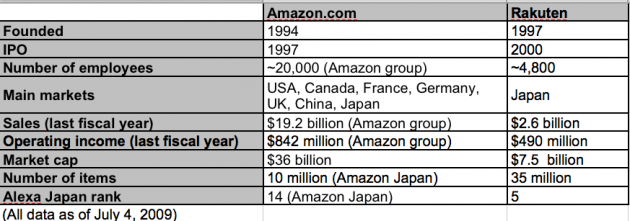
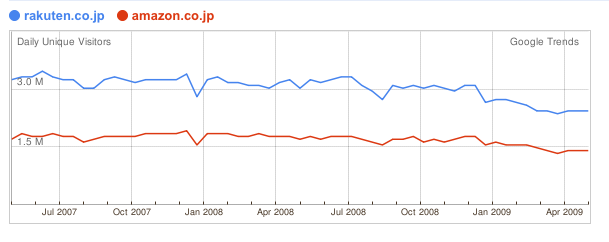
And they’ve been very successful with it, even though Amazon launched their Japanese site as early as 2000. Look at the table below for a head-to-head and a Google Trends traffic comparison chart:
2. Rakuten’s success factors: Aggressive pricing and wide diversification
The idea and main success factor for Rakuten was helping Japanese brick and mortar businesses that wanted to set up customized online storefronts by themselves. As early as around the end of the 1990s, CEO Mikitani began systematically undercutting prices of existing hosting services by up to 75-85% and combined this with an aggressive sales and consulting model. As a trade-off for cutting out middlemen, merchants had to pay upfront, which made it possible for Rakuten to maintain a positive cash flow. Until today, the site offers its merchants a number of services to make their lives easier (real-world seminars, a monthly merchant-only magazine, phone support etc.). In return, Rakuten pockets fixed “virtual real estate” fees from the 28,000+ merchants currently registered on the site, in addition to commission payments (2.6% of each retailer’s sales revenue).
In parallel, the company stepped away from its original B2B2C roots in the last years, quickly turning into a gigantic web conglomerate. And the company transformed more radically than Amazon did in the US: Rakuten acquired popular online portal Infoseek (Alexa Japan rank: 20) to drive traffic to the main site, established an auction service (now Japan’s third largest), provides online securities brokerage, bought an online travel service (Rakuten Travel is now Japan’s biggest hotel reservation site) and offers a blogging platform (the No. 3 in blogging-crazy Japan). In addition, there is a Rakuten credit card (nearly 2 million Japanese own one), a personal consumer credit service, an e-bank (Japan’s biggest), a ticket sales service, a real-world Rakuten baseball team, a popular golf court reservation sub-site etc. etc. You get the picture.
3. Rakuten Marketplace: 35 million items from $1 to $100,000
But despite the rapid diversification in recent years, Rakuten is still known mainly as an online shopping site for the Japanese. And in contrast to Amazon, they can get anything on Rakuten, from used $70,000 four ton-trucks, Gucci handbags, digital content (Amazon Japan doesn’t offer downloads), down to apples and oranges directly offered by regional farmers.
The price level is relatively low for many items, as many shops offer identical products and the collected setting allows for users to quickly compare prices. Shipping is generally free on all books, DVDs, CDs and similar media. Rakuten also has the so-called “Super Points” system in place, a reward program for members (you are not required to register to buy on the site). Amazon’s counter offer, “Amazon Point”, was established as late as 2007.
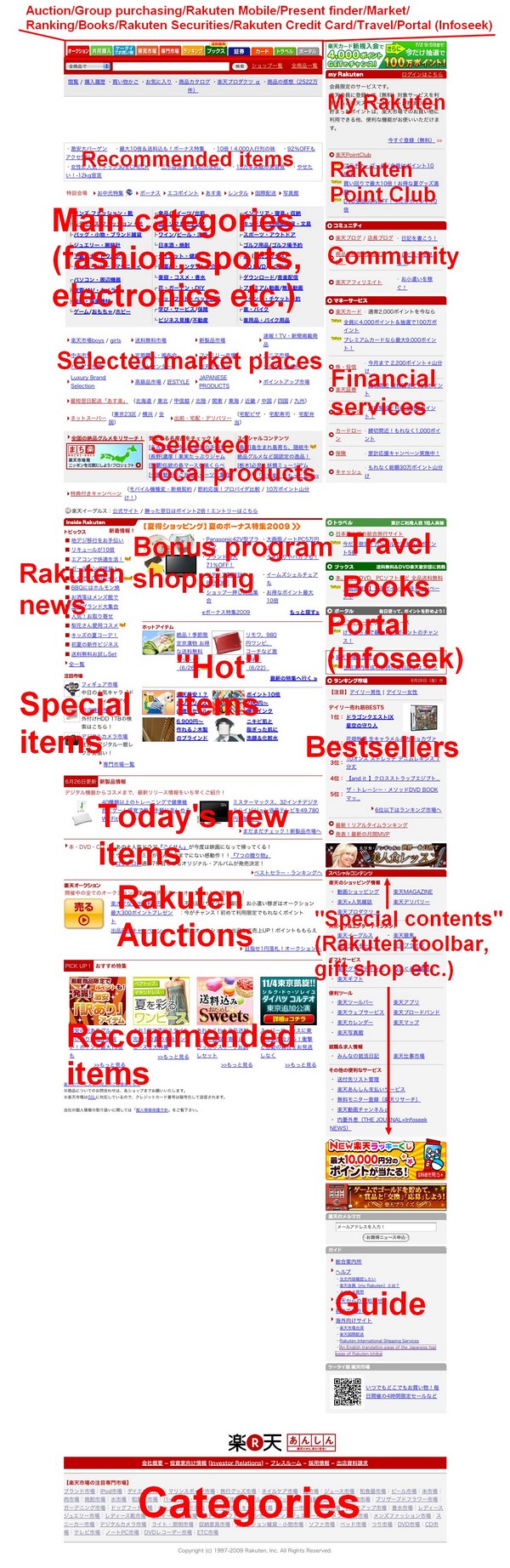
Here is the translated version of Rakuten Ichiba’s massive top page (click to enlarge):
4. Amazon Japan’s strong position
Seeing this cluttered top page (which isn’t regarded unusual in Japan at all), it’s interesting to notice Amazon resists the urge to change their globally uniform design approach to accommodate Japanese tastes (Amazon’s US site basically serves as a design blueprint for all their sites worldwide).
But Amazon isn’t doing business as usual in Japan, making additional investments in its subsidiary instead. Next month, the company will set up a new distribution center just outside Osaka (it will be Amazon’s biggest in Japan). In the last weeks, three new categories with some 130,000 items were added to the site. And it’s possible for Japanese retailers to open an online shop on Amazon since 2006 already.
Overall, Amazon has positioned itself very well in Japan, proving that foreign web companies can enter this country successfully. And they also show that being inferior in traffic doesn’t always translate to being (proportionally) inferior in sales. Amazon’s parent company doesn’t break down sales figures on a country level, but some sources [JP] estimate the Japanese subsidiary rakes in roughly 10% of Amazon’s total sales and income. Assuming this is true, this would bring sales in this country to around $1.9 billion and operating income to a handsome $84 million (even though just yesterday, Japanese tax authorities reportedly demanded back $119 million in taxes from the company for unreported income).
5. Rakuten’s internationalization efforts and English services
Rakuten has been talking about going international for years now, and they’re already testing waters in a handful of countries. In the US, Rakuten acquired New York-based e-commerce company LinkShare for $425 million four years ago (Rakuten USA itself is headquartered in Boston). Rakuten Taiwan and Rakuten Europe (in Luxembourg) were established last year. Rakuten Travel has expanded to Korea, Guam, Thailand and China.
International customers can already book hotels in many Asian countries through Rakuten Travel’s English interface (which is on Rakuten Japan and works very well). About a fourth of all items available for Japanese customers can be ordered from selected countries through a service called Rakuten International Shipping Services. Non-Japanese users can access Google-translated item pages (24 languages are currently supported), place an order, pay via credit card and then wait for direct delivery from Japan (it’s even possible for foreigners to collect Super Points).
This is just a makeshift solution, sure, but way better than what many other Japanese online retailers offer.
6. Conclusion
Rakuten says sales outside Japan currently account for less than 10% of total sales, and overseas sales are currently growing at an average of about 20% monthly. Mikitani regularly mentions Asia (China in particular) as the next big market for his company.
But the current economic crisis has triggered what seems to become a trend among online giants: selective internationalization. MySpace decimated non-US staff just recently, Facebook is rumored to have second thoughts about China and Germany-based business social network Xing last week decided to shelve expansion plans for the US and China.
That’s why my guess is Rakuten will avoid battling it out with Amazon in their core markets and focus on untapped countries or niche segments instead – despite those aggressive announcements of the past. (In January last year, for example, the company said it will make inroads into 27 different countries by 2013. Mikitani regularly claims his final aim is to build the world’s biggest Internet company.)
Things are going quite well in Japan, but on a global level, Rakuten will have a tough time. The big competitors will certainly not cede markets such as Latin America, Africa, India or South East Asia to them standing by and doing nothing. In the US and core markets in Europe, Amazon dominates. In China, Taobao already established itself with 120 million users.
For the time being, there shouldn’t be a realistic chance for external players to win these markets over. This is true even for a conglomerate like Rakuten and its charismatic leader (who, in addition, still has to deal with a pretty strong service called Amazon domestically).