Can Sears Help OpenID Go Mainstream?
by Robin Wauters on July 2, 2009

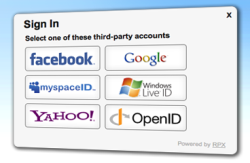
It’s one thing when Internet companies like Facebook adopt OpenID, it’s another when a giant retailer like Sears Holdings Corporation embraces it. Sears has just announced that it will enable over 1 million monthly MySears and MyKmart visitors to use their Google, Facebook, MySpace, Twitter or other accounts to log into the community websites, enabling them to write product reviews and share information about products and services without the need to create a separate account.

Customers will also get access to special offers and coupons in return for their participation in the community.

For the integration, Sears teamed up with Viewpoints Network, a social technology and media company that recently integrated JanRain’s RPX solution into their online community and identification platform.

The question is: is Sears – despite its claims of driving innovation in online retailing, which seems a bit over the top – merely a late adopter looking to try something new or is this a sign of OpenID maturing to a point where it can finally reach that tipping point where it really starts taking off with a mainstream audience?

In my recent interview with OpenID evangelist Chris Messina, he expressed the hope that integrations outside the technology industry – such as the U.S. government – would at some point occur more often, but he also acknowledged that the initiative struggles with branding and getting the word out there.

It’s integrations like these that could really help OpenID gain more traction, but the main question will always be if OpenID is just a solution looking for a problem, or if there’s a genuine need for a decentralized, universal login standard.

Despite the flood of criticism from technology pundits, the jury’s still out on that.

Advertisement

Comments rss icon

  • I’ve integrated RPX authentication on a number of sites and while it is a quick and useful service, it is still immature. There are a number of features still missing — you cannot pass through a return URI so the user can be returned to their starting page, you cannot integrate your own site’s login with the RPX panel, etc.

    I also question how much this will help OpenID’s penetration with the more common selections of Facebook, Google, and AOL available on the RPX panel. If you follow the RPX sign-on routine through you’ll see that there is no way to create a new OpenID account or even a link to click to open a new window with more information on the service.

  • I think the struggle with the branding of OpenID stems from the fact that people aren’t using it because it’s OpenID… they are using it because the big dogs like Google, Facebook, Yahoo, MySpace have adopted it. Nobody wants to see an OpenID logo on their site – since none of their visitors know or care what it is. To them, sites that use OpenID appear to have integrated with all of those big dogs I just mentioned… and that is what matters.

    If I can go to a site and login with my Google account, I really don’t care what technology enabled me to do that. I just care that I can login with my Google account.

    People will use OpenID, but nobody other than the developers that make sites really care that the site is using OpenID to accomplish the login. Just my two cents.

  • Hmm, can we expect more?

  • OpenID is a failure. Most people have a gmail/facebook/myspace account, and are just going to use those if they are implemented.

    • No, giving blind trust and total control of your online identity to the likes of Microsoft, Facebook and Google is failure.

      OpenID offer user control, something I defy you to find in the ToS of the those companies.

      • Todd is correct in principal, but who gets the OpenID user data and behavior insight? In this instance, Sears Holdings gets it.. and when you spend close to $500m in offline advertising (and a declining audience), supporting OpenID will enable the company to better target consumers based upon behavior patterns and generate a higher return on marketing spend. In theory…

  • way to go Sears! their website kicks ass compares to what it was 2 years ago.

  • OpenID is a gigantic failure. Its usability is just plain awful. I’m a fairly technical guy and I can’t even remember what my OpenID is and I’ve had few.

    OpenID = fail

    • OpenID has certainly had some usability challenges the past few years, though the community has really come together and made a lot of progress the past about six months. If you try out the Sears implementation (go to mySears.com and click “log in”) you’ll find that the main UI asks you to pick an OpenID Provider versus typing an OpenID URL into a box. I think that most people will remember which Provider they use. People who are more technical and use their own domain as their OpenID, will then know to choose “OpenID” instead of one of the larger Providers and enter their URL into the box.

      Down the road it will be even better once browsers support identity and different sign in UIs on each site you visit go away. :)

      • @David,

        At Mozilla Labs, we are starting to experiment more with integrating identity in the browser with the Weave project. See http://labs.moz...in-the-browser/ for example.

        Would love to chat more about this if you’re interested.

        • This is aligned with a flock-like strategy, which rocks! I’d love to see a more “passive” way to integrate sign-on and registration without breaking the flow of my task/experience. Flock does a great job in integrating all networks and accounts through the browser. Way to go FF!

  • OpenId does save you the hassle of registering at different sites separately which could be quite time-consuming and frustrating at times.

  • OpenID is far too confusing for most users. I always thought it was mores aimed towards developers. It just plain confuses me. I don’t see it ever catching on. I suppose tech-savvy people like it because of the whole privacy thing but like I said for the average consumer – no way.

  • We are looking at new ways to connect with our customers, and we have been trying different approaches and technologies. Open ID is one of those initiatives. Privacy and trust are essential in developing solid relationships with customers, and we have learned (sometimes the hard way) what works and what doesn’t. We have been listening and involving our customers more in our decisions, and are very much in a learning mode as a company. So, we will watch how this initiative unfolds. Thank you all for your thoughts and comments.

    Rob Harles

    VP SHC Community

    • adding “My” to MySears and MyKmart will probably be the single greatest marketing decision they will ever make. A new standard has been set. Whenever you see “my” as a prefix you know its personal and social. word of mouth anyone?

      myaol myyahoo myspace myfox
      myucla mypyramid myfamily mycorporation myflorida mycareer mynetworktv mymonster mycorporation myhealth myyearbook myfico myjewishlearning myabc mydreamapp

    • Rob – As a VP, we sure do appreciate you trolling sites like this in your spare, non-work time.

      Why is Sears supporting this? Honestly. Is it to track consumer behavior outside of its domain – or more precisely, outside of its MySears consumer forum? Facebook, Amazon, and yahoo are superior models because of the traffic they generate to and within their own sites – you’re trying to slough insights from user behaviors outside of MySears / MyKmart that the company will then use to influence marketing and advertising decisions. I’m pretty sure this is why Eddie invested in this initiative 3 years ago; OpenID is a way around the company adding spyware to its community members.

      If this is not correct, please refute my claim and provide support for why the company – a retailer – would support this initiative?

      • That’s one way of spinning the endeavor. However, the other way to look at it is aggregation and integration of experiences typically fragmented/separate as well as involving Sears HC in the conversational as well as functional mix. Mashups are nothing new here. Neither is data mining for relevancy. In the end, however, the decisions are made to make the experience of the customer better; not to spy on people. As a retail organization, Sears is selling products to people. And Sears (and companies) are very aware of the changing landscape of advertising and media in general – that products and content are (finally) gaining the ground they deserve in terms of priority in creating great experiences.

        See this:

        https://www.adb...ats_itself.html

        One of the reasons why OpenID is considered by companies like Sears is because existing/standard processes are obsolete, if not painful experiences. In fact, OpenID provides a login and registration service while other functionalities and platforms and systems provide data.

        Last, all of these “relationships” with and to social media sites involve clear opt-ins and “handshakes”. A given with this is to also inform customers of how their data is being used as well as offering ways to control this through good UI.

        All data on these social sites is somewhat public anyway. Accessible to any through common points like RSS, etc.

        Michael

  • Will Walmart follow suit?

  • I would have left a comment, but TechCrunch apparently doesn’t accept OpenID *or* Google!

  • It is nice to see Sears innovating its image to capture a new audience.

  • What’s a sears?

  • 1m visitors a month is overstatement by Sears – they have 1m registrants, only about 10% of which are active over the past 30 days.

    Sears is supporting OpenID to get better data and insight into community members online activity – where they go, what they do, etc. The OpenID account is attached to the MySears/Kmart account through Viewpoints. Thus, they’ll get the data and insight into behavior.

    They might not track at an individual level, but they will track at an aggregate level. It’s part of ESL’s master plan of being like Amazon.

  • I guess after Sears having to settle with the government for installing spyware on customers computers they decided this would show how ‘open’ they are..

    At the end of the day they are desperate for information and will do anything to get it.

  • I like OpenID but this doesn’t seem that awesome! Maybe it’s just me.

  • i think this is actually a surprising step forward from a company i wouldnt have normally thought would be leading this eventual trend. it can only help.

Leave Comment

Commenting Options

Enter your personal information to the left, or sign in with your Facebook account by clicking the button below.

Alternatively, you can create an avatar that will appear whenever you leave a comment on a Gravatar-enabled blog.

Trackback URL
Short URL
bugbugbug