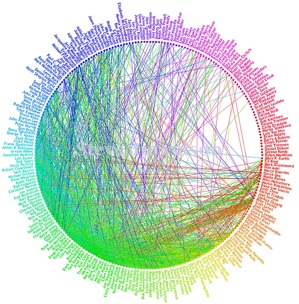
The Top 100 Networked Venture Capitalists
by Erick Schonfeld on June 27, 2009

jurvetosn-friendship-wheel

Do venture investors with the biggest and best networks end up producing the best returns? An academic paper from a few years ago by Yael Hochberg, Alexander Ljungqvist, and Yang Lu titled “Whom You Know Matters: Venture Capital Networks and Investment Performance” (embedded at the bottom of this post) suggests that is the case. They looked at historic venture returns and found that “better-networked VC firms experience significantly better fund performance,” as measured by how many of the companies in their portfolios exited via an IPO or acquisition.

A venture firm’s network in the study was defined as being made up of all the other venture firms who co-invested with it in funding rounds. The more co-investors a venture firm has, the better its network. The better its network, the better its overall returns. The correlation between the size of a venture firm’s network and its returns may have something to do with better access to deal flow, talent, advisers, potential customers, and potential exits.

If this is true, then who are the most connected venture firms and angel investors today? Vijay Dondeti, a graduate student in bioinformatics, applied the analysis in the Hochberg paper to about 2,700 investors in CrunchBase who participated in over 3,300 startup funding rounds between 2006 and 2008. He scored each investor based on how well connected they are to other investors as well as how well-connected their co-investors are to other investors. “In summary,” says Dondeti, “to get a high score, you need to co-invest often with others that also co-invest often.”

So which venture investors have the best networks? Here are the top 10:

1. Draper Fisher Jurvetson
2. Sequoia Capital
3. Accel Partners
4. Intel Capital
5. First Round Capital
6. Dag Ventures
7. New Enterprise Associates
8. Kleiner Perkins Caufield & Byers
9. Benchmark Capital
10. Ron Conway

Draper Fisher Jurvetson takes the top spot. Will its returns beat everyone else’s, or is it just that its spray-and-pray investing strategy gives it an advantage in this type of ranking system? Top-tier firms such as Sequoia, Accel, Kleiner Perkins, and Benchmark also score highly, as does First Round Capital and angel investor Ron Conway.  Other individual investors a little further down the list include Reid Hoffman (No. 18) and Marc Andreessen (no. 31).

Below is a ranking of the Top 100, or you can review the entire data set for all 2,700 investors here.

(Image: Flickr/Steve Jurveston)

Rank VC Investor Raw Score Scaled Score

1 draper-fisher-jurvetson 6721 100.00

2 sequoia-capital 6608 98.33

3 accel-partners 6505 96.80

4 intel-capital 5849 87.03

5 first-round-capital 4881 72.62

6 dag-ventures 4857 72.28

7 new-enterprise-associates 4746 70.61

8 kleiner-perkins-caufield-byers 4695 69.8

.

9 benchmark-capital 4685 69.71

10 ron-conway 4484 66.71

11 charles-river-ventures 4124 61.37

12 goldman-sachs 3926 58.42

13 redpoint-ventures 3915 58.25

14 general-catalyst-partners 3814 56.75

15 bessemer-venture-partners 3622 53.89

16 index-ventures 3469 51.62

17 khosla-ventures 3258 48.47

18 reid-hoffman 3232 48.10

19 sigma-partners 3227 48.01

20 mayfield-fund 3186 47.40

21 oak-investment-partners 3150 46.87

22 norwest-venture-partners 2996 44.57

23 lehman-brothers 2983 44.38

24 greylock 2946 43.83

25 highland-capital-partners 2917 43.40

26 jafco-ventures 2912 43.33

27 omidyar-network 2856 42.50

28 fidelity-ventures 2841 42.27

29 sap-ventures 2831 42.12

30 venrock 2742 40.80

31 marc-andreessen 2462 36.64

32 lightspeed-venture-partners 2446 36.39

33 roger-ehrenberg 2412 35.89

34 foundation-capital 2404 35.76

35 shasta-ventures 2395 35.63

36 us-venture-partners 2378 35.3

.

37 union-square-ventures 2336 34.76

38 canaan-partners-3 2298 34.19

39 atlas-venture 2285 34.00

40 bay-partners 2277 33.88

41 menlo-ventures 2263 33.67

42 mohr-davidow-ventures 2230 33.18

43 interwest-partners 2224 33.10

44 globespan-capital-partners 2209 32.88

45 trident-capital 2203 32.78

46 steamboat-ventures 2183 32.48

47 focus-ventures 2166 32.22

48 atomico-investments 2096 31.18

49 spark-capital 2083 30.99

50 draper-richards 2076 30.89

51 amadeus-capital-partners 2041 30.36

52 greycroft-partners 2039 30.34

53 allen-and-company 1991 29.62

54 founders-fund 1979 29.45

55 meritech-capital-partners 1974 29.38

56 dcm 1974 29.37

57 labrador-ventures 1924 28.63

58 european-founders-fund 1856 27.61

.

59 esther-dyson 1844 27.44

60 jeff-clavier 1802 26.81

61 3i-group 1784 26.55

62 motorola-ventures 1764 26.25

63 jeff-stewart 1749 26.03

64 mission-ventures 1740 25.88

65 cisco 1734 25.81

66 time-warner-investments 1729 25.72

67 comcast-interactive-capital 1726 25.68

68 marc-benioff 1692 25.18

69 martin-varsavsky 1685 25.07

70 betaworks 1684 25.06

71 polaris-venture-partners 1682 25.02

72 trinity-ventures 1673 24.89

73 bezos-expeditions 1667 24.80

74 hummer-winblad-venture-partners 1624 24.17

75 hearstcorporation 1612 23.99

76 presidio-stx 1604 23.86

77 y-combinator 1596 23.75

78 sutter-hill-ventures 1567 23.32

.

79 baseline-ventures 1552 23.09

80 advanced-technology-ventures 1549 23.05

81 wellington-partners 1543 22.96

82 walden-international 1533 22.81

83 granite-ventures 1518 22.58

84 hercules-technology-growth 1504 22.38

85 morgenthaler-ventures 1497 22.28

86 northgate-capital 1491 22.19

87 battery-ventures 1486 22.11

88 scale-venture-partners 1486 22.11

89 crescendo-ventures 1456 21.66

90 emergence-capital-partners 1451 21.60

91 azure-capital-partners 1445 21.51

92 mike-maples 1433 21.32

93 glg-partners 1428 21.24

94 ariel-poler 1418 21.10

95 vantagepoint-venture-partners 1414 21.04

96 north-bridge-venture-partners 1407 20.94

97 matrix-partners 1405 20.90

98 bluerun-ventures 1405 20.90

.

99 waldenvc 1399 20.82

100 rustic-canyon-partners 1384 20.59

.


Whom You Know Matters: Venture Capital Networks and Investment Performance

Advertisement

Responses

Comments rss icon

  • so where can i get a high-res copy of that “friendship wheel” vs. the largely useless thumbnail? :-)

  • Detailed listing of their investments would be nice too.

  • This is not surprising, the VC game more than many other industries is an insiders game. What bothers me is that there is no one descent VC that is New York based and all the money is in the Valley.

    • Not true- there are several good VC’s in NYC. UnionSquareVentures.com and DFJGotham.com for starters.

      • People say that when nobody will listen to his idea…

        • I disagree with you Gebadia. As an ex stockbroker for over 12 years and looking at deals being put together, it is who you know, not what you created. If you go to the majority of these VC firms and tell them you have created a traversable wormhole for time travel, they could care less. They care more about what is you golf game like and who you know. There are so many great ideas. It really is about timing and being at the right place at the right time. Another example Larry and Sergey had to Solicit funds from faculty members, family and friends. VC were not knocking on their garage door at the beginning.

          • If these companies had talent scout rankings i would give them all an “F.” They obviously are betters and not talent scouts. Explains why VC’s have a miserable overall company success rate. Funny how that picture resembles the MyLocator theory.

  • I’m surprised Draper Fisher Jurvetson placed first. I’ve only heard negative things about DFJ. For example, they are well know for screwing their entrepreneurs in terms of the deal terms. The Hotmail got ripped off by DFJ due to shady clauses. Best to avoid.

    • Founder of hotmail almost walked out of the deal (without other options) in order to drive hotmail’s valuation up. Got “cheap” money. If he got screwed on the clauses, well, he played hardball.

    • Draper Fisher Jurvetson is a one hit wonder with Hotmail. I have a friend who did a presentation for them and he came away very unimpressed with their overall technical knowledge. Too many MBA who don’t have any real world experience but only looked at a screen with number to an excel file. These guys are and continue to be a one hit wonder with Hotmail.

      • very funny. We don’t use Excel for investment decisions. I guess I should be happy that you see Hotmail as a bigger hit than Skype, Baidu, ENOC, ATHN, oh heck, I’m not sure it even ranks in our top 10

  • The top 10 list in this report is very similar to the top 10 most active vc firms. Just because a firm is very active, doesn’t meet their returns, measured by multiples, is going to be better than others, so a major flaw in this report. I do agree the a strong network is critical to success, but rather than looking at this from a firm level, I would prefer to see this from a partner level. Which VC partners are the most well connected?

  • That’s a very interesting study, but I do wonder if it is somehow looking backward to a time when exits were at high values to the public market. These days the sweet spot for exits is M&A at a $20 to $50 million valuation. Getting the right amount of capital to do that would seem to run counter to the big syndicates of past years. This would seem to me to support the need for entrepreneurs to build their network of support not through VCs, but more generally through the use of advisers. In other words, money should be obtained for the purposes of finance. And, advisers should be selected on the basis of network.

    I do think that when money is required, it is important to get the right amount, and to get it if possible from a fund that has a strong network. But, the way to determine if a VC is properly networked is more about how the VC is networked with potential strategic partners, service providers and other key people in the ecosystem. And, experience structuring and executing deals is essential. I am expecting that when the evaluation is done in 2013, what we will see is that what makes a successful VC will be closely aligned with what allows an entrepreneur to successfully grow a $10 million revenue business and a $40 million sale.

  • Nice to see our Series B VC up there

  • hey,
    can anyone give me a hint where i find a number on how many online or tech startups were established in 2007 or 2008??
    thanks!!

  • So bigger is better? Imagine that.

  • What a useless metric. How connected someone is is totally useless.

  • A detailed listing of their investments would be welcome. Also, we can have the interviews of these demi-gods on their best and worst investments.

    • Stranger/Danger talks keeping Ycombinator deals to All Time Low - June 28th, 2009 at 6:16 pm PDT

      Maybe the idiot kids of America are finally beginning to realize that it’s probably a better idea to borrow $15,000 from friends and family and not sign a deal with Ycombinator to do business.

      JMHO, but kids see that Ycombinator’s deals beneift Ycombinator, but not them. And now this story affirms the fact that Ycombinator’s business model is less than stellar.

      Chickenhawk VC tactics worked because kids don’t know better. But Adults do, and stranger/danger talks are keeping them away from the Ycombinator paneled van of deception and defeat.

  • AG: The DFJ portfolio is available on our site and searchable. Recent exits include the EnerNOC and athenahealth IPOs in the U.S., and internationally, we were the largest shareholders in Baidu and Skype.

    Jon: as the person who negotiated those terms, I politely disagree. Every round was an up round with vanilla economic terms, and particularly generous terms on founder vesting. We were the only investors in the Series A, Series B, and interesting, the last round of financing.

    As to why we would consistently be ranked as one of the most active and connected venture group, I would simply point to the DFJ Global Network. For over a decade, we have been building a network of networks in the VC business, which has grown to over 140 investment professionals in 30 global locations. http://www.dfj.com/network

    • No reply is even necessary. Some people always find something bad to say about everything. If it wasn’t for VCs and individual investors, most of the companies that are now making up what we know as internet, would not exist. Putting all the rest of the statistics aside, being active during economic downturn is actually much better indication of successful company.

      While we’re working on business plan and starting to look for funding, it’s great to know that there are companies out there looking to invest.

    • Mark Sokol's Fat Head - June 28th, 2009 at 2:12 pm PDT

      May they all go bankrupt.

  • Is coinvestment the key to measure how connected a VC is or is it just the only one available?

    Interesting study, specially for LPs. It would be great to track how this list performs in the future.

  • The analysis omits the fact that the VC asset class has generally awful performance relative to nearly every other asset class over most measurement periods. Performance is massively concentrated in the top 5 or 10% of funds, and the asset class is generally horrible.

    There is only one metric that matters for VC’s and that is IRR. How “networked” a fund is seems silly as a metric, and seeks a correlation that likely does not exist. If you added in biotech focused funds, you would see large “networks” because of the massive capital requirements and large syndicates but even more awful performance statistics.

    On the other hand, private equity funds, as opposed to VC funds, typically have far fewer or no co-investors. Even when large “club” PE deals were happening, it was a pretty small number of funds relative to what a Series F VC backed company ends up with. And PE funds typically have well out performed VC funds over nearly any period you can measure.

    Fund performance matters, the rest is irrelevant.

    • IRR is the best measure to rank performance. However, it is not publicly disclosed. So, the goal is to find something that is more readily available and see how it relates to IRR. Hochberg et al. were able to obtain IRRs using Right To Information requests and found that the strength of the network is correlated to the returns. The other thing to keep in mind is that the IRR is calculated over a 10-15 year cycle. Even if IRRs were readily available, they may not the best way to get a measure of the “current” performance of a VC investor. I am not saying that the extent of the network is the best measure, but it can reflect the current state of things better than the IRRs.

  • Why is Lisa Loeb on the wheel? (About 10 to the right from the top of it). I loved her #1 hit “stay” along with everyone else, but she’s not anywhere in crunchbase: http://www.goog...mp;oq=&aqi=

    The big wheel: http://www.flic...378275/sizes/o/ (and: http://www.yout...h?v=Dh3PLL1F9ZU )

    • The graphic is from my early facebook network, so is not related to the crunchbase analysis in the article.

      I knew her from high school in Dallas, and yes, she rocks.

      You can see some of the network clustering if you mouse over the graph here:
      http://www.flic...son/2234378275/

      • Am I missing something here? Did you say that it was a graphic from YOUR early facebook network?

        Does this mean that you also wrote the blog post ? (It says at the top that Erick wrote it.) Or did Erick ask you for a photo to accompany the piece he wrote?

        It has the apperance of Techcrunch acting as “PR” agency for DFJ ? (Excuse me if I have got the wrong end of the stick) That would be a real network effect!

  • Interesting study, but with one fallacy. Does it mean that a smart VC who goes solo (no network) will perform worse over time?

    This study would have you believe that it’s the case. However, the smart solo VC is stuck in the same category with the too-dumb-to-have-a-network VC, which kills the results.

    I still believe smart VCs can do very well without a network, but this study is inconclusive.

    • Small point, but a smart solo venture capitalist isn’t going to be lacking a network. A network isn’t something that only a company can develop. A person has his own professional network.

  • Perhaps it’s just that better investment opportunities tend to attract more investing firms, and thus the higher return investments tend to be more likely where co-investment occurs.

    more attractive investment = more likely to attract co-investment
    *not*
    better network = more likely co-investment = higher returns

    Why does the VC’s network have to be the driver of co-investment situations?

  • What a useless metric. How connected someone is is totally useless.
    ____________________________
    http://www.acrobatusers.com

  • Amazing to see Ron competing with entire clusters of others. This has got to be a pareto distributed network structure.

  • This conclusion could have been guessed. But it is good to see the reinforcement based on sound data.

  • While how connected a Venture Investor is definitely is important for success, these researchers missed the mark on how to define “connected”.

    It is much more important for VC’s to be connected with executives in established companies\industries who can provide:
    1) advice to portfolio companies
    2) a channel for distributing a startup’s product
    3) managerial talent
    4) a possible acquisition

    Another tweak on the study is how important “connections” are in a specific vertical. I would throw out that the more niche your market the more important that your investor has deep ties.

    A

  • Maybe people _want_ to be connected to successful VC’s and not the other way around.

  • Would be interesting to see how being “networked” relates to their returns. Would also be interesting to see how individual operators within the the VCs rate.

  • Show us the numbers too — how much the invest. I am sure I can find them, but help me not surf..

  • Correlation is not causality.

    The high initial returns could have resulted in a better reputation which attracted more partners.

    Also,both could have been caused by a third factor.

  • surprised Maveron didn’t make the list:

    Capella completed IPO (NASDAQ: CPLA)
    Cranium acquired by Hasbro (NYSE: HAS)
    drugstore.com completed IPO (NASDAQ: DSCM)
    eBay completed IPO (NASDAQ: EBAY)
    Good Technology acquired by Motorola, Inc. (NYSE: MOT)
    JobFlash acquired by Taleo (NASDAQ: TLEO)
    lucy activewear acquired by VF Corporation (NYSE: VFC)
    PeoplePC (NASDAQ: PEOP) acquired by EarthLink company (NASDAQ: ELNK)
    Qsent acquired by TransUnion
    Reactivity acquired by Cisco Systems (NASDAQ: CSCO)
    Shutterfly completed IPO (NASDAQ: SFLY)

  • Great post Erick

    Frankly I never knew so much about venture capitalists until this post. So much of knowledge in this article. The discussion is equally valuable. Good one Erick, keep up the good writings :)

    Sonal
    USourceIT: Riskfree IT outsourcing/ sourcing partner for small and medium buisnesses.

  • Curious to know how the wheel was created? Which software / library?

  • So who *are* the most successful VCs so far, at the moment?
    The ones who have produced the most returns in say, the last 7 years.

  • Jurvetson, I concur fully with you that DFJ is a premier VC firm in the Valley and in the world. I have full respect for the passion with which you guys have built the firm. Do not mind the trolls overhere on TC. They moan and bitch about everything. If you´re successful, some people will always detest you for whatever reason they want.

    It is ironic to read that people are mentioning Hotmail as one of DFJ´s biggest exit. I reckon MSN only paid about $500 million for Hotmail – have you guys not heard of all the blockbuster exits that DFJ has realized so far. They make the Hotmail exit pale in comparison.

  • I combined and re-ranked this list with TechCrunch’s Top 100 Networked VC’s. Interesting results,- Social Media is a big factor, see here: The Top 21 Socially and Deal Networked VC’s http://bit.ly/18XqFI

  • I meant – I re-ranked this list with Larry Cheng’s Top 100 according to GoogleReader subscribtions- the results yield a slightly different, perhaps more balanced view: http://bit.ly/18XqFI

  • Perfect work!
    Gluttony kills more men than the sword.
    Good health is above wealth

  • @Amusis–the authors of the paper present a strong argument to refute reverse causality.

    “We do not believe that our results are driven simply by reverse causality, that is, a higher fund exit rate enables a VC to improve its network position, rather than the other way around. Recall that we construct the network centrality measures from syndication data for the 5 years _before_ a fund is created. The fact that these data can help explain fund performance over the next 10 years suggests that networking truly affects performance.”

    “Moreover, we find little evidence that past exits drive future network position. Instead, what appears to be key in improving a VC firm’s network position is demonstrating skill in selecting, and adding value to, investments.”

Leave Comment

Commenting Options

Enter your personal information to the left, or sign in with your Facebook account by clicking the button below.

Alternatively, you can create an avatar that will appear whenever you leave a comment on a Gravatar-enabled blog.

Trackback URL
Short URL
bugbugbug