Have you nominated someone for a Crunchie today? »
There May Be 50,000 Apps For The iPhone, But Only A Select Few Become Popular
by Robin Wauters on June 25, 2009

AdMob has released its metrics report for May 2009 (PDF download link), and looked closely at the actual distribution of users of the iPhone apps in their network this time. The main take-away? There may be tens of thousands of applications available for the iPhone, but a whole lot of them simply never actually make it onto the device.

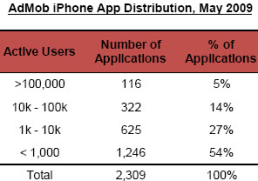
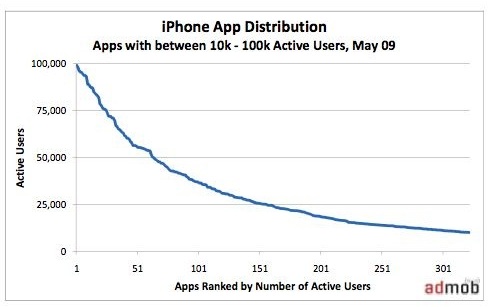
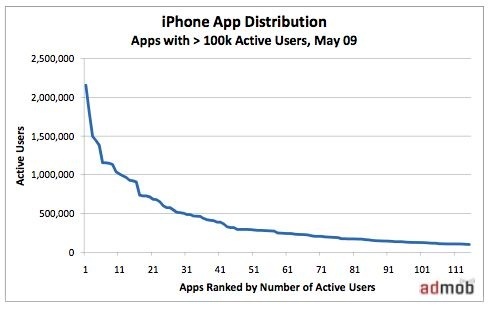
Out of 2,309 tracked applications (representing 15.1 million unique iPhone and iPod Touch users), no less than 54% are actively used by south of 1,000 persons. That’s a very long tail there, and not an economically interesting one at that. Only about 20% of the tracked apps have more than 10,000 active users, and only 5% (or 116 apps) boasts more than 100,000 active users. For the record, an active user is considered to be someone who used the app at least once in May.

Two caveats: the AdMob network evidently doesn’t cover all applications available for the platform in its entirety, and the large majority of those it tracks are free of charge. That means two things: there’s no indication that these findings can correctly be extrapolated to the entire iPhone app universe, and it’s likely the curve is less steep with paid applications (usually, you’d be more actively engaged with an app you paid for than a free app you downloaded just for testing).

The report also correctly points out the App Store ranking system feeds the success of top applications, particularly when they are featured on the Apple website in combination with getting rave reviews.
Advertisement

Comments rss icon

  • Not unlike the computer software market.

  • Seems like lots of developers have spend their time and money unwisely. Good luck to everyone that is dev new apps.

  • That’s exactly why the App store is so successful. If myself and maybe 5 other people have this incredibly weird App we need…there’s an app for that. Almost any possible weird niche app is available, doesn’t matter if a million people use it.

  • YouWait and see the UMOO app. :-)

  • In other news – there are billions of people but only some of us write for techcrunch.

  • I doubt if we can use admob tracker as a case study as most app that are registered on their network are free apps. With those data you can’t possibility estimate the success nor failure in the actual market that consist of major app development studios.

  • App sales follow a power law distribution, but app quality (roughly proportional to time put in) more likely follows a normal distribution. This suggests that there are lots of undiscovered gems in the app store, and lots (and lots) of devs losing their shirts.

    Not unlike the music industry, either. Create artificial scarcity, lure people in with select stories of success culled from the top 1%, and keep turning the money crank.

  • The typical long-tail, which is experienced in the Internet. Distribution of followers in Twitter also looks that pattern as the distribution of book sales by Amazon.
    The most interesting analysis, which is unfortunately missing, is the app price distribution curve. Probably it looks like a long-tail curve, but even flatter, as there are lots of $.99 apps and very few about $9.

  • Interesting data.. I might be one of those active users out there who enjoyed using iphone’s apps.

  • They could increase the visibility of long-tail apps, and increase app conversion rate, and total order value (TOV) significantly if Apple new how to properly merchandise and lay out an ecommerce site! I just bought the 3GS (my first iphone, first time now browsing apps) and I have to say that the discoverability and spotlighting of content is terrible. Got to be the worst ways of discovering content ever. I am not saying that the rest of the iTunes store is easy to brows, but for some reason when you look for music or content it is easier to find what you are looking for. I am looking for a good Golf (scorecard/gps) and Wine app. It is painstakingly hard to really find the best ones out there. I bet I am not finding everything out there- and those are two pretty well covered subjects. What about the longtail? How do I know what I don’t know? iTunes does a horrific job of helping me find the longtail. To truly capitalize on the longtail, you have to have the market, which iTunes does. But at a certain point it still has to be financially viable for a developer to create an app that only a few will buy. And conversely it has to be work Apple’s time, b/c the do have to pay people to review all of those apps. So it benefits the whole community if the owner of the marketplace proactively exposes the breath and depth of the inventory.
    Bottom line; improve search, discoverability and merchandising on the site. If you need help Apple, call me.

    • Apple wants you to buy from their top lists, that’s why the lists are there, and the search feature is so neglected. This approach creates artificial scarcity, which in turn creates best-sellers, which in turn attracts more apps, which in turn sells iPhones.

      Apple needs this approach as long as total app store sales are relatively low—if the $200M or so total revenue were more evenly distributed among the apps, the million-dollar success stories would only be hundred-thousand-dollar success stories, and that’s not going to attract nearly as many developers to the platform.

      • point taken, well played sir. didn’t think about it that way.
        I guess I’m of the opinion that with the right (search) technology you could have the best of both worlds. Would it not be beneficial to highlight the scarcity of apps in certain categories, thereby helping to highlight the gaps where more apps are needed?

  • Did you guys see the cool video showing the activity of the 3000 Google Apps? It shows there download frequency in real-time on a very cool, colorful interface. Here’s the link

    http://www.brea...technology.html

  • I believe most app publishers/owners submit their apps without doing any marketing/promotion. They hope to get the app in the store and let Apple take it from there.

    Any app submitted should be pushed like you would do a web start up.. What do you guys think?

    • Bingo. Is it any surprise the ifart did so well when it was made by an internet marketer?

    • Illiterates Are Peepoe Too - June 25th, 2009 at 7:09 am PDT

      I would venture to say MOST people who own iphones do not even use a single after market app. You guys in this forum might get a different impression because you are techies and you hang around techies. For me and my regular friends, we have never downloaded or installed an app. Here are the some of common uses for our iphones:

      1. “hello, yes, this is Jim, and who is you?…” ”
      2. hi, Renee, would you like to go out tonight?”
      3. “what is an app? … let me guess, App is short for Apple and Apple is dat company dat be making them iphones…

      So to answer your question my Nigerian prince, marketing apps wouldn’t make a difference because no matter how hard apps are pushed, us regular people would never leave our comfort zone to venture into the apps territory. Hell, 92% of us don’t even know what the heo the difference between a browser and a search engine is. Take a look at a recent article by Robyn Wauters: http://www.tech...browser-anyway/

      • I agree with you a lot of people who buy the Iphone for the 1st time are not really aware of the capabilities that it has let alone the hundred’s of apps for it.
        They use it for the basic needs of the phone up until someone enlightens them with other things they can do with it. Then slowly they begin to explore and experiment with different apps.

        Always glad to be of help,

        verblist
        www,verblist.net

  • All this tells you is the relative popularity of ad-based applications and nothing about popular paid applications (Tweetie, Postage, Things, Shopper), or apps based on other revenue models (Kindle, Evernote) or practically any paid game.

    I use the Kindle app and Twitteriffic, Postage, Shopper, and Evernote weekly, and plenty more (Converter, Clinometer) on an as-needed basis.

    Further, I suspect the numbers tell you more about the quality and popularity of ad-based applications than applications in general.

  • Welcome to the Pareto Principle. Only 20% of the apps accounting for the high level of popularity.

  • Is this really news? Consider…
    - Internet has billions of web sites, but only a few of them are..
    - Facebook has tens of thousands of applications, but only a few of them are..
    - Windows has millions of applications, but only a few of them are…
    - Iphone has…

    Is there something *surprising* in this analysis that would make it “news”?

  • Yea… nobody should even try anymore. It’s a waste of time…. (less competition the better for me)

  • A big hurdle w/ the AppStore is the inefficient interface which makes it hard to find applications. Sure there is a wide range of quality, but a better interface might lead to greater overall sales and an increase for a number of individual applications.

  • Bad for developers, not a problem for advertising on the platform. Nothing unexpected here.

  • Like you said, it’s really important to point out the limitations of this report because AdMob is not integrated into a large portion of iPhone apps. The report is interesting but basically just a PR ploy by AdMob.

  • if i develop an app, and it 1000 pay me $5 for it, and it takes me < 20 hours to make it, i am certainly interested in that…

  • Why this is statistically relevant. The sample size is defined as those apps that use adnob. That eliminates many of the premium apps that are in the app store, as well as many free apps, from the sample. While this is interesting, it doesn’t tell the Appstore story.

    I could have easily spun this story as “don’t use Admob if you want more than 100K users.”

  • There are scores of people who want to become actors but only a select few make it.

    There are thousands of startups but only a select few survive.

    There are billions of people but only a select few have most of the wealth.

    There are millions of blogs but only a select few have most of the readership.

    There are thousands of articles on TC and I had to read this one.

  • This is hardly news. The app store is no different from any other business environment. Everybody goes in thinking they’ll make millions and be successfully, but only a select few do.

    The thing about the app store is that when it was first opened up, it was a new frontier. There weren’t a lot of apps to compete with. The first settlers were able to make sales much more easily, but as more and more companies enter the market, it becomes harder and harder to sell things (more competition, quality bar increases, etc)… Just like everywhere else. Hardly surprising.

  • So is the gold rush is over?

    Whats funny is my Blackberry has the same apps as my iPhone so for my needs I just want to pick up a device depending on my needs for the day and the experience is the same. And after 2 years I only use around 10 apps often. I have likely downloaded hundreds but most don’t last an hour before removal.

  • this is so obvious, no one would expect it to be different. If it were, then it would be real news…

  • Umm . . . Long Tail anyone?

  • This is similar to any other business environment. Make a really nice product and market the hell out of it. If you get in TOP100 of category you start getting organic downloads.

Leave Comment

Commenting Options

Enter your personal information to the left, or sign in with your Facebook account by clicking the button below.

Alternatively, you can create an avatar that will appear whenever you leave a comment on a Gravatar-enabled blog.

Trackback URL
Short URL
bugbugbugbug
Techcrunch on Facebook