
Free: Pack Of MySpace Branded Playing Cards »
Opera: Mobile Search On The Rise, Google Still King Of The Hill
by Robin Wauters on June 25, 2009

Opera, the Norwegian software company behind mobile browser Opera Mini, has released its latest State of the Mobile Web report, providing some interesting data points for a detailed look at the evolution of Web browsing on mobile phones.

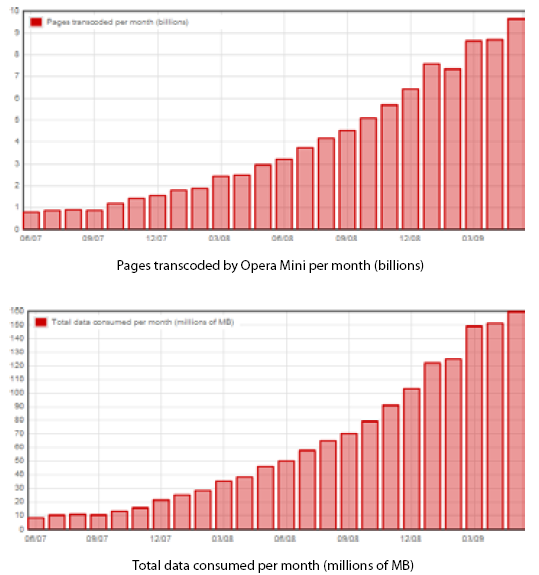
Looking at global trends, Opera Mini’s nearly 25.4 million users (as measured in May 2009, up 8.4% from the month before and up 36% compared to May 2008) have viewed over 9.6 billion pages. Since April, page-views have gone up 11.0% and increased an amazing 227% since May 2008. Opera says Mini users generated nearly 160 million MB of data for operators worldwide in May 2009, and claims that that would be 1.5 PB worth of data if the company didn’t compress this data up to 90%.
As for mobile search, a number of interesting trends are notable. Apart from dominance of local players in some parts of the world (e.g. Biadu in China and Yandex in Russia), Google mostly leads the pack in mobile search across the globe. Opera Mini users in India and Nigeria are the biggest users of search portals. In India, 16.3% of page-views are from search portals, and users viewed an average of 63.7 search-portal pages per month. In Nigeria, 26.6% of page-views are from search portals, and users viewed an average of 49.6 search portal pages per month.

Taking a closer look at Southeast Asia, the company mentions the following key trends: the top 9 countries using Opera Mini in the region (Indonesia, Vietnam, the Philippines, Malaysia, Thailand, Brunei, Singapore, Cambodia and Laos) see continued growth. From May 2008 to May 2009, overall page-views in those countries increased 459%, while the number of unique users went up 119% during the same period. In this region, Google is the undisputed number one mobile search engine, followed by Yahoo. Also noteworthy: Facebook is on its way to challenge the leader in mobile social networking in Southeast Asia (that would be Friendster).

Full report and press release can be found here.

Advertisement

Comments rss icon

  • And Google will continue to be king of the hill, mobile or otherwise – no matter how many Bings, Hunches etc etc appear. Google is greater than the sum of its parts.

  • I’ll give the money browser Opera..

  • Christ, can’t we all just get along?!

  • Does anyone know how to make Opera the default browser on Blackberry? I am tired of clicking on links and having them open in BB’s native browser.

  • Google may be the King but can Bing be the Next Great Thing? I read this article about Bing, Microsoft’s newest baby on officeclip.com. They make a great point about Google being the search Giant should be a little nervous about this new search engine.

    It’s never good to give into the majority because they control the market. Once the market is controlled what happens to your options? Food for thought.
    http://blog.off...xt-great-thing/

  • Hi, Red here…

    In my opinion, Google becomes the king of the hill because Google understands internet users, what they need, what they want and what they use.

    Google somehow knew how to attract the fun part of us, the internet user. First, they do it by giving hi-tech web apps for free, such as Google search for example, Gmail and Google Earth.

    Second, Google perfecting the technology, giving it for free, perfecting it again every day and every hour, then performing business for anyone who wish to get huge exposure to the internet, using Adword.

    Google dominates the internet because the understand user’s psychology and usage habit, an example Yahoo and big Mic (Microsoft) should follow.

  • I do not know if anyone knows this but Opera is also on the Wii internet. It is pretty awesome except when trying to watch flash shows. It needs a flash upgrade.

  • Opera would do well to market their mobile platform well. Consider medical reminders, for instance. So many people die of diabetes-related organ injuries. So many families are distraught. So many women widowed, so many children orphaned. And every American has heard of someone not being able to lead a happy life because he cannot eat sweet/fatty items because of the mandatory survival-diet.
    But nobody seems to be marketing an insulin-shot reminder via SMS.
    Nobody seems to be marketing a blood-sugar check-up SMS reminder. Nobody gives a damn to their own calorie count. These are portrayed as niche markets. That is because vested interests want to make money out of it.
    If people rely on SMS reminders for timely food and health habits, much fewer people will be sick and much fewer people will be caught in treatment vortexes. That means lesser profit for the doctors.
    The whole of USA is shouting itself hoarse on the topic of healthcare, yet how many get daily FREE SMS reminders for insulin shots, blood sugar monitoring, a glass of water, diet reminders before lunch?
    This is a vast unexplored domain for the Free SMS model. Opera is in a position to do something about this. In this market, all your base are belong to Opera.
    If “Green computing” rocks hard, what about a “Healthy Mobility Initiative” ? who wants to wait for the bully M$ to do something about this?
    It is not the presence of the product that is the goal of this initiative, it is the variety of ingenious ways in which you can get people to follow their personal healthcare and medication schedules.
    The problem is simply this:
    when i search for insulin reminder or diabetes reminder, I don’t get any result in the first five for an SMS reminder application.
    Am I “reverse-Google-bombed”? If yes ignore this comment.
    If not, this definitely sucks.
    Someone please fix this.
    Marketing, polish, partnership, affiliation, advertising, tie-ups, benefits, exclusive, embedded ads, these things will figure in the business plans somewhere prominently.
    Opera has the power to reinvent mobile web marketing by using packaged healthcare application suites.
    If you live in a country with too much computerised data on people’s health, you need encryption and data security. If you live in the third world, where healthcare is in a shockingly dangerous state as it is, and it cannot get worse, you need to save lives first, by using plain SMS. That’s like 4 billion people. Out of those, if 1% have the condition that your app handles, that still is 400 million downloads.
    This is a seriously big market.

    This comment is on-topic because Opera leads on the mobile platform, Google search produces no search results for the above two terms, while Opera says Google is still king, and Opera just launched a new platform (Unite) aimed to reinvent data transfer over the internet. Opera should also make a secure encryption layer somewhere for sensitive medical data. To work with the legal issues (HIPAA, etc. )

    As stated above, this is not needed in the third world, which already has large number of people (refugees mainly) being used as guinea pigs for testing of various vaccines and drugs. It cannot get worse than that.

    So just go ahead and make those healthcare apps for the mobile platform. And if they are ready, it is time to market them as lifesavers, which they can very well be. Is President Obama’s team listening?
    The third world does not have to confront the Republicans in Congress, so they have a much better chance at doing this first.

    • Forgot to add this:
      Of all the people who put money into a startup, angel investors are the best, because they help you out when you are not convincing enough, your business plan isn’t attractive enough or apparently not viable, and so on. Angel investors or early investors are generally rich people. Rich people suffer from one or more lifestyle disorders – diabetes, hypertension, gastrointestinal problems, liver health (alcoholism), anxiety / stress (investors on Wall Street). Some of them have been to the Operation theatre and some are scheduled to go there soon. Many are on medication schedules. Investors being businessmen themselves, know exactly how low healthcare industry “professionals” can stoop to keep the money coming. They therefore know the disruptive nature of a computerised product, is successful. They also have been hurt themselves. That plays a big role in getting angel funding. Stanford University is the most spectacular example of this kind of funding – call it guilt-funding, conscience-funding, visionary-funding, cause-funding or any such term. This does actually work, but in the non-profit space. Bill Gates’ foundation invests in research. On the other hand, ORS, which is water, sugar and salt, to prevent dehydration deaths costs nearly nothing, has no traditional research overheads, and has saved hundreds of thousands of lives, if not millions over the last 3-4 decades. Things that are effective can be cheap. A startup team could approach investors with histories of cardiac arrests, diabetes, hypertension, or established foundations for the same. Again, I’d like to stress that marketing and awareness is a major component of the success of this kind of solution. Hence tie-ups seem to be a good idea. But the space seems wide open, given that along with food, clothing, shelter and education, cure and treatment of ailments is a basic need. Before it becomes a tool in the hands of a few mega-corporations like it has become in the USA, other countries would be wise to learn from the failure of the US healthcare system by focussing on prevention rather than cure. The sheer number of affected humans makes prevention a perfectly sensible business model, over the traditionally accepted “lock-in” “continuous cure” model. Milking the tiny rich segment will only take you so far. Embracing the billions is a much broader strategy and beneficial in the long run.
      Investors who have been under the scalpel are the best guys. But don’t bother Steve Jobs. He is too precious to play with. And Bill Gates has been sleeping over this for a decade now.

  • I am really surprised nobody, so it seems, noticed or left a comment about typo on “Baidu”, not “Biadu”.

Leave Comment

Commenting Options

Enter your personal information to the left, or sign in with your Facebook account by clicking the button below.

Alternatively, you can create an avatar that will appear whenever you leave a comment on a Gravatar-enabled blog.

Trackback URL
Short URL
bugbugbug