How to Cross the Digital Divide, Rwanda-Style
by Sarah Lacy on June 24, 2009

ge_rwa_fiber_02Whenever I tell someone the countries I’m hitting for my new book, they start out nodding, then the nodding slows, then they just get confused. “China, India, Brazil, Israel and…Rwanda.” Then there’s the inevitable question: “Rwanda? Is there even any technology in Rwanda?” Sometimes I even get asked if I have to stay in a tent when I go there.

The answer to the second question is no. There are plenty of hotels, and I don’t do tents unless they have outlets and wifi.

The answer to the tech question two fold. First: Despite the last decade of covering nothing but tech, I actually consider myself more of a reporter who covers entrepreneurs. It just so happens that’s normally correlated with technology, especially in the U.S. But increasingly some of the best opportunities to build the next great billion-dollar company even in markets like India and China are more tech-enabled service and product businesses than classic high-tech plays. And really, are Web businesses even about the sheer technology anymore these days?

Second: Yes, there is technology in Rwanda. And there will be more in the next few years. Rwanda is emerging rwanda-computer-muralas an interesting test case on how a digital divide is actually being bridged in a methodical, well-thought-out, step-by-step manner.

The first step was basic connection to one another and the Web over cell phones. Nearly everyone has a cell phone in Rwanda—even people in some of the poorest, most remote areas of the country. My Rwandan SIM card and enough minutes to last a month cost me the equivalent of $12 US dollars. It’s one of the only things that’s cheap in a land-locked country that has to import most everything it consumes. And the cell phone connection works everywhere—even on winding dirt roads where there’s no electricity. We could get a connection on safari in the middle of nowhere, but we can’t seem to get a good connection in our living room in the middle of San Francisco. Who’s the developing nation now, America?

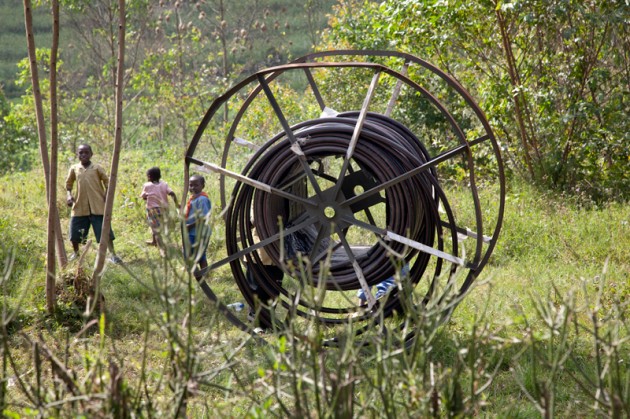
The second step is being rolled out now, literally. Everywhere you go in Rwanda, there are huge spools of fiber optic cable. In two years, every district of the country will be connected to each other and the Internet—something the United States can’t boast. It’s being operated by a private company, but the Rwandan government owns the fiber infrastructure and welcomes competing players to make sure no one company has too much power over the country’s Web access, according to Nkubito Manzi Bakuramutsa, the deputy CEO of Rwanda’s Development Board in charge of IT.

rwanda-googleThe next steps are being coordinated by the government as well: Rwanda sends 300 students at a time to India Institute of Technology to develop skills in hardware, software and telecom they can bring back to their home country. When one kid graduates, another one gets to go. Why IIT? It’s cheaper than Western schools, just as good at training engineers, and has a better understanding of the challenges and needs of emerging markets, Bakuramutsa says. In addition, Rwanda hopes their kids will pick up some of the Indians’ entrepreneurial spirit. (Pay attention here, US: We’re no longer the education destination of choice for the emerging world.)

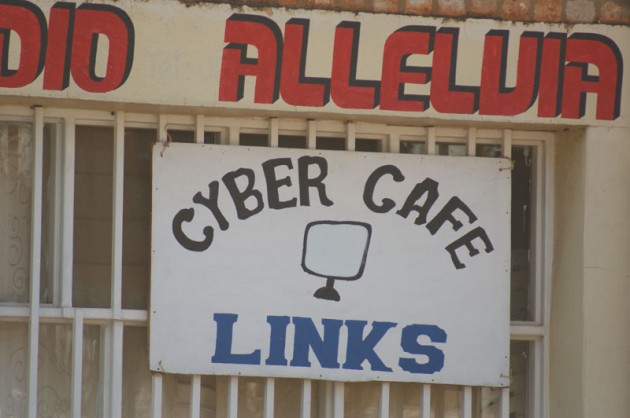
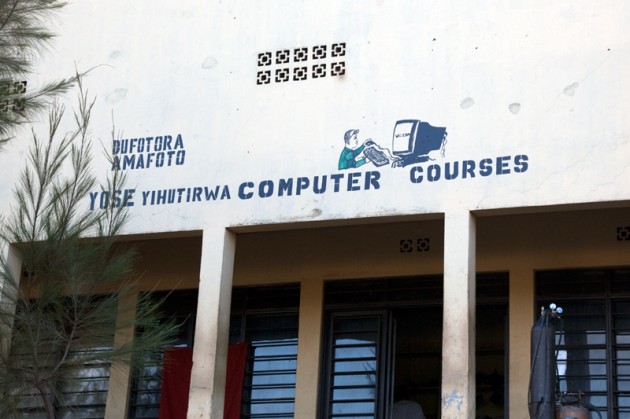
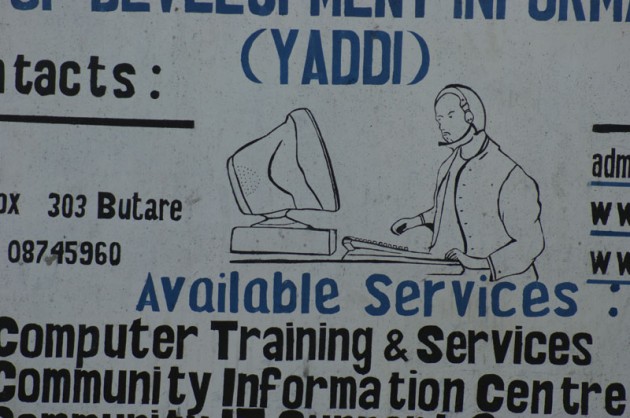
And of course, you need computers to use all that fiber and enjoy all those new Web applications being built by these kids. Right now, all thirty districts of the country have Internet centers with fifty computers for surfing the web at the low cost of fifty cents per hour, and several more computers for learning computer basics, like rwanda-cybercafe1Microsoft Word. There are also privately run Internet cafes dotting the country.
One Laptop per Child just opened a computer learning center in Rwanda’s capital city – in fact, the OLPC folks were in the country at the same time I was doing more outreach. But the Rwandan government isn’t going to leave it up to others. The country itself is buying 100,000 low-cost laptops in the next year to distribute between teachers and students in the country. “I’m in charge of IT here, and I’m rarely short of cash,” Bakuramutsa says with a smile. Last year the government spent $43 million on all of this; this year he says that’s increasing to $100 million.

So where the hell is all this money coming from in a so-called poor African nation? A lot of it traces back to aid and foreign investment. The national budget for Rwanda is 60% taxes and income from the country itself and 40% from “partners”—a lot of those partners are countries and organizations that let Rwanda down during its brutal 1994 Genocide and are stepping up to help the country rebuild. President Paul Kagame has long said he’d rather have foreign investment in Rwanda than foreign aid. But, clearly he’ll take it to make the country a place that one day doesn’t need aid. Call it guilt money if you want, but at least the country is putting it to good use.

The man in charge of all of this, Bakuramutsa, is a Rwandan national but never actually lived in the country until 2007. Just before moving back, he spent a number of years in California working for Hewlett Packard, so ge_rwa_computerhe knows tech. He dreams of a totally automated Rwandan society—one where even the milking of cows is automated. That’s a pretty big leap from the Rwanda of today— where city councils pay people dollars a day to manually trim the grass on the side of highways with machetes and sickles. First steps will include all government forms are moving online in the country, along with medical records.
All that automation is where those 300 IIT grads come in. For Rwanda to truly bridge the digital divide it’ll need locally developed sites and software, and there’s a lot of work to be done. I don’t think anyone is translating Wikipedia or Facebook into Kinyarwandan any time soon, and local Web sites and information pages for Rwandan businesses, hotels and attractions are lacking-to-non-existent. To make an appointment to see the famous Silverback gorillas, you have to physically go to an office in Kigali and pay $500 in cash. In fact almost every place in Rwanda only accepts cash. And if you’re paying in US dollars—the date on the bills better be later than the year 2000. That’s not exactly going to be e-commerce friendly.

When Bakuramutsa says he wants to build a mini-Silicon Valley in Rwanda, he means less a region that will birth the next Hewlett Packard or Google, and more a place that can churn out IT services for Rwanda first, and surrounding countries like Kenya, Tanzania, Uganda second. IT is core not only for the education, rwanda-computer-trainingconnectivity and productivity, but the future economic development of Rwanda.
The tiny country is blessed with some of the most fertile soil in Africa, but few rich deposits of minerals and very little manufacturing and industry. 90% of its people are subsistence farmers, and with a booming population there is not enough land for that kind of economy to scale. Many in the country doubt they can compete with more mature industrial economies of like those in Kenya and Uganda when it comes to manufacturing to say nothing of the dirt-cheap prices of making things in China.

But IT services? Few places in Africa can call that a specialty. And that’s why Bakuramutsa never has a lack of money to invest in IT: Rwanda isn’t just trying to bridge a digital divide—but an economic one.

Advertisement

Comments rss icon

  • Cool read, thanks.

  • Hi Sarah,

    Thanks for this great post. I didn’t know much about Rwanda until I read your post.

    I have to say that I am pretty amazed and impressed by the technology they have. Hope you have a good time and return home safe.

    Mani Raj
    Havoc Marketing

  • Great read, would like to see more articles on rapid adoption of technology outside the US, and the people that foster that kind of growth.

    chris

    • I call bullshit. Once again a long winded post where Sarah constantly talks about herself. Get over yourself. Only a moron would want to read this shit. You’re a hack. Go try some other industry and leave tech to the capable.

      • you have got problem Mr. EDKO

      • Just jealous maybe ?… -YOU- suck.

        Try to run your own e-journal(s) so that we can see what you are capable of ?

        The blogging is precisely about personal experience in something, so that information can be shared in a different manner than it was under the often impersonal, one-way pre-web era. It is more efficient when it touches people like, “see, I witness that matter for you, speaking your usual language ; do you feel impacted ? What I express could be your own feeling too after a similar experience”.

        And, that way of doing usually demystifies the all-tech talk some condescendent specialists abuse of, thinking they impress us much (listen again to related Shania Twain’s song…).

        Fortunately or not, web fora are also the place for misfits to express easily their anger ; it has little more effect there than it would in the real world, since audiences usually can sort it out pretty well.

        A beginner e-journals editor (ca. 1,250,000 reads alltogether ; I learn by walking, having fun in it)

  • Good article, it won’t take long (comparatively speaking) before Rwanda stands tall against the rest of the world from a technological standpoint with the current thinking and investment strategies. They have a blank sheet of paper to start with, no legacy technology, systems or legislation to hold them up or to overcome. This gives Rwanda a great opportunity to take whatever advantage they can from their recent history.

  • I think this has to be the best post I’ve ever seen on TC. Normally the articles are short and very thin with little to no depth of information. Sarah, you did an incredible job on this. I think it’s AP worthy. Hopefully as traditional newspapers fail we’ll still be able to get good reporting like this.

  • You deleted my last post. Did you get any black in you? Why are you there anyways. Forget those people :)

  • Saying IIT is “just as good as” a western education seems like a stretch to me. Having worked with both IIT grads as well as MIT grads (for example) I prefer the latter a zillion times over.

  • Good article, this gives Rwanda a opportunity to take advantage in Africa

  • Great piece, thanks for sharing. And it’s surprising and true just how available wifi is in Africa. My step sister leaves tomorrow to build wells for drinking water and a new medical center in Malawi, yet she’ll be sharing her experience and pictures along the way on Facebook. That’s amazing.

  • Hey Sarah,

    This is fantastic article – both from the perspective of the world and from a nation that is emerging in technology.

    Perhaps what I like best from your article was actually the comment “myself more of a reporter who covers entrepreneurs” and I think TC needs more of it.

    Covering startups is great – and I love reading the latest tech news. But covering the people that start them I think is more interesting – the ups and downs, the highs and lows. It’s not all about raising VC funding and “how easy it is” – I have no doubt that it is as easy as some bloggers make it out to be.

    I’d love to read more about the highs and lows of entrepreneurs – both successful and not. I think it would provide a good balance here on TC – sure there are a lot of successful startups, but Id also love to hear about those that tried and didn’t make it and have now created a new startup which is working. The lessons they learnt and the things they did right and wrong.

    It’s all abut the journey along the way in my mind – TC covers the “success” and the “big time”. For once, follow someone in their dorm room or their local cafe or in their bedroom or study coding day and night and what they are learning, there mistakes and their success’s.

    Great job either way :)

    T.

  • I’ve been writing about mobile for a long time; and its these kinds of articles that challenge me the most. To this writer, thanks for the challenge to practice what I preach.

  • Great post. I agree with chris up there, there should be more articles like this. Thanks for the good work.

  • Great article Sarah and agree with Pete above, one of the best I’ve read on TC in a long time. Looking forward to more

  • A very interesting article and refreshing indeed from the usual Twitter articles.

  • good post. And good you mentioned Indian Institute of technology , the premier engineering institute where it costs $5000 in fees to complete a 4 year course.
    And it is not Rwanda , lot of students are making the Indian colleges their choice because of cost and also because of better understanding of developing world problems.

  • Great stuff Sarah. Maybe US policy makers should travel to Rwanda to learn a thing or two?

    More on the same subject from a recent FastCompany article:

    http://www.fast...nda-rising.html

    • > Maybe US policy makers should travel to Rwanda to learn a thing or two?

      Right, because what America really needs is like, cheap computers and Internet connectivity, right? Hey, let’s go all out — it’d be even cooler if America had a tech company or two!

      I’m not following you.

      (Alright, so you might have picked up on that line where she mentioned being able to get cell phone coverage “even on winding dirt roads where there’s no electricity [and] on safari in the middle of nowhere”. That sounds great, *until* you consider that the government is wasting money with cell phone towers on winding dirt roads and on safari in the middle of nowhere. Put that way, it looks more like a condemnation than an endorsement, but that’s what you get when you place governments in charge of things. Oh well.)

      • Rwanda: design for the future
        US: design for the next election

        There’s a very distinctive lack of long-term planning perspective in the US for MANY issues we’re facing, and it’s not limited to technology issues. Just leaving it for private companies to solve is not cutting it.

  • Funny I am the one laying their under sea fiber optic cables to connect them all.

  • Great post, and I sincerely hope you’re right. Step 3) seems to be missing, in between “1) get Internets 2) get cell phones” and “4) profit! (from booming economy)”. I don’t think it’s that simple; I see tech as a consequence of a booming economy, not as a cause of it, and I’m all for any examples to the contrary.

    Whatever though, I am all for more Internets, and if you are right, the rumbling sound you’re hearing is the combined sound of Western techies everywhere twitching (that or you’re back in San Francisco and you’re in *serious* trouble from that whole “whoops we built a city on a fault line” thing, heh heh). Really, I wonder how many of the People 2.0’s today celebrating these developments will be among those complaining when their tech jobs get outsourced to Rwanda, and demanding Something Be Done (TM) about it…

    • Good point, but I have a different opinion on this.
      In the USA and other developed countries, Technology is the consequence of a booming economy. You seem to be missing the point that almost everything was “tech” at one point or another. Paper, Pencils, the typewriter, telephones, etc.

      Rwanda is simply starting from this point in time… so, there’s no reason why it can’t build off of what has already been established as tech elseware and use it as a starting point for their economy… especially since they don’t have any other industry to provide a base.

  • Top post!,
    great to read.

    I concur with many of the gushing sentiments above. Seems to me that having to put up with no locks on the toilet doors was well worth it.

  • Great article. Congratulations.
    I´ll add that people from Uruguay (the first country to adopt OLPC nationwide) is giving a hand in Rwanda in logistical issues.

  • Where are those Sarah bashers again? when she joined TC? There was a lot them? Are you now converted?

    I am;aAlthough i was never a Sarah basher.

  • Fantastic article – very informative. Would love it if you wrote more on these developments in other emerging economies as well.

  • I used to be the CEO of a company called SolidWorks (a 3D CAD company). Working with President Kagame and his team, we helped create a company called Gasabo3D (www.gasabo3d.com).

    The premise of the company is simple: mechanical drawings get sent in from commercial customers around the world in 2D electronic format. The team in Rwanda “processes” them by building a 3D model and then sends them back over the internet.

    Our motivation at SolidWorks (beyond the philanthropic reasons) was to find a way to help people moving from 2D to 3D capitalize on their existing data. We helped train students at ETO Giterama and the graduates went on to work at Gasabo3D.

    President Kagame is working hard to design the future – I am not sure if I have the statistic completely accurate, but I believe that 1/2 the population is under 25! Without a bold plan the future would be pretty bleak, but I am hopeful that many other companies and industries will help the Rwandans realize the future that they are designing.

    John J. McEleney
    Former CEO, SolidWorks Corporation

    • I just checked Gasabo 3D site ; that’s an outstanding example of capitalizing on existing skills to build new ones. I hope this JV will be successfull and more famous.

      I do not forget that we have developed here in France a fantastic tool, CATIA (from Dassault avionics) that sells much more than Rafale multirole fighters…

  • Great article, one of the best in a very long time here at TC. Keep up the good work. Thank you Sarah.

  • Hi Sarah,

    Wonderful photograghs. I think that you mentioned some excellent points too-that Rwanda can become a major player in the ICT field. As well as your point that the local agrarian sector is not large enough to accommodate the country’s growth.

    One question that I was hoping to see addressed is where those fiber optic cables are connecting to-outside of Rwanda. If I am not mistaken, someone told me that they are linking to the same fiber optic system that Kenya is laying off of their coast beneath the Indian Ocean.

  • yea definitly one of the best pieces of writing TC has ever seen. A rare departure from the rampant microsoft slander…

  • Good to see that TC is acknowledging some of the tech potential in Africa. I just got back from spending nine months in Uganda and Malawi with short visits to Rwanda and Zambia included.

    What amazed me about Rwanda was how much faster the Internet service was there than all three of the other countries. I was also impressed at how modern the Kigali Institute of Science and Technology (KIST) appeared (at least from the outside).

    I have heard that President Kagame’s philosophy is: “We don’t have the natural resources of surrounding countries, so we have to be smarter than them.” I also heard from one of the locals there that President Kagame’s goal is to have every student in the country using a laptop (which I find hard to believe, but it’s an aggressive goal nonetheless).

    Time will only tell how successful Rwanda is at achieving its goals, but I believe that whoever takes the risk to invest smartly in Africa has a very good chance of reaping rich rewards.

  • “We could get a connection on safari in the middle of nowhere, but we can’t seem to get a good connection in our living room in the middle of San Francisco. Who’s the developing nation now, America?”

    Ah that’s like saying that Rwanda has superior traffic management based on the observation that you did not witness any traffic jams while on safari.
    You don’t have good connection in your living room, because it is a living room in the middle of San Francisco … with lots of concrete, and steel in the concrete and high deflecting buildings made of concrete and steel in the concrete, and a good amount of interference from all sorts of stuff you’ll find in a city and not on safaris. In rural areas a transmitter will provide up to 10km of network coverage. In cities that’s down to 150m or less. So you need lots of transmitters. It is just not practicle to aim at providing good coverage in everyone’s living room’s middle.
    Try a satellite phone.

    • In the middle of dolores park, SF, the connection is crap. previously in my living room in soho, hong kong, we’re talking serious concrete, the connection was great. lets face it mobile connectivity in the US is bollocks no matter where you are.

  • Very good post Sarah, thank you for the reporting.

  • How is the web hosting industry there? Any local datacenters?

  • Digital Divide is obvisouly huge.

    obizy.com computer

  • I’ll be making the vtc.com tech tutorials site free for a year for many countries in Africa, so perhaps that will help. (80,000 video tutorials)

  • I had the oppertunity to help design a architectural project in Rwanda and the technology aspect was very challenging
    http://www.yout...h?v=NW9BOVL6bQM

  • Great. I think its important for all African nations to start to position themselves firmly in providing turnkey IT services locally. For rwanda, it was a great experience for me, i am actually very proud of the conscious efforts of the Government…I am proud to be African.

  • Sarah, can you please provide reference for the statement that Rwanda sends 300 students to IIT. Having graduated from an IIT 2 years back, I never heard of anyone coming over from Rwanda. Certainly not in the flagship B.Tech program which is considered one of the hardest exam in the world to crack and limited to Indians only, and neither did I hear of any Rwandans in any summer programs. Googling for it, I found an obscure reference of Rwandans taking distance-learning courses, which can hardly be termed as ‘going to IIT’. The remaining results are quotes taken from this very post.

  • Yes, in Rwanda we’ve already seen that the unthinkable can be done and we are ready for miracles. The will to be equal to the best in the world, we’ve seen, can get you there.

    Thank you for the encouragement, Ms Lacy

  • Great to See TC focusing on African Tech, Tech in Africa is thriving and has always been… just not as much exposure.

    http://www.startupafrica.com

  • Sandra Makowski - June 25th, 2009 at 6:15 am PDT

    I just came back from spending two months in Rwanda. I was also amazed at the amount of people with cell phones. Where I stayed there was no running water, and electricity for only a couple of hours a day – and yet, everyone – including little children seemed to have cell phone and selling SIM cards. I don’t get it – it seems to me that the government should be investing in improving the daily lives of its people with basic needs.

    A problem that I also see is that the government is changing the national language of the country from French to English – with really no set program in place to accomplish this.

    And, the people daily live the horrors of the genocide. This country called the “land of a thousand hills” is also a land of “a thousand problems” – I pray daily for this country and its’ suffering people

  • Good stuff Sarah……well said

  • This is great stuff you’re writing, ‘Indiana Lacy’.

    Having a permanent writer covering African tech scene, or in any other interesting and fairly unknown region, in this way, would be fantastic.

    I have a feeling Africa will rise as internet equalizes access to information across the world, and the competitive edge many countries have on their education systems will vaporize.

    That will also mean that ideas on how to increase productivity will reach all corners of the world simultaneously in the coming decades.

    • Dear Sarah: Stay in Africa. Love Everyone in America! - June 28th, 2009 at 6:41 pm PDT

      Hey Sarah.

      Stay in AFrica for a couple of years, doing work with the poor. No writing, just working with your hands. No memiors. Just selflessly helping others.

      Now THAT is a book I’d buy.

  • This is very interesting. I’ll be in Rwanda to take an unpaid summer position in July-September and after that plan to travel around some other emerging markets in Africa to understand the opportunities and challenges they face. It would be great if we can meet in Kigali for a chat .

  • Good look at the condition on the ground. Once Rwanda starts to move past being a regional IT hub then it will need to connect with remote work opportunities in the IT field on an international level. Samasource has been working with companies in Kenya to do that and will be expanding to other African nations, including Rwanda, soon. Anyone interested in the development of a strong IT economy in Africa should check out what Samasource is doing. You can follow blurbs on Twitter @samasource, the website at http://www.samasource.org, or on Facebook, just search Samasource. We strongly agree with President Kagame that foreign investment is crucial – but so is supporting Rwanda’s IT entrepreneurs and helping them grow by connecting them to larger markets.

  • Thanks Sarah for giving a testimony for Rwanda,
    I am a software developer (web, mobile & SMS apps) in a starting up company here in Kigali .
    I think all development in Rwanda during the last 15 years is due to the government commitment to promote Education and Technology .
    I did school in China on a government scholarship and this contributed a lot on what I am doing now .
    I also participated in some trainings in the US and I have some insight about ICT in the US .
    I have an idea on something that should advance technology in developing countries like Rwanda : Open Source .
    I believe that Open Source should save some development areas in Rwanda including Education and Health care .
    I participate in an Open Source development program (i.e Google Summer of Code, OpenMRS) and I realized that developing countries have an alternative option to use FLOSS .
    OpenMRS (www.openmrs.org) is an open source electronic medical record system being deployed in some Rwandan clinics to gather patient records for further analysis.
    An other example from what I believe in (Open Source for developing countries) is how I found many students at KIST(www.kist.ac.rw) are starting using Ubuntu Linux or OpenSolaris as an alternative to MS Windows . How many people are using Mozilla Firefox or Google Chrome instead of MS Internet Explorer to surfer the net ? How many of them are using VLC media player to enjoy their multimedia content ? How may kids are going to use OLPC there ?
    There shouldn’t be any doubts on what technology fits the poor, FLOSS is a perfect solution to developing countries .

    Thanks,

    I blog here: http://nzeyi.wordpress.com, I talk more about Education and Technology in Africa .

    - Antoine

  • I’m sort of surprised this article doesn’t mention the biggest news in East African tech since, well, uh, EVER: the coming of 3 fiber-optic cables this year to Mombasa, in Kenya — the regional fiber link.

    While the local fiber Lacy mentions is helpful, it doesn’t connect people to the rest of the world, which is extremely important for African engineers who want to tap into global markets for services.

    My organization, Samasource, held 3 Facebook Developer Garages all over Africa last year, including in Rwanda’s neighbor Uganda — our mission: to teach young developers how to make money by building Facebook apps. Despite awesome hardware in some of the universities, bandwidth was a problem for us. VSAT connections are costly and slow.

    There’s a lot more coverage of this at blog.samasource.org; also check out WhiteAfrican, Appfrica, and Timbuktu Chronicles — probably the best blogs on Africa and tech.

  • You are lying that nearly every one in Rwanda has a cell phone. Rwanda’s population is estimated at 10 million people. The country has only two cellphone netwworks, with MTN boasting 95% market share with not even a million subscribers! I hope this lie doesn’t end up in the book you are so claiming to be researching for. These facts are simple ones, and you can find them if you were a little serious!

Leave Comment

Commenting Options

Enter your personal information to the left, or sign in with your Facebook account by clicking the button below.

Alternatively, you can create an avatar that will appear whenever you leave a comment on a Gravatar-enabled blog.

Trackback URL
Short URL
bugbugbug