Since it launched a year ago, Apple’s App Store has had a series of successes (50,000 apps, a billion downloads, transforming the market), but also some failures. While plenty of people talk about the abundance of junk apps in the store, I have never seen that as a problem since no one is forcing anyone to download them — and believe it or not, some people actually do, for whatever reason, love fart apps. But one real problem has been Apple’s uneven policy when it comes to the acceptance and rejection of apps into the store.
It looks like we should be seeing some improvements on that front shortly, as the new iPhone 3.0 software has parental controls built-in which will restrict kids under a certain age from using certain apps. While that won’t solve some silly rejections, it should ease the burden on app screeners having to look closely at apps that are clearly intended for a mature audience.
So, I’m hopeful on that front. But there’s a new potentially troublesome front opening up as well: Bait and switch apps. Yes, the old practice of luring customers with a shiny price, only to reveal the real cost after (in this case, the download), could find its way to the App Store, thanks to in-app purchases.
Let me be clear: I think in-app purchases are potentially the most exciting thing about the new iPhone 3.0 SDK for developers. I believe it will mean a boatload of money for a great many of them as well as Apple, which takes its 30% cut. But where there is money to be made, there is money to be taken. And we’re likely to see a rise in apps that seem priced way too good to be true — because they are, until you download them.
Now, this won’t be a huge problem because no app can force you to make an in-app purchase. But it could potentially clutter up the store with these falsely cheap apps. And depending on how misleading Apple allows some apps to be with the in-app purchases, we could see a bunch of people buying stuff they didn’t really want to be buying.
One of the first potentially troubling apps in this regard for the iPhone 3.0 software launched last week, Gokivo [iTunes Link]. The app sells for $0.99, but that doesn’t give you access to the biggest selling point of the app: Turn-by-turn navigation. That will set you back another $9.99 a month. Now, to be fair, Gokivo does give you plenty of other features for your $0.99, but as you can see on the App Store review board, most people believed they were getting the turn-by-turn functionality with that money as well.
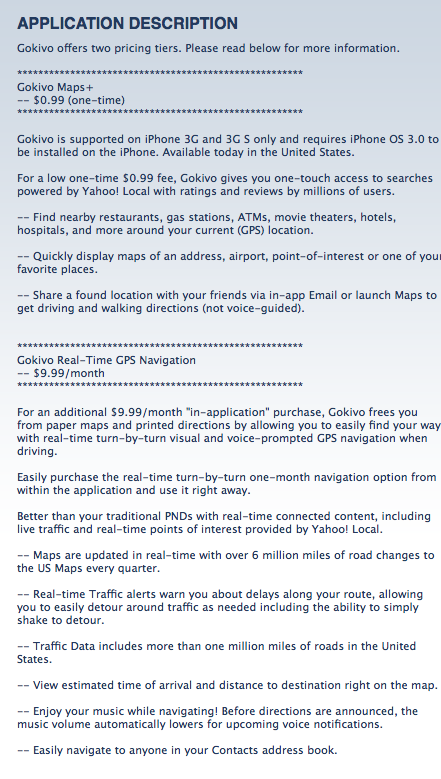
Part of that was Gokivo’s somewhat tricky wording when the app first launched. That wording has been cleaned up now, but it’s still not good enough. Basically now you have a series of asterisks on the app page sidebar denoting the most important part of the app: That it’s $9.99 a month to use the turn-by-turn features.
Apple should create an obvious way to see that these type of apps feature in-app purchase components as a key part of them. Hell, there should be a prominent label any app that uses any in-app purchases, so consumers know what they’re potentially getting into. This should definitely be on the App Store page for these apps, but it should also probably pop-up when you go to download the app itself. Developer-made text asterisks are not going to cut it.
But it’s probably unfair to pick on Gokivo, because it is just the first of many turn-by-turn GPS apps that are likely to hit the App Store. And all will likely have the same type of pricing structure. It make sense, most GPS apps/units do charge a monthly fee, so why shouldn’t the iPhone versions? That’s why I think this is just all about the way Apple highlights these apps.
But that’s a reasonable example. Just wait until the first $0.99 games come out that feature basically no content for that price, and force you to buy additional content to gain any experience. Gaming is the obvious one, but really, it could be any app that does this. And I think those are coming.
Maybe Apple expects its app screeners to look to make sure all apps have an appropriate level on content for the $0.99 price point. But that’s a foolish dream given what we’ve seen so far from these screeners.
And what else is a bit annoying to a number of developers I’ve talked to, is that Apple is forcing you to charge at least $0.99 to have in-app purchases as an option. As I understand it, this is because Apple wants to maintain a section of the App Store that is totally free. But by doing that, it’s sort of creating situations like the Gokivo app, where it appears like they’re charging only $0.99 upfront to be deceptively cheap — that’s probably not the case, but it looks like it. And that’s a problem. Because it could make a lot of apps look like classic bait and switch ones. And why do that, when real bait and switch ones are coming too?


Agreed. The ‘force’ charge in order to charge is kind of lame. For example take a city guide like lonely planet. It would make sense to download the app for free and download each city from within the app for x amount of money. But they’d be forced to charge 99 cents for nothing the way the system is currently setup.
But, this “force” charge is deceptive and there’s the rub. You are deceived to the extent of believing the initial apps value to the whole apps value. I agree with MG when he says that such apps with in-apps buying would clutter the app store. Hence there SHOULD be a label or a clear-cut explanation on what the particular apps has is store for the user (like what it offers for that $0.99 or so).
@Rohan – A solution to that problem could be to charge 99 cents for the app and give the user 1 credit towards a city guide of their choice.
Are you allowed to give credits? Is it a easy thing to do in the appstore?
No, credits/rebates are explicitly disallowed to be included in the initial purchase price of the app. This could be a circumvention of the “no in-app purchase for free apps” policy.
i think lonely planet will work fine. buy a city guide for 10 bucks. then, say for 5.99 or 6.99, you can purchase additional cities in-app. Just write your app to expand, instead of writing a “reader” app, and selling content.
I agree that pricing should be up-front, and listed on the app’s page. example:
Lonely Planet Chicago 9.99
–In App Purchase available. Additional cities 5.99
or
Game 2.99
–10 levels included, additional levels .99 per 5 levels.
or something line that…
The “force charge” is totally lame and accomplishes nothing for users and hurts developers.
There’s no reason for it, and it will essentially cause developers to develop two versions of the game – the free “Lite” version and the full version.
Why bother? Just so Apple can have a “totally free section of the App Store?” Why? How does that help users in any way when the “totally free section” is jammed with half-baked “Lite” apps anyway?
All this rule does is make it harder for users to upgrade to the full version – under this rule, they have to try out an app with the “lite” version, and if they like it, they have locate and download the full version.
Stupid. Waste. Of Time.
I disagree with most sentiment here. As a consumer, I want to know that Free is Free. The worst thing would be download a “Free” app only to find there are hidden charges everywhere. That is one of the worst consumer experiences that perpetuates any market. I’m fine with the charge-to-charge rule.
Why are there “hidden charges?” How are they “hidden?”
How is it any different from downloading the “Lite” version of an app that requires you to download the full version (and install it seperately) in order to get the good stuff?
If you download a craptastic app with “hidden charges,” you either didn’t read the reviews, or you are an early adopter. Either way, why should we make it harder for developers to protect consumers from the horrors of having to uninstall a lousy app?
Honestly, I don’t see the big deal from the user’s perspective. However, I definitely see why developers don’t want to have to create two versions of a good app and require users to install the paid version seperately after trying out the “Lite” version.
It’s lame. Users are punished for discovering a quality app by requiring them to go through an extra step – and developers in two ways: they are forced to create two versions of the same app, and they potentially lose customers in the transition from free to paid.
Totally lame and counter to the normal Apple experience. And for what? So Apple can have a “totally free section” that is utterly meaningless.
take a look at the offical formula one app, costs £4.99 but then you have to pay for each race after that. Also the stuff you pay for is available for free online and also the live timing is not live according to reviews.
basically this is the same as DLC for the xbox. Ah gone are the days when people would release a complete game for a reasonable price
As much as I love the iPhone and think it is a brilliant piece of product development, I can’t rid myself of the thought that this whole accept/reject policy is pure censorship on behalf of Apple. Imagine buying a TV and the makers of the hardware decide what shows you can watch or not?!?!
Gokivo aren’t “forced” into having 99c – they could much less disengeniously charge $9.99 and give you the first month into the bargain. IMHO the current App Store purchase price should also be the upper limit on the in app purchase price – that way developers would be forced to ensure there was decent value in the initial purchase and let consumers easily see the sorts of prices they’ll be paying for content later on. It would also be good if the full price list for all relevant in app purchases was automatically linked from the apps page in iTunes.
They *could* do that, and it makes logical sense. But, it doesn’t give people the option of just using the app without the turn by turn. There’s no option to try out the app to see how good the app is without the premium feature. They could do a totally free one, perhaps, then say “download our other one to get the extra features” but that’s rather lame too.
Not sure why the app store can’t have “completely free” and “free trials” sections. It would seem to help everyone be much more ‘up front’ about their app.
People dont comment on MG’s post. You will unnecessarily lose your peace of mind for one full day!
Hey, if you are so anti-MG, then why don’t you go and read TechCrunch without MG : http://feeds2.f...urner.com/no-mg
I would have expected tge inapp purchase apps to be for free without the optikn to initially charge anything. This way nobody could be tricked into anything because you first pay when it’s an inapp purchase…
I think the idea of charging subscribers makes sense, but only if the apps that come with the subscription are free. There has to be an incentive for consumers to want access to it badly enough.
I agree with nils, the issue with the in-app purchase feature is that it can only be applied to paid apps. Initially I thought this would eliminate the need for “lite” versions if users could download the app for free with one free level, then to unlock the full game was in app purchase, but this isn’t the case. To have in app purchases it must be a paid app, this is where the bait and switch is really an issue, but wouldn’t be if free apps could have in app purchases.
How is this bait and switch? The description on the appstore is very clear about what is available for $.99 versus $9.99. It’s not even in small print.
exactly. seriously, i can’t believe TC is giving voice to anyone upset that they had to pay more than $.99 for turn by turn navigation. morons like that are ruining the app store.
Apple can certainly do this very simply – it can make the developer provide a menu-card of in-app services along with the application submission and then display it to customers in a standardized format.
Agree. Very simple to implement.
Further, Apple isn’t doing anything for consumers by creating a “totally free” silo of apps. If anything, the range of good versus bad apps is much larger than the paid section.
It’s chock-full of “Lite” versions, all of which require users who want more content to uninstall, then download and install the full version. STUPID.
Just get rid of the sections and have all apps in the same section. Download some apps for free – if you like what you see, download more content for a fee.
What is the big deal? It simplifies the customer experience and reduces workload for developers.
Nobody can make a case for a “totally free section.”
If you own an iphone/ipod touch and have an itunes account and credit card to purchase apps, you’re probably old enough and educated enough to READ AND RESEARCH BEFORE YOU BUY.
If the author’s description meets app store guidelines and also described what you would get for the initial price, and what you get with the optional $9.99/month, then you are the only one to blame if you were “confused”.
On the other hand, if this particular app LIED or failed to disclose this in the description, you SHOULD be calling them specifically out for bait-n-switch.
Journalism fail.
You’ve got to be kidding, Ken. MG specifically says “That’s why I think this is just all about the way Apple highlights these apps.” He’s calling attention to a potential problem that I too think will be big.
If you knew anything about the App Store, you’d know he’s completely right – Apple can’t just leave it up to developers to write descriptions, they should highlight In-App costs clearly at the top of each App page.
Journalism win.
Wrong. Adam Griffiths fail. “Bait and switch” isn’t eliminated with this ridiculous “free only” section.
What is the harm in downloading a free app that requires payment to unlock additional content or features?
There is no additional danger to consumers than if they downloaded a craptastic FREE only app only to find out it’s really a “Lite” version! It’s the same freaking deal.
It’s not like the in-app purchase feature can be “accidentally” accessed…oops, you pushed the “BUY” button! Sucker! HAHA.
No, there will be a confirmation screen and a number of Apple-implemented “fail safe” mechanisms to prevent such things.
So please do tell us how Apple is “protecting customers from bait and switch with a so-called free only section?”
If Apple let us ship our Apps for free, and add content (or hours usage for a fee) we’d be back to the tried and tested shareware model.
Their rules make this behavior totally predictable.
“Free remains Free” is the stupidest thing to come out of Apple.
it think it’s purely for accounting reasons that apple does this
When are subscriptions being rolled out? Will that work like it will just charge your iTunes account, say, 99 cents a month (or whatever) if you subscribe?
My problem is what you get at at the end of the article. The requirement to be a paid app before you can use in-app purchase.
For me as a developer, I’d rather make a free version of my apps that is functional, but not fully-functional, and then have people purchase the add-on to “complete” the app, kind of a shareware mentality.
One of the biggest problems with the app store so far is that the only way to give people a try-before-you-buy is to create two versions of your app, a free and a paid version. In-App purchases could have solved this problem easily, BUT Apple decided to screw that up by making it where you could not use in-app purchase if your original app was free, thus leading people to create 99 cent “lite” versions of their apps and charging for full. The problem here is that people expect a certain amount of functionality when they “buy” something, and so now your lite application has to be fully functional, thus destroying the in-app purchase model entirely.
“Free remains free”, thanks for sticking it to us Apple!
Hmm, when you put it that way, I can see how Apple did something totally stupid….
One would have imagined that Apple would employ smarter decision makers, but no.
agreed.
Free app should be allowed to have in-app purchases. so it’s more like a free trial.
Exactly. I’m working on an app right now that would ideally have a free version which would allow customers to do one thing, and a paid version which would add some functionality.
Instead, I now have to create a LITE version, and my customers have to find the paid version on their own, using the LITE version as a guide.
There is NO REASON for this that makes any sense.
What did anyone expect? The AppStore is nothing more than a marketplace for iPhone Apps and will eventually resort to all the tricks that brick and mortar or other online vendors use. It is no different than any other marketplace.
Anyone thinking that it should operate differently needs to remember that all parties involved in the selling of an app are there to make money. Do I like what Gokivo did? No, but it is no different than my Nokia N810 on the box saying that it can provide turn-by-turn navigation only to find out that you need to pay a $120/year subscription to use it.
Business is still business and all tactics will be used to make a sale.
Correct. And those who deliver what the customer wants will be rewarded, and those who don’t, like Gokivo (and even Apple in some respects), will lose business as a result.
It seems like the easy way around this for Gokivo would be to charge $9.99 for the app and then give the first month of service for free. That way they don’t look like they’re being deceptive if that wasn’t the intent.
What kind of idiot pay for T-by-T navigation by the month?
Normal people only needs it for a couple of summer months and a few one day subscription for long weekends.
2x$10 + 3x$3 = $29 a year.
Frankly, I’ve stopped purchasing iPhone apps and won’t buy any more until Apple makes it possible to create trial versions of applications. I’m tired of paying money, even if it’s just $.99, and discovering the app wasn’t what I was hoping for.
MG,
Well done bringing this point to light. You are 100% correct.
While the introduction of micro transactions is very exciting, we are also going to see a flood of more worthless applications that ride in on a low (or free) price point, only to jack up the cost through purchasable functionality.
Our hope is that Apple has strict enforcement of application’s descriptive text on the store if they take advantage of in-app purchasing. This is doubtful, but it would make a huge difference if they screened the text to make sure it was perfectly clear how this app works in terms of purchasing. Some people are leaning toward ‘buyer beware’ but to insure that, we need the ‘packaging’ to provide all the information needed to make an educated decision.
-Alex, AppVee
Alex – we already HAVE a flood of worthless applications that ride in on a low (or free) price point, only to jack up the cost through requiring the user to download a seperate FULL version.
What is the difference?
Meanwhile, legitimate developers have to jump through hoops just so Apple can pretend it’s creating a user-friendly environment?
When Apple initially announced their policy on in-app purchases, I too was concerned with “bait and switch”. But ultimately I don’t see it being much of a problem. The reviewers will skewer any app that doesn’t provide value. One doesn’t even have to read the reviews. Just a glance at the distribution of the star ratings will tell the story.
There are many idiots among iPhone users believing that for 1 dollar one time fee they can get turn-by-turn navigation. Amen
If they didn’t want to be deceptive they would charge 9.99 which would include 1 month free and have that be advertised in big bold lettering. As it is they want to “give away” the App to make customers think they are getting something which they are not, i.e. an App that stands alone. If they want to make a different version which is free and does not have the ability to do turn by turn then they are free to do so.
If Apple allowed free versions to have in-app purchases, the Gokivo example wouldn’t be an issue – the consumer would have downloaded a free product. If they don’t like it, uninstall. No harm done.
But because they had to pay 99 cents for a crap product, the consumer has already investeda buck. Now, if the customer uninstalls he basically has wasted a dollar…
This is not necessary – we can have FREE TRIAL VERSIONS of software if Apple wasn’t being so stupid.
Instead, we have 99cent trial versions. Not exactly customer friendly, Apple.
Tough issue. In-app purchases have value for both developers and customers. But significant potential for abuse and fraud. I suspect the community will end up policing this best. Which ultimately sucks, since that means someone will have to be “had” before word gets out.
Will Apple approve each in-app purchase option? Lots of work, but might help.
You’re right but ultimately anyone who tries to “sleaze” their OWN customers will get it in the shorts through BAD reviews listed right below. So, sure – one or two might be suckered in but the rest will be turned off by sleazeball tactics – ultimately the BEST course of action is to be upfront. I will pay X for an app I find useful ad if it’s X per month or X per add-on – I have no problem if it’s something I will use but if they try to slip one by me, all hey will end up doing is cheating THEMSELVES in the long run with many FEWER customers who do NOT TRUST them …
Here’s a novel idea:
If you have a TOTALLY free app, anyone can write a review. This means even the sleazy developers can spam reviews in.
But if you have a free app with in-app purchase, only those who have paid good money can review the product.
This would ensure a higher-quality set of reviews for apps that require payment. Developers would be highly unlikley to fork over $$ to Apple just so they can write reviews.
Thus, we have a highly reliable review system that will warn consumers if a “free” app with in-app purchase is worth the download.
Adding on to your point, some people write foolishly critical reviews of apps that they do not even own. (What compels them to do this is beyond me.) Apple has eliminated this problem – at least with paid apps – by making people buy the apps before allowing them to review the app. By making the minimum in-app purchase be one dollar there is a minimal cost to writing reviews which should eliminate these foolish critics and promote a better class of reviews.
Real simple fix.
Any app with future purchase requirements should end with a different cent than 9.
Buy once apps are $.99, 1.99, 2.99 etc
In app pay apps are $.97, 1.97, 2.97 etc.
You know at once when browsing if an app has future costs associated without having to read a description.
That Job should suffer and Socrates and Jesus die while the wicked prosper, then seems unjust. ,
check out http://itunes.a...d302326354?mt=8
This is setup is a basic lite then upgrade to a full version if you like it.