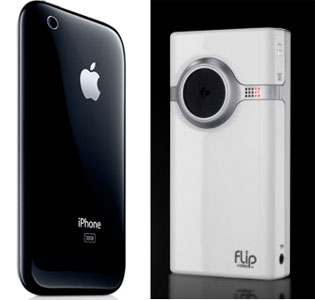
As successful as Pure Digital has been with their Flip line of video cameras – selling $150 million worth of them last year – they face a new type of threat that they can’t defeat. The video capable iPhone, and video mobile phones in general, will make them irrelevant in the next couple of years.
Flip cameras have really grown on me. A year ago I didn’t see any point in it, since most point and shoot cameras did everything the Flip could do at the same or better price point, and they took good pictures, too. The Flip was very simple to use, but the software wasn’t so great and it didn’t play well with Macs. I didn’t see the point in carrying the extra device.
But at the end of last year Flip released the Mino HD and everything changed. The device was a lot smaller than most point and shoot cameras, and took way better video (1280 x 720 high definition video v. 640 x 480 on most point and shoot cameras). They also fixed the software to work well with Macs. And the joy of taking a device out of the box – no cords or wires at all – was real. Their $590 million exit to Cisco was well deserved. I now love my Flip camera, and not just because the company sent me a check for $1.3 million.
Along the way Pure Digital fought ridicule from the big video camera companies, who said nobody would want the device. Then, once Pure Digital proved the market, all those competitors jumped in with their own offerings. There are now many devices with similar tech specs as the Flip, but Pure Digital has managed to stay ahead of them all by innovating faster.
Flip Can’t Beat The iPhone
That’s just not something they’re going to be able to do v. the iPhone and other similar devices to come.
The new iPhone takes very good video (640 x 480). That isn’t as good as the Flip (not yet anyway, word is that it actually can shoot HD video but is being slightly crippled), but it’s still able to shoot perfectly good videos on the go (example), which is exactly what the Flip is for. And the iPhone has something that the Flip will never realistically have, cellular and wifi connectivity that lets you upload your videos immediately. No need to sync back with your base computer to edit the video and upload it. You can do basic editing right on the iPhone, and publish it to YouTube immediately. As an added bonus, that video can be geo-stamped via the phone’s GPS capability.
That makes it significantly more useful as a video device than the Flip, and worth the reduction in quality. You already have to make some quality tradeoffs with the Flip anyway, so if you are going to have a second video device after your iPhone, it may as well be a slightly bigger video camera that you keep in your bag. I just don’t see people grabbing that Flip when they run out the door.
And one last killer feature of the iPhone – live streaming video from services like Ustream and Qik are already a reality – most TechCrunch authors have been using it for months on the old iPhone. At some point soon Apple will allow those apps to launch, and iPhone users will be able to stream video in real time from their phones to the Internet.
The Flip still costs less than the iPhone, and the transition will be gradual. But most everyone carries a phone anyway. And within a couple of years video will be as ubiquitous on those phones as photos are today. Flip won’t have a chance.
Or do they?
Flip As A Brand v. Flip As A Device
Last year I wrote about a possible way for Amazon to fork it’s Kindle business to really dominate the e-book market: build signature devices and actually pay ODMs to use the software in a unique reverse-licensing model:
Imagine if Amazon launched a licensing program that gave hardware manufacturers the ability to build Kindle clones, along with an incentive to sell them at near-zero margins. Amazon would give those manufacturers access to the core Kindle hardware specs (there’s no real magic there anyway) and the right to call it a Kindle device so long as they also put the core Kindle software on the device. That software links the device to Amazon’s store, meaning downloads revenue flows through Amazon.
Flip could do something similar – leverage its brand to convince handset manufacturers to Flip-certify their devices.
Garmin, facing stiff competition for its GPS devices from mobile phones, is doing exactly this: “the nuvifone is Garmin’s entry into the cellular phone market and considered key to the company’s future. Cell phone carriers have increasingly been chipping away at Garmin’s market, adding navigational features to their phones.”
There’s no reason why Cisco shouldn’t work with handset makers to make them “Flip certified” – high quality video hardware plus the awesome Flip software installed right on the phone.
Another way for Flip to go is to launch a series of higher quality video cameras to compete higher up the food chain.
Both strategies have big holes, and neither may work. But one thing is certain – In another year there will likely be multiple mobile devices that record video as well as the Flip, and have the benefit of GPS geo-stamping and mobile uploading. Flip will hit a huge brick wall. If the brand wants to live, it needs to adapt.


because everyone who wants a video camera wants a phone with a $1500/yr phone/data plan attached to it (or $700 phone with no plan)
speculate out a couple of years from now. People take far more photos with their mobile phones today than all other cameras combined. That’s going to happen with video, too. The low end of the market will be destroyed.
40 million iphones and ipod touches have been sold since 2007. Add video to the ipod touch too and you’ve got many times more users than Flip does. It’s inevitable.
And for users who don’t want to pay for data, they can just store it on the phone and sync later. It’s still better than the Flip because they don’t have to carry two devices, and the video will have GPS data associated with it.
ok if the ipod touch does it then i can see the association, but i think the iphone is too expensive right now.
Guy Kawasaki posted these pics taken with the old iPhone and new 3.iPhone.
Big difference actually http://is.gd/17943
You are correct that people take more photos with phones than cameras, but the fact is that a lot of people do still choose to carry a camera.
The same is probably also true (even now) for video, but I still think there will be a market for dedicated video cameras like the Flip.
Flip don’t need to sell a camera to everyone who has a phone, but they do need to keep making smaller, cheaper and better quality products. Based on their track record, I’d say they’re as well placed as anyone to do that.
What mike is saying it spot on. I’m taking my 3gs on vacation next week. So no need to take a camera or camcorder…
I think you’ll find you are a small minority. Mobile phone video and photo quality will never match dedicated camera quality for the price, and for any important photos I’d always want a dedicated camera with the usual advantages.
The iPhone takes *decent* photos and videos in certain ideal conditions. I’d say the camera is now on par with my 6 year-old Canon.
I think Mike’s theory is certainly interesting, but I don’t agree with it. If we’re looking several years out, the technology advancements that help mobile phones improve quality will continue for dedicated devices. We’ll have smaller and cheaper HD cameras as phones improve as well.
The instant upload argument holds water though. I imagine loads of people in younger generations demanding the instant gratification of uploading content immediately.
However, the sort of content that demands instant sharing usually doesn’t require high quality. The photos and videos I take on my vacation *do* require high quality, and I don’t need to be sharing them instantly.
is the new iPhone a flip cam killer? {seesmic_video:{”url_thumbnail”:{”value”:”http://t.seesmic.com/thumbnail/km0piYaCsq_th1.jpg”}”title”:{”value”:”is the new iPhone a flip cam killer? ”}”videoUri”:{”value”:”http://www.seesmic.com/video/7jrDbZ5L7F”}}}
“People take far more photos with their mobile phones today than all other cameras combined”
I’m not sure that this is completely accurate, or if there is any way to assess the truth of this assertion.
You’re basing your judgement on your own environment, filled with people who rush out to buy the newest cellphone as soon as they’re released.
But not everyone has a cellphone, or likes cellphones, or wants a cellphone that does anymore more than make a call. And not everyone interested in taking photos is going to be satisfied at the quality of what they get from their cellphone cameras.
Single purposed, easy to use, and quality devices will continue to have a market, as others have noted with the iPod (and one can say the same about the point and shoots, and the digital SLRs.)
I received a freebie Flip video camera to review, and frankly, it’s a fun little thing.
yo mike…
deleting comments still doesn’t change the fact that you don’t have the record/chops to be commenting on what will/won’t work…
you’re a joke..
a hack writer, but i love ya still!!
They will do okay for a few years.
Your point about being “Flip certified” is valid.
Flip should start thinking of themselves as a software company.
apparently they already do, since using my flip cam is a joy until i plug it into my computer and experience the abject crapitude of their software. only a software company would decide to emulate “full-mode” windows media player (with a dash of greeting card s/w for good measure).
Michael, purpose build devices will always do well. That is why the iPhone or music enabled mobile phoes will not kill the iPod/MP3 players.
On the light side, I think you should start recording your videos using a Flip.. what you use presently does a really POOR job!
Yes, you are right, i love to carry my MP3 while jog, not iPhone
Agreed, most videos on TC are of the interviewee’s chin, neck and shoulders
Many people I know replaced their old iPods with the purchase of an iPhone.
all our videos are on the flip. the ones you are calling awful.
Then Flip has to show you how to use their stuff. It is their hands now.
Correct .i agreed
I think Flip still has a solid market. For me, phones are better for some spur of the moment events, but quality really sucks so I hate it.
Flip is a really attractive choice for vacations and day trips, or even birthday parties. Events where I KNOW that I want to capture something.
A phone is always there, but for us non-bloggers, it is pretty rare to need to capture video on the fly.
Flip’s pricing and size make it a strong choice.
My wife and I had this exact conversation earlier today. The first thing she asked me after I showed her the video was, “so does this mean we should sell the Flip?”
iphone to replace the flip? {seesmic_video:{”url_thumbnail”:{”value”:”http://t.seesmic.com/thumbnail/ut7EUfgo0V_th1.jpg”}”title”:{”value”:”iphone to replace the flip? ”}”videoUri”:{”value”:”http://www.seesmic.com/video/ru68vX4ekv”}}}
you two are ridiculously good looking….
you know, i don’t get this whole video reply thing. it’s so much easier just to read a comment than to have to stop and watch some guy’s video where he speaks what he could’ve just typed.
Video replies do suck. Unless you’re a hot chick, preferably naked, no one cares about what you’re saying.
Where did you pay $500 for an iPhone???
You don’t have to lie to get your point across.
But if it’s a naked hot chick, you wouldn’t pay attention to what she has to say so the point would become moot.
@steven
Losing your phone = paying full price for it, last time I checked the new iPhone are around $500.
and my wife is a hot chick.
Flip has only about 7 years left. Devices like the iPhone already have the ability to shoot HD video. The only reason it won’t do so anytime soon is that 3g can’t handle it. The move to LTE can. Flip has nowhere to go from there. They can offer Flip certifications but it really holds little or no value because people buy them for price and not quality. They not only have to worry about mobile phones but the iPod touch will eventually gain those features as well.
Garmin is also a company that is in trouble if they think they can tie their software to one phone. TomTom is already planning GPS for multiple mobile platforms and will have a huge lead in marketshare and trust if Garmin doesn’t change their ways.
Don’t you think that dedicated video devices can focus more on price/quality than phone companies? I mean like sensors, video stability, low light recording?
What about life? For me, a camera retains value a year or more longer than a camera.
I meant “longer than a phone.”
I’d give it more like 3-5 years. The price of a Mino HD is close to the price of an entry digital camcorder which have better features and are getting smaller every year.
In fact, I hate flip phones and camera’s. They seem to bulky in the world where smaller is better (exclusive of biological features
)
Apparently the 3G S chip set is 720 capability for the camera. If it was any other company I would say the function might get a upgrade at some point but I’m sure that will be next years incremental upgrade for apple.
battery life is the key thing here though, how long can you record on the iphone vs the flip before…. umm battery done!
only a matter of time before we start seeing big battery blocks for the iphone along with steadycam mounts and general tripod connecter cases etc.
and.. how well does the iphone do against flip in low light situations, probably comparable but thats another area flip could improve
as for flips days being numbered, unlikely really but it makes for shocking headline
Battery life: My Flip Mino HD goes about 2 hours 15 min on a charge. I got about 3 hours out of my iPhone 3G|S.
Battery Blocks: I agree. The best choice Apple made with the 3G|S was to keep the 3G form factor. The Mophie JuicePack Air is a fantastic shell that form fits to the phone, and doubles the battery life.
Low Light: Actually, they are about equal. Both produce passable, grainy videos in low light. Fine for popping a video of friends dancing in a club up on Facebok or YouTube, but nothing worth writing home about.
I’ve been carrying the 3G|S exclusively for the last few days, and can safely say that I won’t carry my Flip, or my old Sony 5MP P&S camera anymore. The 3G|S is less featured, to be sure, but spits out comparable images, and is just there. My Flip now sits in my DSLR bag, for when I’m out really needing the quality.
The Flip has been a great device so far. Giving a good hand to bloggers, reporters in their daily work.
Providing better editing of offline content definitely helped.
However, in the new era of communication, the need of ‘live’ video has been growing and different streams have emerged.
From the traditional video camera manufacturers, providing Wlan capacities to their devices, partnering with mobile software developers (Joikuspot turns your Symbian phone in a wlan access point, allowing to share your GPRS/Edge/3G to any Wlan capable device), to mobile phone manufacturers with Smartphones.
The gap between Smartphones and pocket video cameras is definitely being filled when speaking of online content.
Apple iPhone 3GS *finally* brings a ‘decent’ camera to the product family. However, one still needs to jailbreak the device to benefit from live streaming.
Other manufacturer such as Samsung and Nokia have been heavily investing in video capacities.
The Omnia HD allows recording in HD resolution and does a
pretty good job at it. Only downside is the audio, far from being at par with the video quality. It should also support Qik, as it is a Symbian &S60 v5.0 device.
The N97 brings a 5MP sensor, 640×480 24fps hardware encoding as well as Qik and Boingo preloaded. Qik provides live, offline and backup possibilities. Boingo offers wlan roaming over 100s of Hotspots around the world, reducing live coverage costs and allowing higher video streaming bandwidth, hence better quality.
As of now, the N97 presents the best ‘out of the box’ fully mobile experience for bloggers & reporters on the go.
Looking forward to the next quarters for more innovation in that field from the different actors on that market.
Thank God, I´m not living “in an iPhone world” !
I was thinking about getting the flip, but changed my mind and went with the Sony Webbie HD. its just a little bigger (but still fits easily into my pocket) and I get a few more features an bigger HD dimention.
Planning on myaking Dreamscape wallpapers with it using stardock software. there is something cool about an animated background of trees, rivers and animals that’s just nice.
anyway, sony webbie hd for me. 200 dollars BUT you HAVE to buy a flash drive of which adds to the over all price
Let’s give Flip a chance, who knows right?
what does “I Trush” mean?
The first flip was great, but the controls on the next one, the mino, they went with the smooth iPhone thing. Just kept going off in everyones pockets. The battery was sealed in , so if you wanted to charge it up you had to plug it into a USB, whats that all about. So we switched to Vado’s instead. Lower quality not as “sexy” , but less hassle and still the problem of batteries . I’m running about 30 of them at the moment too and there is really a market for these devices.
as a P.S i just got a load of 3Gs and touches, but why no camera on the touch, that seems a mistake.
1. iphone will die. Android is 100x better.
2. Flip is just a brand, a Flip costs less than $50 to manufacture by Taipei companies. Flip makes huge profit margins. You can buy Taipei brands directly for $75 that do exactly the same as a $199 Flip.
3. Flip and other camcorder brands WILL add WiFi and maybe even HSDPA for direct uploads of HD quality to Youtube and other sites.
4. What matters is not only the resolution. Good optics make Sanyo 720p camcorders the best pocketable ones, and Sanyo has microphone inputs.
5. Though all sub $100 HD camcorders will not only have WiFi upload, they will also have a minijack audio input for better quality audio recording using external microphones. They will even have bluetooth for cheap and high quality wireless microphone recordings.
Arrington, you got kids or tech novices (w/o a data plan) in your life? Well compensated geeks like us have no need for Flip. But there’s still a market for simple, budget video recording devices.
Flip could survive by adding LTE or WiMaX (whichever one becomes the standard) into their cameras. As well as keeping their prices low and more affordable then the iPhones of the world.
Also create a website where users upload their mobile high quality vids (vids from whatever platform) and have it work seamlessly/automatically with the flip. Youtube of mobile Vids.
I’m pretty sure that in the future, device like the Flip or any other small consumer camcorder will be able to connect to a “3G” network and be able to upload video on the go.
Flip is an ugly insiders game where Sequoia sells its company to Cisco for so much money, when there is no apparent value for Cisco this transaction. I’m positive that there is behind the scene monkey-business. Every stupid or smart camera can do what flip can and better, many smart offer phones cameras than flip. Maybe the SEC should look into that.
Are you seriously deleting my comments on this thread?
1. Android will dominate over iphone. Android is open and free and manufactured by the whole industry, not by one monopolistic American company.
2. Flip is a brand, manufactured by Taiwanese companies for $50, you can find other Taiwanese brands of exactly the same product at $75.
3. Flip and other camcorder brands will add WiFi and HSDPA in the products.
4. Sanyo makes the highest quality camcorder optics in pocket 720p or 1080p camcorders with the Sanyo HD2000. I use the Sanyo HD1000 for over a year and a half.
5. All sub $100 camcorder brands will add mini-jack microphone input for higher quality audio recordings. All will add Bluetooth microphone recordings as well.
ok you can delete this double post.
“1. Android will dominate over iphone. Android is open and free and manufactured by the whole industry, not by one monopolistic American company.”
You mean the way Linux on the desktop dominates?
Flip could run Android and expose only the capabilities that make sense for a internet-enabled video camera. The iPhone positioned as a multi-function device would soon lose focus and fail if it tried to compete against too many devices that are not trying to be a phone but are simply interested in being the best device for a specific application.
The iPhone is “positioned as a multi-function device” by virtue of having, y’know, downloadable applications, not to mention the expansion port that those applications have access to.
But really, I don’t get the “X will fail because Y is (subjectively) better” mentality; while there are some cases where that’s true, it’s far from true in all cases. I’d suggest that what we see most often in computer and consumer electronics markets is a preference for universality of data formats: Unicode is supplanting other character encoding formats, HTML fended off early hypertext competitors and has beaten subsequent attempts to dethrone it. Sometimes this is a commercial zero-sum game, as we recently saw with Blu-Ray and HD-DVD — there was simply no good market reason to have both formats.
However, it’s important to note that this universality has very little to do with “openness” and very much to do with compatibility. The comment about “you mean the way Linux on the desktop dominates?” was snarky, but pretty much on the money. Android isn’t going to “dominate over iphone” because of the joy and love of its grand Open Sourceness, because the majority of users do not take that into consideration when they’re making smartphone purchases. Believing otherwise is like believing that Ogg Vorbis will become the dominant audio file format in all online music stores any day now: it may be the way you want the world to work, but the world hasn’t shown you a lick of evidence to suggest it’s gonna work that way any time soon.
To be more on point, I don’t always agree with Arrington’s thoughts, but this seems fundamentally sound to me. An iPhone isn’t going to supplant a DSLR or even a good compact, but an old photography saw is “the best camera is the one you have with you.” The iPhone doesn’t need to be better than a Canon G9; it just needs to be good enough that if it happens to be the camera you have with you, you won’t have to make apologies for having used it. Flip can stay in the game, however, by adding features that aren’t likely to be worth it to stuff in a phone: image stabilization is an obvious one.
By adding a WiFi (802.11) radio, a 2ndary, front-side camera, and Skype/ SIP soft-phone (e.g. could use one’s Vonage SIP credentials, Cisco could have a great home phone capable of video conferencing and shooting home videos at a very good price point (~$300) when compared to an iPhone +contract.
Adding 4th generation wireless technology (LTE or WiMax) wouldn’t make sense because it will be a while until those networks are viable (WiMax is only available in Baltimore or Portland).
With the coming spin off of Skype into a separate company, Skype will be looking to do lots more BD deals; or Cisco might even acquire them whlesale. Don’t underestimate VOIP running on unlicensed radio spectrum just because the VOIP revolution has been stifled to date (thank you Ebay).
I see where you are going with this. However I use the flip to interview people on the go. So for my purposes it is perfect. I would agree they might not sell as many but there will still be a place for them. Esp is their software improves.
I have both the Flip Ultra and the iPhone 3Gs and like both very much
The Flip has a few small features that were key points for me:
1. Instant On – Best feature yet.
2. TriPod Socket – Picked one up at the $ Store
iPhone can’t sit steady in your hand like a flat bottomed Flip or TriPod mounted Flip.
iPhone wins in the ability to edit, email, post video on the fly, as well as record more than 60 minutes of video.
Of course a full featured device would be best but I don’t see the iPhone docks available yet for steady video and instant on.
I will still have both devices for some time.
2. TriPod Socket – Picked one up at the $ Store
iPhone can’t sit steady in your hand like a flat bottomed Flip or TriPod mounted Flip.
We buy those tripods with plastic bulldog clips for all our presenters, works with and without phones/cameras with screw sockets
When I read the headline, I thought it was about Motorola’s flip phone. Ha ha. Talk about being behind the curve.
This is a total tunnel vision analysis by techies. Usage models in the real world are not always about have every utility in a single device as much as techies drool about the day.
In an Arrington world, everyone owns an iPhone. In reality, not so much.
Flip, and the idea of an easy to use portable HD camera, are here to stay.
@coldbrew – I believe Clear WiMax has now been rolled out in Atlanta (with Vegas, Chicago and Dallas coming later this year). We should start seeing dual-radio wireless devices by the end of the year.
That may be true, but using a technology with a de facto monopoly that will only cover what % of the US population (let’s be generous and say 10%) in order to push distribution of a new device sounds like suicide. WiMax (802.16) radios won’t have the volume required to push costs down to be competitive with WiFi, and the coverage will be sup-par for the next 2 years. Dual-radio devices will be more likely to have 3G (preferably GSM)+ WiFi, and it would be financially irresponsible to build a device using a new wireless technology with such poor coverage.
Lots a good points here, but sounds like we all just have to Flip a coin -cause it’s 50/50. Its a wait and see mode.
ugh, you have to be kidding me.
I think you are on to something. As more and more cell phones gain high resolution video recording, dedicated video shooters will begin to feel pressure.
HOWEVER, as with all predictions about convergence, it boils down to UI. If you have to hit 3x the buttons or do 3x the work on a cell phone to get that video vs using a Flip, ppl will still stick to Flip.
And I don’t think Flip has really ANYTHING to worry about from Apple. Apple has always had shitty cameras on the iPhone. Flip should REALLY be scared of the Omnia HD’s purported 720p video capture, and the Nokia n86, while it can’t do 720p I don’t think, you can bet that it is on its way.
You’ll probably have to wait another 3 iterations of the iPhone before you break 720p, and thats simply because Apple won’t commit to the tradeoff between thick camera modules, and the traditional thinness of the iPhone.
As far as connectivity, its really only going to hit its stride once LTE has been deployed widely for a while. So look for it to be commonplace it a couple years.
If my daughter goes out with her grandparents for the day, do i just give them my iPhone?
Deleted the first time – not sure why. This is a total tunnel vision analysis by techies. Usage models in the real world are not always about have every utility in a single device as much as techies drool about the day.
they need to get the price WAY down, below 60 dollars at most – otherwise there’s no back door to the preteen market (specifically, the “not yet a cellphone owner” market)…that’s the last bastion of hope for growth for this utility…even low cost digital cameras record video and are simple enough for a 5 year old to use – and they’re cheaper, and recording is simple and easy…
Here’s the problem with this argument:
Most people don’t own an iPhone. Those that do, demographicly and statisticly, are not reflective of the customer base a flip video camera is targeted too.
We’re talking here about overlapping consumers, and I think Michael is right that for this market segment, Flip needs to consider some changes.
But on the whole? As other commentators have pointed out, no one wants the AT & T contract, the high price tag for the unit itself (which will be out of style and out of date in a year), and all because you can edit video on the phone doesn’t mean you should.
What’s easy to miss in Michael’s argument is the rumor that every iPod, most notably the Touch, is going to have a camera soon. A $200 touch that can shoot respectable VGA video and stills, play great games, e-mail, etc. poses a threat to a lot of consumer electronics companies…
It’s not just the iPhone that records video.
For me, the Flip is a great device. But, then again, I admit, I represent a small market. I want a pretty good video camera that is cheap enough that I don’t mind if it gets destroyed. I don’t want to strap my iPhone to a rocket or kite, or onto my son’s bike to capture his racing, but I don’t mind doing so with my $50 flip. Oh yeah, I guess I didn’t pay full price for it, either. So, I guess my point is this. It doesn’t matter how good phone video gets. There will still be a market for inexpensive video cameras.
I’ve already had video on my first generation iPhone for the last six months thanks to Jay Freeman’s Cycorder. Although it’s only 384×288 it’s still an option.
As said above, iPhones and other cell phones with photo capability have not killed lower-end digital cameras. Not even close. So I don’t think the new iPhone will kill Flip or others like it.
You gotta be nuts! I’m not going to give up resolution to post a crapped out-blurry video on YouTube. Total SpAzZ! Apple just want’s to start up another take-down of a “better that iPhone” product.
Besides, if I loose the “precious” iPhone, there goes my video camera too. Think about it.
And I really do mean THINK ABOUT IT!
I’m just surprised the diner had “Bye Bye Bye” from Nsync on the Jukebox.
How come you guys never report on real phones, like the SE Satio for example? The iPhone isn’t the only phone in the market, nor is it the most exciting one by any stretch of imagination.
Igor, don’t expect to read positive reviews on non-Apple phones on this blog. Nokia, Sony-Ericsson, LG, Samsung are not US-based companies; they are not based in the Bay Area and as Americans say: You probably haven’t watched the Mobile Wars video where Arrington openly tried to humiliate Nokia – the World’s market leader.
I don’t agree with Michael’s argument. See my comments on Friendfeed. http://friendfe...in-iphone-world
would it kill you to post them here?
No, but Michael can’t delete my comments if they are posted elsewhere
I am pretty sure , Flip will have wireless integration and direct upload to video/photo hosting sites soon. They can also be DLNA compliant . That way I can see flip videos directly on my TV(wirelessly. I can have my laptop connected to TV and browse flip through my laptop connected to TV or a DLNA compliant settop box.
That way they can compete with bigger camera companies and cell phones as well.
Flip may or may not disappear, but what will happen for sure is that the iPhone will eat into their market. The question will then be whether it’s even profitable to keep the Flip around.
The market for flips will be increasingly squeezed on both sides. Casual users will find mobile video to be good enough (as technology improves, this will only grow larger).
On the top end, digital camcorders are only getting smaller and more portable and plus offer the higher end features that Flip would have to strive for in order to differentiate itself from mobile phones.
So the flip sits in an uncomfortable niche where people want higher rez and more space than a mobile phone but don’t want to shell out an extra $100 for a digital camcorder. A shrinking market I say.
Michael, you need to think outside of your valley, iphone and geek box.
Blackberry, which sells more devices than Apple, only has a 2% marketshare in the cell phone world. So….smartphones in general may be less than 5%?
That leaves a lot of folks for Flip to sell to.
I’ll reverse that on you. Flip has sold around $200 million of their phones at an average price point of $200. That’s a million or so devices. Apple has sold 40 million iphone and ipod touches.
I have a new iPhone 3G S. It’s great, but I think that for at least the next 2 years or so, Flips will have a fairly good market. They’ve go to make hay while the sun shines. But after that, who knows? Two years in the electronics world is a like decades for the rest of the world. The new iPhone and the Flip are both currently amazing devices. But in two years, they’re both gonna look like antiques.
I think what Michael is getting at is that you need to look a few years into the future. At this time, yes, smartphones make up a small percentage of total phone sales, but at some point they will rule the cellular market.
If you own a smartphone, how often do you pull out a digital camera to take a picture? I’d assume that, for the most part, your digital photos are taken with the phone. Michael is saying that the same thing will happen with video and that Flip needs to really innovate here so that they don’t get pushed out of the market.
It’s naive to think the majority of cell phone users will have non-video capable phones in 3-5 years. Think of a cell phone user in 1990: “A camera on my phone? That’ll never happen.”
I find it amusing how shortsighted many TechCrunch commenters are sometimes, when you’d think they’d look a little further in terms of technological advances than others.
I guess I am in the minority, but I rarely take photos or videos with my phone or even a point and shoot for that matter. I much prefer the image quality and control I get from my DSLR’s. It is unlikely that the cameras in cell phones will ever get to the point where they even come close to matching the image quality of even the cheapest entry level DSLR. At least in the foreseeable future.
The other thing is that for home video I would assume it is at least 80% of people who never replay or watch the content they shoot.
So when you are doing that on digicam or tape it works out to be very expensive for something you’ll never see. Same way that film went, people prefer the zero cost option of digital and then just lose it when they store it away in directories and drives they can never remember
So the important thing isnt the quality, its more down to whether or not you can transfer it to somewhere where you think you might be able to watch it in the future, LOL. I cant do that so easy with the iphones, unless there is a way to see them as a drive, but the flip/vado/kodaks you can
I’m impressed, and kind of flattered, to see the speed with which Mr Arrington deletes comments that go against his pro-Apple party line and which he cannot refute with argument. Have you considered a job with the Iranian Homeland Security Ministry?
To restate it — the iPhone’s screen is disappointingly low-res (320×480) which was fine for 2007, but today is lame. Most of the new Euro/Asian smartphones have 640×480 screens, and some even now, shipping, have 800×480. They also usually have better optics by Zeiss or Nikon. Then again, maybe the argument is that they are Betamax to Apple’s inferior VHS. Still, I always preferred Beta because it just looked better!
That’s why it’s a good idea to post your comments elsewhere and refer to them from here. At least Mike can’t delete them elsewhere! Mike’s and TechCrunch’s credibility will drip very fast in my opinion, if he continues to delete comments like he has on this thread.
There will always be a market for single purpose devices and a market for convergence devices. I don’t think these markets compete nearly as much as people think they do.
Single purpose devices will always have better quality, and there will be people that quality matters to. There will always be people who simply don’t want all the features of a convergence device.
Cell phones have long been able to take pictures. People take a lot of pictures with them. But they haven’t replaced real cameras – I think people are just taking pictures where they wouldn’t have taken pictures before. It doesn’t mean they don’t have a real camera that they’d bring and use when it matters.
Flip is a good product and as long as it continues to be, I suspect it will have a market niche.