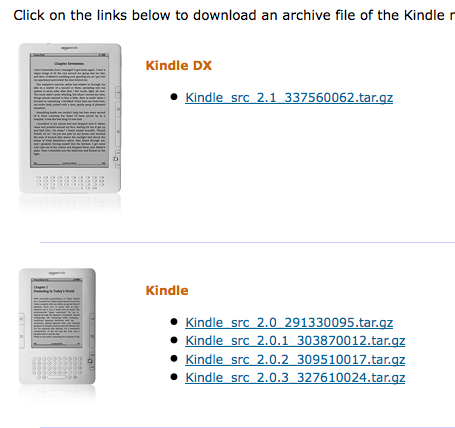
So this isn’t new, it’s actually been available since late 2007 as far as I can tell, but enough people are tweeting about it today, that’s it’s worth mentioning again. Amazon has a page where you can download the Kindle’s source code.
What is new today is that the Kindle DX, its new larger reader, has also been added to the mix of downloadable code. And you can also download the code to all the previous firmware version of both the first and second generation Kindles.
In big bold letters, Amazon includes the agreement you enter into by downloading the source code:
AMAZON AND ITS AFFILIATES PROVIDE THE SOURCE CODE TO YOU ON AN “AS IS” BASIS WITHOUT REPRESENTATIONS OR WARRANTIES OF ANY KIND. YOU EXPRESSLY AGREE THAT YOUR USE OF THE SOURCE CODE IS AT YOUR SOLE RISK. TO THE FULL EXTENT PERMISSIBLE BY APPLICABLE LAW, AMAZON AND ITS AFFILIATES DISCLAIM ALL WARRANTIES, EXPRESS OR IMPLIED, INCLUDING, BUT NOT LIMITED TO, IMPLIED WARRANTIES OF MERCHANTABILITY AND FITNESS FOR A PARTICULAR PURPOSE. AMAZON AND ITS AFFILIATES WILL NOT BE LIABLE FOR ANY DAMAGES OF ANY KIND ARISING FROM THE USE OF THE SOURCE CODE, INCLUDING, BUT NOT LIMITED TO DIRECT, INDIRECT, INCIDENTAL, PUNITIVE, AND CONSEQUENTIAL DAMAGES.
But if that doesn’t scare you away, go for it. I’m not really sure what anyone has done or is doing with it, but it’s cool that Amazon has opened it up.
Update: Here’s a bit more about this from a technical perspective from commenter Rod Begbie:
This isn’t the source to the Kindle application. It’s just the GPL libraries used to power the Kindle software, along with the patches made by Amazon to those libraries.
There’s nothing in the tarball that relates to reading books.
[thanks @danielbru]


What about the source code of the iPhone app ?
I would love to get that
This isn’t the source to the Kindle application. It’s just the GPL libraries used to power the Kindle software, along with the patches made by Amazon to those libraries.
There’s nothing in the tarball that relates to reading books.
Thanks Rod.
They’re doing this to satisfy licensing issues related to GPL etc… and As Rod mentions there’s no ‘meaty’ code in here like the book reading stuff.
So “Kindle promotes Free Libraries by Law” ?
There’s a business model in that.
Get a clue. That’s not the Kindle source code, it’s just the source for portions taken from GPL projects, which they’re required to distribute by law. They don’t reveal anything about the Kindle, and it’s not a sign of Amazon “opening up” or anything.
So what could someone do with this code anyway?
Kindle has CDC implementation (a form of java for non developers). It has all the apps written in java. There was talk of opening up kindle for third party apps at one point (App store for kindle anyone?).
http://javaswam...le-has-jvm.html
thanks for the laugh you guys!!!!!
i keep thinking of how some “caugh” VCs.. think being on TC is great.. but my god, you guys, i’m not impressed by your tech chops!!
the comments i see are seriously lacking in any understanding of tech issues, policies, strategies, or anything, other than basic comments…
i’m assuming VCs don’t really follow most of the threads here!!
the code Amazon has released has to do with the low level drivers for the device.. the higher level code that actually does the interesting stuff is a function of (i think) e technologies, and amazon… (my memory is fuzzy on this..)
Yes, app store for the kindle! Here’s what I want to do with my as yet unpurchased kindle (I don’t see the need to buy one until I can do the following):
Problem: I have diverse and unique interests largely unshared by my immediate social circle. Specifically, I like to contemplate and discuss God, reality, existence, etc. and pretty much only that (I’d put all other topics a distant second). The majority of my peer group enjoys other topics (and may indeed have the same problem; perhaps the content of our conversations is merely the lowest common denominator? Gossip, politics, weather, relationships, career?). I view books as a conversation between the author, previous authors/influences, the current reader, other authors, future authors, etc. I, like other readers and authors like to check sources/footnotes, do my own research (usually a quick wikipedia search) on unfamiliar terms and people. I also like to make notes, but they currently sit in the books themselves.
The potential: Turning books into a conversation – allowing commenting, sharing, aggregation of intellectual capital of the readership and authorship, research, local options, etc. I would pay for this, but would prefer to have all of this feed into the Amazon rec engine so my next book is spot on.
With this backstory, here are all things I want to do.
1. Import my FB and LI networks.
2. Have them tagged by their interests and be able to sort so I can share book recs, segments of text, comments, analysis, relevant links.
3. Have every action within this ecosystem count. Points for reading, commenting, sharing, points for having comments/analysis rated highly, etc. These points are associated with my tags, the tags of the book, tags of the author, etc. so the a true SME metric can be calculated.
4. Add comments/links inline as a read.
5. Choose whether I want the activity public or private or to share with a group of SME’s, friends, etc.
6. Be able to say agree/disagree in line.
7. Have summary reports available of my own activity.
8. Be able to find SME’s and their books, comments, influences, activity, etc.
9. Own this activity and be able to publish to my FB profile, blog, etc.
10. Have a searchable taxonomy ala the Britannica Great Books Synopticon and be able to find all the major advances in the exploration/development of a particular theme/idea, e.g. search “Love” and find all importance references from Dante to Toni Morrison.
11. Be able to just read these advances without buying a full book, e.g. iTunes of Netflix. I’m interested in an all-you can eat model.
12. Full profile of interests, SME’s, education, bio, etc. of readers and authors.
13. Enable the 2 most advance levels of reading – analytical and synoptical.
Amazon – please let me know when the above is ready. Phase two: Please read How to Read a Book by Mortimer Adler. Please read the “Great Conversation” by Adler as well. Ruminate on them and how these ideas can be turned into better products and more enjoyable conversation.
I think you’re looking for “Microsoft Word”.
It’s not just GPL code — they have bsdiff source code there too, and bsdiff has never been GPLed (I should know: I wrote it).
It looks to me like they put all of the open source code they’re using up there.
“but enough people are tweeting about it today, that’s it’s worth mentioning again”
… in other news, techrunch resigns to its irrelevance and has given in to twitter. from this day forth all techcrunch stories will be determined by the most popular hashtags on twitter.
(i would have posted this to twitter first, but it’s over the 140 character limit)
Cool, might make e books that much bigger and maybe more devices will support Amazon.
Like Rod said It’s just the GPL libraries used to power the Kindle software
Since this article was shown completely 100% factually inaccurate, why is it still up?
This is very irresponsible reporting.
1) As others have pointed out, this isn’t all of the Kindle source code. It’s a selection released in order to comply with the license requirements of the code written by other people which they modified for their own purposes. It’s good that they are not behaving illegally, but this is hardly something to praise them for. They benefited from using this code, and that benefit comes with an obligation to share their improvements. Quid pro quo, share alike.
2) Because the Kindle is a DRMed platform, the source code release does not actually give the user freedoms the user is intended to have by the free software licenses involved. Yes, you can look at Amazon’s changes and in theory you can make further improvements to code that *could* run on the Kindle. That would be awesome — except for Amazon has blocked your ability to put modified code back on your own device. Doing so requires circumventing part of their DRM system, which could earn you criminal prosecution under the DMCA. If Amazon were actually being a good free software community citizen, it would not block you loading modified software on to your own device. Look but don’t touch is the message here.
3) What’s not released is significant — the code, for example, that allows Amazon to arbitrarily disable the Text to Speech feature whenever they want, remotely.
Code that gives them significant power over users and how we can access books (in ways that have nothing to do with actual copyright law) remains secret.
So, the Kindle is still defective by design (http://defectivebydesign.org)
.
Don’t you mean I can *has* it?