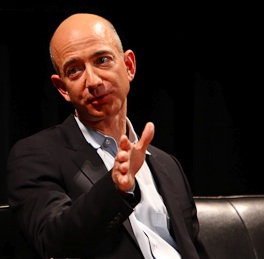
Google’s book settlement with the Author’s Guild has drawn an unusual number of critics and an antitrust investigation by the Department of Justice. Amazon CEO Jefrey Bezos doesn’t like it either.
Asked about the settlement onstage today at Wired’s Disruptive By Design Conference, Bezos replied:
That settlement in our opinion needs to be revisited. It doesn’t seem right that you should kind of get a prize for violating a large series of copyrights. The class action settlement law . . . , you can’t believe that is the way it actually works.
Google’s book settlement gives it a blanket right to display the text of any orphan work (unclaimed books still under copyright), and to sell digital copies of such works. Since the majority of book actually fall under this category, the settlement would in effect give Google an exclusive right to show or sell these books. Amazon, the world’s largest book store, is not part of the settlement and would have no legal way to sell these same books without exposing itself to copyright violations.
There is a way out of this. As I’ve suggested before:
Google should amend some of the terms of the settlement to make it non-exclusive and the Author’s Guild should extend the same terms to any other company or organization that wants to digitize orphan books.
In other words, Google needs to free the orphans. Don’t make this just a deal between authors and Google. Make it a deal between authors and any existing or future book digitizer.
Bezos also had some good advice for company founders and entrepreneurs: “Be stubborn on the big things and be flexible on the details.”
On failure, he pointed out that only rarely is the cost of failure more than the cost of not trying anything at all:
One of the reasons companies are so non-experimental is that they over-dramatize how expensive failure is going to be.
Failure is not that expensive. You almost never hear a company criticized for failing to try something
As long as it is not a bet-the-company kind of failure, most companies can survive. Amazon has tried and failed at auctions and search, for example. But its bets on Web services and the Kindle are paying off. The winners pay for the losers. That is important to remember.


Jeff Bezos for president!
yeah, what he said
Bezos “Failure is not that expensive. You almost never hear a company criticized for failing to try something”
I guess Bezos has NEVER read a techcrunch post.
It should be searcheable. Thats it. We have come past books.
…and when the country is going to crap, he can just stand on the podium and laugh. I will begin to laugh with him and all is well….
I need to get a Bezos laugh ringtone.
Wow, I finally read an uplifting article on TechCrunch…um sorta. Seriously there’s so many negative flame wars posted here lately that it’s refreshing to have an article end on a good note. Even though you did criticize Google’s clever move. Seriously though, thanks Erick
I whole-heartedly agree, if Google can digitize and sell orphaned books, anyone should be able to
barnes and noble is the world’s largest book store. wtf is amazon?
Nice comments by Bezos
dont be evil
unless it makes us money
us money, waiting..
Those are some great comments by Bezos.
The rule should be everyone. If the rule cannot be enforced for everyone, then there should be no rule to begin with.
Google book is very usefull .oh Amazon CEO Jefrey Bezos doesn’t like it either. Rules…!
nice, thank you
People generally download such content through peer-to-peer networks and there is no penalty for doing so?
There is a penalty, just look at all the RIAA cases.
The issue is that pursuing the penalty is expensive for the enforcer, and isn’t all that important, so they don’t put much effort into it except for the most extreme examples.
None of the RIAA cases were about orphan works.
The truth is that Google, Amazon and Apple are all going to have something to worry about if the feds ever get serious about Antitrust enforcement again. However, it has been a long time since anyone in government has really worried about leveling the playing field, in Search, Book Sales, Music Downloads, etc.
None of the RIAA cases were about orphan works.
BTW I love your blog!
I think the “don’t be evil” is actually anagram for “don’t be (a)live”
a- is for amazon, privacy, ms, etc…
It is unbelievable that Google is getting those books Some bidding on those unclaimed books sounds more reasonable – why should Google get those books for free -125 million is peanuts – I’m sure MS, Amazon or even private buyer would have create more value for the treasury than selling this exclusively for Google.
how is it ok for a library to lend a book, however when goog provides the same book via internet peeps think goog should pay? if goog pays you pay, prob through ads. what goog is doing is great. screw centralization!
how is it ok for a library to lend a book, however when goog provides the same book via internet peeps think goog should pay? if goog pays you pay, prob through ads.
Yeah. true.