Does America Need to Make Things?
by Sarah Lacy on June 14, 2009

KIGALI, RWANDA– As I’ve mentioned before I like my entrepreneurs risk-taking and a little crazy. Earlier this week on TechTicker, we ran an interview with a guy who fits that bill: Shai Agassi.

In some ways, Agassi is even more ambitious than Elon Musk—you know, the guy who builds rockets and $100,000 electric sports cars. Agassi wants to re-engineer the entire auto and oil infrastructure with electric cars, charging stations, battery replacement stations (staring robots who actually change the battery for you) and sophisticated software to keep it all running—one country at a time. His company is called Better Place, and while some have accused Agassi of being an egomaniac, I give him huge props for walking away from one of the most powerful jobs in the tech world to start a new company that was this hard to pull off.

I last interviewed Agassi several years ago on stage when he was at SAP, and I was covering the oh-so-sexy enterprise software beat for BusinessWeek. If memory serves, we were good-naturedly sparring about whether Oracle’s acquisition strategy would work. (I’d argue I was right.) But I have to say, I like this Shai better. He made his name as an intense and gifted entrepreneur who wasn’t afraid to take risk and sometimes people like that are wasted inside big organizations, even if they have the top job. Agassi seemed inspired and unleashed compared to his SAP days. There’s more about Better Place itself and Agassi’s plan here.

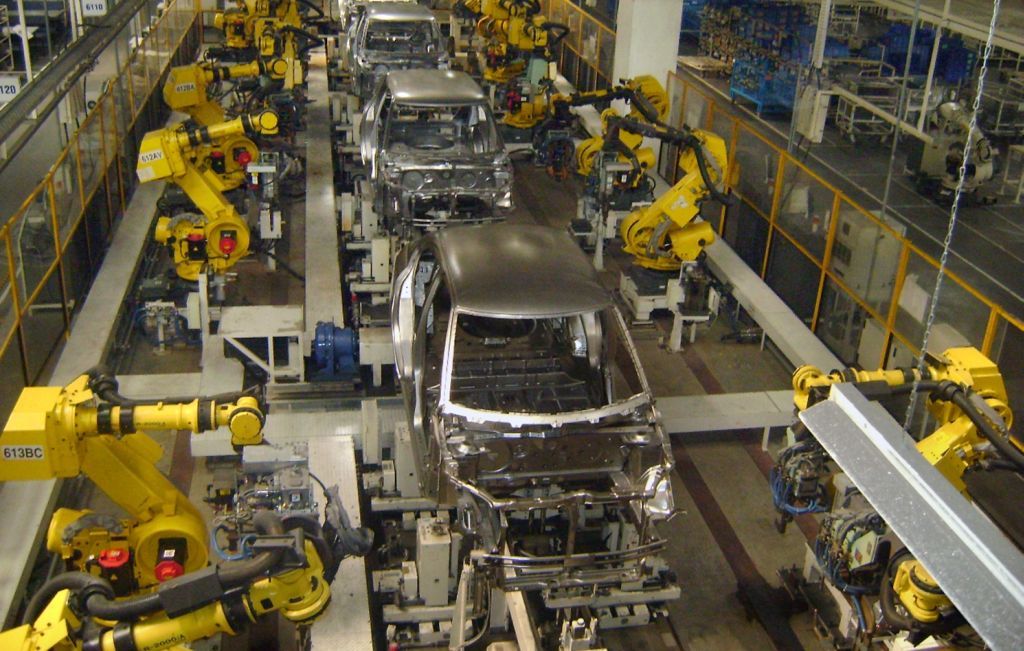
But at the end of the third segment (embedded below), Agassi said something that’s been sticking in my head ever since: America has to start making things or the economy won’t work. He argues you don’t have a country with just a service economy to support it. I’m starting to fear that he’s right, especially spending time last month in China and this week in central Africa, both places where manufacturing and consumer goods industries are being built fresh and in incredibly innovative ways. It’s a bit like what you kept hearing after the dot com bust: When things turn south it’s good to have hard assets to fall back on.

Trust me, as I sit on a terrace in a landlocked African nation that has to import almost everything to great expense, America doesn’t want to get in the pure-consumer, non-producer game. And while some argue the intellectual work—ala thinking up the idea or doing the hard core engineering—is higher margin, it’s absurd and arrogant to think we’ve got a lock on the people who can do that kind of thinking.

This is clearly the biggest concern in the rust belt where thousands of manufacturing job are at risk. But if Agassi is right, Silicon Valley is in trouble too, because we hardly make anything anymore. Look at the semiconductor business: Most start-ups for the last ten years have been so-called “fabless” chip companies. And how many gadgets are made here? The great age of networking and telecom rollouts are over—instead monopolies are upping revenues by “metering” our broadband not rolling out a newer, faster infrastructure. Even outsourcing low-level software development to Balkan states contributes to this. It’s a win-win for now, but long-term emerging markets benefit more than we do.

Tech got in this situation for two reasons: technology advanced quickly enough we could outsource all the assembly and VCs liked it that way because it’s cheap. But there’s more than enough cash flowing around this Valley to fund a few risky, expensive manufacturing plays. Here’s what I’d like to see America start making again. Leave your ideas in the comments.

1. Better consumer devices. For decades VCs have shied away from consumer devices given the manufacturing and consumer marketing costs. Sure there are loads of duds out there to support that point. But whether they’re entirely made in the US or not, haven’t the iPhone, the Flip, the Kindle, the Jawbone and others proven a good device that does something well still has a future coming out of the Valley? Increasingly, people will pay up for brilliant device execution even if it only does one thing well, even if it’s not necessarily a new category.

2. Cars. Yep, we’re doing it already but it largely hasn’t been funded by the Valley. Musk invested $70 million of his own money and Agassi’s cash mostly came from Israelis. Props to Kleiner Perkins Caufield & Byers for funding Tesla competitor Fisker. But now that these pioneers have proven there’s a viable market here, the US establishment whether it’s the Valley top brass, DC lawmakers or Detroit need to get behind it in action, not words. Although President Barack Obama has been careful to say the government won’t dictate strategy for the car companies we now own, Agassi thinks America should take the opportunity to push on electric manufacturing hard. After all, we do own them. Why not get something out of it? (More on that in the video below too.)

3. Medicine. What ever happened to the biotech boom? The promise from decoding the genome? The rhetoric that the Valley was going to give birth to dozens of Genentechs? I’ll tell you what: VCs got into the habit of selling promising pre-clinical research to big pharma early and often. There’s no more company building in biotech, and that’s a shame. I get that drug discovery is hard and expensive, but we need the innovation, real science and jobs if you ask me. There’s also the side benefit of screwing with the big pharma oligopolies. And saving lives is generally a good thing for the country.

4. Electric planes that go really fast. Ok, it sounds even crazier than rockets or electric cars, but every time I board a creaky old Boeing jet for a 10-hour-plus international flight, I can’t stop thinking about Musk’s idea for an electric plane that’s supersonic and lands vertically. I don’t even know if that’s feasible, but I’m ready to retire my much-beloved noise-reduction headset if it is. If anyone would like to build a teleportation device I’ll sign up for a beta tester on that one too. I don’t care if there’s a risk that my organs will arrive on the outside of my body, I’m so over 20-to-30 hour flights on planes older than I am.

Advertisement

Comments rss icon

  • Well, co-CEO technically,

    he got passed for the big job

    • Sarah,

      This is to inform you that your writing has a pompous air to it. Please do us all a favor and drop the “trust me’s”, “you knows”, “look”, and rhetorical questions.

      Sincerely,

      Bob

    • It will be interesting to see how much money from the ARRA will go towards purchasing products manufactured in China or software development outsourced to India and the Ukraine. Not only did we stop making things, our taxes eventually fund making things abroad too!

  • Léo Apotheker
    Chief Executive Officer
    Joined SAP: 1988
    Appointed to Executive Board: 2002
    Current Executive Board term expires: 2010

    Special responsibilities: Overall responsibility for SAP’s strategy, marketing, industry solutions, global communications, and internal audit

    Other board memberships: Supervisory Board, AXA, Paris, France; and Supervisory Board, Schneider Electric, Rueil-Malmaison, France

    Learn more about Léo Apotheker.

    The media should start stating the fact that he got passed for the big job.

  • Absolutely, basic economics. Our credit system is also based upon asset based lending, which includes businesses and their respective assets. It will be a complete disaster for the United States if we don’t balance productive offshoring with solid manufacturing and production.

    • Bullshit. We just need to make things that will be accepted in exchange for our imports. Services / Virtual Goods (software) are fine as long as they are accepted by our creditors.

      • Very well said. Your comment, sir, is the bottom line. America so far has been exporting dollars and living off of it, nobody really needed to work. Those good old days are coming to an end. So what is America going to export now? No one knows. Obama is trying to fix the situation but have Americans become too uncompetitive? I am afraid of the answer.

    • What exactly is “manufacturing” and “production”? I write software … isn’t that producing something? Or does it only count if I’m handing out a physical object like CDs?

  • Non-American Citizen - June 14th, 2009 at 2:40 pm PDT

    Enough with the “we don’t build things anymore” mantra. Is this really true? We do build our own houses. We build our own roads. We build massive mining equipment and construction equipment via Caterpillar. We produce a massive amount of food coast to coast. We build cars. Remember, Toyotas, Hondas, BMWs, Mercedes, build cars here in America; we build almost as many cars as the Japanese (check Wikipedia). We build planes via Boeing, Gulfstream, etc… We build and deploy satellites. So other than food, shelter, cars, iPhones, planes, industrial machinery such as John Deere and Caterpillar, movies, software, medicine, we hardly make anything. And guess what, if and when oil prices shoot through the roof, more manufacturing will naturally find its way to our shores since building close to the end market will reduce overseas shipping costs. I know in the cynical techworld, America is always second-rate, but the reality is we’re on top because we have a massively self-sufficient economy.

    • We build weapons. Lots and lots of weapons.

    • ” We produce a massive amount of food coast to coast. We build cars. Remember, Toyotas, Hondas, BMWs, Mercedes, build cars here in America; we build almost as many cars as the Japanese (check Wikipedia).”

      Correct, our workers assemble the cars, and our citizens purchase the cars, and then our dollars go overseas to the engineers who designed the cars, upper managment and CEO’s of these companies, where they spend that money to buy products made by their locally owned companies, using their local labor who pays local taxes.

      In effect every time you buy a Toyota, even though you may have helped employ paycheck to paycheck living factory workers in the Midwest to assemble the car, you just funneled the profits overseas to foreign countries that will never send that money back here to our country because they export far more to us then we ever import from them.

      IF and ONLY IF we had balanced foreign trade, could this be a sustainable economic model. With our perpetual trade deficit, those foreign auto makers are nothing but large siphon hoses on our economic gas tank. Even something like the much touted iPhone from Silicon Vally can be a economic siphon if the product is not marketed and sold in masses overseas at a rate higher then the cost of the foriegn produced internal components as many of those components are produced by overseas chip manufacturers in countries that maintain a large trade deficit from America. Look at China, Japan and Vietnam as examples. Between these three countries, according to the US Census Bureau so far for the calendar year 2009 we have a negative trade imbalance of $82,279,700,000 (That averages out to $489,760,119 every single day).

      Since Sarah wrote this article yesterday, and my writing of this post today, we have lost just shy of one billion dollars to these three countries, any by Friday we will have lost another 2.4 billion dollars.

      Germany is no better, we loose another 47 million dollars to them every single day.

      If anyone can still go and say that assembleing these foreign cars and providing near poverty level wage factory jobs for our workers is actually helping our economy, you are either ignorant to the facts, or refuse to accept the facts at hand. Either way you are contributing to the economic problem, and probably think you’re saving money by shopping at Wal-Mart.

      • Actually, Toyota does have technical research centers in the United States, employing many engineers and scientists from US Universities.

        But I agree with the rest of your assessment. Electronics, textiles, toys (90% of them) and many other goods are produced outside the US. And unfortunately, what is produced in the US, even by US companies, is usually just something assembled from imports.

    • Tunic el Matador - June 15th, 2009 at 11:30 am PDT

      America does not have a “self sufficient economy”, far from it.

      Your trade deficit (imports vs exports) has been increasing at an alarming rate since 1997, and reached the deficit high point of 817.3 billion dollars around 2004.

      In addition, you import capital (loans) from other countries to fund the deficit and running of the country, to the tune of trillions each year for the foreseeable future, if someone is willing to loan you the money.

    • Software Developer - June 16th, 2009 at 9:50 am PDT

      Thanks for this. With all of the negativity lately it is good to be reminded we do indeed build things in this country.

      We do seem to have lost an edge somewhere along the way, especially in my field of software development. I don’t believe it’s just a VC issuse however. All corporate America has labor arbitrage fever related to IT.

  • This is the stuff I don’t think we want the government to get involved in. If other countries want to produce our physical goods at insanely low costs, we’re better off using our available labor for those service based industries.

    If we can import all our vehicles from another country, the people who were going to be making those here can now go do something else, like giving massages. Wouldn’t society be better off if we still get those cars we want and everyone can get a massage every week?

    I don’t think that protecting jobs because we feel they are “hard assets” is something we should get involved in politically. Let our dollars be the vote there.

    • Hi Ankit, exactly. That is what the country needs. Another massage salon. When time will come, you will have nobody to build rockets, cars, and factories. Just a bunch of losers with excellent dick-sucking skills.

  • “electric plane that’s supersonic and lands vertically”
    That is a little harder to make than a website…

    • And that’s exactly why we should be building them. This country once focused on creating great works of engineering. Now we build social platforms.

      • What’s so bad about social platforms? Who says they won’t drive innovation in new areas?

        Maybe we’ll soon have more devices that are linked to our social networks. Maybe you take a picture with your camera, and it’s instantly uploaded over a wireless network, the people in the picture are tagged, and it all shows up on your profile. That camera, the tagging software, the wireless infrastructure, etc. are all things of value.

        Also, remember that while the social platforms are what might get press attention on a daily basis, there are people who are focused on other innovations. Look at the companies on this list and think about how many of them were around 20 years ago: http://en.wikip...light_companies

        What I see happening in a lot of these challenges is that the barrier to entry is being reduced – chip designs don’t need to build their own fabrication plants, video makers don’t need to worry about distribution (Youtube), music companies can simply toss their music online (iTunes), Amazon has warehouses where you can store your inventory and they can handle everything for you, etc. In each industry, the barrier to entry is being significantly reduced. I don’t know why it’s being portrayed as an issue that VC money is going towards companies that design something and none of them actually make it.

        Personally, I don’t see an issue with these changes and honestly, the quicker it happens, the better. Even if it turns out this is somehow “wrong”, it’s best we learn it as quickly as possible and move onto the next thing. There’s no point in fumbling around, getting political figures involved, etc. when we can do things 10 times faster in the private industry.

        • Really? Automatic distribution and tagging of photos? Yeah, that will propel America to the forefront of global innovation and solve fundamental human needs for decades.

          Meanwhile, the camera is built in China, and the software programmed in India. But hey, Americans can instantly share their snapshots from their private space flights! Woohoo!

        • Back in 1776, 90% of the US labour force was in farming. Today it is fewer than 2%. Throughout the 19th century decried the fall in farming and its exchange for factory jobs and the rhetoric was the same as it is today about the service industry: what is the point of having a factory if you are not farming? Real wealth, they said, is from the land.

          Working in farming is horrible, and working in factories is bad (it used to be horrible). Service jobs are far better and our aim – throughout the world – should be to get every human being into a service job and leave the manual labor for the robots.

          PS once again, a thoughtful article, thank you Sarah.

          • I don’t think building a super jet would be considered horrible, hard labor. Indeed, I think the workers would be filled with pride to do it.

            You’re also over-glorifying service jobs. For many people, a service industry job means flipping burgers, or handling customer complaints, or filling out cover sheets on TPS reports. Those aren’t exactly preferable to working in a factory or even on a farm.

            There are millions of people who would love to have a good factory job here in America.

          • @Mohammad Al-Ubaydl Great comment. I wrote about this in detail http://www.2009depression.com.

        • “What’s so bad about social platforms? Who says they won’t drive innovation in new areas?”

          Exactly! What good are physical “things” when our futures are clearly heads is floating in jars.

  • Non-American Citizen - June 14th, 2009 at 2:49 pm PDT

    Americans consider themselves to be in depression when unemployment is 9%. The French and Germans would consider this full employment.

  • Loved the article and I couldn’t agree more. We’ve got to make things. We can. We should. Will we?

  • I had lunch with an angel investor the other day, and he laughed when I asked him about all the Web 2.0 startups that commanded such high valuations. He wouldn’t touch them, citing the decline of MySpace as an example of an over-valued company that seemed so hot just a year ago.

    Rather, he’s taking advantage of the recession to purchase non-glamorous, specialized manufacturing firms that have years of proven sales and a small but steady clientele. No fictitious business plans with bogus 5-year projections here — he can just look at their past record, and their solid, physical assets. He sees the recession as short term, and that these niche manufacturers will eventually get back to normal speed.

    He couldn’t say the same about the Web 2.0 startups, since they have flimsy revenue models, and could be wiped out simply because consumers get bored of them.

  • I’ve been saying this in conversations with friends for the past 3-4 years; I completely agree. I’ll be the first to admit, working as a developer and tech strategy guy, at the end of the day many American worker push emails and digital bits for a job and there’s nothing of tangible value in the end. I’m not saying “information workers” aren’t necessary, but as in so many other ecosystems DIVERSITY is key – manufacturing, services, medicine, academia, etc. America has gotten services-heavy in its employment profile. At the same time, American companies and consumers have to sacrifice the desire to have everything cheap otherwise manufacturing will never thrive in the US again. We have to understand that paying a bit more is the price we pay for a thirving domestic economy.

    • there’s nothing of tangible value in the end

      Then maybe you’re at the wrong job? I can’t see how working on a factory line and producing a shovel is better than working as a developer making a software tool that will improve doing something else.

  • i stopped reading when you said elon musk is ambitious. all he did was rebadge a lotus elise and add crappy powerpacks, and screwing up the front to rear weight distribution.

  • Muslim Is The New Cool - June 14th, 2009 at 3:12 pm PDT

    Sup Sarah Full-Of-Controversy Lacy.

  • Changing car batteries seems to me like a brilliant idea. It’s a major hold back of electric vehicles in that the customer views their mode of transport as a device that will eventually run out of battery. It sucks when your phone goes dead, but if your car goes dead, you are literally stranded.

    If there was an across the board standardised electric car battery, every electric vehicle could get a replacement with minimal hassle and the customer wouldn’t have to worry about charge times etc.

    • Tunic el Matador - June 15th, 2009 at 11:41 am PDT

      Changing car batteries does sound like a good idea until you realize how massive the fixed costs to produce a chain of such service stations (or modify the existing ones) would be, and considering how slowly the electric cars are making inroads into the car fleets.

      Furthermore, the service stations would be left incrementally useless as battery ranges improve very rapidly, which is why the return on investment calculations are likely to show massive losses from such investments.

      • Drive down the road. Tell me how many gas stations there are. Then drive 5 more miles down the road. I bet you see more gas stations if you live in any sort of suburban area. But every car on the road can get easily 200 miles on a tank. So why aren’t there gas stations only every 200 miles? Same deal with electric. You build the infrastructure, it’s still valid even after ranges increase.

  • you are not very ambitious, are you?

  • While we have certainly shipped jobs overseas and slowly migrating to more service oriented jobs, you have to realize that the US still leads and is growing in many technology fields with new pushes for clean energy, aerospace programs, medicine and food production remains strong.

    Now granted we do get a lot of items from other countries, but usually it is just parts and assembled in US.

    Besides, these other countries that are mass producing are mass producing crap. Lead in toys is a great example. They keep that up and no one will be buying from them either.

  • Stuart Marshall - June 14th, 2009 at 3:26 pm PDT

    Whoever started the meme about America needing to manufacture stuff to be competitive sure caused a lot of confused thinking.
    The key to economic success is to do stuff that is valuable and that others cannot easily do. Typical manufacturing satisfies neither of those criteria.
    High end engineering and design does satisfy those criteria.
    The trouble that much of America is facing is that those without much education or valuable skills are unable to provide much unique value in comparison to a lot of other people in the world.
    Without the benefit of excess capital from overvalued property (i.e. the real estate bubble) the working class is going to get poorer. America will slowly converge toward economies like China and India, with a wealthy upper and professional class, and a poor working class. Ironically, this may actually be good for the wealthy and professionals of America.
    If we want the working class of America to prosper more then we need, as a country, to provide cheaper and better education. Education and advanced skills are necessary to provide stuff that is valuable and that others cannot easily do. Manufacturing is a red herring.

  • The snag is that average factory labor cost on Earth is under $2/hour and in the US is over $20/hour. This makes it difficult to justify labor intensive manufacturing in the US. It’s the same reason why Japanese manufacturing moved off shore. Most manufacturing still requires labor. Things need filling, cleaning, reapairing etc. even when automated. Our costs need to come down significantly before we are going to be manfacturing anything portable, light and non persishable. It’s kind of why we have stuck to the large bulky cars, trucks and white goods. Some high valued items with a high USP or monopoly control (Patented drugs etc.) continue to be manufactured here as the labor costs aren’t such a factor but not for your average router or consumer device.

    Basically manufactured things that fit in boxes are portable so they are made wherever is cheapest. Services use language so move with greater difficulty while language and cultural barriers remain. It really isn’t a choice we make between manufacturing and service, it’s the realities that drive the direction, we just get to choose to what extent to focus on adjusting or resisting.

    • Agreed which is why we see the continuing cycle of manufacturing being exported to poorer countries, those countries get richer, and then they export their labor to another poorer country.

      So, for large scale manufacturing to become feasible again in the US the workable scenarios are:

      - wait for the entire world’s pay scale to (relatively) equalize

      - really ridiculous government intervention in the form of subsidies or protective tariffs (not possible with the current international dependencies IMHO)

      - watch hyperinflation devalue the US dollar to the point $20/hr is now really $2/hr again as per your figures. Very frightening and with the current money printing going on by the government, very possible.

      Yuck.

  • The problem is really the VC’s kill more innovation then they foster.

    Gone are the days where someone, or a group of people invest time and money to develop an idea, then bring it to market and slowly grow a business.

    Today it’s about: pitch an idea, build a prototype in a few weeks, launch a beta in 4-6 more weeks, be profitable within 3-6 months.

    Very few things were perfected in the course of weeks.

    That’s the price we pay for “easy startups”. Every so often you’ll get a Google whose able to take advantage of economy of scale and quick profitability when it needs to.

    I don’t think there are any VC firms who are willing to put in millions and wait 10-15 years in hopes that research produces something that could be profitable.

    As a result we’re now more about incremental innovations rather than disruptive innovations.

    • I’m still waiting for a book called “Flipping” to be written. It seems to be a thread through many of the current problems in our economy, from real estate to startups. Most VC’s these days dream of creating the next Facebook, and selling it quickly to Google, after it gets written up by TechCrunch. :) (Substitute other company names as per your preference). One of my favorite videos on YouTube has Frank Zappa before his untimely death talking about the problem with the music industry. To sum it up, he said they don’t really take chances anymore on new talent, they only try to recreate what they know works. I think that problem may spread far beyond the music industry these days.

  • Per your request, my idea is, you’re right. The US needs to truss up its consumer production. I’ve seen an analogue in my hometown. Many supporting industries built up around producers, creating a population boom. Then, producers left. Support industries (their workers) fell flat. Big trouble. Hard to get a job with experience flippin’ burgers.

    As for cars, we”d LOVE to buy a US car, if a US maker would just get around to making one as reliable, fuel-efficient, and overall cost-effective as e.g. the Toyotas we own. As it is, we’re gonna get 15 or more years out of these boogers. If the US doesn’t come up with a better vehicle by THEN, we’re looking at more Toyotas.

    We’re not rich: we can’t afford to support inferior products. And, in fact, you may well find that MANY US auto employees THEMSELVES buy autos from foreign-owned (US-built) companies.

    The US needs to put new ideas into new actualization.

    • Of course those Toyotas are made here too. Cars are at least expensive to ship so all the manufacturers find it worth while to do manufacturing here and each major market. It’s just so much easier for the outside and domestic firms to do a Saturn and set up a new plant from scratch than it is to refocus GM or Chrystler on the customer.

      • Toyota and Honda build alot of their cars here, but not (primarily) because of shipping costs. It’s because of Dollar/Yen imbalances (dollar getting weaker against the yen) as well as some protectionist tariffs that were passed in the 80’s.

        Another thing that is interesting is that Toyotas and Hondas were in general, *never* cheaper than domestics. They have almost never competed on price, only on quality and features.

  • We must be net exporter to maintain our superpower status. Good points about Shai Agassi. He is a driven guy from a high-achiever family. I wish him well; if he succeed even fractionally at his current endeavor, this world will be a better place, guaranteed.

    Exporting high margin is key indeed. Israel exports know how and high-tech very successfully.

    How about we export:
    1. Best health care @ best prices
    2. Best tech to produce clean energy
    3. Best culture
    I will take two out of three.

  • Staring robots changing your battery? What are they staring at?

  • Electric cars are a beautiful dream. My concern has always been that there’ll just be too much resistance from the fossil fuel industry to ever allow it to happen. Good on this guy for trying, though.

  • We need to build and create real products and wealth.
    BTW, Agassi need to stick to what he knows. Which I’m not really sure what that is :)

  • Sarah Lacy is really miscast here on TC. Her articles just don’t fit in general TC story flow.

  • can we hear more from your African trip, are you planning to write a blog post on that

  • Sarah Lacy
    can we hear more from your African trip, are you planning to write a blog post on that

    • Just ask Ash.. are you single is what you really want to know? I am here for you buddy..me I am more abou Rhandi or Randi Z.. now she would be a fun first day.. I would go to the whitehouse and say feed us or we will shut down Obama’s Facebook fan page..

  • From the sale of an iPhone, Apple makes $100 profit, the chip-designer in Taiwan $10 and the actual manufacturer of the iPhone in China, $1.

    Globablization works very well for America :)

    • That is not true because if everyone outsources who is going to have the money to buy the products… you outsource the software development, the hardware, and only 4 people design it here… who is going to have money to buy it?

  • Some good memories of Kigali. I called it the city on the ridges. Some very sad and sobering memories too and I’m sure you know what I mean. Enjoy your time in Africa.

  • People who produce real things have almost always been more in demand then ‘idea people’…people willing to get their hands dirty usually do better for society as a whole. But that actually doesn’t matter because when $100+ oil is a reality…China won’t be making ‘cheap’ steel with natural resources from Brazil. If North America wants steel, we will have to make it.

  • No we don’t need to make things. I covered here http://www.2009depression.com.

    As I have discussed in my article mentioned above, someone somewhere back in the early 1920’s probably said, “If we don’t farm and grow our own crops our economy won’t work” or “If we don’t save the railroad industry our economy won’t last”. Both were replaced with manufacturing and cars, respectively.

    We do make things and will make things, but only if it relates to technology. But to make it work we an immediate and drastic change in our education system. We need to focus all education on technology related studies. This process will take 10 to 15 years to see any results so we need to do it starting today.

    If tomorrow everyone decides blue painted rocks are the only thing that matters then our economy needs to become focused on blue painted rocks and education based on blue paint.

    Our economy is what we make it and its based on what we make. If social websites, blogs, and gaming are the only things anyone age 30 and under care about then thats what our economy should be based on.

    Asia has won the battle at making cars. The U.S. needs to accept that and move on. The U.S. needs to focus on what we are good at and make sure we corner the market on that. The world is no different than an industry (any industry pick one) the market becomes saturated and the theory that we a business or U.S. can be everything to everyone doesn’t work any longer. The web and mobile web is and should be our focus.

    We have to drop the old economy and start a new one just as we did with manufacturing and when we moved away from wood and coal to oil and gasoline. Its just going to take another 10 to 15 years, as happened during the Great Depression for those clinging onto the old economy, steam and railroad back then, manufacturing, gasoline, newspapers and cars today.

    Its only when newspapers, broadcast television, wired phones, the U.S. auto industry, and oil go away that we will be in the next phase of the economy and that our economy will turn around.

    • Even as the country moved from agriculture to manufacturing with the industrial revolution (and two world wars) we continued to grow our food and fibre. When America moved to high tech and “services” we lost track of the fact that we still need to make stuff. It has been a source of long slow decline in a balanced economy.

      I am distressed when I hear Americans opining that we can’t “do” electric cars, renewable energy, a smart grid, etc. In 1908 a Model-T cost the equivalent of $108,000 expressed in average wages. Not many years later, automobile ownership was commonplace.

      Let’s get back our “can do” attitude.

  • I went to the genocide museum in Kigali, and then gorilla trekking. I remember they turned off the electricity between dusk and dawn in Rwanda.

    I envy you spending time there now, and I know your post is right; we have to make things. I think clean tech will catch on, partly because it’s so heavily subsidized. And I believe there’s a lot of opportunity left in health care.

    Last point: don’t listen to the trolls.

  • The US has the world’s largest high-tech consumer market, which China and India don’t. That’s why Apple is able to come up with consumer electronics innovations and HTC isn’t. In the US, you see people using smartphones, for example, constantly, so you get ideas about how to improve smartphones. In China and India, you don’t. For a better explanation from the creator of this theory read Amar Bidhe http://www.bhide.net/

    • I agree, but manufacturer countries can strangle countries that only design stuff. They just deliver less goods, prices go up. Furthermore China and India are big countries (about 2.5 billion people total) and their economies are growing. They can concentrate on their internal markets and when those markets will start becoming as remunerative as the US and the European one (still a long time to go, but it will be), having all the US and European factories will give them a very large negotiation point for anything they like.

  • There are three ways to create wealth:
    1. you dig it out of the ground
    2. you grow it
    3. you make something

    Number one is still working to some extent, but the long term outlook is suspect.

    Number two is solid (and it is not horrible, despite the claims of @idiopathic to the contrary)

    Number three – we need to be concerned. Low skill, low cost manufacturing is gone. We need to focus on high skill, unique, innovative products.

    Anything else, including the so-called “service industry” is just redistribution, not creation, of wealth. If North America tries to compete in global markets on the basis of redistribution, our long-term prospects are not good.

  • Sarah, I couldn’t agree with you more. Our economy is at much greater risk in the near future than most people can imagine. The only place where we potentially disagree is the cause. Yes, I agree that we lack any significant production to remain a global powerhouse in the next century, but I also think that the 7 deadly sins are at the root of our problems: Extravagance, Gluttony, Greed, Acedia, Wrath, Envy, and Pride. No, I am not a religious zealot either.

    I worked at Bell Labs about 15 years ago and they were doing some great things, but they didn’t have the right top execs to see these things through. For example, a team that shared space with us was working on noise cancellation technology that by now could easily make the cabin of an airplane whisper quiet. 15 years later, and we still don’t have anything close to that available on the market. There are so many other examples that I could list. How often does anyone mention Bell Labs these days? Most of that organization got absorbed into Lucent Technologies, which is when I decided to leave. Then the ensuing CEOs made all the wrong decisions for the company in order to line their own pockets. Schacht, McGinn and Russo were the typical type of greedy CEOs that are ruining this country’s economy. They drove one of the world’s most prestigious research facilities into the ground. Add to that list Bernard Madoff and the execs at Enron, Tyco, Adelphia, AOL, Lehman Brothers, just to name a few.

    It doesn’t take a card carrying member of Mensa to know that this country’s future is in serious jeopardy.

  • of course you have to make things. fundamentally, ecconomically its vital because people still want to buy things. So if your buying stuff in your local shop that was made abroad, your local shop might take 20%, but that means 80% is on a slow boat to china( metaphorically speaking). So unless you think a country can export more services than the value of the goods it imports it is crazy. Why is a country losing vast amounts of money every year different to GM losing vast amounts of money, eventually you will go bankrupt, or whatever the balance of payments equivalent is?!

    Not to mention the other trivial point that is, you have to have at least some manufacturing base to be able to defend yourself. If china goes bad, you cant exactly rely on importing, warships, tanks and planes can you. And even if your 100% services ecconomy had decided to keep a military infrastructure, you would still be at a massive disadvantage because you will miss the factories you used to have that could have been converted rather than having to be rebuilt. (slightly outside the box point i know, but still has to be made.)

  • Right ..!! Medicine I get that drug discovery is hard and expensive, but we need the innovation and can save lives is generally a good thing for the country.

  • It is very short-sighted, not to mention a bit conceited, to believe that we can just design things in the U.S., but have them built somewhere else. The knowledge of how to design good products will not last.

    The knowledge of product development and especially industrial design comes from the experience of actually making things. The U.S. had put itself into a leadership position to design good products because it knew what separated good product design from bad through the experience of decades of modern manufacturing. If you design something that can’t be built efficiently, or will break down, you fail. And it’s mainly through the making things that you gain this knowledge.

    It’s only a matter of time before our knowledge about product design is made obsolete by advances in materials and manufacturing. And the people who will gain that knowledge and become tomorrow’s product designers are the people who are making things now.

    • very well said

      • But why can’t U.S designers and engineers work in cooperation with foreign manufacturers?

        Design products in the U.S, send them abroad for manufacturing, study them products, make improvements.

        It’s as cheap for people in the U.S to be designers as it is for those in emerging markets to be workers.

        Think about it.

        One world!

  • As Owen Brunette noted, there’s a severe labor cost disparity between the USA and much of the rest of the world. Whenever this disparity isn’t offset by transportation costs, it’s reasonable to expect things will be made elsewhere. Greater freedom to abuse laborers and the environment in some countries also plays a role. I think any revival of manufacturing in the USA will require overcoming these obstacles.

  • I agree completely with the basic premise, but the piece is written as though Silicon Valley VC money is the only path. What’s missing from the Silicon Valley mindset is the idea that modest success is an acceptable outcome. VCs would rather see companies fail and cut their losses than be saddled with conservative companies that grow slowly and crank out small profits every year without gunning for an IPO or major acquisition. That attitude is fine for VCs but it’s not going to spark a US manufacturing renaissance – at least not a sustainable one.

    I recently spent some time visiting a client that manufactures composite bicycle wheels outside Indianapolis. Zipp been successful making only high-end products for a niche market and they were acquired in 2007. I truly believe that, if they’d had VC funding, there would have been pressure to do the opposites of all the things that made Zipp a success: grow too quickly, expand down-market, use lower-grade materials, and probably move production offshore. Instead, they were free to succeed at their own pace.

  • In Head to Head by Lester Thurow, the author made an argument that invesetors in the USA can afford to manufacture goods, but they refuse to do anything that results in a low profit margin. This book is older, but I think it still applies. Unforutnately, once someone gets money, all they think about is keeping it, or making huge sums with it, nothing in between. If I had 250 million, I would make a car if I knew my return would be 3%. Why? Because I have always been a happy person without money, and I would be happy with a 250 million dollar auto plant. 10% over 3% would not make me any “happier” nor affect my decision to fulfill a dream.

    The populace of America has less money to spend if they are all in the poorly paid service sector. This is a two way street (company paying wages vs. employee buying goods.) People making $8/hour can afford to make far less purchases.

    Exports – Can’t export a latte. (Well, one can build a Starbucks in Laotia…but shipping one does not make sense.) We do need more exports. We should think about generating more tax revenue from rapidly growing societies, and evening out our trade imbalance. Need a widget to do that.

    We certainly do need to make things. Hopefully the escalating wages in China and Mexico will turn around the attitudes of the money brokers in New York. With them always chasing the easy buck (a building boom, selling mortgages to poor people, Google stock) I highly doubt our return to a great industrial age.

  • Stealing a quote from my blog, “AmericanBOOM is a blog dedicated to recapturing the manufacturing sector, job base and economy that built our country and created a middle class with a high standard of living. While it is not an easy task to control our politicians as successfully as special interest groups do, we can control how we spend our money as individual citizens. AmericanBOOM is dedicated to supporting American manufacturers whose “made in America” products create jobs for Americans and tax revenue for our country. AmericanBOOM is fighting to stem the massive outflow of dollars, jobs and equity that leaves us making nothing, owning nothing and continuously lowers our standard of living…”

    The point is, government can’t fix our economy, it can only screw it up. Also, mandating protectionism by law will never work. But, if we want to rebuild our standard of living and create jobs we have to stand up as consumers and support manufacturing in America by buying American made products.

  • If America wants the 21st century to be as good as the 20th than we need to be on the cutting edge of nanotechnology, biotechnology and artificial intelligence, and then we need to build a manufacturing base on that knowledge. Anything less and we will become second rate.

  • I think this is how it will happen: (1) we will try to subsidize manufacturers, (2) the mounting debt load will drive up yields/cost of borrowing, (3) we’ll solve the problem: reduce the minimum cost of domestic labor.

    Perhaps this is a course that all societies take; the start off ambitious. Then they build up until they reach a level of wealth and prosperity never before seen by humanity up to that point.

    Then that society gets concerned with raising the minimum standard of living for everyone, and in the process, becomes inefficient. In the past these societies collapsed the world into eras of darkness. Today, the fluidity of our global society should allow dominance to (relatively) smoothly flow from the recessing society to the developing society; the prime contender seems to be China.

  • HUMAN CAPITAL AND EDUCATION

    The comment “America needs to things” is correct. The issue is: what should America make? America makes products that have high value and therefore commands high prices and margins (e.g., iPhone, advanced medicine etc.). The key to the US’ competitiveness will be (1) human capital (2) reduced government. Immigration and better education will lead to better human capital. We need to keep government out of our lives and business as much as possible.

  • Last time I checked, Apple’s “Made in China, Designed in California” approach had that company with $30 billion in the bank. Just-in-time manufacturing means that Toyota builds most of their cars aimed for the North American market IN North America.

    Despite all the long term trends, the US still has a LONG way to fall before it loses it’s #1 world ranking in industrial output and manufacturing; it might not be making the worlds computers, gdgts, and other consumer-ables, but it still makes lots of “things”, and it will for the foreseeable future.

    • The difference is between an expanding economyu and a contracting economy.

      In an expanding economy, branding is very important. People don’t just want a shoe; they want a Nike. And the U.S. was quick to pick up on this and make a lot of money moving the less-important manufacturing somewhere else.

      The problem is that in a contracting economy, people don’t want Nike’s; they just want shoes. And you can’t build a manufacturing center overnight.

      America made a lot of money during the expansion but in the same way slash-and-burn can make you money. It’s a one way street. It would still be ok if it saved a lot of that money to find a way back, but it spent like a sailor and used it all up plus most of its debt capacity. All America has left to get it out of this mess is its military.

      • You sure said a mouth full there. I believe if America continues on the path we’re on now, the only thing we will be building is military products, and then, who will be doing that. It is not like enough of our kids are pursing tech/science degrees. Where will our idea/development base come from? The governments answer is overseas, but it is foolish to think that we will keep these people overtime. If company after company is being shipped overseas, then that is where the engineers will go. Sorry to say it, but the vast majority, or should I say the overall majority of engineering and science students are from overseas and just about all of them plan on returning home to benefit their own countries. As an engineering student here in the US, born and raised. I have had enough of these CEO’s that don’t know jack shit about tech, and only want to make a profit to line their pockets. Then we have politicians that couldn’t find their ass with both hands if their damn lives depended on it. A lot of innovation and development ideas are crushed simply because you can’t make a buck on it quickly, development takes time. Innovation takes time, it takes long hours and hard work. Oh I’m sorry; the bastards running the majority of our companies wouldn’t know anything about hard work because they have BA and law degrees, worthless pieces of shit that only think they are smart because they can use twitter. They so oblivious they think it is like high level programming. They are now a “techie” because they can post words on their blog, oh whoo hooo. I have come to two conclusions. Either I will have to work for the government producing military related tech, or I will have to transport myself overseas to an area like Japan to really engage in the development/innovation that my heart desires. That is where people do something on the basis of benefiting humanity/economy/country instead of being filthy hogs who only want to line their own pockets. Isn’t that what America was created for, benefiting mankind as a whole. Providing a land where people can reach and accomplish their dreams. We are quickly losing that, hell, we’ve lost that already. I’m not concerned about money; I’m concerned about the well being and future of this country. I feel as though my hard work is for nothing when idiotic morons are running and calling the shots. Many of my professors didn’t pursue careers in industry or retired early because of management problems. They had to deal with fools that knew nothing of development bossing them around. They felt as if they couldn’t do their jobs and they couldn’t do what they loved, innovation. This is the reason why they are in academia and gave their business managers the rod. I feel my efforts and talent will be better suited in an environment that will encourage and promote these creative abilities. Congrats America, in scaring away your core of innovation. Kids these days are more concerned about being popular than creating leading tech advances. Or, they are concerned about who is shoving their dick up Paris Hilton’s ass. Pretty much sums up America in one sentence. You perpetual dumbasses can fend for yourself. Go tweet that you tards, that is about all this generation knows how to do these days. Good day.

  • Yeah that’s great, but you need to make American labor cheaper by deregulating and lowering taxes, if you want to make America a viable (manufacturing) economy again.

    • Funny, because when we were most successful in this country was when we were highly regulated, and taxes were high (92-71% on the wealthy).

      If you want America to be viable, have sane trade policies, with fair tariff agreements, mandating companies to have a standard of production practices (like OSHA, waste removal, etc.), and worker standards (non-sweatshop labor). As well as increasing the minimum wage to a living wage which is set by prevailing costs.

      Manufacturing things creates wealth. Buying cheap crap from other countries, with credit we borrow from those same countries, creates nothing but crap debt.

Leave Comment

Commenting Options

Enter your personal information to the left, or sign in with your Facebook account by clicking the button below.

Alternatively, you can create an avatar that will appear whenever you leave a comment on a Gravatar-enabled blog.

Trackback URL
Short URL
bugbugbug