 Last month Mozilla introduced us to Jetpack, a new project from its Labs team that could well change the way browser extensions are installed over the next few years. The project is still in early stages — its blog describes it as primarily a technology preview — but some very cool things are already starting to emerge. Today Mozilla is releasing Jetpack .2, which introduces us to a handful of new features: the sidebar, persistent data storage, and the future.
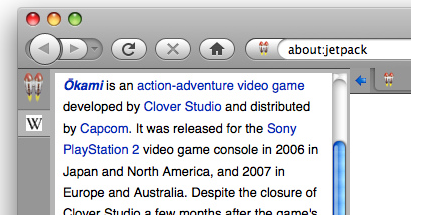
Sidebars are meant to serve as light and quick side panels in your browser. This kind of feature has existed for years as traditional browser plugins and Firefox extensions, but Jetpack sidebars come with one major advantage: users don’t have to restart their browser to install them. The Mozilla team has put together a sample called the “Video Slide”, which allows you to tuck any video you’re currently watching into the left slidebar, so you can browse the web while the clip keeps playing in view (be sure to check out the video below to see it in action).
Jetpack: Slidebar from Aza Raskin on Vimeo.
Included with this release the Mozilla team is also introducing a jetpack.future function, which allows developers to make use of APIs that aren’t yet stable (sidebars are included as part of these future-looking APIs). From the Mozilla blog:
Jetpack is two things at once: it is a platform for experimentation and it is also a solid set of APIs that anyone to easily build new Firefox features. To enable Jetpack to be both stable and — at the same time — to experiment with not-quite-yet-ready features we’ve added the ability to import new features from the “future”.
Finally, the new version adds support for persistent data storage between browser restarts, which will be key for creating advanced extensions.
Jetpack is still in early stages and for the time being is probably more interesting for developers than your average Firefox user. But it’s a very compelling project because it could make life much easier for some startups, depending on how robust the technology eventually becomes. We’ve covered plenty of companies building very impressive browser plugins that have fizzled out largely because they couldn’t get users to actually install their plugin — easy as it may seem, that browser reboot can be a real turn-off, especially when you’ve got multiple windows open. By removing this barrier to entry, Jetpack could become a boon for developers.
If you’d like to check out some of the other 40+ available Jetpacks, check out the list here, which includes an instant dictionary lookup and a Gmail notifier.