Google Translator Kit: Automated Translation Meets Crowdsourcing
by Robin Wauters on June 10, 2009

Only a handful of blogs picked up on Google’s fresh Translator Toolkit, which the company launched yesterday by means of a blog post, but this new service really deserves a second look, if only because Wikimedia apparently sees the tool as something that could “change the way Wikipedia grows in other languages”.

You can read an extensive review of the product over at Google Blogoscoped, but here’s the gist:

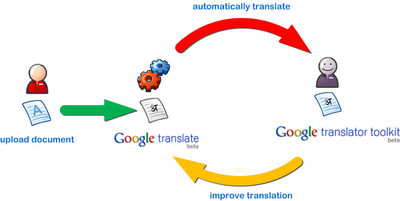
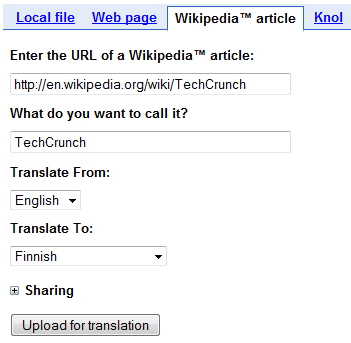
Google Translator Kit enables anyone to upload documents for a variety of formats (HTML, Microsoft Word, Rich Text, OpenDocument Text and Plain Text), enter the URL for a file on the web or input a direct link to a Wikipedia article or Knol entry. After submission, the text that requires translation is automatically translated in the back-end and subsequently featured in a so-called ‘Workbench’, neatly placing the resulting text in the target language next to the original.
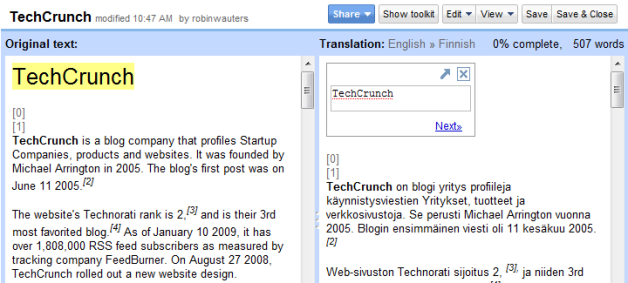
Google will search their translation memory for previous, human translations of the uploaded segment and show the translations in the Search Results tab. Color-coded segments will depict ‘exact’ matches and ‘partial’ matches, so you can edit the text based on the memory as well as previous, human translations. In addition, you can use the computer-generated translation in the Computer Translation tab to jump-start the translation of your current segment. When available, the toolkit will also search Google’s multilingual glossaries to help you translate specific terminology for your language, or you could use the Dictionary tab to do custom searches on Google’s multilingual dictionaries.

Besides the self-learning ability of the toolkit, the service also makes it incredibly easy for people to collaborate on translations, bringing a human, crowd-sourced touch to the automated process of Google’s Translate service.

(Thanks for the heads up, ArabCrunch)

Advertisement

Comments rss icon

  • Amazing product after google transliterate, if they get behind this one the way they did for transliterate then this would be the next big thing.

  • Thank you Robin for featuring ArabCrunch again :)
    I’ll inshallah be a daily user of the toolkit as i am planning to launch the Arabic version of AC very soon. It saves so much time, and the collaboration is what I was looking for in a translation app.

  • Hello my fellow insomniacs. This is one of the best possible uses for crowdsourcing I could imagine. I wonder if some day we will see an entire Wiki style active layer built into the web with legions of authenticated translation acolytes being grown from the entire web population. They would have a special Google button on a browser toolbar which would pop up the interface displayed in this TechCrunch bar, and be allowed to make direct foreign language edits to any page that they have permission to do so. Permission would be granted indirectly by all webmasters participating in the Google global language webmasters consortium; a voluntary affair similar to the way millions of webmasters now allow Google to manage their Analytics program. Translation acolytes would have various trust levels where the lower the trust level, the more approval votes you need from fellow acolytes before a change was committed. The acolyte trust score would also be managed by crowdsourcing where acolytes that attempt to add self-promotional edits or even spam get demoted, and those with a history of high accuracy edits get promoted. It would be sort of a persistent roving distributed translation team that keeps the web multi-lingual and also through their efforts, continue to update and improve Google’s machine translation algorithms. God I need some sleep.

  • Damn it only works from English source material. I have an application form in Dutch I need to fill in (but I only know English). I was going to use this tool to upload the pdf and then try and get help translating this by bringing in my father online (and in another country) to translate, well fix any errors in the automatic translation, it doesn’t look like this tool aides this use case.

    Netherlands Passport Application form
    http://www.neth...index.php?i=141

    The PDF:

    http://www.neth.../document/6.pdf

  • Great !
    It cannot be worse than the current TechCrunch translations in French!

  • this is the awesome software of google and are very useful . it helps to translate the languages from one language to another language home page.

  • Sounds great. hope it will bring us more interculture communication. thx.

  • Looks nice, Transposh has been doing a similar thing for wordpress blogs for some time. Nice to know we have a small competitor ;)

  • It is amazing I really appreciate it this is the awesome software of google and are very useful . it helps to translate the languages from one language to another language home page.

  • This service is a great gift for freelance translators who cannot afford translation memory software. Today there are a few translation services (such as OneHourTranslation.com which I’m a member translator at) which allows people with language skills to work as a translators. The service Google offers here can save them a lot of time and money, since many translations seems to have some similarities (especially translation of business-related docs and emails). I also curious to know how the collaboration feature will work for professional use.

  • This isn’t really a big innovation. The only difference here is scale because Google has the reach. However applying their knowledge of databases would be pretty handy in string matching.

    Translation memory software is pretty cheap if you think about it. Trados isn’t that expensive and if you’re making your living doing translation its a worthy investment. You don’t build a house without owning a drill. Buy the software. And if freelance for specific companies that use SDLX, the lite version is free.

    This won’t be replacing professional translation services anytime soon though. It still doesn’t guarantee 100% accuracy since it doesn’t pick up on the new document’s context.

    Still, Google’s doing some neat stuff in the field, but won’t be killing the field of human translation anytime soon.

  • It’s interesting that google is finally looking at language tools again. I’ll have to use this sometime soon.

  • Google is trying to fix useless Google Translations. I doubt there is silver bullet solution that provides universal way for translation, this is why Google is not the company to implement decent translation solutions. We are launching way better organized web site translation tool in August 2009. See 99translations.com.

  • Yes, but can it do Jive???

  • Thanks for the article.

    This probably works best for simple texts as you have here on TC.

    I am going to test how it works and translate selected Russian lessons from our educational site. If you are curious, feel free to check it out or join http://masterru...f=2&t=17620

  • Hoping to get some dood tranlation results for some English langauage only training guides into other languages

  • You realise the ‘translated’ Finnish text in the first sample picture is absolute garbage?

    Not a very good ad for the product, I’d say.

  • While – as others have pointed out – Google Translator Toolkit won’t “kill” human translators and agencies, it will transform the market radically (and in times of globalization, translation services is a big market).

    First, translation memory software (both stand-alone products and enterprise level client-server solutions) is a big business with dozens of competing players – and they are now challenged by a free, browser-based product/service in the same way that Google Docs + Spreadsheets challenges traditional office software. And believe me that the difference between Trados’ commercial products and Google’s free offering is *much* smaller than e.g. the gap between MS Word and Google Docs. I really wouldn’t want to work for SDL International today.

    Bur what’s far more interesting here is the issue of translation memories (TM).

    Most non-translators may not be familiar with this term, but TMs (large collections of re-usable segments) are the *cough* “family jewels” for every business that is doing technical, scientific or legal translations. Many of these companies are sitting on large databases with hundreds of thousands of translation units (TUs). This is what they use when maintaining multilingual documents, where often just a few TUs change between two versions of a product/publication (this is not machine translation, folks, but computer-assisted translation – something very different!).

    A service that allows millions of amateur and semi-professional translators to pour their translations into a worldwide, open TM will do to this business what flickr and istockphoto have done to commercial photography. In the long run, this will probably be a very good thing for worldwide communication – the sheer amount of TUs will allow Google to finally provide real-time translation of documents in acceptable quality. But this will hurt the business of many professional translators in Western countries, who are already facing aggressive competition from India.

    I used to be a technical translator myself, and I can only say I’m happy that I have started transforming my business into something new. If I had to compete with millions of people whose life does *not* depend on charging 10 to 15 cent/word, I wouldn’t sleep too well tonight.

  • Will be interesting to see the impact of this kit on multi-language splogging and other sites who regularly take full copies of others work and place ads around the content. Even more reason for anyone who creates original content to claim their fair share of the revenue made from these sites via the ad networks.

  • This REALLY needs other source languages to be really useful

  • Anwaar Alkhanbashi - June 13th, 2009 at 2:55 am PDT

    it support our languge hardly …i like it

  • The very same service has been launched 2 years ago by Traduwiki.org. A small company has come up with the same functionalities as Google shows them. Google isn’t innovating on this one.

  • i tried and i am impressed with it, translations werent that bad actually

  • Very cool, but language translation is just not that accurate yet.

  • Anyone seen reviews of this implemented?

Leave Comment

Commenting Options

Enter your personal information to the left, or sign in with your Facebook account by clicking the button below.

Alternatively, you can create an avatar that will appear whenever you leave a comment on a Gravatar-enabled blog.

Trackback URL
Short URL
bugbugbugbug
Techcrunch on Facebook