Yahoo’s purchase of FoxyTunes for a rumored $30M legitimized the add-on play as a product strategy for Israeli startups.
I see new startups in this category almost weekly. We’re bearish on add-on plays because the “get them to download, install and use” parts are tricky – and monetizing those users is nearly impossible. In recent months, though, SimilarWeb’s name keeps popping-up and the reason may be the technology it’s spent two years building out. Sequoia Capital Israel, we’ve heard, is spending extra time looking into it and your typical add-on play doesn’t normally make their cut. So what is it about this little company?
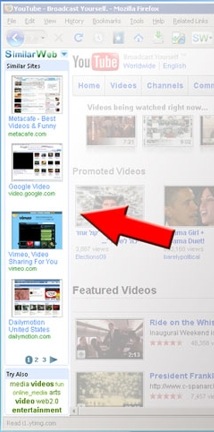
On the surface SimilarWeb is everything you’d expect from a discovery Firefox/IE add-on. Once installed it docks to either side of the browser and displays similar sites, displayed as thumbnails or as a list. Users can rate each result with a thumbs up or down, the latter removing the result all together. Users can also suggest a site by pasting-in a URL. This not only customizes the user’s own results, it also impacts global results for all users. If you don’t want to install the add-on but still want to see it in action, try SimilarSites which pretty much mimics the experience in a web app.
Or Offer, CEO, was visibly uncomfortable every time I tried prying details about their technology, but finally relented with some general explanations: The backbone of SimilarWeb’s technology is based on multiphase analysis, which in plain English means that there are several engines running in the background, analyzing websites based on different mechanics, metrics and workflows. These include: user browsing trends, user ratings, tag analysis, ecosphere analysis, semantic breakdowns, and automated background research.
The company claims to have mapped millions of sites, and adding tens of thousands daily. This means that it will always suggest other sites, regardless of whether the site the user is currently on is a popular one, or one much further down the tail.
Nothing of the above stands out particularly or sheds light as to what’s so interesting about this company. A technical due diligence may be what’s necessary to truly understand SimilarWeb’s edge. No matter how you look at it though, the company is doing what it needs to be taken seriously… It has amassed thousands of users in the three months since its launch. Dr. Yossi Vardi is an investor and they seem to have Sequoia’s attention. Must be satisfying after two year’s worth of coding under the radar.


Its difficult to see this product picking up enough value to be worth Sequoia’s time.
Nothing extraordinary. The niche for finding similar sites is very, very small. Most people tend to rely on the same old networks for all their news. Its only the info-hogs who would use this service.
On second thoughts, the company’s CEO has one of the coolest names I’ve seen in the business world
I agree that people usually go back to the same sites over and over again, but that is what makes this product so interesting – It will change how we surf the web, make it more associative and help people manage the great mass of info the web pours on you.
Looking forward to see how they develop it even more.. Good luck!
His middle name is Macon, as in “Or Macon Offer”
The CEO’s Hebrew name surely sounds amusing in English. The meaning:
“Or” – light (the one you see)
“Ofer” – deer (like bambi)
Good luck to SimilarWeb
cute idea and the execution here is the key (the technology here might be trivial). Going to Sequoia or any other VC might kill this small company (like other feature companies, they don’t really need a lot of money and can find some angels). This company doesn’t answer to the stupid VC mantra “a billion dollars company” but a cool company that needs to survive until it will be bought. Hope this guys will be smart enough not to be dazzle because of the Sequoia name…
I been using it for more then a month now,
It has become a part of my day to day browsing, makes it easy for me to do research for my work because of how it shows me where else I can go to find relevant data
It’s still a bit rough around the edges, but the results it brings are excellent, and it’s very easy to use
Is this kind of add-on really useful?
Seems to do the job, even better than some other companies in this field. Good luck guys!
Cool idea
I played with it and it looks like a great product!
I am familiar with this company, and the technology is really amazing! By mixing unique algorithms, and user inputs, they pinpoint sites which are always of interest and relevance! I’ve discovered many new sites using their tool and became addicted to associative browsing
keep the goodies coming!
I’m confused, how does this relate to Twitter?
I’m using this add-on on a daily basis, works great!
What’s their business model? Straight sidebar advertising or charging for the traffic they direct (making them biased)?
After trying the product I must say I’m a little disappointed – it lacks some real time (or close to real time) association. If I’m @ techcrunch reading about a company, I would like some related sites about what I’m reading not only about the website. (in Techcrunch you can see – readwriteweb, digg, google?!!!!..) Those results are the basic layer and it works OK most of the time. But and this is all about product design, I would like to know also similar sites to what I’m reading now – if I’m reading about Obama on NYT I wish to see similar article in Chicago Tribune and not the Chicago Tribune homepage .
Regarding the algorithm, it seems very trivial to mimic…
Thank you for trying our product, it is true that at this time we provide similarity to websites only, however, in the very near future We plans to introduce a feature for just what you are referring to.
Stay tuned
Dude, very interesting name
Why wait? To see articles related to the specific topics you are reading about you can use MashLogic right now.
We detect relevant terms on web pages and give you links to related articles on online newspapers, blogs, and Twitter.
If you are a Firefox user, you can install a TechCrunch Edition by clicking the MashLogic icon in front of Twitter and Facebook in the top nav bar.
I don’t understand what the startup is all about. Do you want to find similar sites about Obama? type ‘Obama’ on Google. Do you want to find video sharing sites such as youtube? type ‘video sharing’ on Google and you will find tousands of reliable similar sites.
Google will give you tons of crap and too much information. This thing is supposed to take searching and surfing to the next level.
And so far it looks rather interesting..
Oh come on. Site with miniscule traffic and user base gets (pays?) local reporter to write puff piece on TC in a last desperate ditch for investors.
“Sequoia Capital Israel, we’ve heard, is spending extra time looking into it.” Well now, I don’t suppose you heard that from the founders?
wish they would look at http://www.worstpizza.com finally!
I like it. I use the product, and see its value. I believe that this product will pick up significant market share, which means that it is a worthy investment by the VC.
works great and for a guy that is always looking for recipes to cook its a great tool !
This is an amazing product
As a business developer I find my self using the site every day to find similar companies and services
I must say, this is one of the neatest products I have ever bumped into. When you first install it you think exactly like some of the comments in this thread, you think there is no actual need for it and so on. At some point you find out your getting more productive in your surfing and it’s not just that. I had a theory that every person has its own permanent 10 or 20 sites he visits every day. well, that should change, because when you start using similarweb – it is perfectly provides you with a greater field of surfing, shows you websites you didn’t think your should check, even after you find something you wanted, you can always find similar results which most of the time expands your findings.
lol, Or macon offer LOL!
If their technology is that good, it may be the end of web rings, which were not that great to begin with. Good luck.
I bet I know why the CEO was visibly uncomfortable when discussing the technology. The most obvious way to determine similar sites is to crawl the web finding correlations between links on the same page, which, although probably quite effective, is also probably not legal because it is a repurposing of editorial content. Maybe Sequoia legal should look into this before forking over the dough.