Modeling The True Value Of Social Networks: 2009 Edition
by Michael Arrington on June 4, 2009

A year ago we modeled out the true value of various social networks based on the idea that users in high-value online advertising markets like Japan, the UK and the U.S. were worth more (financially speaking) than those in lower value online advertising markets. Facebook had recently become the largest worldwide social network in terms of users, but based on our model MySpace was still by far the most valuable social network.

We’ve now remodeled social network valuations based on current user numbers and Facebook’s most recent $10 billion valuation. The results are dramatically different.

Based on the original year-old model, if Facebook was worth $15 billion (their then-current valuation), MySpace, with far more U.S. users, was worth nearly $20 billion:

Our model takes Comscore data for available countries and regions. We’ve graphed each of 26 well known social networks with the data we have been able to collect. We’ve then calculated the average advertising spend (estimated by PriceWaterhouseCoopers in a recent report) for each person online in each of those countries. For example, in the U.S., the total 2008 estimated Internet advertising spend is $25.2 billion. We’ve divided that by the number of people online in the U.S. according to Comscore (191 million), to get an average Internet spend per person of $132. View the raw data and calculations here.

The U.S., by the way, is only the 4th most valuable market per Internet user, trailing The UK ($213), Australia ($148) and Denmark ($144).

We’ve then multiplied the average Internet spend per user in each market with the number of unique users each social network has in that market, essentially creating a “weighted average” based on the advertising dollars chasing users. If a social network has more users in the U.S., Japan, the UK, Germany, Australia, and other bigger advertising networks, they will have a higher weighted average valuation.

We believe this model is an effective way to rank various competing social networks. It bumps down networks like Orkut and Friendster who have tens of millions of users in markets with very little advertising spend, and bumps up networks with lots of users in higher value markets.

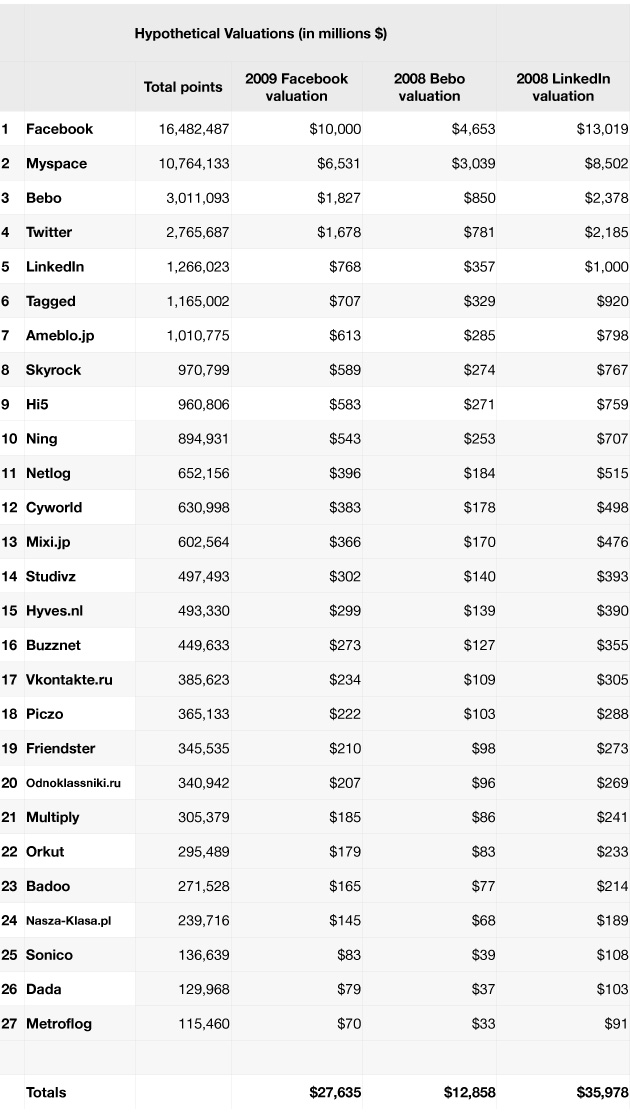
Based on this model, MySpace is by far the most valuable social network. Second place Facebook has just 75% of the value of MySpace (even though it now has more users), followed by Bebo (26% of MySpace value), Hi5 and Amebio. LinkedIn comes in at no. 11, at 6% of MySpace’s value.

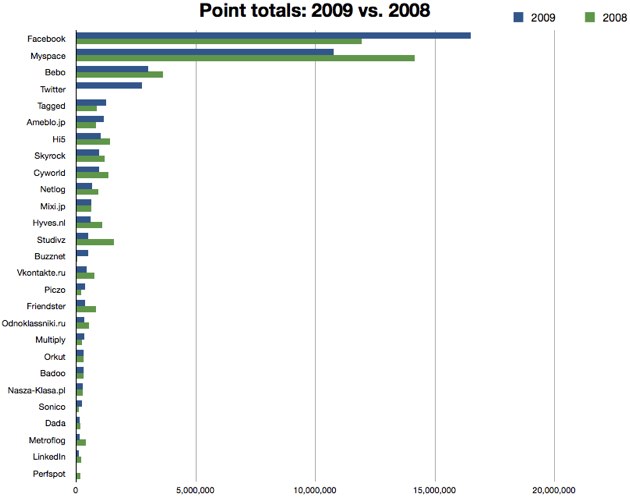
The new model takes into account the dramatic rise of Facebook usage over the last year, the massive recent decline in MySpace usage, and less dramatic changes in the other social networks. We’ve also modeled out the various valuations with the old Bebo ($850 million) and LinkedIn ($1 billion) valuations as pivot points. We’ve also added Twitter to the list just for kicks.

The bottom line: If Facebook is worth $10 billion today, MySpace is worth just $6.5 billion. Bebo is worth $1.8 billion, Twitter is worth $1.7 billion and LinkedIn is worth $0.8 billion. Facebook also accounts for 37% of all social networking value points in our model. Another way of saying this: If Facebook is worth $10 billion, the value of the entire social networking industry is $27.1 billion.

Lots of charts and graphs below. The full model is here if you want to look at all the data (I recommend zooming unless you have super vision). Thanks to TechCrunch intern Dan Romero for running the new model.
chart


Advertisement

Responses

Comments rss icon

  • Intersting that by this model, MySpace is most valuable. I thought it would be Facebook. Projections for 2010?

    • no…MySpace was way more valuable in 2008. Now, it’s only worth 10/16 of Facebook.

      • i guess 5/8 doesn’t look as good.

      • I don’t understand why MySpace is less valuable than Facebook now. It still earns more, no? Users mean zip if each bunch of users cost them money to support (hardware & programmers & sys-admins don’t come cheap)

        • because our model (and common sense) says so.

          • Hey Mike, I understand what you are saying – and I understand that facebook has seen huge growth – but common sense tells me that display advertising on social networks is becoming less effective and thus, less valuable.

            If facebook does not find the magic bullet they are so boldly searching for – and eventually has to turn on the massive display ad spigot to keep the lights on – it may turn out that they over played their hand.

            Your model (and a lot of other very smart people’s model) assumes that facebook will invent some magic monetization model that does not exist…and thats a pretty big assumption. You are counting on facebook doing something that even Google has not done…and I don’t think you are taking the proven lifecycle of these types of sites into account. The fact of the matter is, these types of businesses do not last forever…8-10 years would be a great run.

            Sometimes, in the real world, you have to look at the bottom line when you place a value on a company…everything else is pie in the sky.

          • After watching CNBC reports tonight. I beg to differ on your opinions of display advertising on social network sites.

          • A year from this these numbers will probably have to be reset again. Valuation is all about assigning a multiple based on growth prospects to future earnings. Thus, if we believe that Facebook can transition their user growth into the same type of revenue growth over time then it most likely is worth than Myspace which has declining usership.

      • what about the social network Ning and their many social networks?

  • I didn’t realize Friendster was that low on the chart

  • I don’t think Linkedin is even worth $0.8 billion. A lot of spam and clutter not to mention, not a lot of people are staying on the site.

  • Valuation models for social networking websites should take into account not just current earnings but future earnings as well. This would yield a non-linear relationship between userbase and value, since network effects give very large sites like Facebook more stability and very small sites less stability.

  • What about YouTube. All my h2s and Gs are On There

  • Why is perfspot using icons from istockphoto? Can’t they afford to pay a designer?

  • What no myYearbook?

  • Riiiiight… If Bebo was worth $1.8bn, then why wouldn’t AOL sell it at say a 33% discount of $1.2bn? AOL would make $400 million profit on an asset that’s proved to be pretty worthless to them.

  • how about chinese sites like xiaonei and qq?

  • It’s a good overview and things are probably in the right order, but LinkedIn is only worth $1B because they’re profitable and haven’t raised any larger rounds.

  • I wonder if we can create some better valuation by virtue of comparing expenses along with this data.

    Of course, it’s been said that some countries cost considerably more than they contribute… placing networks such as Mixi, CyWorld, and Hyves considerably higher up(homogenous, single, affluent country), whereas others would drop quite a bit.

  • how does this leave your beloved seesmic? just wondering…

  • Great study Mike!

    I’m surprised by the fact that some of the networks are way below than I thought.

    One question I have though;

    Perfspot has a $14 million valuation based on Facebook’s latest 10 billion valuation and they have only 23,567 users. I’m sure there are many little websites (I don’t want to call networks) on the internet with that number of users. Most of them don’t even get valuation of 1 million.

    So how do we give these valuations, we’re not just looking for the numbers right?

  • I am confused with the $132 internet spend per user. Is it a hypothetical value. It has to be… I have never made any purchase in fb nor any of my friends that I know of.

    Is the spend include ads of ad clicks ???

    • That number is derived from a) the total amount Internet advertising spending in a given country divided by b) the total number of Internet users in a country. That gives you spending per capita.

  • It makes a good blog post and interesting discussion, but it’s definitely the wrong way to value these companies. As a former Piczo employee, this valuation makes me laugh…and not in a good way. There may be some truths to these valuations for the top 5 (although the AOL folks would probably laugh at the Bebo numbers) but they make a lot less sense for the tier 2, 3, and 4 companies.

    • It depends on how much you value comScore data. It’s a model that makes smaller countries (in terms of population; many European countries) with high advertising more valuable than larger countries with very little ad spending.

      We used advertising spending because it is the business model for nearly all of these sites.

      • Yeah, I understand that you have to make some standard assumptions to put together a model like this. I just find it personally amusing because of the $200M number next to Piczo when I’m sure Stardoll paid a tiny fraction of that when they acquired the company. And I know firsthand how unmonetizable a large chunk of the installed base was. It’s tough schlepping ads to 13 yo girls – many of who don’t speak English.

      • Non of the ad spends for these sites are directly proportional to the bottom line, if these esitmated comscore aligned hypothesis figures where to account for some sort of break-even relation then there would be a certain credability in the calculations.
        From a business perspective there is no value without a return, show me the profit and loss.

      • Interesting analysis. But just adding up the comScore uniques for these countries undercounts a lot of traffic. For sites with a lot of international users — like ours (hi5), Orkut, etc. — comScore’s total WW uniques are 3-5X the total uniques used for this analysis.

  • I always thought bebo was tiny compared to facebook/myspace/twitter, obviously not. Interesting to see things change, I recently – few days ago – started using facebook ‘properly’ and whilst I’m not particularly found of the whole social networking idea, it’s a painless experience and I can see why it’s being favoured over myspace.

  • Interesting modeling although I doubt this is realistic and if anyone would shell out these amounts to buy these companies. Without taking costs and free cash flow into account, revenues don’t say much. I can make a Trillion in revenue and make a loss of a 100 Billion. Moreover, scale may not necessarily mean more profits. Your profit maximization occurs when your marginal revenue is equal to the marginal costs.

  • Nice study but some serious issues with the methodology:

    1) Most people have accepted that an advertising model will not provide profits – the reason everyone is waiting for the magic monetisation ideas from Twitter and FB.

    2) The more successful (revenue / user) sites are those that have focused on micro payments such as Odnoklassniki, SMSGupShup – DST will will bring monetisation skills to Facebook, while taking content and interaction ideas.

    3) Surely ignoring China (more internet uses than the USA) and India (more users than any European country) just because Comscore doesn’t go there is just very short sighted, there is a world out here you know…

    • 1) Facebook currently makes several hundred million dollars a year off ads.

      2) It will be interesting to see how Facebook Payments does now that it is live.

      3) Do you have a suggestion for a reliable source for Chinese websites?

  • A lot of these companies will now try to use your calculations to sell themselves. lol

  • Will chip in on China. Agree with Danny — leaving China out of this is out of touch. There are multiple social platforms that have successfully extracted value out of user interactions. Not necessarily SNS per se, the TenCent owned QQ instant messaging one is a good example of the freemium model. Somewhat dated but still relevant today: http://www.plus...e_QQ_Sample.pdf

  • Nice to see a standard market power law asserting itself (2-3 major players and a lot of noise).

  • nice chart..The discussion too is going nice..
    its intersting to know about the huge market value of face book and myspace..

  • How this model would perform with niche social networks?

    Luis

  • Shouldn’t a valuation include leader premiums, top-bottom-line multiples, price-earnings growth amongst the many valuation attributes & considerations?

  • The whole Social Network marketplace seems to be worth about $30bn – half as much as one dodgy Scottish bank.
    http://www.busi...-banks-ceos-out

  • Keen on the communities thoughts relating to using Comscore as the basis for much of these calculations. I know that in Europe their numbers are based on panel data and as such many nieched sites do not report accuratly as they are not accuratley represented on the panels.

    This is unlikely to impact the big players who are very broad in reach and who demographis cloasely match the panels, but could certianly under (or over?) report baseline user numbers in networks that have a more specific audience like Orkut (India and SE Asia) and Linkedin (corporate).

  • wheres you tube?

  • why do you think ads are the only way to monetize the network ? most professionals value their linked in network much more highly than students do their FB network. That’s why linked in’s valuation is higher – recruiters and companies pay them money for their services.

  • Netlog is way undervalued here. Come on USA…wake and smell the Europe.

    Also, if AOL could sell Bebo for 25% of what they paid for them, I’m sure they would.

  • too bad your analysis only accounts for ad revs, which makes the conclusions skewed, particularly for companies like LinkedIn

  • Any thought on Ning, they don’t seem to be in the model.

  • this approach depends on the theory that social networks are good at making money from advertising, but so far MySpace excepted (thanks to the content focus) they have been universally pretty poor at driving ad revenue. Thats why i would argue this over values them

    The money for social networks is in non advertising revenues

  • First off, great info – thanks for taking the time to put this together and share. After review, a question came to mind.

    Although you used an apples-to-apples approach in defining the valuation, the one thing I think would be interesting to incorporate is 3rd party usage.

    For example, there’s a slew of off-site 3rd party Twitter applications available and being used by people who aren’t registered Twitter users. I’m pretty sure there are 3rd party apps for other social network sites as well. This would then increase the actual user numbers.

    Point being is that if Facebook was valued at 10 Million, it would be nice to know if that valuation included non-registered users who access 3rd party apps. If so, then the same should be incorporated to value the other social networks.

  • Seriously? This data is almost useless, since you actually left the largest social network out. Facebook is the biggest? One of the biggest, agreed. You forgot a little social network called QZone. It hit the 200 million user mark back in March. But I guess Japan (which makes everything you own that China doesn’t) isn’t a major player right? Broaden your horizons and data a little.

  • - Did you remove Google, Yahoo, MSN, Ask revenues from the Internet Advertising Spend?

    - Did you by any chance account for the long-tailed distribution of the spending?

    It’s always interesting to do the analysis but not analysis is correct. Bad information is worse than no information.

  • This is terrible data at best, shoddy and self serving publicity journalism at worst.

    1) Comscore panels could never represent global audiences, nor B2B sites, which you probably know, so why would you even attempt to project them to global audiences?

    2) Where are fair representations of China, India, European sites? See first point.

    3) Your valuation model is absurdly simplistic and shallow. Total Ad Rev / Total US Subscribers * Inaccurate traffic figures? Really?

    4) Ad revenue is a terrible basis for valuation in the first place.

    • 1) We’re all ears if you think there is a better publicly available data source than comScore.

      2) comScore doesn’t have data for China.

      3) The model is (Total users in a country) * (Per capita advertising spending). This weighted model makes users in the U.K. more valuable than U.S. users.

      4) Advertising is the primary business model for nearly all of the sites surveyed.

  • This will definitely change in future because of growing markets world wide.. cant wait..

  • Interesting model, I am sure lots of them will change their revenue streams soon :-)
    The Ad´s pillar ist not enough!

  • MyYearBook is crushing most of the networks outside of your top 5 (according to Compete) and they didn’t make the list. MocoSpace is also larger than the majority of the sites on your list. Both of those sites get the majority of their users from the U.S. as well.

    • You should have started the sentence with “according to Compete” in ALL CAPS so readers would have known to move on to the next comment…

  • These kind of reports do ’sell the papers,’ but not to be disrecpectful or unappreciative, such reports are just one input at a moment in time.

    I have always believed that to truly value something, the average or mean of all the bids is a better indicator of valaution.test

    I am NOT trying to knockdown any company – I appreciate how bloody difficult it is to create success (because I have not achieved that level in life so far).

    Continuing with my thought, a better indicator of valuation of Facebook say, is not what the last buyer/funder offered, but the average or mean of all the completed/validated offers on the table.

    This number will be less that what is publicized for popular consumption, but I think it is more ‘representative’ of what the marketplace is thinking.

    The whole focus is on what the winning or accepted bid, while I think its best to ALSO focus on what other validated buyers bid.

    I understand that a ’seller’ needs only one buyer, and that inscribes the valuation in stone. But I propose a Change: that analysts, reporters and media ** ALSO ** try to find out and publicize how the other bidders who lost valued the bid.time

    (Of course, the seller has to and gets to decide whose bid he/she accepts).

    The true-undecipherableER valuation should be a range, because the Valuation is a function of both the price AND the terms or value addfunction , and while the terms are confidential, the Other valuations do give an indication, albeit opaque and undecipherable,undecipherable of the terms.

    A range will stand the test of time.

    If one applies this to real-estate, one could see its merit.

  • How in the world do you feel that Facebook with far less commercial areas (ie advertising) is worth more than MySpace? Or that twitter with almost zero revenue is worth more than LinkedIn?

  • Hmmm… two russian networking websites are in the list of 20. Interesting…

  • Does ComScore have enough data to add FriendFeed to the model?

  • It looks like the model is just based on ad revenue. Does it leave out subscription revenue potential? I’m thinking about LinkedIn’s business account options and whatnot. Wouldn’t additional revenue via subscriptions increase the valuations for the few sites that have implemented such features?

  • Funny enough, try to include google and yahoo as a social network… because they will quietly become more social.

    If YAHOO unveils something truly social it will open up a whole new business opportunity for them.

    And while we’re at it, where’s Ning?

  • Quite fun to see this valuation thingy reappear.
    For China’s mysteries, we have a very fair valuation based on… stock price. Tencent is listed in Hong Kong and its valuation is 21 billion USD. This is twice your figure on Facebook and is not vapory as it is based on stock price (= many people agreeing), which itself is based on uber-strong revenue figures:

    Last year Tencent made 1 billion in revenue (3x Facebook) and over 400 million in net profits (how many times Facebook’s loss?). This year they are on track to 1.5 billion and over 600 million profit (>580 million paid for MySpace).

    Your graph also leaves out Japan’s leading mobile SNS DeNA and GREE, both valued at over 1 billion USD on Japan’s Mothers stock exchange, with profit margins in the 50-60% range.

    There are also a bunch of problems that we addressed last year in the following post:
    “Valuating social networks – it’s not that easy (TechCrunch remix)” (http://www.plus...star.com/?p=126)

    We’re in 2009 and leaving out virtual goods business models is a clear flaw as ad-based models shortcomings have been now widely recognized. You should rename it “Valuing Western social networks based on advertising revenue”, which would be more accurate.

  • I love techcrunch, but I think you are really over simplifying this for the following reason:

    1) You assume ad revenue is the only source of income for companies forgoing subscription, items, and service revenue

    2) You assume all social site users command the same ad revenue. (LinkedIn business users are worth a lot more than a 14 year old teenager on facebook). Using average ad spend just doesn’t make a lot of since. Why not break it down by age group? Comcast has that data.

    Finally, I know you guys have to write something to fill your pages, but I expected more.

  • FWIW I found this interesting. Of course the model could be better, but given the data available, I think you guys did a great job.

    For me, it would be interesting to throw some non-social networks into the list, to see where they sit. Thinking Youtube, Google, eBay, Skype, Craigslist, etc. For most of these guys, you could even include revenue, since they’re public companies.

Leave Comment

Commenting Options

Enter your personal information to the left, or sign in with your Facebook account by clicking the button below.

Alternatively, you can create an avatar that will appear whenever you leave a comment on a Gravatar-enabled blog.

Trackback URL
Short URL
bugbugbug
