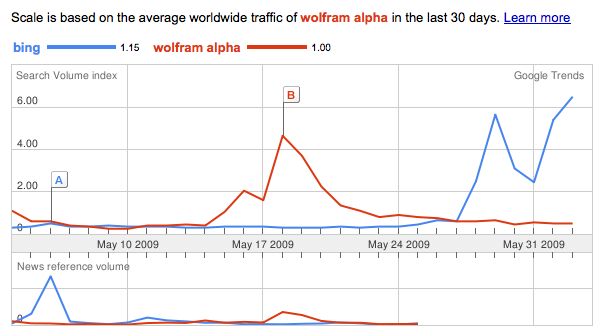
In the past month, we’ve seen some new search engine launches. Two in particular were able to generate a hype cycle of early positive reviews and excitement: Bing and Wolfram Alpha. One was launched by Microsoft, and the other by a startup. It is inherently not a fair comparison because Microsoft has so much more money to spend on marketing ($80 to $100 million is earmarked for Bing)> But most of the buzz so far has been generated by the respective launches with all of the blog and news coverage that entails.
So even though it is not fair, let’s compare the two, because it is instructive. There is little data on actual traffic or search volume for either site at this point. Instead, I looked at another proxy of interest: Google searches for both sites as measured by Google Trends. As you can see by the chart above, searches for “Wolfram Alpha” began to build up the weekend that it soft launched on May 15, peaking the following Monday, and then trailing off after that. It had a strong showing, and then interest waned.
Interest in Bing, on the other hand, started out just as strong with its unveiling last week. Then when it actually launched, interest shot up even higher. The positive experience many people had with their first search certainly helped.
Now, the question is: Can Bing keep up the momentum, or will interest in the latest search experiment fade away as fast as it did for Wolfram Alpha? That is where Microsoft’s big check book and that advertising campaign come in. You are going to be hearing a lot more about Bing overt the next few months: on TV, on the Web, and, yes, even on Google. Microsoft cannot afford to let Bing disappear from view.


As far as I can tell, MS hasn’t even started their marketing campaign for Bing yet. So really, so far, we’re nowhere near the peak of buzz surrounding Bing.
Pretty soon (I give it a week or two), we’ll start seeing blog posts about whether Google has an “answer” to Bing.
When was the last time Google had to come up with an “answer” to anything from MS (or anyone else for that matter) in web search?
“When was the last time Google had to come up with an “answer” to anything from MS (or anyone else for that matter) in web search?”
Indeed. Man am I glad someone dared to go up against the giant. Even if it’s another giant. A better Google as a consequence of Microsoft’s competition is a win on all counts.
In my mind, Google comes up with an “answer” within days, case and point being the launch of Wolfram Alpha. Thinking that Wolfram Alpha was better in organizing and structuring data (which it is), Google decided to show off Google Squared. Unfortunately it sucks. Here’s a Techcrunch article about it: http://www.tech...xclusive-video/
Google manages to evade competition by generating buzz on their own products, days or hours within the launch of a competitors products. Maybe thats why you’ve never heard of Google being challenged.
Microsoft have started sending emails(I think to those who have entered an alternative email address in their hotmail or live account) for marketing bing. Poor
The marketing push has begun. They have bing.com commercials playing during prime time TV.
I think Bing will be a little more successful with traffic if everyone with a Hotmail or MSN or MSN.com user searches with Bing from the homepage. MSN is the 2nd most visited site on the internet and all that traffic will flow directly to Bing.com
Bing is not that much different from Google at all. But there is one important difference, and that is the targeting. While Google targets everyone, Bing appears to be targeting mostly online shoppers (travel, shopping, etc.).
If Bing delivers better comparisons and results in their searches, users will increasingly being shifting from Google to Bing for their “shopping” related searches. This will cause a shift in advertising dollars from Google to Microsoft as well. Now we all know where 99% of Google’s revenues are derived from.
My 2 cents is that Microsoft is literally trying to steal only the profitable segment of Google’s search business and leave them all the “crap” traffic which does not monetize. Whether they will succeed is another story. But it is for this reason they are prepared to invest $100 million on advertising.
Khalid, On the contrary, I just saw a commercial on prime time for Bing last night(this was in the midwestern US).
Oh lol, my bad. I guess we are officially under the MS marketing assault…
How does this relate to twitter?
Hehehe.
Too funny, but MG TWIT did not write this article…
MG TWIT IS THE TECH CRUNCH TWITTER DOUCHE
And you’re just that anonymous commenting douche…
HEHE WELL THAT MG (MOSTLY GOOGLE BIAS) is a douche… is well known… he has a history of really really dumb and not researched articles… so far all but one..
I think they’re different markets. WA is great from a tech/science perspective. It feels very technical in it’s responses, and very accurate, but for very specific queries.
Bing, IMO, just has an incredible UX. It will do well because a lot of people will enjoy using it. It’s flow is streamlined and it’s very friendly. It may be a tad on the side of more complicated and cluttered, but that may just be relative to what most of us are used to (a’la Google).
Both will find a niche/market and do well I believe.
Wait, who’s Microsoft again?
This is going to change the way we work. Googling is a word in our vocabulary after Google search Engine, but now we probably could get anohter, however, its not easy, Google has gone so far…
Also, not relvant directly to topic, but very relevant to IT indutry and young people, there is a great Conference in Sydney for Young People! To register, visit,
http://www.acs....2009conference/
Don’t know if you saw it or not but microsoft came out with a interesting (can’t say it’s good) commercial for bing – check it out http://adage.co...ticle_id=137044
Definitely interesting. I think they should even try to put Microsoft name in there. Too many negative feelings. After a long time we have seen something from MS that is generating this much buzz.
Holy crap that is beautiful… nice commercial.
I’m really annoyed that MS is spending money on advertising rather than some form of product development, so that they would have something to offer besides a sidebar with pictures.
Momentum? Marketing? You’ve got to be kidding. They force-fed this service to IE6 users (aka the sheep of the internet).
At best it’s a reminder of who ultimately controls those systems.
I’m more included to say that any individual still using IE6 deserves what they got; and any IT dept forcing users to still use IE6 deserves whatever backlash they get.
I’ve seen a text ad for Bing on MySpace.
Wolfram Alpha is not a Search Engine
Whatever
Not whatever, your comparison is pointless. They cater to two completely different markets you hack.
I agree they are two very different animals altogether, but on a general perspective they both provide answers based on a specific search criteria, which allows us to label Wolfram|Alpha as a “search engine”.
The main difference is the number of answers provided by both. W|A provides always provides one answer as a summary, whereas Bing and every traditional search engine out there provides several answers for you to choose from.
W|A provides better results for queries that have only one answer, and because of this its usefulness is limited.
However, it is so much better at this than all other engines that it’s even unfair to compare. I foresee a time in which we will (finally.., for the first time in years) use more than one search algorithm based on the type of information we’re looking for.
Bing seems to be quite good at returning relevant information about transactional/commercial queries such as traveling, shopping, etc.
I am also quite in love with its preview feature.
I might have to agree. Its definitely not a search engine as we define them today.
The poster may be correct Erick. I’ve been doing some general research work this week and I’ve tried asking WolframAlpha a number of questions and I haven’t got a single answer out of it.
“how many game consoles are there in the world”
WA doesn’t know what to do with your input.
Found answers on both Bing and G.
“what’s the hottest chilli”
WA doesn’t…
Found…
“adobe air”
WA gives me some facts about adobe and their stock price
B and G take me to download Air
If you look at the example queries on the right hand side of WA, they aren’t exactly search queries. They can provide you with facts about known entities and that’s about the extent of it.
WA is more some sort of known data collation tool rather than a search engine. I’ve yet to find anything really useful out of it.
I agree, wolfram alpha is not a search engine. its microsoft encarta.
when i first heard the name “bing”, i was like, that’s an ugly name, but after i kept saying it, then it started to mean something.
As of wolframalpha.com, it’s just too long and awful for a search engine, i can’t even spell it without googling or “binging” it (still ugly).
i hope they rename it soon…!
Bet you really loved Kumo then.
Kumo sounds weird for a search engine too. It may sound better for Game site may be.
I seriously enjoy using Bing. I’m surprised to be even saying this. I did not think anything could pull me away. But Bing just feels better for some reason? Maybe it’s the added info they put on searches via mouse over or even the layout. I have no clue all I know is I’ve been using Bing over google for the past couple days. *shrug*
Wolfram doesn’t really return valid search results, but it’s fun to ask it random questions. Maybe the reason we don’t use Alpha is because we don’t know how to yet?
me too, I think I am going to change my defualt search provider…. can’t believe I am saying this
Wolfram Alpha is not a Search Engine
and Google has just introduced GOOGLE SQUARED =))
Wolfram Alpha is like an Almanac. It’s not a search engine. The web could use an almanac/scientific calculator and W.A. provides it. I’m just not sure how commercially successful that concept is. If W.A. wants to make money they may have to try going in some different directions with it.
One thing that struck me about Wolfram Alpha from a user experience perspective, is that it intimidated me quite literally. And I’m a smart person — or so my dog tells me. But I arrived at this search engine unaware of what to ask it. I felt like there was a wrong question. I felt like I needed to be careful, because I was asking it to compute something. I felt like I was responsible to give it something neatly computable — and a user should never feel like that.
Is a search engine really a search engine if you’re not sure what to enter? That’s why Google wins the day, to me.
Has anyone else felt like this with WA?
Wolfram Research has been around since 1987. How is that a startup?
Couldn’t agree more. It’s poor to get such basic facts wrong.
Right. Ever heard of Mathematica, TC?
That was the first thing I noticed too.
Well said Erick!
BTW, I consider WolframAlpha to be an absolute crap. It only works well with example searches they’ve presented. I’ve done maybe 40 queries on it and maybe 5 have given me something useful. It’s mostly a giant miss.
PS: From his Mathematica book:
About the Author
“Stephen Wolfram is the creator of Mathematica, and a well-known scientist. He is widely regarded as the most important innovator in technical computing today, as well as one of the world’s most original research scientists.”
LMAO!!!!!!! Self-delusional fool.
I think perhaps W|A was publicized (by its creators or by word of mouth, misinformed tech bloggers
, etc) as something it was not.
It is most definitely not a traditional search engine and it will not give you an answer to queries that are non-computational/statistical/historical.
So it should not be used as such. It’s just a place you go to get factual computations and summarized answers and for these uses it is actually pretty damn good.
Nonsense. I used it for KNOWLEDGE based searches. Stuff like: “how long does cat live” or “cat lifespan”. This is the precisely type of stuff that it should be able to do.
I suggest you give these searches a try yourself.
Finally, show me the searches that YOU found useful there (and are not on example pages or other people’s blogs). I doubt you’ll come up with more than 5.
“cat lifespan” gives the usual “Wolfram|Alpha isn’t sure what to do with your input.” reply… almost completely unusable. (I have an engineering PhD.)
Steven Marlin said…
I used it for KNOWLEDGE based searches
Knowledge based database grows? If the facts aren’t present in the Knowledge based then retrieval won’t find anything. Just exactly as if you don’t know anything about the subject of differential calculus (DC for short). Suppose you don’t know anything at all about DC, ie, the knowledge in your brain cells and neurons don’t have any info or facts about DC. If I ask you right now to describe to me how to test the continuity of a multivariable function F(x,y,z) which has 3 independent variables (ie, x, y and z) at an arbitrary point (x0, y0, z0), then you have no answer (ie, no retrieval) since the knowledge is not stored in your neurons knowledge database. But if you acquired such knowledge by doing some reading on the subject and familiarize yourself with it and after some days or weeks, you then fully grasp the concepts/facts about the topic/subject of differential calculus, where if we meet up again and I will repeat my question to you about the problem of describing the continuity of a multivariate function at an arbitrary point, then bingo, you will come back with an answer, because your knowledge faculty does indeed contain such facts/knowledge nuggets. Knowledge database grows over time exactly as how humans acquired knowledge from the external world. We just don’t learn how to program in one session, because it takes time to acquire them.
Falafulu’s post seems to answer it, as the life span of a cat isn’t in the knowledge database, it wouldn’t be able to find your answers.
You call my post nonsense, because you were not able to find this specific bit of information. You said I could not find 5 answers that weren’t in examples in blogs. Let’s see:
1.
“Circumference of earth in meters”
W|A gives me
4.007504×10^7 meters
Plus additional conversions in other units (miles, km, light seconds)
2.
“Birthdate of Wolfgang Amadeus Mozart”
January 27, 1756
Along with other date formats, as well as time that has passed since then in years, months, weeks, days. Also sunrise/sunset information of that day.
3.
“Distance from New York, New York to London, England”
3468 miles
Along with conversion to other units and direct travel times at speeds of sound, light, and aircraft.
4.
You’ll like this one:
“Tetrahydrocannabinol”
Gives me chemical formulas in several formats, 3D model, chemical properties, etc
5.
“Area of Galapagos Islands”
2663 sq.mi
Along with the areas of individual islands and conversions in different units.
6.
“Life expectancy of Nigeria”
46.9 years (2009 estimate)
Along with other facts about the country, such as population, population density, median age.
The message to take from all this is that we’re approaching a time in which we will use different search tools to find answers to different types of queries. Google or Bing or Yahoo! couldn’t dream of giving this kind of detailed summarized results to these queries.
For other types of queries, of course, traditional search engines have the upper hand.
For real-time searching it’s hard not to go with Twitter, although Google does a good job of keeping indexed data up to date.
Steven Marlin said…
Self-delusional fool
So, you call Stephen a fool without knowing his background made you really like a real fool. Such statement makes you look daft.
Stephen has published papers in reputable Physics Journals as Physics Review Letters and others and widely cited by other researchers.
Here are some of Stephen peer review publications in the field of Particle Physics.
If you can understand a single publication or topic from Stephen’s list, then you’re Ok, ie, you’re not a fool. However if you don’t have a clue at all to what he has published which I believe you are, then I will crown you the title of being an undisputed fool commentator here.
Stephen Wolfram’s last peer reviewed article is in 1980s! 1980s!!!!
And he calls himself “widely regarded as the most important innovator in technical computing today”. Laughing my f*cking ass off! regarded by WHOM? His staff?! People whose checks he signs?!
NAME ME ONE CREDIBLE SCIENTIST WHO CONSIDERS STEPHEN WOLFRAM “the most important innovator in technical computing today”. JUST ONE, Falafulu Fisi!
If you don’t get W|A that’s fine, no need to bash Stephen Wolfram’s reputation within the scientific community.
I agree the audience for W|A is narrow, If you want to look up content on web pages go for it.
No one said to try and use W|A instead of Google, it is really articles like this that encourage the asinine comparison.
All in all this is about as relevant a conversation as debating thesaurus vs dictionary.
Yes, peer reviewed from the 1980s but it doesn’t mean you can understand them. Too difficult for the neurons in your brain to comprehend those topics and that’s fact. Some of the publications that Stephen did in the 1980s are still evolving such as QED, pioneered by Physics Nobel Laureate, late Prof. Richard Feynman.
Stephen Marlin you talked like an idiot/fool or one who is daft. I challenged you to read Stephen’s publications and see if you understand them because you derided a man by calling him a fool, who himself has gained the respects of individuals who are have monumental contributions to science. Late Richard Feynman, the legendary Nobelist in physics called Wolfram “astonishing”.
By the way, what’s your definition of technical computing? Technical computing is mathematical computing which is heart & soul of what Physicists/Mathematicians are doing everyday. I’ll go further. Feynman first proposed Quantum Computing in the early 1980s and it is one of the hottest topics in technical computing of today and for future generations as well. You need to understand Quantum Mechanics first to be able to even understand the most basic of quantum computing. QED is directly applicable in in quantum computing.
If Nobel Laureates such as Prof. Gell-Mann, & Prof. Feynman were impressed with Dr. Wolfram when he was at CalTech, then who the fuck are you to deride who have contributed to civilization’s knowledge/technology?
PS : Look up on the internet Richard Feynman’s letter to Stephen Wolfram, which is available if you Google, ” Feynman’s letter and Wolfram”.
Give respect to man and stop this derision because he is in different par to Twitter founders, Digg founders or some of those Web-2.0 entrepreneurs.
The biggest problem is that WA is geared towards the academic community, not the general populace. Wolfram is indeed highly respected as an important innovator in technical computing *within the academic community*. Sadly, I think the ivory towers have been a little too comfortable and that WA shows just how out of touch with the “real world” high-level academia is.
Bing is not that good, i think.
I don’t think Wolfram Research is a startup.
isn’t the Bing traffic due to MSN sending it over from Live search?
bing gives better porn search results what do you expect
are you sure you weren’t on bang.com? or f-ing.com?
Neither looks like a google-beater. I’m not holding my breath.
I wish you would.
+1
I’d honestly like to try bing more often, but the convenience of search built into Chrome’s browser is hard to overcome.
*a few minutes pass*
Oh hey, I changed the default search! (der) We’ll see what a Bing life is like!
Here is what everyone is missing: the vast majority of people only demand “decent” results. For anything. Search, food, sex, car insurance, you name it. Oh yeah, and it’s those people who are clicking on the ads too. For that reason alone, Google has nothing to worry about. Until a groundbreakingly USEFUL improvement in search is made (which might be made by GOOG anyway) they own the game. Then again, Obama could always break them up. Ridiculous you say…. so was a black president a year ago.
this is awsome.. wiki is pulled in to bing, and then adds navagational bar.
http://www.bing...&FORM=Z7FD2
Hmm… what should we make of the fact that GTrends was used to do the measurement? I like Bing but MS has a long way to go before the’ll make a dent. I love wolfram…. I think their approach brings a completely new perspective to the mix.
Went on Alex and checked out cuil.com stats as well…suprisingly the search engine is holding at about 13k rank. I thought it would have died by now.
i’m still waiting for voice recognition
I haven’t had any positive experiences with Bing.
I have a feeling tat bing can become the next google or at least challenge it over the next few years
Bing’s success is purely depending on marketing.lets see how they do it
i tried Bing, and it is nothing, NOTHING new… I feel that the screen is too cluttered with results, and half of them have nothing to do with what I was looking for…
Btw… the way their forced this crap to IE6 users, just shows HOW Microsoft thinks… It will SURELY backfire at them..
Bing can succeed by not being awful. If it can avoid awfulness then millions of IE users won’t make the effort to change their default search engine or go to Google.com for searches. If it can retain users then Microsoft can afford to start paying for user acquisition for Bing.
Bing feels pretty good. It performed poorly today when I searched for a few products to purchase, but I’m guessing it’s good enough (for now) to slow the IE-user exodus and let MS start purchasing some market share.
I tried bing search engine. It is similar to msn search engine. I hope they will improve andd make it better.
google is maybe still better
Microsoft has been sending their bots out over more than 18 months. So Bing has collected a large amount of data.
Regarding the article, how valid is it to compare the two apps? As the previous comments show, we can debate endlessly about the merits of one or the other.
WolframAlpha is a “computational engine.” Bing is a “search engine.” Search for these two terms in Google and you get 58K and 274M results respectively.
Thus, Erick compares apples and oranges. It is hardly surprising that interest in Bing exceeds that in WolframAlpha. Indeed given Microsoft’s marketing machine (to which Erick refers, but misses the point), it’s amazing how much interest was generated by WolframAlpha compared with Bing.
In any case, Erick makes an unfair comparison and does little to elucidate the utility or features of either app, IMO.
i don’t think wolfram categorizes as a search engine yet. its more of a scientific version of answers.com.
Search Engine is a really strange land… a lot of millions dollar for “strange” products (who said Cuil?). Do you know Mnemoo ? Take a look here for the demo: http://www.mnemoo.com It’s interesting because it is a search engine built by a micro startup with a budget of 1/100000000 of common budgets for SE. So do you think that the technology value was 1/100000000 respect search engine giants, or there are other factors ? And which factors are really important to compete ?
Until one month ago i thought that a good budget and cutting-edge technology was enought, now i think that we have to find hidden factors of search engine market.
If Google is a search engine, then Bing is a decision engine, Wolfram|Alpha is a computational engine, and I guess Wikipedia is a knowledge engine.
Hey, excellent choice in post titles, if I do say so myself. They say that imitation is the highest form of flattery: http://tinyurl.com/ccownx
Still calling WolframAlpha a search engine? Get a clue.
Set your browser’s search box to Bing and give a try for a while (not just a day or two).
It is a good enough engine with some great features. Yes, it needs some tuning and improvements abut unless you are a Googler, your interest should be that Bing will gain market share and that Google will have some competition.
>>>It is inherently not a fair comparison because Microsoft has so much more money to spend.
I disagree, I say, it’s not a fair comparison because Bing is a search engine and Wolfram is some kinda sophisticated mathematical quantitative derivitive analysis algorithmic calculus floating point quantum mechanical blah blah blah….
It’ll be interesting to see how the competition between Bing and Google actually turns out – two giants facing off. I don’t think Bing has actually gotten to the meat of its marketing efforts, so there’s a chance it might actually give Google a run for its money. It’s just sad that startups (whether Wolfram was meant as a search engine or not) probably will find it more difficult to compete against giants of the industry.
The purpose of bing and wolfram are quite different. So there is no point of comparison at all!
I have to agree with the general opinion here that the two don’t really deserve to be compared, even if it’s just about the popularity of their launchings. I think what this really points out is the evolution of “search” (maybe deserving to be loosely used now days) as a whole. There are so many niche places that handle certain areas of expertise and ultimately, if users want the best results for a specific topic, that’s needed today.
Eventually. I think actual search engines are going to lean toward being tops in specific search topics to ensure it gets traffic no matter what. Today’s search field is ever-evolving, I think that’s why you see success in meta-search engines like http://www.eZanga.com which are trying to gather the most relevant results from other engines and present them to the user.
Google complained that IE gave preference to Microsoft sites, so Microsoft removed that preference.
Why isn’t there a preference in Chrome for Bing?
And why does Firefox favors Google? Probably because Google pays it money that accounts for 85% of its budget. So Firefox and Mozilla are not impartial.
Why does Google always announce new products on the same day as other companies announce their new products:
On the day that Wolfram Alpha was announced, Google announced Google Options (I think that’s what is was called) on April 29.
Then on the day that Microsoft announced Bing, Google announces Wave.
I guess Google likes to steal other company’s spotlight. Very telling about the odd mindset that is Google.