Live from the RealTime CrunchUp »
Google Wave Drips With Ambition. A New Communication Platform For A New Web.
by MG Siegler on May 28, 2009

google_wave_logoYesterday, during the Google I/O keynote, Google’s VP of Engineering, Vic Gundotra, laid out a grand vision for the direction Google sees the web heading towards with the move to the HTML 5 standard. While we’re not there yet, all the major browser players besides Microsoft are aligned and ready for the next phase, which will include such things as the ability to run 3D games and movies in the browser without additional plug-ins. But Google wants to take it one step further with a brand new method of communication for this new era. It’s called Google Wave.

Everyone uses email and instant messaging on the web now, but imagine if you could tie those two forms of communication together and add a load of functionality on top of it. At its most fundamental form, that’s essentially what Wave is. Developed by brothers Lars and Jens Rasmussen and Stephanie Hannon out of Google’s Sydney, Australia offices, Wave was born out of the idea that email and instant messaging, as successful as they still are, were both created a very long time ago. We now have a much more robust web full of content and brimming with a desire to share stuff. Or as Lars Rasumussen put it, “Wave is what email would look like if it were invented today.”

Having seen a lengthy demonstration, as ridiculous as it may sound, I have to agree. Wave offers a very sleek and easy way to navigate and participate in communication on the web that makes both email and instant messaging look stale. The much better comparison is coincidentally the company started by another group of (former) Googlers, FriendFeed. But Wave is a different product for a number of reasons, and seemingly has loftier goals — all of which I’ll touch on below.
google_wave_snapshots_inbox

Features

During our demonstration, the Wave team kept reiterating that the product is still basically in its infancy. While it was born out of an idea Jens Rasmussen had in 2004, it was placed on the back-burner (while he and brother Lars got busy building what would eventually become Google Maps), only to be resurrected in 2007, and finally set free for internal testing only a few months ago. The reason Google kept reiterating this is because the feature set as it exists right now is just a sliver of what they intend it to be eventually. That said, there’s already plenty to do.

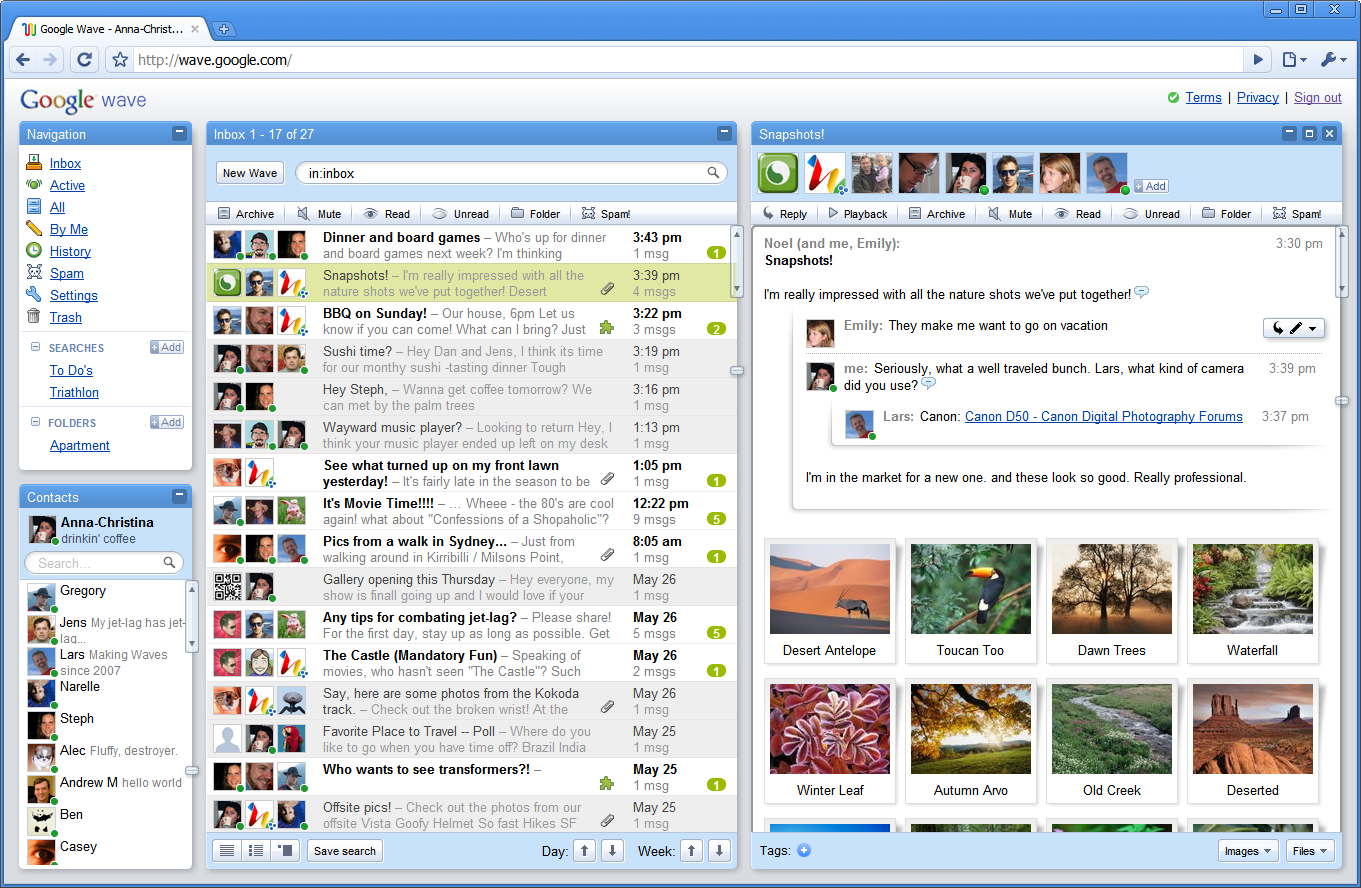
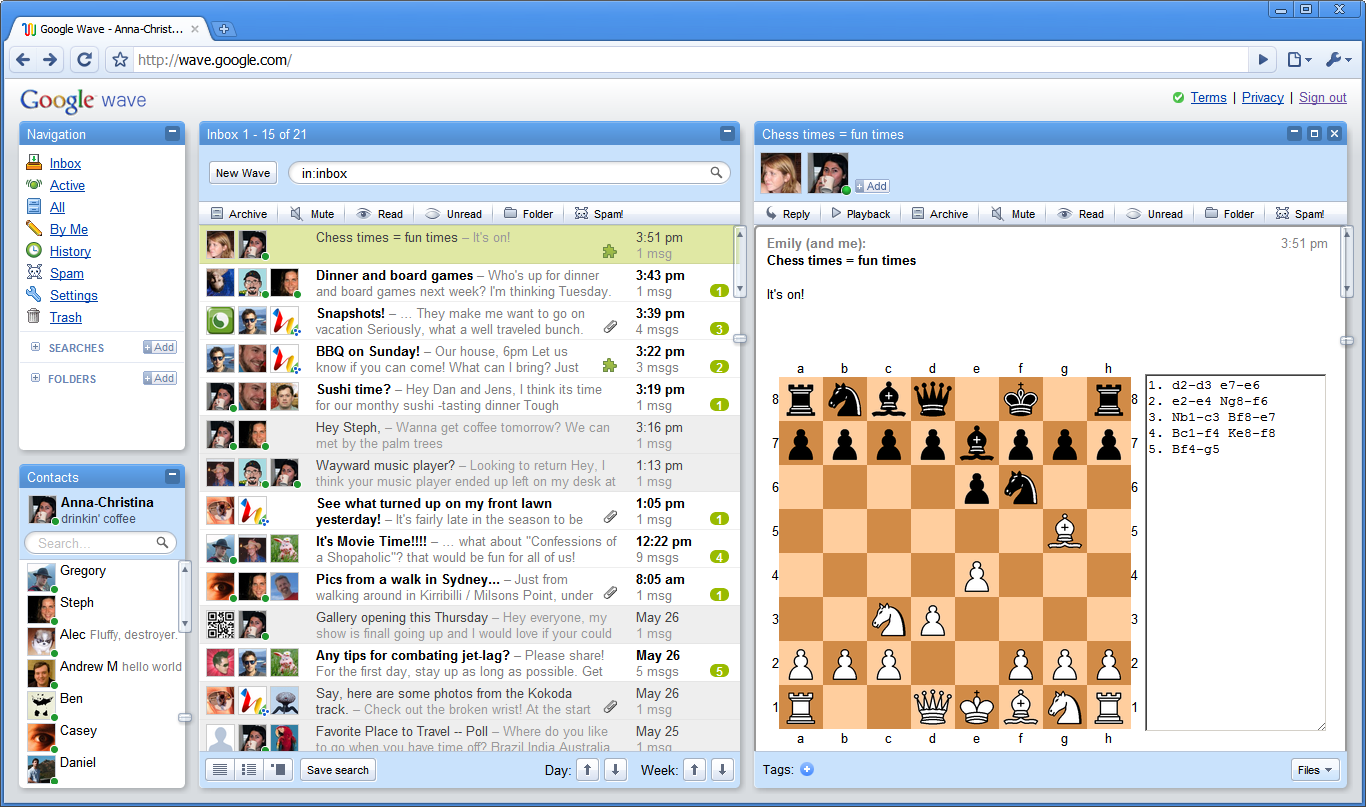
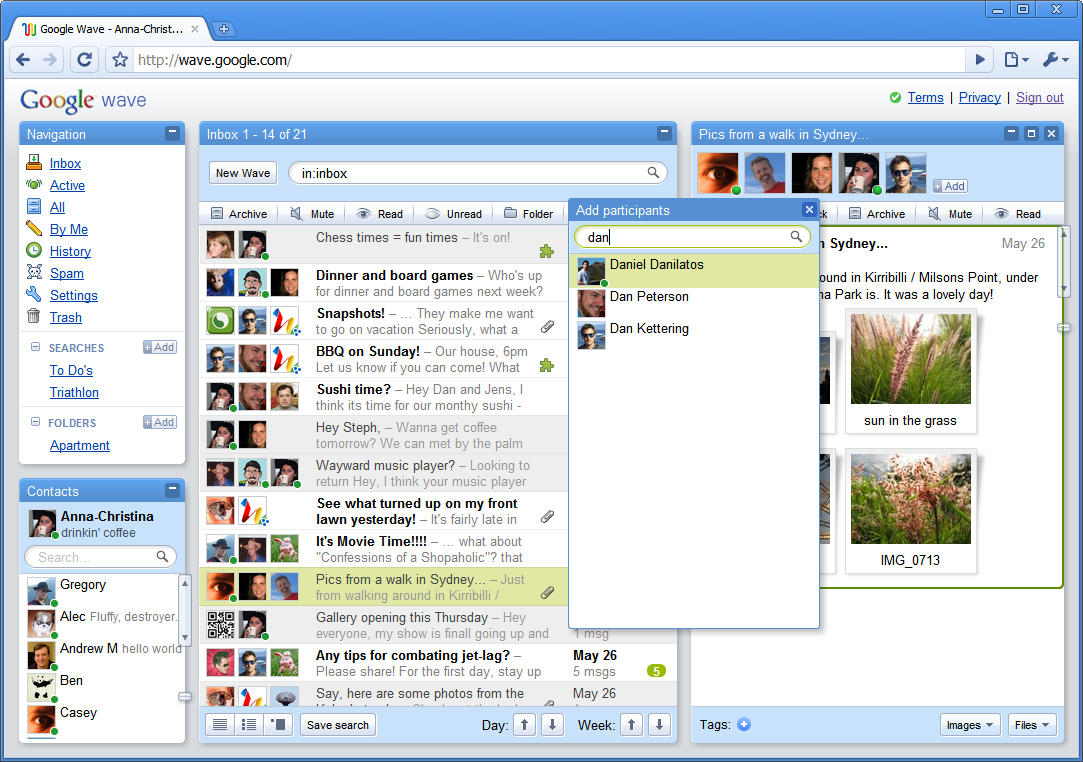
Wave features a left-hand sidebar “Navigation” and a list of your contacts, from Google Contacts, below that. But the main part of the screen is your Wave inbox. This looks similar to what your Gmail inbox looks like except it feature the faces of your friends who are involved in each thread. There are also number indicators signifying if there is new content in that thread. This is an important distinction from Gmail — it isn’t just about new messages, there can be any kind of new content in these waves.

Clicking on any of the wave threads will open another pane to the right of the inbox that shows that wave in its entirety. Let’s say one wave is a message from a friend and you want to reply to it. If they’re not currently online, you can do it below their message just as you may in Gmail. Except there’s no bulky new message creator to pop open, you simply start typing below your friend’s message. But perhaps you want to respond to a particular part of their message — well you can do that too simply by starting to type below the part you’re replying to.

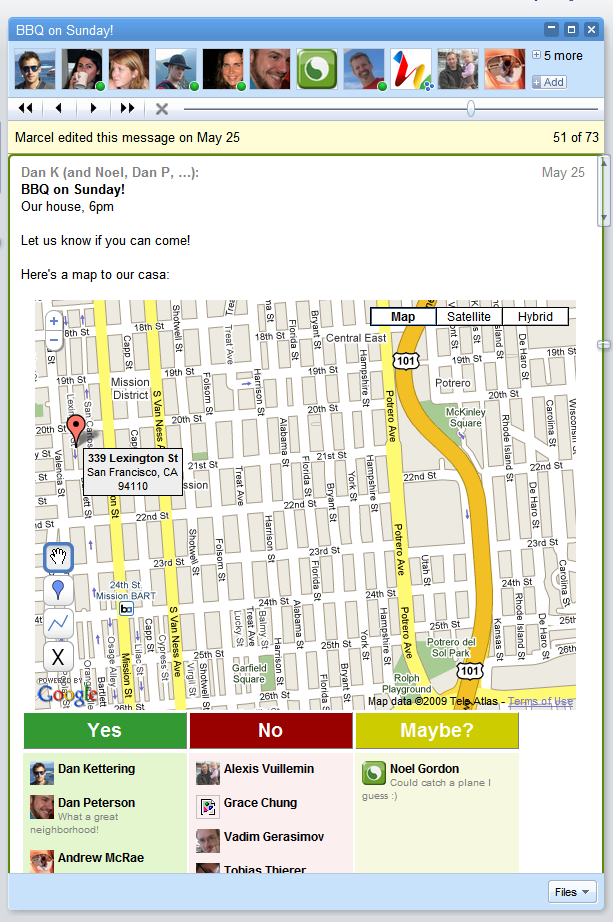
Maybe you want to add another friend to the wave. You can do that by going over to your contact box and dragging their picture into the wave. This is where things really start to get interesting. If that friend wants to get caught up on what everyone else in the wave has already been talking about, they can do so by using the “Playback” feature. This is sort of like rewinding the wave to see what has happened in the past and you can watch it progress through its changes.
google_wave_concurrent_edit

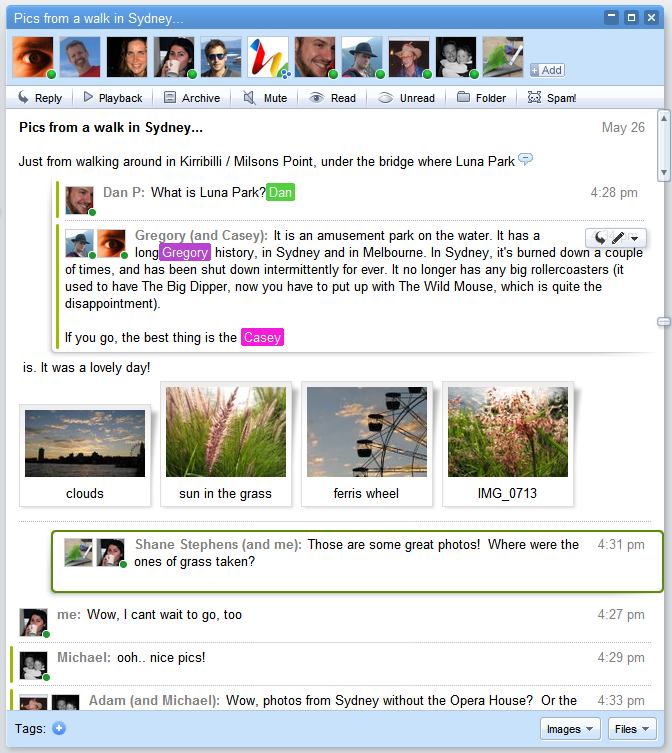
But if two of the people involved in the wave are online at the same time, you can talk to each other in real time, all in the same wave. Simply start typing, and your friend will see words as you enter them, and vice versa. This is the element that’s like instant messaging obviously, but the key is that it’s just a small part of what potentially makes up a wave conversation. And if you don’t like the idea of real-time communication where the other person can see what you are typing as you type, you can enter a “Draft” mode to hide your words until you’re ready to send them.

And say there is one person in a multi-person thread that you want to message privately. You can easily break-off a private conversation in the wave. Obviously, only you and the other recipient would be able to see this message, but for the both of you it would remain in the flow of the wave itself, keeping it in context.

But Wave is hardly just about traditional styles of messaging and replying that we’ve become accustomed to with email and IM. You can also edit things wiki-style with concurrent group collaboration. As anyone who has ever tried to group-edit a document on something like Google Docs knows, this can get tricky fast. But Wave offers a nice UI and real-time edit updates to ensure that even a few people editing something in a wave don’t step all over each other. When someone is editing something, you see their name outlined by a brightly colored box next to the edits they are making in real-time. If you get confused, you can just use the Playback feature I described above to jump around and see the edits.

And from here we go much deeper. Say you want to share some recent photos on Wave, if you have a browser with Gears installed, all you have to do is drag and drop the pictures right into the Wave window. It’s worth noting that this is the one Achilles heel keeping Wave from being fully functional with the “modern” web browsers (Firefox, Chrome, Safari and Opera) without any additional add-ons. (”Modern” is Google’s passive aggressive way of calling out Microsoft’s Internet Explorer.) Google says it would like to see such functionality added to the HTML 5 standards because it really simplifies this type of sharing.
google_wave_yes_no_maybe_inbox

And it’s pretty damn cool. If you share pictures in a wave thread with several other people, from the moment after you drag the photos into the wave on your end, your friends can see the thumbnails of them on their screen. Everyone in the wave can collaborate to change the titles of the pictures, and you can view things like a slideshow of the images.

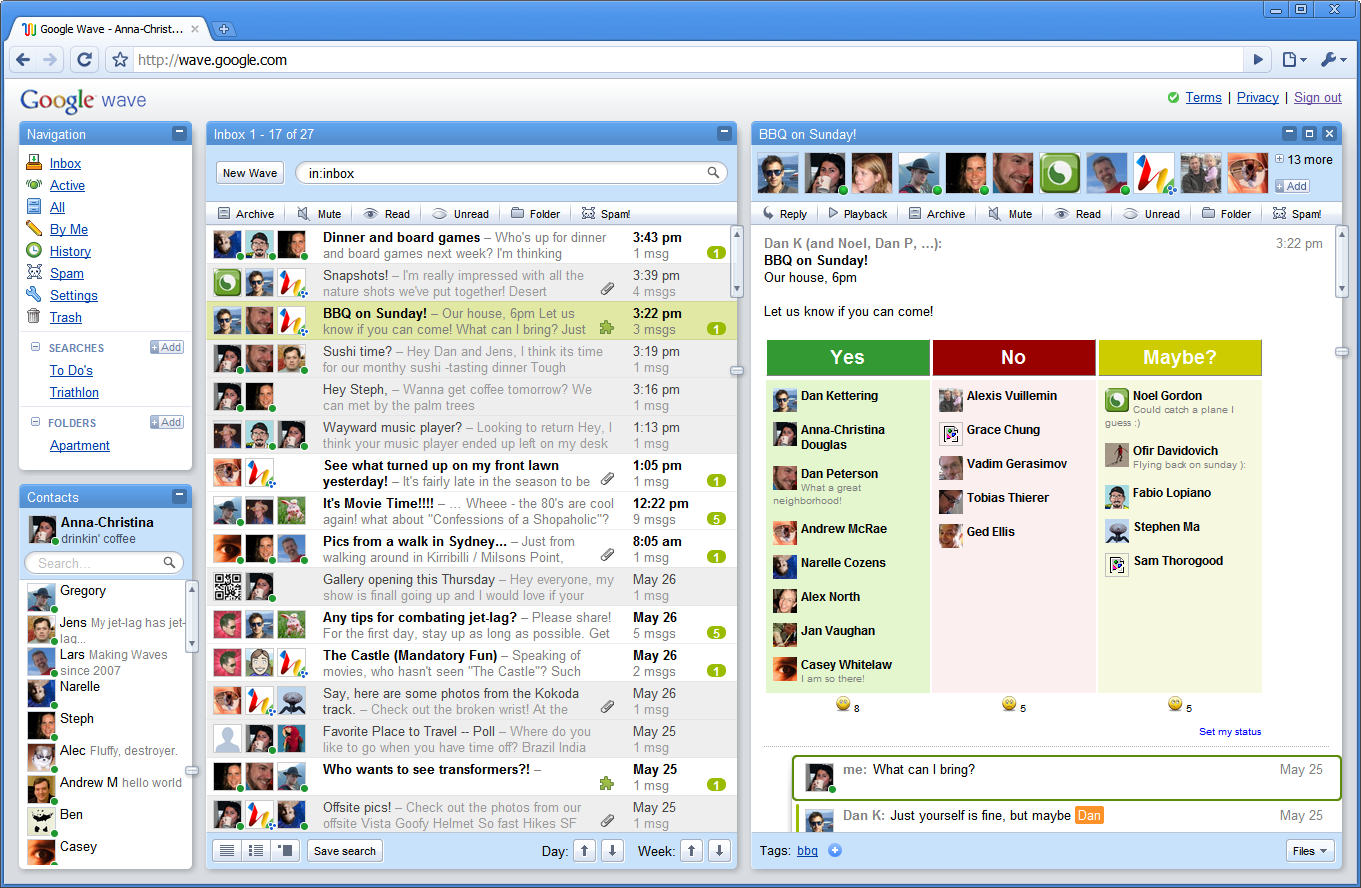
But pictures are just the beginning. Other example of things you can share in Wave include Google Maps (that you can edit), games, event invitations, and more. And those are just the examples the Wave team itself has thought of. Which brings us to the next point of Wave.

Wave As Web Communication

Google isn’t just thinking of Wave as another web app that it creates and you use on one site — it wants you to be able to use it across all sites on the web. Say, for example, you have a blog. As a post, you could share a wave with the public and allow others to see what you and the other people in your wave are doing. And these visitors to your blog could even join in as well right from your blog, and all the information would be placed right into the original wave.

This could work a few ways. Either you could enable anonymous collaboration on the wave on your site, offer users the ability to sign-in with a certain method you already have on your site, like a comment user name, or they could sign in and interact with their Wave/Google name. We asked about using something like Facebook Connect as a method by which you could edit a wave, and though Lars Rasmussen said they hadn’t yet worked on anything specifically for such functionality, they are very much thinking about it — though you can be sure that Google would prefer Friend Connect.

Waves can also be published as their own entities on the web. This would make them and their content indexable by Google’s bots. But the Wave team is careful to note that if something is published to the public on the web, there’s a big indicator of that within the wave that you may see in your main Wave pane.
google_wave_inbox_chess

And it’s not just blogs that Google wants Wave on, it’s pretty much any type of site you can imagine. And for a lot of different uses. For example, plenty of companies user some type of management system for communication beyond email or IM. We use Yammer, and when I was with VentureBeat, we used a FriendFeed private room. Yammer is good but it is just basically Twitter on your own system. The FriendFeed room is much more dynamic, but FriendFeed hosts that. Wave could offer the best of both worlds, and they’re all for companies or even individuals hosting Waves on their own servers.

That’s one of the keys to this entire idea. Google doesn’t want Wave to be another one of its apps, it wants Wave to be a communication platform that it may have started, but flourishes all over the web in a bunch of different places. Which brings up the next point.

Developers, Developers, Developers

Gundotra, who used to work for Microsoft, cited Bill Gates’ early insistence on having a robust developer community as one of the keys to the success of Windows. (And we all know what current CEO Steve Ballmer thinks about developers.) That same emphasis on developers is helping newer platforms like Android and the iPhone grow. And if Wave is to be successful, the entire team knows it will once again be because of developers.

While the Rasmussen brothers and Hannon, along with some 50 developers now working on the project at Google have built a very intriguing framework, it is just a taste of the potential of Wave if the development community embraces it. On Friday, Google will open Wave’s APIs to developers to let them have at it. The hope is that in short order, there will be a ton of gadgets, extensions, mash-ups and interesting sites all built around the Wave concept.
google_wave_map_yes_no_maybe

The idea is to make the system as open for adoption as possible. The team wants to see Waves created by someone communicating with Waves created by someone else. “We want it to be an open system like email. We want other services to build Wave services even in competition with Google,” Lars Rasmussen told us.

And with that in mind, Google plans to open source Wave. This will be the third phase of Google Wave. The first is Google Wave, the product, which Google creates, works on and eventually releases to the public as a web app. The second is Google Wave, the platform, which we outlined above as a system in place for developers to get involved in and create things for. But the third aspect is Google Wave, the protocol, which is its existence as a web communication platform. Find out more at the Waveprotocol.org site.

Because it will be open sourced (as Google gets it ready for a public release), it won’t be just Google that is in charge of what it becomes. As it has been doing with Android, it will largely be the development community that dictates where it goes. Or, at least, that’s the hope.

A New Web

So, if you’ve read this far, you’re probably thinking that Wave either sounds great or you’re confused as to what it exactly is. It really is one of those products that you have to see in action to understand. Unfortunately, unless you’re a developer, you’re not going to be able to see it right away. As we noted at the beginning, Wave is still in its early stages, but Google sees enough promise in it that it wants to get the developer community involved as early as possible — and that’s why we’re seeing it launch at Google I/O.

It’s also important to note that Wave is very much centered around the key fundamentals Google is focusing on with HTML 5: The canvas element, the video element, geolocation, App Cache and Database and Web Workers. You can read more about those on O’Reilly Radar or in our live coverage from yesterday, but one of the keys for Wave will be the Web Workers. This capability allows you to run background processes outside of the browser so it doesn’t slow to a crawl which running very rich apps — which Wave is.

Web Workers helps turns the browser into a more full-fledged launch pad for the next generation of web apps. That was the main point of yesterday’s keynote and today’s provides the best example thus far of one of these new-style apps in Wave.

It’s a really interesting concept, one that you really do need to see in action. It’s ambitious as hell — which we love — but that also leaves it open to the possibility of it falling on its face. But that’s how great products are born. And the potential reward is huge if Google has its way as the ringleader of the complete transition to our digital lives on the web.
google_wave_inbox_add

Update: We’re sitting in the day 2 Google I/O keynote where the team is showing off Google Wave. There are a number of impressive features that we didn’t even go into (yes, there’s that much to this). One of my favorites is that not only is search real-time in Wave, but it’s really live. For example, if you remove an ‘e’ from “Here” it will disappear from the results for that word. Likewise, if you add the “e” back on, it will pop up again — instantaneously.

Another great feature is the advanced spell checker that not only looks through a dictionary for spelling, but looks for context in your sentence. It’s crazy to think that this could work, but it does as they’re showing it off.

And yes, Wave will work with Twitter. The team itself created a gadget for it that they call “Twave” that brings in tweets from your stream, complete with your contacts’ Twitter icons. You can respond to these tweets from within Wave and they will go back to your Twitter stream. But the best feature is Twave’s search feature which scans Twitter in real time and updates live when new results come in. You can use this to track anything you want in real-time.

Now the team is showing off a wave that can translate to other languages in real-time. Again, impressive.

The demo at Google I/O has just ended to huge standing ovation. If today is any indication, this is going to be big.

Update 2: And here’s an interview we recorded with the creators of Google Wave. Hear them explain the product in their own words.

Update 3: And here’s our coverage of the post-keynote press Q&A session.

Update 4: And finally, here’s a video of the full demo from I/O today. You’ll want to watch this if you’re interested in Wave.

Advertisement

Responses

Comments rss icon

  • I wanna play with it.

    • Yet again, MG = Mostly Google.

      Google Wave will be yet another Google initiative that won’t fly.

      • Siegler is one of the best, if not the best writer TechCrunch has ever seen, his posts might feauture on Google or Twitter a lot, and that’s because that’s where the news is coming from. Deal with it, or don’t read it.

        I commend Mr Siegler for this once again brilliantly written and insightful article.

        • I second this, he may be a Twitter whore but damn good reads!

          • i read for 2 mins. still couldnt make out what is this goog wave. give the definition in first paragraph, dear MGS.

        • Easy man, I actually agree with the comment. I am sick of this guy writing about Google and Twitter all the time, TC is getting boring now and becoming more like the AP or any normal news outlet.

          • actually prob with this guy is always writes about currently popular / hyped things. He should let others in TC to cover current in thing, should not hijack all popular stories.

        • I totally wholy agree with you Derry. I praise Mr Siegler higly for the things he has done and his profound insight in the internet scene.

          This idea will be grabbed by everybody, I wanted this for ages. I’m glad somebody is working at this. I don’t know where the world would be today without the cheritable work of Google, Facebook and Twitter. I hope I could somehow repay them some day.

          Catherine Dumbaz

      • Yeah this is big news, Twitter stories are boring but this is actually huge news.

      • What a strange, false thing to say: ‘another Google initiative that won’t fly’. Most things they touch fly out of this world: Google Maps, Chat, Mail, Android, the Search itself?

        I wonder why you would write such a thing?

        • Maybe, he is working for Microsoft and is panicked, disgusted and put to shame after Google’s easy and light wave poo-poohed their Bing.

          Or maybe, this is the once-upon-a-time man of the moment, Steve Ballmer himself

        • Orkut, Google Answers, Google Videos (no, not Youtube), Google Catalog, Google Print Ads, what’s that short lived avatar world they tried?

          The point is they create a lot of products, some work, some don’t. They also buy a lot of products that sometimes don’t go off the shelf. And “out of this world” for some products you detailed is a bit much, for instance the maps system was initially used by some Germany company but their map was tiny and their reach was not that far – that plays a huge deal.

          Don’t know about Google Wave, I’m a little worried about typing and checking what I typed before I sent it. Don’t see myself using it in a work environment.

          • watch the video. the guy constantly says he can’t spell. Not a problem.

            I can TOTALLY see me using this in a work environment.

          • Just because you don’t use them doesn’t mean they don’t fly.

            Orkut is very popular in Brazil (and somewhere else), google answers often appear in search results (at least for me) (maybe a little less than Yahoo, but still), video doesn’t need to fly since they have youtube anyway ;)

            But, generally, those products have a competition, unlike the brand new wave.

            Man, I can’t wait to see it in action. And I too see how it fits my internet life.

          • Moron .. you can turn real time chatting off … watch the video

          • Since when is dreaming big and reach high a bad thing? The fact that they swing out all these creative ideas is a good thing, if some of them flop- so what. At least they are innovative attempts.

      • Is this idiotic comment a joke? Wave is one of the most impressive things I’ve seen come from ANY company in a couple of years. I wouldn’t be surprised if this is all you hear about for the next couple of weeks, not just on TC, but every tech blog on the web. Watch the video jackass. Incredible stuff.

    • I am still confused and I still don’t get the additional value of this over the other million apps…

      Gotta play with it first I guess indeed…

    • Exec summary. Play by play, key scene clips of 1:20:00 Google Wave Video: http://journik....-summary-of-120

    • I came across a similar product colayer
      its is also a web collaboration and communication tool with powerful contextual communication abilityies.Even it offers many more features as video,sms,email,etc…

      • Yes, Colayer is also good collaborative and contextual communication PLATFORM, started to built from 8-10 yrs back!! where we can see very similar features that google WAVE is developing…
        Here you can check more info at colayer.com with there cool virtual reception…..

    • thats what she said

  • Well covered and heck, i am super excited.

  • I’ve signed up for it –> Wave.google.com

    It looks great feature wise but also runs the risk of being a little too cluttered. Very un-Google like. Obviously that’s only just judging from the screenshots and I might change my opinion once I get my hands on it.

  • Extremely well covered. The concept confuses the hell out of me to be honest, but I’m looking forward to getting more details.

  • So the idea is that Google BECOMES the Internet?

    • Web 3.0 is a zero-sum game

    • Yes and no.

      They’re making this an open source standard. It won’t be something that they can just take away. If you watch the video, you’ll see how they have different companies like Acme Waves – Waves isn’t a Google app – it’s a global web protocol/platform.

    • Isn’t that the case already? And why is it that a bad thing?

    • Google had closed a big whole that could have eventually been exploited to a competitors advantage. On the search front Google pretty much dominated everything but content creation and the standards to create this content.

      If their competetoirs had not been asleep they could have easliy created something like wave and eventually used this to catch up with Google. Now it seems that this could be a difficult thing to do; especillay since Google will now have millions of developers helping them to expand the “Open” project.

      Who the hell inside of MS, and Yahoo missed this ?
      Do they have an anwser for Wave or are they all now in the nokia mode; chasing the leader in a game that they can never win.

      Bravo Google. I m not your biggest fan….But I think with Wave you have changed the game.

      MS and the rest. You should take a good hard look inside your organizations and ask yourselves why it is that you cannot innovate and change the game the way that apple and google can.

      For the Open Source communiyt, Why did this idea not come from the Open Source community ?

      It woudl have been nice if game changing technology started in Open Source. Why do this not happen any more ?

    • Not at all. Every company or ISP has their own SMTP Email server right. Well if this takes off the way Google and the rest of us hope then you will see Wave servers running right along side them. Some will run the Open Source Wave server released by Google, but if you don’t like Google’s implementation of Wave then you’re free to write your own or source one from anywhere else. And like Email today, all Wave servers will be able to talk to each other using the open, standard Wave protocol.

  • Wow! Add this to the MetaMee concept (http://bit.ly/metamee) and what else would we need? Cool stuff!

  • This looks like an upgraded iGoogle

    • i totally second that comment. it’ll be VERY interesting to see if it’ll get enough PR to make a dent into the whole socialphere with myspace and FB already offering many of those ajax-y features. part of what makes me nervous about this is that i honestly never liked gmail (i prefer thunderbird), because the whole “threaded conversation” seemed so unnatural… once it comes out i’ll definitely try it, but would this be something i would log into every day? not sure yet.

  • Very Interesting and exciting development. Appreciate the Screenshots and coverage of Google I/O.

  • have to agree with what everyone else has said, it looks confusing. i can’t wait to see the keynote to get a better idea of what exactly this is and where it can potentially go.

  • The last thing this internet needs is more consolidation into the hands of Google. They always put up the usual smokescreen (”we want people to build applications that compete with us!”) yet you can be sure their own services will be fronted, as they are with google search’s “bento box” now.

  • This is turning out to be a great summer for technology innovation … Wolfram, Kumo, and now this …

    • I agree, lot came out this summer, and we have so much more to expect. Computers are not only for scientist and for gamers anymore, they are social tools and the big players in the industry sure know that. I don’t know how much good it brought to our society, but computers are more and more part of our social life, it’s scary in a way!

  • silicon valley dropout (@silvaldropout) - May 28th, 2009 at 9:18 am PDT

    the fact it took so much words to explain it speaks volume

  • I really liked the concept of waves.

    Two ideas:

    Exploit the use of tags and taglinks to help waves propagate in a bottom-up manner within the social network. See ISS (Instant Syndicating Standards) for more details.
    Checkout SamePlace for real-time collaborations, specially the concept of Shared Web Applications

    • I wrote some years ago about tags in such a capacity, and very much agree. The difference between a Tweet, an SMS, and and Email is simply where they go to. So, I don’t only see bottom up propagation as a possibility.

  • Google Wave is a really nice idea that also seems to be packaged nicely.

    It makes sense to seamlessly converge different communication channels and make each communication topic a social object regardless of how the dialog is composed – emails, IMs, pictures, videos, links, news clips, you name it.

    I would like to see data import and integration features compared to those of FriendFeed. One Interesting difference compared to FriendFeed streams is that these communication channels (called waves) are not open.

    Anyway, I’ve signed up as a bug reporter. :-)

    Cheers!
    Shonzilla

  • Does anyone else think this is designed to be a FACEBOOK challenger?

    The social aspect, with apps built on it (ie events) is what people use facebook for. I think ever since Google discovered people use facebook to chat/send invites/send messages/share photos with friends, they realized Gmail/GTalk is becoming obsolete as a social communication medium.

    I’m curious to see how many facebook app developers move to wave.

    • Agree this is very much what FB is all about except that its in your network. I’m guessing that one of the things Wave will get to the market is to be able to do FB like stuff on an open ended network like email ….

    • This feels like a direct challenge to Facebook. I’m not that confused by it at all, to be honest. If the social web is about ‘the conversation’ this is a way of Google explicitly owning that conversation and integrating IM, email, status, video etc. into one broad place where people can interact and share information in a variety of ways.

      The reason Facebook would be better positioned to win this battle is that they probably have the better asset which in this case is the network of friends/contacts.

      They already are the meeting place. But this is part of Google’s ability to integrate your profile from your Gmail and everything else and consolidate your individual existence into one user account.

      Another question is how the interaction is ported out to other destinations. Can you join a conversation on Wave from your Twitter account for example?

    • Yep, that’s my idea too. Lure the developers with the magic words, “open source”, then pepper it with plenty of ads when it has gained traction.

      It seems like a cool thing never the less and it will be intresting to see how this unfolds. If it is a Facebook contender i wonder what they have in mind when it comes to adding and searching for friends and contacts.

    • Yes, I think this has the potential to be a challenger to FB, twitter, FriendFeed, etc. Google is definitely in the forefront of making the entire web social and collaborative. I’m looking forward to see how it works with Android.

      ~Bob

      • Jagadeesh Krishnamurthy - May 28th, 2009 at 11:41 am PDT

        I agree.

        This will be a competition to many initiatives like FB, Twitter, etc.

        As it has been illustrated in the past, users are moving towards single point of contact for convenience, and Google is fast becoming that. With the opening of APIs, I am pretty sure there will be Web Apps coming in for third party services like FB, Twitter and others which will eat into their advertising pie.

        JK

    • Google is also lucky because Many users have or a google account, or a youtube account which already lets them access a huge user base.

    • I think Google has seen what Danah Boyd related recently and wants to get in front of the game:

      “I was surprised to find that email is deader than ever among teens. As more of their parents and teachers are getting on Facebook (or MySpace), they see little reason to email with anyone. Thus, email is increasingly needed for having an account on various sites and for getting access to or sending attachments. But even when teens do use email for ‘work’, they do not use it for social purposes.” http://www.zeph...rs_to_ques.html

      They’re not particularly important now, but a generation that grows up without email will be a big deal for Google soon enough.

      • This is silly, respectfully. It’s a classic mistake of adults who are trying to “understand” kids, to confuse generational affects with some larger cultural change. Five years ago, no teens used e-mail either. They were all on Livejournal and Myspace. Now they all use e-mail, every day (although not necessarily for “socializing” but not just for work either–that’s a false dichotomy). E-mail has *never* been used by teens aside from the geeks.

    • Definitely smells like a competing product to FB, because FB is as much a communication platform as it is a social network. Also with the rise of SMS & Twitter, do people really have the appetite any more for long form social communication? What everyone loves about Twitter is a simple 140 character limit!

    • Yep. good insight.

    • You guys are missing the fact that this is also a protocol. Facebook can integrate this.

    • I think this is not direct competitor to FB. As I understood this should be open in sense that you can build own system if you like. And this system could be out of Google’s reach.

      FB is closed system with FB’s servers. It is a huge risk for e.g. companies doing research. Of course you can say it’s competitor to FB because Wace could be a substitute for many popular FB services.

  • I really liked the concept of waves. Two ideas:

    Exploit the use of tags and taglinks to help waves propagate in a bottom-up manner within the social network. See ISS (Instant Syndicating Standards) for more details.
    Checkout SamePlace for real-time collaborations, specially the concept of Shared Web Applications

  • Looks cool, geeky users have been looking for a tool like this for a while

    The flip side is non-geeky users might find it too intimidating or overwhelming .. so adoption might be an issue on this one

    By the way isnt all this sharing of various types of messaging, media, games etc and commenting already happening on FB anyways?

    • Sure, but Facebook isn’t open. A Facebook equivalent where you could choose your provider/interface would be huge. How pissed do people get when FB changes the interface around or changes privacy settings or whatever? They can get away with it because they own everything and they know their users have no choice but to deal with it. With email (for example), if you don’t like something about your email application, switch to a different one. Waves would work the same way once it’s open sourced.

    • Yes – I agree. the social adoption will be the challenger as you have to really shift mindset to this form of communication. But I guess once you experience the power of it you will not want to go back or reduce time on non-wave communication media

  • What’s the upside for Google as a company? This seems to be a massive project with a lot of consumer benefit, but the investment that Google is making with their time, money, and manpower would indicate that there is something about Wave that they can capitalize on eventually.

    • data…data…more data…real time search…more data.

      • Adverts? I don’t see how that would work if it’s actually actually open source. Wave providers will have their own advertisements, not Google’s.

    • Data, plus the fact that they’ll be light years ahead with their client by the time it’s open-sourced. People could develop and use other clients, but Google will likely have the lion’s share of users for a very long time.

    • In the same way that Google 411 is just a way to harvest speech samples for improving speech-to-text, perhaps this is a way for Google to harvest data about relationships between various kinds of content, between which it would be difficult to connect the dots without such a mashed-up data set. The “published to web” portion of the talk is a nod in this direction IMO.

    • If Google ever figures out how to market enterprise sw, they could use Wave and Docs to destroy MS Outlook, Sharepoint and Office. I think Wave has the capability to be much better/more simply integrated with other enterprise apps (CRM, bug/issue trackers, purchasing/HR workflows, etc) than Outlook.

  • Nice and very interesting. Much better to read rather than reading about Twitter!

    Good one TC team! Wave seems to be the next big thing!

  • I think Google is going to eat the world… well, it would if it had a mouth.

    It has hands (otherwise how could it ‘wave’), so maybe it’s developing one. In Sydney probably.

  • This has the potential to not just evolve email and IM, but distributed social networking and identity management. It’s colossal, unexpected, and incredibly exciting.

    And an open protocol, which is what’s required to really make it an integral part of the web infrastructure. Awesome.

  • Perhaps a look at the next generation of social media, where SM simply becomes an overlay for content — wherever it might be.

  • Thanks TC for the great article. Keep up the good work!

  • It look very slick, and it seems to me like a next generation real-time Wiki. However, I am not sure I want people to “experience” my one finger typing skills in real-time. :-)

    The biggest potential is in the openness of the API, and the ability of Google to build a large dev community.

    Sharepoint has huge market share. Will this become a real competitor?

  • strange product. they need to get back to making people click on ads!

  • This could be the EVERYTHING Killer if it’s done right… can I import my contacts NOW!

  • Amazing! Truly innovative. I want it now! :)

  • Anything Google produces is over crowned………..but are not criticized for their mistakes ..

    y this bias … :-(
    take a look at this url
    https://service...rms/wavesignup/

    it doesnt even do simple email validation ……….pathetic

  • It looks interesting, but I’ll have to see more of the functionality to understand it’s potential usefulness.

  • How far off is this vision from becoming a usable… “service”? It’s not really a service is it; it’s like rewiring the the way we use the Web. I can’t wait to get my hands on it!

  • No one about the death of MS Office, Facebook, Friendfeed and Twitter all in once?

    • yeah the moment i finished digesting what i read in this article, i immediately think to myself “hey this is friendfeed, only that this allow you to correct someone else’s comments + do rich-formatting of what you have to say (the gmap + voting + other widget integration)”

      the difference is that in ff / twitter your conversationsare public (yes ff and twitter have private feature), and in wave all your waves are private, unless you want them public

  • Interesting that you mention FriendFeed, the panes moving from left to right set up an implied hierarchy (people like an email client, then waves) which sounds like a good way to manage the content. That alone sounds more manageable than the relentless real time of FriendFeed.

    But of course I look forward to the presentation to see exactly what you’re describing…

  • Would it kill you guys to make a “print” CSS? Sometimes people like to ready articles in the can.

  • Looks like a re-packaging of i-google.

    • Then you either didn’t read the article or didn’t understand it. This is not at all like iGoogle.

    • iGoogle does nothing. This does … everything I have ever dreamed of. :) No but seriously. iGoogle makes no difference in the content it contains. This, this is like a pretty awesome comment system only from a different angle than other comment systems, plus aspirations to world domination.

  • Love the idea. Unfortunately Google doesn’t understand interface.

    • Well, the good thing about this is that it’s an open protocol – i.e. you don’t have to use a Google product in the same way you don’t have to use a certain product to access an IMAP email account.

  • looks real , real cool.
    This might bring another revolution in communication the way gmail brought innovation in mails.
    Go google!!

  • Wow this looks really cool, can’t wait to get the beta.

  • Makes a hell of a lot of sense, especially as an open platform play.

    My simple net out is that this is a model that deals elegantly with both messages and payloads, where the payloads could be pics, videos, posts, songs, maps, people/product/business listings, etc.

    As such, there is a lot of value in how the handling layer processes these messages/payloads, enabling them to be aggregated and/or filtered into logical constructs, like NOW, LOCAL, TYPE, POPULAR, VIRAL, ENGAGING, etc.

    I blogged about an application model that is very complimentary to this (and for which I have modeled out six very specific use cases) in a post called:

    “Right Here Now” services: weaving a real-time web around status
    http://bit.ly/i40h

    Check it out if interested.

    Mark

  • The reason email, Twitter and instant messaging have gained such mass adoption is because they are brain dead simple. Google Wave may be brain dead simple but it doesn’t look like it from the screenshot.

  • social media meets productivity ? Finally?

    http://post.ly/gPI

  • If this has Google Voice integration, it would be a killer app. Sometimes, a phone call conveys much more than an IM. Imagine being given an option to record your voice conversation or even a voice message which would appear as a wave.

    • Not for everyone. People SMS all the time because it’s more convenient. And people could use voip applications but they’re still IMing instead.

      Personally voice messaging means nothing to me without video.

    • I think what would make it a killer app would be handwriting/drawing back and forth. But that’s just my personal taste.

  • Howard McKinley - May 28th, 2009 at 10:37 am PDT

    Looks a lot like twitter + facebook + email + IM… Sounds like this idea was visited before: http://bit.ly/metamee and http://bit.ly/nbssp

  • The problem is… here is another service/site where you will have to get all your friends into (which you may have just done with facebook) and get them all to collaborate. i have contacts in gmail, but we do not communicate in this way and probably never will. I like the social Windows live web activities but to get it to work fully I have to get them all into it. Will all my facebook friends abandon that and move over to this? People may get tired of this just as I am.

    • Consider that your friends don’t need to do anything for *you* to be able to interact with the via Wave. That’s what interests me about it. Because the protocol is open, and the system is designed for federation, nothing is stopping various sites from building “bridges”.

      Coming from Google, though, Gmail and Gtalk are the obvious starting points: People send you an e-mail or chat to you via Gtalk? It can show up as a Wave, and you can interact with it that way, and any of your friends that happen to decide to use Wave can interact with it easier.

      Facebook could expose the Facebook wall as a Wave.

      Etc.

      It’s less of a new service and more of a new way of interacting with underlying applications in a way that *can* be more interactive and “realtime” but doesn’t have to be.

  • Looks really cool. First innovative thing I’ve seen from Google for a while, but I’m really impressed. And damn MG, this must have taken you a good 3-4 hours to write, it’s a huge article. But thanks for all the detail and screenshots!

  • I’m surprised everyone seems to think this is ‘revolutionary’. There are many platforms like this already in existence that allow users across multiple desktops to communicate (e.g. the Lotus Sametime application has a meeting function that essentially replicates this environment). Of course, this is a great application of that type of platform focused towards mass audiences through the browser…bravo to google for realizing the potential of such technologies.

    • Fo real. This is Yahoo Mail.

      And perhaps the beginning of google’s UI crappification.

    • I agree with you the interface and superficial functionality isn’t revolutionary. What is revolutionary is rolling out a platform that does this that supports federation and uses an open protocol so people can build stuff around it.

    • Version Control – Every change is available to you.
      History – Navigate that history with a scrubber or interesting search (”show me where/when they start talking about Hitler”)
      (Possibly) Light Weight – Access how /you/ want to, with the features you need, shaped by target devices and the clients made for them
      Federate – Use your own code to host your data. Why trust your data to anyone else?

      I could go on and on.

  • Is this a product, a technology, or a standard? Seems like a hail mary pass to leap frog twitter and facebook.

  • could this be developed into an operating system?

  • Was anyone else there at Google I/O that has additional insight or opinions? This seems like it’s going to flood across the web upon release, I guess like a huge wave. Wierd.

    I’m in love.

    Waiting for the Keynote video on wave.google.com now.

  • so microsoft is spending $100 on an advertising campaign for is rebranded search and google is launching ambitious new product for the next generation web. MSFT is so screwed. they need to stop running after google and give the web a break.

    wave looks sweet, facebook aslo has something to worry about here except it appears its all about google services, which is a mistake, i simple do not want to use one provider for everything I do on the web, thats scary and lame. but this looks cool, cant wait to check it out.

    • You’re right. MSFT is chasing Google’s tail with various iterations of search that add nothing new. Meanwhile, Google is launching a platform that could take a big bite out of Microsoft’s cash cow Outlook app (as part of Office).

      • Sorry for the months later reply but my interest in Google Wave brought me to reading this article again. I must say I believe Wave could be a revolution that will not only take a big bite out of Outlook, but Exchange and Sharepoint as well. The more I look at Wave, the more it makes sense. I think that one day we will look back and wonder how we ever lived without it.

  • This is so not Google like. I like to keep things simple, this is the exact opposite.

    • I agree. I want simpler tools that move technology out of my way. This looks like it would give me ADD.

    • WAVE = architecture astronauts gone crazy…

      check out the architecture white papers..They are so clever, my head hurts

      http://www.wave...org/whitepapers

      This is one technology which is trying to evolve top-down instead of bottom up

      • I think this is quite ambitious product from Google. They really try to develop a new basic technology not just improve old ones or take advantage of old ones.

        I’m interested to see what happens. They really have to take all the possible aspects in to account: users, technology, business, further development …

        I think Google is trying to become some kind of consult house that has special insight to the several new open source technologies: first Android, now Wave.

        I read from somewhere that eight of nine companies bringing Android phones on market this year has been in co-operation with Google. I think this kind of help is not free.

        Think when a big corporation e.g. General Electric decides to start using Wave …

        Where do you think they will buy the consultancy?

        Who can help such big companies?

        Who really knows the technology?

        • i came across a similar product colayer
          its is also a web collaboration and communication tool with powerful contextual communication abilityies.Even it offers many more features as video,sms,email,etc…….

Leave Comment

Commenting Options

Enter your personal information to the left, or sign in with your Facebook account by clicking the button below.

Alternatively, you can create an avatar that will appear whenever you leave a comment on a Gravatar-enabled blog.

Trackback URL
Short URL

RealTime CrunchUp Sponsors:

bugbugbugbug
Techcrunch on Facebook