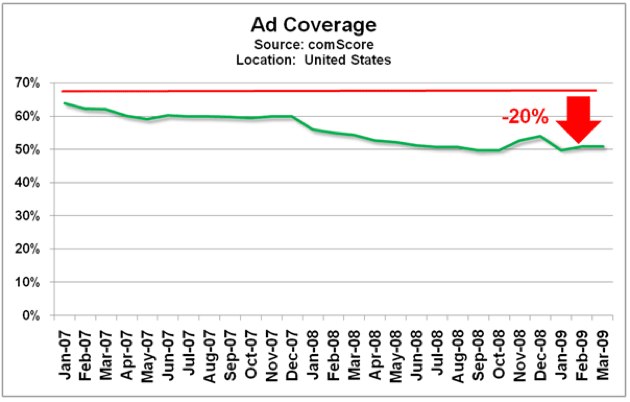
Comscore has a fascinating post today talking about the relative decline in paid search ad clicks when compared to search query volume in the U.S. Search queries are up 68% in the last year, but paid clicks are up only 18% in the same period.
Comscore says the reason for the decline is that there are less search queries that show ads, and proposes that a reason for less ads is that searches are getting longer, up from an average of 2.8 words per query a year ago to just over 3 today. Comscore says: “And this apparently reduces the likelihood that an advertiser has bid to have his/her ad included in the results page from these longer queries, due to paid search advertising strategies that limit ad coverage, such as Exact Match, Negative Match, and bid management software campaign optimization.”
Yeah I’m not buying that.
The reason there are less ads on search results, I believe, is that there are, simply, less advertisers. Far less. Big spenders, the category leaders, are just gone. Sharper Image, Wickes Furniture, Levitz, Foot Locker, Wilson’s Leather, Ann Taylor, Zales, Mervyn’s, Macy’s, Circuit City and a ton of other retailers are either shutting down entirely or closing lots of stores. And more are on the way. All of these companies used to spend tons of money on paid search ads. Those budgets don’t exist any more.
Efficient Frontier says of Q1 2009:
“Search engine spending was down overall by 13% YOY and 3.3% Q/Q. The relationship between spending and ROI trends shows that advertisers continue to adjust their budgets to compensate for the economic downturn and to improve ROI. Monthly spend trends indicate that the additional decline in search engine spending in Q1 2009 was directly linked to the decline in ROI between November 2008 and January 2009. As ROI continued to decline, advertisers continued to cut their budgets in an effort to become more efficient.”
and
“CPCs are down across the board by 19% YOY and 13% Q/Q indicating that the entire marketplace is deflating as advertisers cut budgets and spend less. On a Q/Q basis, CPCs have declined by 14% on Google Search, 7% on Google Content, 28% on Microsoft Live Search, and 16% on Yahoo Search in Q1 2009 over Q4 2008.”
I agree with Comscore that the main driver for the decline in ad coverage are improvements in ad targeting, particularly by Google. But the secondary driver, it seems to me, has nothing to do with query length. Perhaps it’s simply because so many advertisers are no longer advertisers. Drawing a line from that to less ad impressions is fairly straightforward.


Of course the answer is both and even more.
Longer queries, more advanced boolean searches, fewer advertisers, increasing ad avoidance …. a perfect storm for ad driven business models.
I am sure Techcrunch is feeling the heat as well.
In addition a proliferation of new search sites that have no ads whatsoeve so far, including a small startup company you may want to consider profiling called twitter.
I think the conclusion is correct. There’s a huge mismatch between ads and queries. I was just looking for office space last week and tried all kinds of queries, each search turned up a different batch of advertisers, unfortunately none of them actually had office space, just email collection (spam) systems.
In any case, this is good news for publishers running Adsense. Adsense is more likely to connect with people in the long-tail.
Re: “Yeah I’m not buying that.”
Mike,
you don’t actually have to buy anything! It’s totally free! It’s like, you go on that Comscore Internet, and then, you like read what they say on their Internet. And then you know what they say. You don’t need to give them money for that. It’s like, free and stuff. It’s the same as when I go to the TechCrunch Internet and read what you say. And then, I just know what you say – without paying anything!! It’s totally crazy, but it’s true! I totally sware to God!
Pulitzer prize winning journalism, and humor. thanks.
The comscore post seemed a bit muddled to me, first it was talking about paid search clicks not keeping pace with organic search (for which they had data), but then switched to the topic of overall coverage on paid search being down (with much less data).
I think the answer is even more simple that you suggest Mike. I don’t think key variable is less buyers/consumers.
Less people are clicking on paid ads because they don’t have as much discretionary income and are buying less products. That seems to me to be the clearest reason for the discrepancy between the 68% vs 18% growth rate.
meant to say “I do think the key variable is”
damn 2:00am drunk comment leaving….
no, click rates are actually up.
Clicks rates may be up but it looks like it’s just window shopping
Is Sequoia China in Trouble?
Mike you guys removed Lacy’s post on and about Sequoia.
I believe you owe us your readers an explaination why you did this.
Oh and I still have a copy of the article.
I’d suggest folks google “Is Sequoia China in Trouble”
CIAO
Is Sequoia China In Trouble?
[POSTED BY, AND LATER CENSORED BY TECHCRUNCH]
BEIJING, CHINA- Starbucks is a franchise in China that worked. The company opened locations at the bottom of all the major tourist hotels and downtown areas where returning Chinese, expats and business people traveling to China would pop in for some familiarity and to hold meetings, much like they do in the U.S. For people hoping to mix with that crowd, Starbucks became something of an aspirational brand in China. Tea was what your parents drank; a latte was something exotic and western.
No one thought Starbucks would work in China, but it did. Sequoia Capital, however, is not Starbucks.
There are a few ways to set up venture activity in China. One is to become a limited partner for a local firm. Another is to relocate an existing partner to build an office. The most common is to hire well-known, connected investors already in China, and Intel Capital, which has been investing in China longer than almost anyone, is one of a few farm systems for that. Typically this is known as the “franchise model.” The hired China partners operate under the Kleiner Perkins or Sequoia brand name and typically share the same limited partners, but the funds themselves are separate. In exchange for that name and fund raising advantage, the Valley firms take a healthy chunk of the carry.
It seemed like the best of all strategies a few years ago. These firms want experts but don’t necessarily want to slow down or meddle in their deal making. But the cache of the top Valley brands only goes so far over here. In 2008 Kleiner Perkins’ China partnership exploded, with two of its four partners quitting in a dispute that was far more contentious than a lot of Valley media reported at the time. In a week of touring China’s start-up scene, I’ve barely heard the KPCB brand mentioned at all. Now, it seems it’s Sequoia’s turn for some humble China pie.
It’s no secret Mike Mortiz has been traveling back-and-forth to China a great deal, and he’s fond of telling reporters that’s because of all the opportunity. I asked him at Kenshoo’s recent US launch party about the unique challenges of investing in China versus the US, Europe or Israel. He said he wasn’t trying to stonewall on the answer, but that all venture investing was just hard, no one place more than another.
Really? Several sources in China and Silicon Valley have confirmed Moritz has been in China this week addressing Sequoia’s so-called “China Problem.” In February, one of Sequoia China’s founding partners, Zhang Fan, resigned due to “personal reasons.” I’ve now talked to close to twenty sources in the venture scene in Beijing and Shanghai who say those “reasons” were that Zhang was well known for taking bribes, kickbacks and other unethical behavior. People are fond of pointing out that Zhang’s biggest hit was Asia Media Company, which later had to de-list from the Tokyo Stock Exchange under a scandal. Whether it’s true or not, he certainly didn’t do Sequoia’s brand any favors here.
That left the other founding managing director at the helm, the highly respected Neil Shen, who founded Ctrip.com, the so-called “Expedia of China,” and Home Inns & Hotels Management. I’ve talked to several VCs and entrepreneurs in China who say Shen is a prickly guy but his deal judgment is unparalleled in the country. He’s even a bit of a hero to some entrepreneurs. But unfortunately, Shen too is in hot water. U.S. firm Carlyle Group is suing Shen for more than $200 million in damages for allegedly blocking a Carlyle deal in a Chinese medical research firm. Said one person close to Sequoia in China, “Moritz will have to fire him. He has no choice.”
If that’s the case, it may not be obvious at first. Venture capitalists tend to fire partners gradually and quietly. Frequently they’re still given offices and assistants as they phase out of decision making.
seemed to be one of the better-adapted Valley names here. It still employs two other managing directors and several more vice presidents and associates in China, but for many Chinese entrepreneurs Shen represented the brand as much as Moritz does in the U.S. There are few China investors with solid operating experience, particularly in the Internet.
And it can’t be good news for Sequoia’s limited partners who haven’t taken to kindly to Sequoia’s pressure to make them invest in not only China, but in other unproven Sequoia funds aimed at India and later stage U.S. companies, according to very wide-spread reports and my own reporting.
Player hating is part of human nature, so it’s no surprise that other Valley investors have whispered with glee that the once-dominant Sequoia seems distracted by all this. The competition’s biggest fear: Moritz solves the problems and Sequoia starts to focus on what it does well again.
(Sequoia did not respond to a detailed request for comment or clairification of this story and has a long-standing policy of not commenting on the firm’s internal matters.)
I agree with Mike here. The reason, as he opines, is definitely the existence of fewer advertisers combined with lower budgets.
The real question now is how should ad driven business react to this?
1. Change your business model – For many, this is nearly impossible.
2. Close down – Err, no.
3. Stimulate demand – Sounds better. Discounts, coupons, geotargeting, lower budget thresholds.
All can evidently, encourage advertisers to open up their wallets again.
What clearly won’t work is doing nothing and just waiting for the economy to get better.
Even worse, relying exclusively on Google to “fix” the problem.
I disagree. My CTR gets higher every month.
Maybe these numbers help explain Google’s decision to allow a little more leeway in (competitor) trademark use in ad text.
How about the fact that your average surfers (searchers) understand the web economics. They understand when to click on ads and when to browse through organic results.
Let’s face it, unlike the TV commercials and infomercials, no one is forced to go through the Contextual Ads anymore. Surfers (searchers) understand that the Ads mean business, which means for them to open up the wallet and in this tough economy, not every one is in that position.
no, people are clicking more ads, not less.
everyone who has been using adsense has seen their profits going down in the past months. i ‘m firmly with Michael here, there ’s no way people just decided to search for weird keywords
Speak for yourself. I might break a personal Adsense record this month.
and I attribute this to Adplanner, Google’s new “interest-based” advertising algorithm, hard work, etc.
Heard a lot of ups and downs on their Adsense earnings these past few months maybe because of what we are facing right now.
Here is the underlying problem – there is absolutely zero transparency from Google.
If Google is on pace to miss analyst numbers – what on earth stops them from reducing their adsense payout by 10%, 20% or more?
As it stands – they can do whatever they want to do…If people are clicking on $4 ads on your site – Google can pay you 1¢ and keep $3.99 to hit their numbers – and that is perfectly within their terms.
I wish MA would do a “real” indepth piece on this issue…as it effects a ton of his readers.
This opinion is in direct conflict to John Battelle’s view from federated media. http://bit.ly/m61ev Their opinion being that there is a clear trend towards conversational marketing (a banner under which FMs business is marketing) I tend to agree with the view on reduced spending overall rather than lengths of queries. There has always been an issue with matching key words, and increasing the length of a query from 2.8 average to 3 isnt really going to change things fundamentally. Phrase matching removes most of that problem, and isnt exactly new.
Michael:
We considered whether it was “bankrupt advertisers” causing the decrease in ad coverage and concluded that that couldn’t be the explanation because the trends we’re seeing started well before the recession began. There were no “bankrupt advertisers” in January 2007 and you can already see ad coverage dropping.
Gian
sometimes ad spends fall before the actual shutting down of the business.
Does not compute, Michael. There was no ad spending fall off when we first started to see ad coverage declining. Search spending was up a whopping 37% in the first half of 2007 when ad coverage was already dropping.
Gian
no reason for a falloff in ad coverage to suggest a decline in industry revenue. I don’t get your argument. happy to discuss by phone or email though, let me know.
With ad prices (cpc levels) in the thank, its actually a massive opportunity to increase margins across AdWords campaigns. Less competition and lower budgets means lower cost per clicks, more share of voice, and greater opportunities for vendors that still have budget to spend.
yes. ROIs are up.
I think Arrington is pretty much on target here.
July / August last year I was spending $10,000 a month marketing a Dubai real estate site until market imploded.
should read: “fewer” ads not “less”
yes, please!
Fewer ads means less “noise”, which presents a great opportunity for companies to build their brands (as opposed to just selling ‘x’ number of ‘whatever’).
History tells us that the economy will bounce back. Companies – especially up and comers – who use the down time to impress their brand on consumers will find themselves in a much more competitive position after the bounce.
To me that’s a good investment!
But, in the end, you do need to sell x numbers of something. The era of building brands with borrowed dollars is almost over. Twitter, with its half a million cat followers, will be recognized as the last great absurdity of this era. Yes, there is an opportunity emerging: it is an opportunity to sell x numbers of whatever.
I agree with Mike that this drop is due to large advertisers disappearing or cutting down their spend. But at the same time, we are beginning to see an interesting new pattern evolving. A *small* but interesting and significant trend, where hundreds and thousands of smaller advertisers, who never stood a chance against the larger advertisers with bigger mega ad spends are now stepping. Previously the smaller advertisers could not afford sophisticated SEM services or tools, Not only are they now better educated on SEM, but they now also have access to (and came up to speed in using) several free or relatively cheaper analytical tools and services, helping them hone in on specific niches in the long tail. They are constantly cherry picking available opportunities in the long tail and the long keyword sector and are able to respond to, and take advantage of, available supply on a daily/hourly basis.
It will be interesting to see if this trend spearheaded by tons of smaller players can counter the down fall due to larger players disappearing. Can they bring up the eco system in the market place? My take is yes. The question is when. We are already seeing that trend gaining traction in our network.
I agree with you. I think that local advertisers have a huge opportunity here to get into the SEM channel. As the big players back off, now small businesses that would have to compete for ad space can dominate for certain geo keywords. I would like to see figures that compare the rate of growth for local vs national advertisers.
Further hypothesis: Advertisers may be realizing that paid search is a pretty expensive way to generate sales leads, and in addition to downsizing marketing budgets, they may be adapting marketing strategies accordingly. In some cases, a cheaper way may be to acquire niche-relevant content-rich web properties which already have significant traffic and to direct that traffic to the new owner. Of course, there are variations on this theme, and other strategies that may deliver higher ROI than PPC advertising.
if there are fewer advertisers, it should follow that the adwords rates should be going down… we haven’t seen a decline in prices yet and have seen some words actually increase a bit
our focus is more ’soft’ words, about family and people, so might be a corollary to people staying in more/spending less thus that vs. retail type keywords
Michael, I’ve read a few articles about this trend already and I’m surprised none of them suggested what you have. Sure, there are multiple trends at work here, but the economy is probably the largest factor.
You mention in the comments that click rates are up but that’s a misleading figure in and of itself. Can you provide some context and/or backup? Clicks on ads relative to organic results? Clicks on ads in total month by month? If it’s the latter and search volume is increasing at a higher rate, then one could say click rates are actually going down…
Disclaimer: I thoroughly enjoy the TC blog but I find this post inaccurate and very short-sighted.
First, the title is in contradiction with the actual article. Impressions and clicks are two different things. I’d be willing to bet dollars-to-doughnuts that impressions are up much more than 18%.
Second, I’d like to see some examples of industry’s that now have no advertisers. Just because some of the “big boys” are gone, it doesn’t mean that no one is filling the void. In fact I think it’s quite the opposite. Now that the big boys are gone it opens up the field for even more advertisers.
There’s not a single company that was mentioned in this post that won’t/can’t be replaced with other (smaller) advertisers. So what if I can’t get the latest back massage gizmo from Sharper Image? A search for the term “back massager” on Google returns ads in all 10 AdWord positions within the first page. And there are plenty more advertisers on page two and beyond.
For your theory to be correct we’d have to be talking “only”, about industry’s where the barrier to entry is too high for others. Think automobiles, big pharma, and airplanes.
But we’re not talking about those industrys. We’re talking about electronic widgets, shoes, furniture, leather jackets and so on.
Trying to pigeon-hole the slow down to one cause is…. well… just wrong.
My company runs a decent sized AdWords campaign. Over the past couple of years our average monthly spend has gone from $100,000 a month to $30,000 a month. We can directly attribute this to quite a few things we’re aware of and a few we’re not. The ones we’re aware of are:
-Better (free) analytics
-Better (free) split testing
-Decline in the economy
-Increased competition lowering conversion rates, in turn lowering our spend on particular keywords. This turns in to a vicious cycle for Google as all advertisers start doing this.
-Increased competition from affiliate programs. People are looking for more ways to make money in this economy and are joining affiliate programs. Keep in mind these people are just trying to make enough money to pay the phone, light or mortgage. The don’t have to worry about large amounts of net from their ads. This compounds the issue above.
-More savvy searchers. People are understanding that AdWords (and the like) are paid ads and avoid clicking them.
-Just like banner blindness I’m afraid we’re starting to see text ad blindness.
-Web 2.0 and long tail purchasing
While I don’t agree with this post I don’t agree with the longer queries theory either. Advertisers are constantly looking for better performing keywords and they have the tools to see what people are searching for. Tools like Google’s keyword suggestion and Wordtracker.com. There are NO undiscovered keywords or keyword phrases.
This is the most sensible analysis on this topic.
Also, as advertisers get better at targeting their customers they should see their spend go down.
Plus the text ad blindness…
We always wondered who clicked on these ads?
Do any of you TechCrunch readers ever click on advertising
Or is it “Joe The Plumber” who clicks on the advertisements?
there is definitely less advertisement in google and ads show up much less in the queries. I have the same impression
If comscore’s hypothesis is correct (searches are getting longer, more terms) then that says advertisers should review their PPC ad campaigns and look to bid on longer search terms that may be germane to the product or service they are marketing. Comscore is saying that their are no advertisers associated with many longer terms. I find that hard to believe with Google Adwords … but no harm punching in bids on longer search terms and seeing how they fare. This strategy just might be a way to increase traffic on a lower cost per click basis.
You are killing me – fewer not less….
I have seen the opposite. CPC rates going up. I have compared CPC rates for most of the keywords driving current campaigns that I am managing, and the CPC rates were up.
And no, we are not fighting for position, all the campaigns are optmized to ROI on a portfolio basis.
What I think is that more and more users are leaning that results on the left are paid ads, and they are clicking less on those.
At the same time, altough big retailers are closing, there are much more small time retailers this year against last year. Paid search is a pretty good channel for small retailers trying to grow their business. They can’t afford, magazine ads, radio or TV. And many of those retailers are venturing into PPC without very good knowledge and try to fight for position by increasing their bids. That way all CPC goes up.
Anybody agree? Would like to comment?
I appreciate.
Thanks
adblock plus
50M downloads
700K /week
Balooney! Ad revenues are going down because conversion rates have gone down. Less sales per 100 clicks result in a lower price the advertiser is ready to pay, period.
PPC spending is undergoing a huge change. Advertisers are demanding much higher ROIs from SEM agencies and they have been getting it. Some of the drop in ad revenues has come because people have gotten better at this. And search is more granular, with longer search queries so there are more words to compete on, consequently the competition is diminished. From the discussion, it seems as if lower click prices, have more than compensated for higher CTRs. Further, the growth in queries is accelerating, but interestingly, the growth on previously unseen queries is growing, so there is a portion of queries that never generate revenue.
Terrific article and great discussion.
Tim, you said PPC is undergoing a huge change. Well if fact it is. At Hydra we have seen tremendous growth in CPA or cost per action. The big difference is that you only have to pay for the ads that get you the desired action. There are no wasted ad dollars. In fact, you can take the money you make on the return from the CPA ads and apply them to other areas of your marketing budget.
Google over the past few months has really clamped down on long tail bidding by not showing your ad for sear terms they deem as not having enough search volume
To try just add a bunch of low volume long tail keywords to your account and you will sometimes get a message right next to the keyword telling you the search volume is too low to display your ad.
This is because Google wants advertisers to rely less on exact match and more on theeir broad and phrase match options giving them the ability to show your ad for as many “related” keyword as possible
its true
I used to spend 800€ / month for advertising my wellness and now I came down to 300€ / month
there are 2 reasons for that:
1. I figure out that prices per clicks somehow droped and immediatelly I lowered my bids
2. There are so many other opprtunities which are free, like FB and Twittter which I want to explore more.
Generally speaking, bad economy is making everybody to squeez their budgets. My theory is also that Twitter is taking big lump of searches now.
I personally use Twitter now for 30%-50% of my searches.
My 2 cents..
1. All PPC search engines are expensive for advertisers. Consumers are getting better deals where it costs less for advertisers.
2. Advertisers are getting smarter.
Searchers are getting smarter too. They click more on organic links instead of advertising links.
Another important thing to remember is that Google stopped giving out kickbacks to agencies based on monthly/yearly revenue generated. So previously an agency would have an incentive to tell a customer “You need to bid $10 here because you need to see if it works and move down from there to an ROI that is acceptable.” Totally nuts but I had these discussions (never used somebody to even started a sentence like that
) previously.
So I presume that this led to a drop in prices as agencies are more measured on ROI.
It’s a good thing, not a bad thing.
The dirty secret of advertising is that people have been spending too much on it for years and years: it’s got this seductive little thing: people feel ~so~ damn good when they hear their business being talked about on the radio that they don’t think rationally about ROI — at least they didn’t until they started running PPC campaigns where you really can measure the ROI.
I gotta little site about cars that uses AdSense and I’ll tell ya: I’d like to make all the Chevy ads go away. It’s hard to block them because there’s a whole “car-tel” associated with general motors: dealers, brokers, and other numbskulls who are trying to convince Washington that they’re interested in selling cars.
The CTR on Chevy ads is indisinguishable from zero. Why? Give your local Chevy dealer a caller and you’ll learn why… prices for new GM vehicles have gone up, not down, in the last two years. All this talk about incentives is a shell game: you can get better value at the Honda dealer across the street, discounting the fact that (whatever the president says) the supply chain to make parts for warranty repairs on your new Chevy might not exist in three years.
When the Chevy ads are gone, people who ~really~ make money on PPC ads come in, and I get a respectable CTR and eCPM.
Bad ads displace good ads. Getting rid of bad ads might lower profits for ad networks in the short term, but it makes it possible for good ads to move in. Once businesses form that are able to make honest money from PPC ads, advertising prices get bid up, and both advertising networks and sites with inventory get more money.
I see this happening with Facebook ads: Facebook has banished the “flat tummy” and “teeth whitening” ads that dominate the other social networking sites. More advertisers are being attracted by low rates: as some manage to connect with users and make real money, facebook ads will mature into a great platform.
from my experience…..we are trending upwards in clicks/impressions, while our cpcs are dropping. this is all great for us.
I would love to say i’m a genius, but I attribute it all to declining competition
There are some other explanations for this, too. It’s not just a reduction in coverage due to decreased budgets. Hitting the long-tail keywords effectively takes decent staffing, too.
Any SEM agency software can create a 1MM+ keyword campaign, but the lists I’ve seen generated by software are pure crap. It takes a human being to develop those lists, and there are simply fewer human beings working on that right now.
Ironically, if a company can develop a long tail campaign effectively, the traffic is cheaper by an order of magnitude sometimes, usually with better conversion rates due to very specific matching that puts the customer further into the sales funnel.
i wholeheartedly agree.
I’ve been one of the few to bad-talk software. People rely way too much on some third-party software to manage their campaigns.
I loves me some excel…maybe access for those bigger jobs.
1 guy 1 cup video