
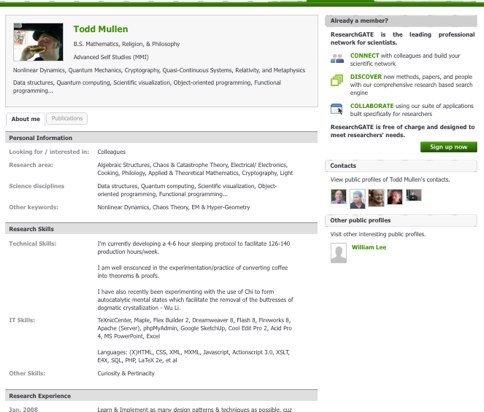
Creating a social network for scientists is not a revolutionary idea—Academia.edu, Ologeez, and Lab Meeting are all startups that have developed variations of communities for researchers and scientists to share their works. ResearchGATE joins the group by offering a free LinkedIn-like professional network that allows scientists to connect with other colleagues, discover new methods, papers, and people and then collaborate using applications built specifically for researchers.
On ResearchGATE, scientists can create Facebook-like profiles where users can list their education, work experience, skills and interests and attach research papers. Users can add professional contacts by searching for other researchers who have the same focus. ResearchGATE also gives users the option to engage in online discussions by joining or forming groups. ResearchGATE also offers a few applications that help connect scientists in the virtual world. ReStory, similar to GoogleDocs, allows users to collaborate together with colleagues to write and edit documents. ReMeet lets users schedule meetings and conference calls online and ReVote enables users to create surveys and polls on topics. ResearchGATE is planning to roll out several new features in the near future including virtual conferencing and a job board.
The site also offers a powerful search capacity that scours its internal resources and all major external research databases, including Pubmed, Citeseer and others, to find research papers. ResearchGATE also suggests similar papers written about a topic when users upload their own papers, giving users an easy easy to find like-minded individuals and papers. And based on the profiles of other members, ResearchGATE can suggest other scientists, groups, and resources to users.
Currently, ResearchGATE, which was launched earlier this year, has a user base of 50,000 researchers from 196 different countries. More than 40,000 papers and documents have been uploaded to the site and there have been 1100 groups formed around different subject matters. For example, over 100 Influenza specialists formed a research group to discuss the outbreak of the Swine Flu. And more than 1300 researchers from different disciplines formed a group to discuss research methodology and practices. According to the site, ResearchGATE’s groups center mostly around the disciplines of biology, medicine and computer science.
Competitor Labmeeting, lets scientists upload all of those documents, organize them, search them, and share them. Academia.edu also lets scientists connect with each other and provides a useful news feed of papers, conferences and project news and allows users to stay up to date on current events in their field. What makes ResearchGATE’s site useful is not only its its ability to share documents but to be able to connect with scientists all over the world on issues of interest. By suggesting users with similar interests, the site does a lot of the networking work for users. Of course, one of ResearchGATE’s biggest challenges will be recruiting large numbers of scientists to the site. ResearchGATE is hoping to do this by forging partnerships with universities and research institutions and already has a few on board including The University of Georgia and the Medical School of Hannover, Germany.


in fact, there are lots of social networks for scientists. lots more than named in this article. but none of them offers applications similar to these you find on researchgate. their semantic search engine, for example, is really state of the art.
bullshit. I am a scientist. I have an account on the site. I have tried it. and it is crap
you sure sound like a scientist.
First of all I would not prefer the LinkedIn clone around my scientific life. Why I wrote this let me explain! I am embryonic stem cell researcher and I am the member of stem cell society in LinkedIn and we are sharing our theoretical informations and practical experiences immediately. As for meeting information, honestly I do not think any new adventure part also in this network system as you claimed. We scientists based on our scientific field are in connect also each other and in our institutes many meeting advertisements are available. You can say but this is more organized! I would say then how can you do it? I did not see any detailed process to sort every information it out. In order to make a precise group in different fields in biological science, first of all topics should be precisely sorted out. In here I smelled advertisement rather than functional details. When I made precise group in LinkedIn working exactly what I am working on; why I should prefer another LinkedIn network? I am not interested in DNA methylation let say but epigenetics cover it, should I stay within the group working DNA methylation because search machine caught the word epigenetics and directed me to this scientific group? I am interested in host immune reaction against the H1N1 virus but I find myself among the scientists who are working on proteins for H1N1 virus adaptation? Sorry as a responsible scientist in human science, I need more details in order not to find me in the middle of the chaos. Let us make advertisement first when we understand Research Gate structure and functionality. Otherwise it will stay as a more closed clone of LinkedIn. Thank you for your concern. And I am looking forward to hearing from you.
Hey,
I understand your concern, Senem.
I think and I used researchgate now a lot, Researchgate is much more dynamic than linkedin. If you use the search, you can find researchers, resources, group discussions which are related to the keywords, which you provided.
A lot of researchers are providing their research skilss and research area. I tried it on my own and in my field it worked well.
Just start to play around.
I’m glad this is happening in areas and specific niches where the actual benefits of all this social network navel gazing can actually help make progress that matters.
They could probably take revenues by buying out or aligning with companies that facilitate submissions and conference creation IRL as well.
i.e.
EventBrite
http://www.eventbrite.com/
SpeakerRate
http://speakerrate.com/
OpenConf
http://www.openconf.com/
ConfTool
http://www.conftool.net/
etc…
Any idea on which methods they are using to monetize this?
Is it related to MIT ? Just asking because it is located in Boston.
No – the CEO – Ijad Madisch has ties to Harvard Medical School however.
Have used it and ResearchGate will truly enhance research and make it more fun + social. Scientists are more social than one may think.
Very useful and nice designed web 2.0 platform, looking forward to the next updates!
Harry Seldon, I do believe one of the guys behind RG is from Boston, think he works at MGH.
Truly a lot going on this space. To make the set complete, I’d like to add Mendeley, featured in TechCrunch posts about their snagging 2 million in funding [1] and the more recent (and nerdy) post on TC UK [2]. Also, Nature Networks [3] as a great social interaction resource.
[1] http://www.tech...anagement-tool/
[2] http://uk.techc...m-for-academia/
[3] http://network.nature.com/
the end of a digital media revolution. internet and mobile media are saturated. whats gonna happen?
ScientistLocator.com – lab work
I’m trying out Mendeley (mendeley.com) at the moment. Doesn’t have all those collaboration tools (skype and dropbox usually do the job, though), but it offers nice ways to manage, share and discover scientific papers for research projects. Even offers a Word plugin for citing.
I prefere scholarz.net. It offers the same networking features, but combines them with a powerful research tool. You can do your personal research & reference management, collaborate in working groups AND network. I like this combination.
it’s a great idea, and wonderful if it works out well and attracts scientists, but in the end i suspect that most specialists are already quite self-organizing via events, research groups, grant-related research activity and other areas of analog interaction- and if they work in corporate environments, then corp policy may preclude them from participating openly in such sites/networks…
Good point. I think this is status quo. However, dont you think that this is a matter of time and there is a new generation (the web 2.0 generation or science 2.0) coming, which will take advantage from these scientific networking platforms?
i am an internal med doc and have you guys heard of sermo? it’s a social network for physicians and doctors.. it covers tons of specialties from surgery, internal med, neurology, psychiatry, radiology, gynecology, etc… it seems to be working pretty well–docs tend to be self organizing but this is just an adjunct to communication for scientists…
I have a list of almost 50 biomedical community sites: http://sciencer...cians-the-list/
The combination of efficient research work, paired with management and working group in the net is the future. MfG Michael
take it for future, never be fast in decisions and facts, so look foward , the future is the net…
Dear all, thank you for the post and the comments. Since all the people reading this post are interested in social networks for scientists (whether they like it or not) I thought you may be interested in PRESANS: yet another social network for scientists: http://www.presans.com.
However, we are not competitors at all with ResearchGate: in our case, the social network is actually “just” a tool: PRESANS is a new open innovation intermediary in France for scientists around the world. We are launching the private beta period mid-september 2009. Registration is already open on http://www.presans.com. PRESANS spins off of the Technology Transfer Office of the Ecole Polytechnique.
Basically, PRESANS is a social network for Experts (researchers, scientists, engineers etc.). We provide Experts with a range of free services through our internet platform and Experts are paid significant rewards to solve R&D challenges (from tens to hundreds of K euros). So the social network is really a tool to help us to manage and keep the contact with the Experts.
This means that, even if PRESANS is another social network for scientist, this one is also for you!
Thank you very much for reading this post and I am really looking forward to reading your comments and to seeing you PRESANS ( http://www.presans.com/ ). And REMEMBER: registration has already opened for the beta and the actual launching is mid-september 2009.
Cheers,
Albert Meige, founder of PRESANS (and researcher in Plasma Physics!)
PS: I apology if you have seen a similar post of mine in another thread, I could not choose between the two.