Have you nominated someone for a Crunchie today? »
How The Kindle Now Lets You Steal This Blog
by Erick Schonfeld on May 14, 2009

Amazon’s new blog publishing program has a major flaw: it lets anyone steal other people’s blogs and charge readers for them.

Yesterday, Amazon opened up the ability to publish a blog on the Kindle to anyone who sets up an account. Today, anyone can claim a blog even if it is not theirs, charge a subscription fee for it, and collect the proceeds. In fact, somebody already did just this with TechCrunch.

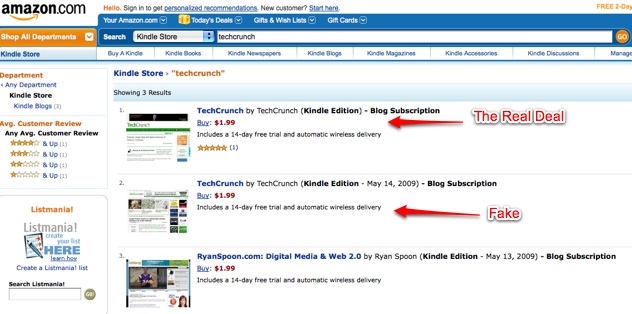
If you search for “TechCrunch” in the Kindle store, the top result is our official blog for the Kindle, which you can subscribe to for $1.99 a month. Right under it is another official-looking TechCrunch blog, which in fact serves up our feed and also costs $1.99, but we don’t see a cent of that money.

The second Kindle blog was created by Josh Fraser, the co-founder of EventVue, who notified us and Amazon immediately and offered to give it back to us. He created it just to see if he could and was flabbergasted to discover there is no verification process to ensure people actually own the blogs they are claiming. As Fraser points out:

Not only does this enable me to get the revenue share for a blog I don’t write, I can also change the feed to post whatever I want to Kindle subscribers under the TechCrunch brand.

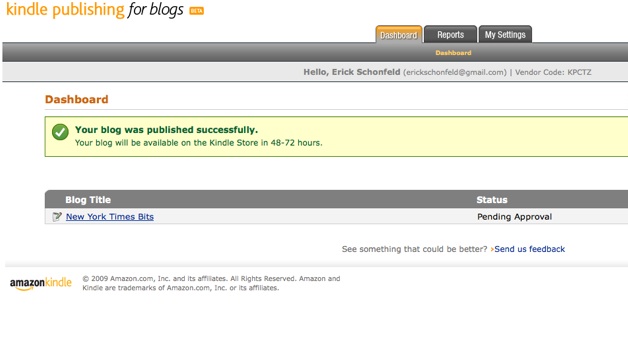
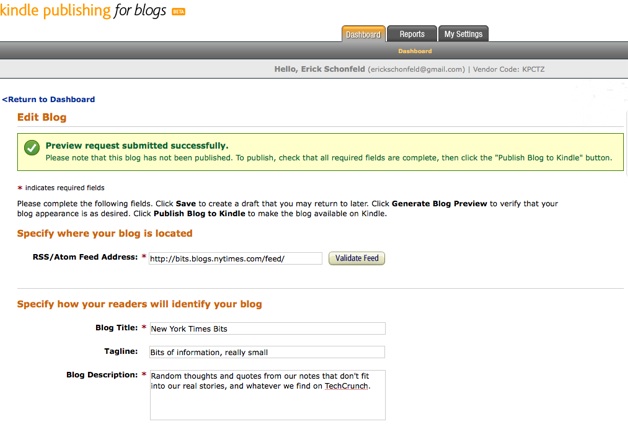
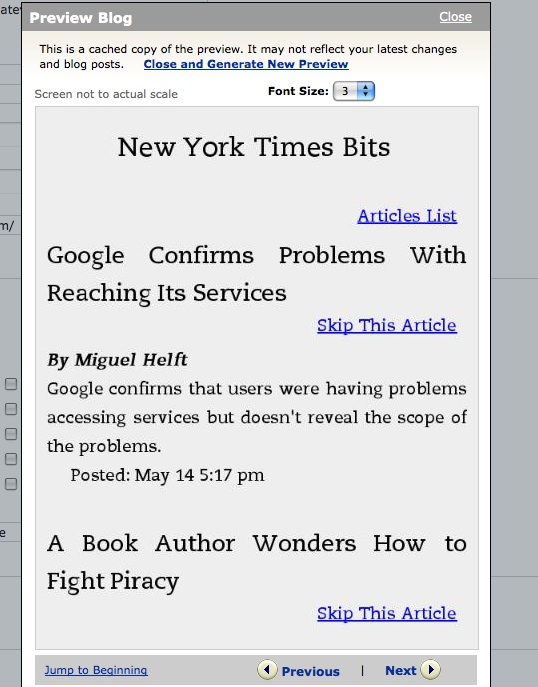
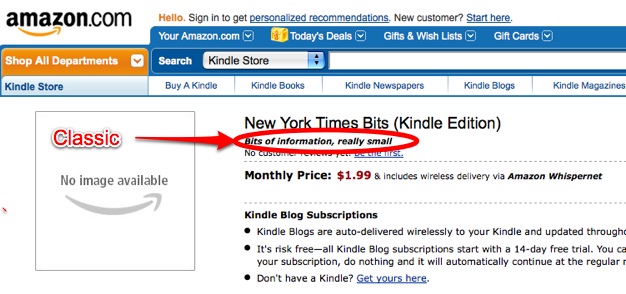
Not quite believing this could be so easy, I decided to create my own account on the Kindle Publishing for Blogs Beta and went through the process of claiming a blog I don’t own: the New York Times’ Bits blog. It was really easy. All I had to do was put in the URL for the Bits blog RSS feed, which Amazon “validated” as being a real feed. Then it asked me to enter a Blog title, tagline, description, screenshot, an image for the masthead on the Kindle itself, and search keywords that would return the blog as a result.

Obviously, you can put whatever you want in these fields. I held back from uploading an inappropriate image, but did have a little fun with the tagline: (”Bits of information, really small”) and the description (”Random thoughts and quotes from our notes that don’t fit into our real stories, and whatever we find on TechCrunch”).

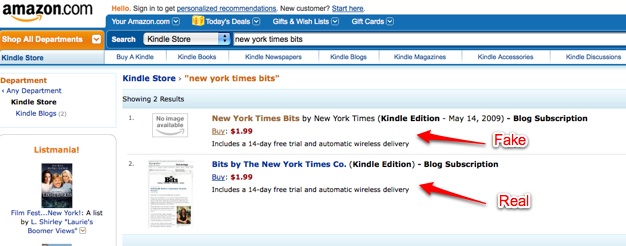
Now, if you search for “New York Times Bits” on the Kindle store, the version I created comes up as the first result and the official version comes up second. My tagline is there, and if you subscribe to my version 30 percent of your $1.99 subscription will be routed to my bank account.

Don’t worry, though. I will donate all proceeds to a lunch-money fund for New York Times technology journalists (they’ve had their expense accounts cut back, you know). Or Amazon could just fix its blog claiming procedure.

Update: Apparently, it is not just blogs that can be claimed. Uploading books is pretty easy too. Journalist Paul Carr emails us to say that he was able to upload his book, Bringing Nothing To The Party: Confessions Of A New Media Whore, to the Kindle Store ” in less than 24 hrs without even once being asked to prove that a) I was the author b) I had the electronic rights for the US.” Talk about opening the door to book piracy.

Update 2: Amazon has removed the fake blogs from the Kindle store. A spokesperson provided the following statement:

Kindle Publishing for Blogs Beta is a powerful way for bloggers to publish their content to the Kindle community and we have streamlined the process to help rights holders launch their content as quickly as possible.

Occasionally, people publish material to which they do not have rights, in violation of the Terms and Conditions for Kindle Publishing for Blogs. In these cases we react vigorously to remove unauthorized copyrighted material.

The listing of a few unauthorized blogs was unfortunate and we have subsequently removed those titles.
Advertisement

Responses

Comments rss icon

  • Why do you guys have a problem with this? You should be paying these guys for stealing and publishing your blog. Isn’t that what Arrington says about music? Or is it suddenly different when you’re the one producing the content.

  • eric…

    don’t get me wrong.. but aren’t you/TC being a bit hypocritical here…

    mike has advocated that it’s ok to copy music before in other posts here on TC. I (and others) have challenged him on this, and his comments (and those of TC) was that the issue of piracy was going to happen, so deal with it.

    I even asked if it would be ok to get a copy of the Tech review you guys charge for, and to then give it away for free (with no answer by the way)!

    so, what’s the issue here… you either say piracy/theft is ok, or it isn’t…

    at least try to keep your principles… which ever way they lay/lie…

    peace

    • The argument towards copying content as a beneficial act dies when someone else is making a profit off of your content.

      It may be considered okay if you’re not being paid for your content due to the promotion, but if anyone can just steal it and sell it as their own that is NOT okay.

      • Fact is a lot of the so-called beneficial music services out there are making a profit — or hope to make a profit — off other people’s content through advertising or other indirect channels. It’s no better than directly selling other people’s content.

      • no…

        it’s flat out wrong to copy someone’s music/content if they don’t allow you to.

        there’s really no two ways about it…

        ask someone who’s created something electronic, how they feel about someone copying their material, without their permission..

    • I am not making a judgment either way. Simply pointing out how easy it is to do this on the Kindle.

      Whether Amazon should even charge for blogs on the Kindle when they are free on the Internet is another issue.

      But they do charge for them, and they now have a major loophole enabling anyone to collect payments for other people’s feeds.

  • Thats a serious flaw.
    The guys at Amazon need to address this big time.

  • Selling other peoples work is wrong. Stealing/Downloading it is not.

  • Sounds like sour grapes cause you were late to the table…

  • Downloading is one thing…making a profit off someone else’s writing/workand selling it as their own is something else entirely.

    • so i can take your money//TV/car/etc.. and park it at my place and it’s ok? but if i sell it, that’s wrong!!!!!

      you can’t be real? or are you like 10?

      theft is theft….

      i take something that you haven’t given me rights to take, it’s theft…

      you guys are amazing with the way you twist logic/things to somehow allow you to sleep at night….

      “your honor.. i only made here do oral.. we didn’t have ’sex’ so i didn’t rape her..”…. my god man.. stop trying to twist logic…

      • Just to clarify, I think you would have to somehow make a copy of my “money/TV/car/etc” for it to be similar.

      • This guy is a moron, we are talking bits and he is thinking physical items.

        • ryan… i’m not the moron…

          i’m the guy who recognizes that if you were to spend a year of your life creating software.. then i don’t have the right to simply copy it and somehow twist my words to say it’s ok… if you didn’t give me permission to it, i don;t have the rights to take it.

          go ask your parents… or better yet, become a developer/creator of something that you try to sell, that has an actual value…

          until you get to that level, i’m way above your pay grade…

        • Well, if given the opportunity I would rather have people steal my work. Because if people aren’t trying to steal what you make, it probably sucks. I’m of the philosophy that software should be free. That is why everything I make on my own accord is open source. Mentioning pay grades, it seems all you care about is the money. Take a look at http://movies.y...m/mv/boxoffice/ as you can see Star Trek made less in its first week then x-men origins. Looks to me like stealing equates to buzz which equals dollars. Even though x-men was inferior to Star Trek, it still did better at the first week of the box office. But what do I know, you are above my pay grade.

  • Honestly, I don’t think TechCrunch is saying this is bad for TechCrunch. They’re just merely exposing a flaw in Amazon’s Kindle RSS blog system. This is a flaw that publishers who do care about piracy and hijacking can now know about and do something about it.

    TechCrunch isn’t saying, “wahhhhh we’re going to lose $5 a month in revenue!” They’re just exposing the problem with the system in its current form.

    In my opinion, it beats hearing about Twitter all day. Maybe TechCrunch should stop reporting real news like this and post another Twitter story.

    • i agree 100%. TC isn’t complaining, just exposing a system flaw.

      CERTAINLY beat reading another Twitter post. Maybe they should make a separate section for Twitter love making. ugh

    • adam..

      if you’re right.. and TC isn’t complaining.. and TC really doesn’t care if someone takes their content and then resells it. I propose my earlier statement.

      TC produces a Tech review, which is for sale for ~149.00. i’d like to buy a copy of the next issue, and then give it away to whoever wants it.. Or I might sell it for a few bucks… TC should have no issue with that, right?

      Didn’t think so…

      As others have said.. hypocrisy

      • Tom, then perhaps you should save your claims of hypocrisy for a post where TechCrunch bitches about people stealing and distributing their yearly crunchbase review.

        To my knowledge, no such post has been made therefore I think your claim is irrelevant to this blog post.

        Asking a hypothetical question in order to push your agenda that TC is a hypocritical blog and should burn to the ground isn’t necessary nor is it appropriate for this post.

        Save your pitchforks and witch hunt for another day.

        • sorry adam…

          i disagree… i think pointing out large hypocrisy is always useful. and we can agree to disagree.

          and nope, i don’t advocate violence, nor do i advocate buring TC to the ground…

          i simply stated that there appears to be hypocrisy when TC complains about something happening to them, but has made it a point to say the same thing happening to others is OK…

          your milage might vary…

      • No, it’s more like TechCrunch has something on sale at Wal-mart for $149, and then the Wall Street Journal gets the cheque for the profits.

        The user, in either case (real or fake feed), is still paying the $1.99, and 30% of it is supposed to go to the owner of the content, not somebody who just happened to fill out the form. Using the music analogy, it would be like someone “claiming” they wrote that lady gaga song that keeps popping up here on TC. Then when radios play the song, and pay their royalties to SoundExchange, SoundExchange pays the money to the person that claimed they wrote it. Can you see how that’s different than someone pirating a song?

        • the difference is in your mind…

          kevin.. if you create something.. a book.. a piece of sculpture, whatever.. i don’t get to do what i want to with your creation, unless you allow me to… it’s as simple as that..

          so if you create a piece of software.. i buy it from you.. i don’t get to give it to 100,000 of my closest friends unless you allow me to.

          trying to bring in whether i get paid when i give the song away, or if i do it for free isn’t the issue… i can’t do anything with it, unless you allow me to…

          this approach preserves your rights as the owner/creator of the content.. if you’ve ever created actual digital content (software/books/music/etc…) then you’d start to get this..

          however, if you’re a consumer, then you want what you want, when you want it…

          as a thought excercise… if you work for a company that produces digital content/items.. talk to your CEO, tell him/her, that they should allow anyone to simply copy the stuff you produce for free… see how long you keep your job…

        • I’m merely saying that this article is not hypocritical. That is the extent of my previous comment.

  • Yeah, I twitted briefly about this, how Amazon’s not providing any type of help as part of the sign-up form about important feed issues.

    If you’re NOT putting out a full feed, then I think you’re not really giving Kindle all it needs — but they don’t alert you to the need to change (and didn’t flag our short feed, when I gave that to it).

    If you do give a full feed, you could always publish this via a hidden address that only Amazon knows (Movable Type makes this easy; WordPress, well, still looking for a solution). That means the general public might only get your short feed (including would be Kindle thieves), but the Amazon full feed you send would be protected.

    Of course, if you put a full feed out to the general public, then this is yet another way where that feed can get abused. Kind of sad, but I figure at least Amazon will start dealing with it on their end. Not so easy to deal with sites that just assume a full feed is a right to republish your entire web site.

  • I poop in TechCrunch’s general direction

  • plus music is entertainment and I dont see any of the users on piratebay opening up their own shops and selling the music as their own

    • Yes, perfect. You haven’t seen it, it must not happen. Probably a solid proof that there’s no such thing as sex either.

      You can buy CDs created from torrents all over the place. One disc band collections of MP3s, movies, software, the works– and often not just on the street but on eBay, craigslist, etc. People do profit from other people’s work, and so do The Pirate Bay. Or do you imagine they turn off the ads on TPB as soon as the break even on hosting costs?

  • Shut Up and Write - May 14th, 2009 at 2:46 pm PDT

    I recall TC’s policy towards stealing music was “Shut up and Play”.

    How is re-purposing TC’s feed any different than “Shut up and Write”?

  • Complete idiocy. Just amazing to me.

  • This is a MAJOR BUG! I don’t how Amazon can do this? Seems like this blogging option was launched in a hurry by Amazon.

    I can’t believe this they don’t have a way to authenticate the blogs!

  • Wow, that was a good find. Did you find that or did someone tip you off about this flaw?

  • Insane hole! I’d assumed they were doing what the rest of the world does where you need to put code or a file on your server for verification.

    As a first step, at least. As a second step, why on earth let one blog be listed more than once? One blog = one account collecting the cash, right?

  • And the bigger problem, alluded to in the article but not expanded upon to its full aggravating expected intent, is someone putting up famous blogs that go to just what kind of explicit content? If it took you more time to come up with an answer than it does in a simple word association game, you aren’t a real web user.

  • While I agree this is not right, my issue is “What right does Amazon have to charge for something that is free?”

    You can receive the latest blog post on any blog via email, twitter, RSS, or just by going to the website, the list goes on and on. I can see if they were promoting your blog (a form of advertising), but just making it available on Kindle? Is it worth the price? Are there really people who are paying for this?

  • i would guess the approval process needs some polishing. that’s all.

  • Which, BTW I’ll take down if they ask kindly

  • Crazy. I would have thought that it would have had to have been at least as “complicated” of a cliaming procedure as the Technorati claim. Something that proves that you have access to edit the site in question.

    Wow. Good Find.

  • Google does proper site verification for those using its webmaster tools, see:

    http://www.goog...c.py?topic=8469

    using a unique metatag or a unique file placed in the root directory of the site (which they then crawl to test whether the metatag/file is present). I wish more sites would do this, especially those running affiliate programs or banner networks (a lot of identity theft and fraud occurs as people pretend to own large sites in order to get into a monetization program).

    • Yeah I don’t get why they can’t just do that. It’s amusing in this case, but there’s no reason to even have it happening.

      That being said, I am glad to have more TC comments on whether they’d care if someone copied their work and redistributed it in a decent form. This site should load in like 5K not 500K.

  • What prevents one from publishing the blogs they read as one rss feed and then signing up for it? Seems like an easy to get all your feeds for free

  • yes, screw TC. hypocrites. anyone who disagrees with their BS music-stealing policy should start selling TC Kindle subscriptions….

  • Where are these fakesters bank accounts? Amazon makes you sign up and provide a bank account number.

  • This is absurd. Amazon needs to implement a WHOIS check on your email address and name or SOMETHING before this gets way out of hand.

    When I subscribe to TechCrunch, I want to know that money is going to TECHCRUNCH, not some pirate.

  • Ouch!! who in their right mind pay for an RSS feed on the Amazon Kindle….. sad :(

    • Who in their right mind would buy a Kindle, when we’ve got two-page color flat panel displays for scratch these days?
      Follow me on twitter. @imadipshit2

  • not only do they take 70% of the revenue, they don’t actually both to check they’re rewarding the right person – which would be a pretty simple process (add a CNAME, upload an HTML file, add a meta tag to the blog – all established practices)

    will be interesting to see if they both to fix the technical issue (and if the business model actually manages to fly)

  • You should have used Amazon’s blog (feed://www.amazon.com/gp/daily/rss.xml) instead of Bits for your little experiment. Give them a taste of their own medicine.

  • Expect this gap to be filled pronto. As for RSS feeds, if too much information clogs up the available “free” pipeline they’ll probably adjust that policy as well.

  • Why is this a problem? If a feed does not want anyone to be able to register this, they can check who is actually requesting the feed and not serve it if it comes from the Kindle? They can also utilize specific urls that are only known to the blog author and allow that traffic to go through when the request comes from Amazon.

    Also, how is this any different from domain names? That is okay? My company had to pay $32000 for our domain name because someone had registered it first.

    • “If a feed does not want anyone to be able to register this, they can check who is actually requesting the feed and not serve it if it comes from the Kindle?”

      Amazon should be doing at least the basic amount of due diligence. Even Google’s Webmaster Tools – which doesn’t really allow you to do anything damaging! – requires you to put an HTML file or meta tag on your website to prove ownership.

      “Also, how is this any different from domain names? That is okay? My company had to pay $32000 for our domain name because someone had registered it first.”

      Did your company have a trademark on the domain? Blog posts are covered by copyright, but domain names are not – you must explicitly register a trademark.

  • Does it really matter? No one in their right mind would possibly pay for TechCrunch no matter who was selling it.

  • Can someone write a blog and fill it with articles on how to steal a blog? so i can steal it? Thanks.

  • if this problem is not addressed soon their will be alot of emails to amazon!!

  • Ask the RIAA for help.

  • Great post Erick. Thanks for covering this story.

    I shared a few of my thought here:
    http://www.onli...name-ownership/

  • Well this is a major flaw that should be fixed. But this is a beta product and not perfect right out of the gate.

  • You should be happy; you now have another way of monetizing your blog beside advertising.
    Peace.

  • Currently Kindle blog website doesn’t allow to login:
    “Login email and password do not match”

  • , Kindle like TOTALLY ROCKS!

    RT
    http://www.whos...watching.net.tc

  • This is an easy problem to solve – a way to “authenticate” any copyrighted work and prove you are the owner or have obtained the rights from the owner to resell it or repurpose the work or publication. See http://info.ico...r_copyright.htm

  • So, isn’t amazon already stealing our money by making us pay for free blogs on the kindle? Do the strip 100% of any ads on them? or do you just secretly hate the kindle and want it to die a fee-filled death.

  • Came in here thinking I’d be the first one to point out the head-popping hypocrisy; turns out only a few folks aren’t.

    Much more extensive thoughts on the topic at my blog

  • Thanks for the tip. I just tried publishing my blog. It took about 5 minutes to get everything set up. An hour or two later it’s live and for sale on the Kindle Blog Store.

  • I noticed this same problem when I signed up our blog. As long as the real owner is on top of things, it seems like it would be pretty easy to sort everything out and delete the fake account.

    I talk about the submission experience in our blog, and also discuss what submitting a blog to amazon can do for SEO.

  • WTF? Serious? Why can’t they require a meta tag verification like Google Webmasters does?

Leave Comment

Commenting Options

Enter your personal information to the left, or sign in with your Facebook account by clicking the button below.

Alternatively, you can create an avatar that will appear whenever you leave a comment on a Gravatar-enabled blog.

Trackback URL
Short URL
bugbugbugbug
Techcrunch on Facebook