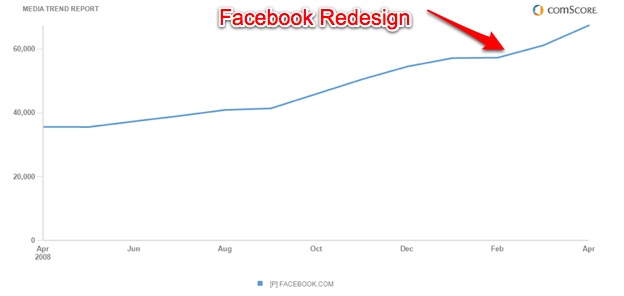
When Facebook redesigned its homepage in early March in a wholehearted embrace of the real-time activity stream as its primary user interface, everybody complained. “Why on earth does the world need 2 Twitters?,” asked one of my friends on Facebook. Twitter-envy aside, some early data suggests that embracing the stream was the right decision after all.
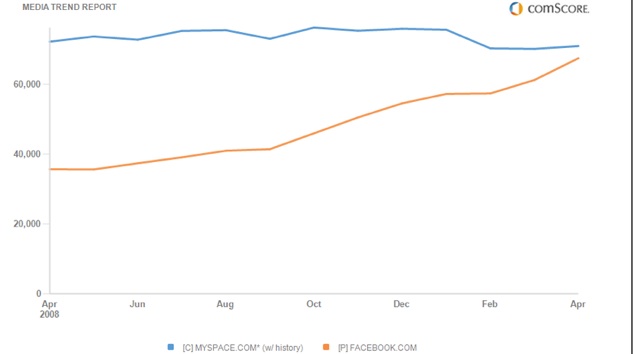
Since the redesign went into effect, Facebook’s growth has accelerated. After flat 0.3 growth in February, Facebook added nearly 4 million unique U.S. visitors in March (up 6.6 percent over February), and another 5 million in April (up 10.3 percent over March) to end at 67.5 million domestic uniques, according to comScore. That puts it within kissing distance of MySpace’s 71 million unique U.S. visitors in April, by the way (see chart below), and keeps a healthy 50-million visitor gap with Twitter, which added 8 million U.S. visitors in April alone.
Facebook is not alone when it comes to wading in the stream. AOL has found religion as well and is injecting “lifestreams” into everything from Bebo to Socialthing to AIM.
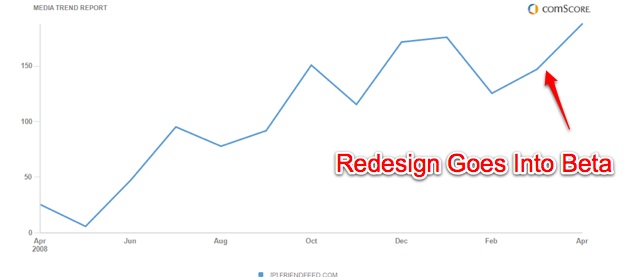
On the other end of the spectrum, is tiny FriendFeed, which is one big activity stream. Despite leading on the innovation front, FriendFeed has been struggling when it comes to gaining users. But a redesign that went into beta in early April, and is now the default homepage seems to be paying off with a 28 percent rise in unique visitors in April and more time spent on the site ComScore only estimates 188,000 unique visitors in that month (Quantcast puts it a bit higher at 241,000), so it is still extremely niche, but at least its numbers are now headed in the right direction. The redesign makes the whole feed update continuously now so you can really watch your what your friends are doing on the Web as they are doing it.
Complain all your like, but the stream is here to stay and it will only get stronger.


The analysis here is very shaky. I wonder how much of facebook’s accelerated growth is due to fan page push.
Short term gain. But insiders in fb will have more insights, that few people drown in spammers’ streem.
The analysis looks very shaky, both of these charts look like standard growth with an arrow pointing randomly somewhere in the middle.
I would give it to you that the friendfeed chart has the most distinct increase during the period of releasing their redesign, but still I wouldn’t look to much into these charts!
Activity Streams are what actually define a social site. Just like every site now has some kind of interaction such as user logins, commenting, rating, etc. In a couple of years every site will have some kind of activity stream.
Better to be in front than behind the trend.
Omar Ismail +1
sometimes I wonder if a redesign of my sites would make sense. I see you guys have gone through several here, but not sure it really increases your traffic. Correct me if I am wrong of course!
But I am not sure if a redesign of http://www.worstpizza.com will help me, I guess we will see after I try it.
could you please stop spamming blog comments with unrelated posts linking to your site?
I agree that activity streams are a vital element of social networks and it is likely they will become even ore central to those services. But I also wonder if in this case the other changes in Facebook (fanpages etc.) might have contributed to the recent growth even more !?
One thing is clear again, the change to the twitter style stream has definitely not hurt FB, against the predictions of a lot of users and complainers.
It’s kind of ridiculous how much coverage FriendFeed gets for being such a niche service. Just goes to show how nepotistic and cozy Silicon Valley bloggers are with their favorite startups.
Also, yes, this analysis isn’t just shaky, it’s non-existent. Correlation doesn’t equal causation, as any first-year stats student could tell you. Facebook has done a lot, especially in terms of international outreach, that could more easily explain its growth.
Hauser’s comment is spot on. To say FB’s redesign is directly proportional to it’s growth is a pretty big stretch. I doubt someone was thought ” Oh, look at this new layout for FB! I’m gonna join!”. Also, what do these new people have to compare the new layout to? Did they not like the previous layout so they deleted their account only to start up a new account when they read online they have a new layout??
How about number of PVs/user? That’s a better measure of FB’s redesign than total uniques.
You have a point, Eric. However the increase in the angle of the slope on the graph tells us that the increase in user activity is due to the redesign and not the natural growth in users.
@david other things have changed besides the redesign. fan pages have a new look. you can ‘follow’ people. as the media exploded coverage of twitter, social networking in general surely got a boost.
The point here is that facebook’s acceleration is is likely not attributed to its redesign. More accurately, Erik’s logic in making that claim is flawed because there are many other (more significant factors) that likely caused this growth.
When a chain of sports stores across the country is about to go bankrupt, they rebrand. Redesigning their entire shopping experience. The company not only brings their business back to life, but doubles any revenues from the past.
The web is relatively young, companies still underestimate the power of good design.
The reason no one uses FriendFeed is because its visual design appeals to a 14 year old.
Smart Brand + Great Usability + Appropriate Design = happy users
The redesign was successful and very much effective. The graph proves it.
Uh, that graph proves basically nothing. facebook has been on an upward trend for virtually the entire period of the graph, making “flat” periods more the exception than the rule. I see absolutely no conclusive evidence here.
Maybe the more page views are people trying to find features which have disappeared…
yeah maybe
or spending time joining groups against the redesign…
redesign = news coverage = more people looking at your product.
There is no evidence that the redesign is responsible for this uptick, and its also important to point out that the current Facebook design has evolved drastically from the initial change that pissed off most users. 90% of what people were complaining about has been resolved.
There is no evidence that the redesign is responsible for the surge in traffic. Seems to me like the holiday season saw a decrease in traffic.
One could postulate that it picked up again once people came home from the holidays and sobered up from all the drinking. FB is growing at the same rate as the pre Dec-Feb numbers.
Ugh, I’ve been really disappointed in your coverage of Facebook of late. First you completely ignore the fan page impact (I was at whole foods yesterday and they had a stand alone plaque at the entrance with their facebook page credentials…then you go on and don’t even cover or mention the complete re-design and obliteration of the “friends” section of the site. An area which was one of the most useful – especially as an executive summary of sorts for feed activity.
How about covering the idiotic layout that places the other core useful elements (birthdays and calendars) at the bottom of the home page and makes them difficult to utilize?
Sure, the feed is cute – and sure it has uses – but in trying to push it they have severely hindered actual value and usability.
You also leave one out other important element. One that you should be familiar with if you’ve used Twitter with more than 400 followed contacts. That the stream goes into overload and you start missing information – important information. When you lack the filters or tools (or in facebook’s case remove them) people eventually start to burn out.
Try dealing with the modern facebook with 700 contacts you want to keep in touch with. If not for their market share, i’d be more than happy to jump ship and i’m an avid facebook supporter and long time user.
Lets try to explain again:
February has 10% FEWER DAYS. That means on a chart like this, its always going to look like things flattened a bit. Then March shows a big jump as expected. Stop confusing correlation with causation.
I agree – there is no shown correlation in anything.
Show pageviews per user or time spent or logins per user and i’ll believe.
I use facebook less than ever since the redsign (and because of it) and I know 2 people who gave up on it and deactivated – which shocked me.
Illogical reasoning. You can not make such a deduction by just looking at unique visitors graph.
Friend Feed is much better. Good move for them.
I love friendfeed but the colors are killing me. That is my only complain.
Now, FB’s growth wouldn’t have to do with the in-your-face, spam-your-friends box that is now part of the homepage when you visit? Or with the same spam-your-friends box you get when you click “Friends”, rather than show you…well…a list of your friends, you know, something *useful*? FB is starting to remind me of Plaxo’s early days…
Exactly. It’s turning into a sleazy marketing/promotion/spam approach instead of attracting users by, oh you, delivering a quality, useful offering.
Real time streaming is the way to go. Twitter started it and others are now following.
Goes to show that the customer isn’t always right!
That is not logical to say that new users joined FB because of the redesign. New users don’t even know what the site looks like or how it works before they register and start using it.
I tend to use FB less now–there is information overload and I don’t have time to wade through the silly information that the site presents to me.
test
Thanks to all the press and free publicity, the new users probably joined to find out what the noise was all about.
i don’t think this has to do with the redesign, i think facebook is simply growing by default.
Facebook’s growth may be accelerating but I’m guessing that’s not related to the redesign.
I strongly believe the redesign was a bad result for Facebook. On that note, I believe if you were to examine Facebook’s core user’s, prior to the redesign, I would guess that you would see these user’s activity and visits to Facebook on the decline. I believe this as my core group of Facebook friend’s activity has been on a decline to the point where I visit Facebook significantly less than I used to pre-redesign.
I’m having CB Radio Flashbacks…
Another great example of having to change in order to grow.
Yet again Facebook proves that they have a sixth sense for pushing the product in the right direction. Hats off to them for not bowing down to the increasingly loud, but obviously small minority who just seem resistant to change.
Everyone agrees (even some @Facebook) that the redesign force fed the audience a new methodology.
I don’t think the spike has to do with how good or “ahead of the game” techcrunch claims it to be but how the community responded.
The negative community response caused a media backlash which had new people registering on account of being out of the loop.
In other words: There is no such thing as bad publicity.
I can only say : Quizes for the masses! I hate it so much …
Good for them but I’d like to see PV/user.
When I go to FB now all I get is massive spam/videos by my “fan pages” and videos and stupid “5 things xxx” by 3/4 of my friends.
Wow, exciting.
Interesting light insight into the fact that UI redesigns can positively effect user take-up and site growth, which is something we have known for decades now of course.
Would like to see a more in depth comparison of various data from these sites and try to isolate which changes impact on users most positively.
There was also a fair point about FaceBook introducing Fan Pages as actual profiles, which is kind of ‘cheating’.
I think redesign does not effect the traffic very much. Because new user also dont the what the old design.
Redesigning is a mark of changing of the site. So, it may affect the guest’s idea.
Facebook annoys me because it always make my browser to freeze