 Online survey tools are a dime a dozen, but you will not be sorry you’ve checked this one out.
I signed up for Survs earlier this year because I’ve tried a number of online survey applications in the past and none have proven to suit my specific needs so far, and I wanted to see if it was a match for the likes of SurveyMonkey, Zoomerang and countless others I’ve tested. Unfortunately, the startup was in private beta and refused to grant me access for months on end, until today. As just announced on the company’s blog, Survs is now in public beta and free for all to take for a ride.
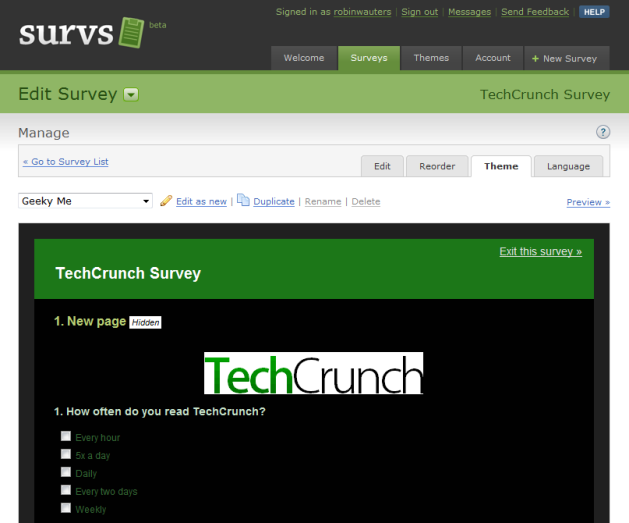
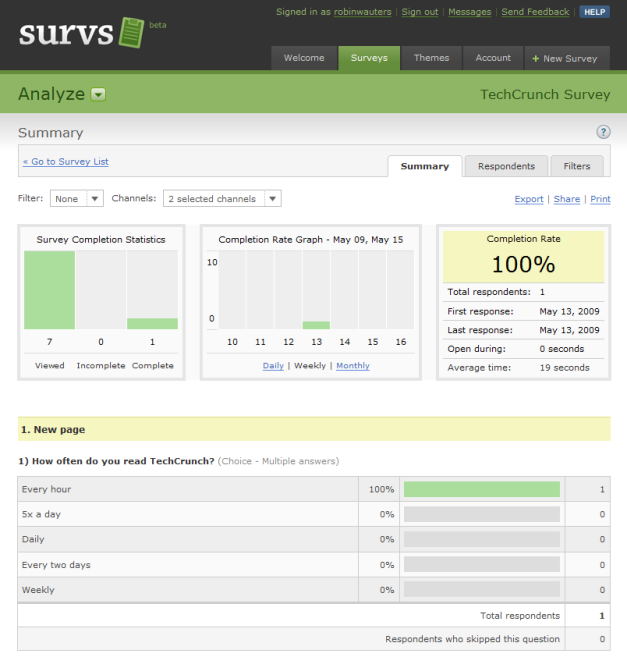
Survs helps you create, edit, deploy and analyze web-based surveys that can be easily and significantly customized. Not to say that it boasts loads of features you won’t find in any other online survey tool, but I found it incredibly easy to set up and edit new surveys as a first-time user and that’s already a notable achievement for services that are so easily made over-complex.
I particularly liked the fact that a lot of attention has gone to the overall design and copywriting of the AJAX-heavy application, which made the whole experience remarkably straightforward every step of the way. Survs lets you kick off with a basic feel, but after some time you’ll notice the little things that show how much power remains hidden behind the application’s primary screens.
The service has been designed to make it easy to collaborate with other people on surveys, and it even enables you to share your surveys results, templates and themes online at any point, which are features that are too often missing when web survey tool providers start feeling the need to make their applications too simple. In my opinion, Survs pretty much strikes the perfect balance between easy-to-use and feature-rich.
Surveys can be distributed to users in various channels, each with their own reports, either by a simple hyperlink, e-mail or an embeddable widget. I created a quick one you can see below, but if I have any gripes about Survs it’s that they don’t really deliver a great end user experience:
http://www.survs.com/survey?id=Z2V5NR9Q&channel=JDFP1JXWP2
Extra bonus points go to Survs for considering internationalization of the service right off the bat, with the ability to choose from eight (mostly European) languages for survey templates and text fields. Users can even go ahead and create and apply custom languages sets to any survey, which is very smart.
The app may well be in public beta for now, but no word on pricing yet, although the company is boasting about the fact that it will charge competitive prices for upgraded accounts. So far, you can see the link for the upgrade plan in your account settings, but clicking in it doesn’t reveal the tariff plan yet nor does it tell you anything about the premium features you’ll be buying yet. I asked the company for feedback about that part of the equation, but unless they utterly fail to live up to their promises of keeping the rates below average, I’d definitely consider becoming a paying customer.
Update: that was quick.
“Paying customers are charged monthly or annually. Monthly plans range from $20 USD to $120 USD, in addition to the feature-limited free plan. All paid plans are complemented with a usage rate. Each of these plans include a maximum number of survey responses that can be collected per month. Customers exceeding this threshold will be charged for each response over the limit in the end of the relevant subscription cycle.”
Survs is a product of Enough Pepper, a small startup from Lisbon, Portugal.