
Today saw the launch of two new real-time search engines, from OneRiot and Tweetmeme. While the two are slightly different in ways that I went into earlier, all that really matters are the results you get. So I put those two to the test along with Twitter Search, Google Search, FriendFeed and the recently launched Scoopler. To see which would give the best results based on a current event.
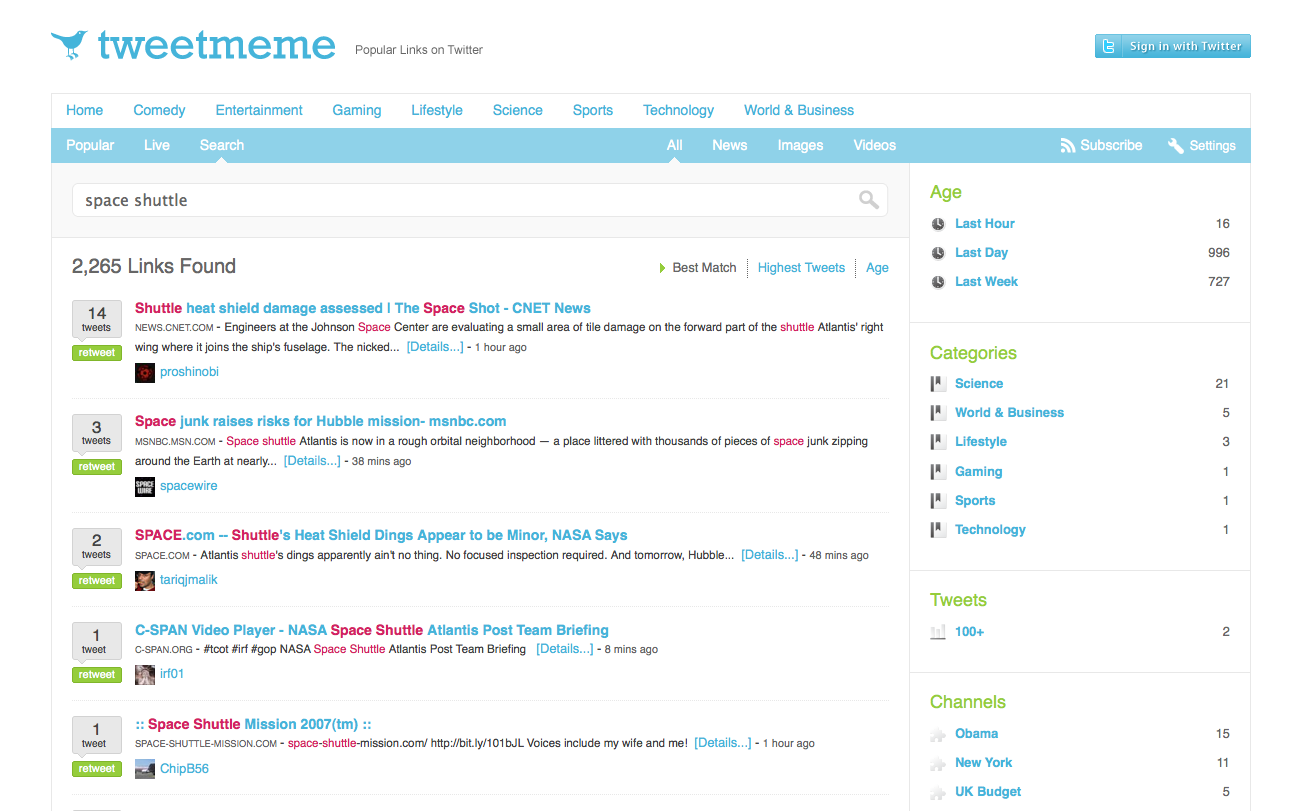
One bit of news I was interested in was the space shuttle, because it received some damage today while venturing into space. I decided to do a pretty generic search for “Space Shuttle,” since that is likely what most people would enter of all the possible combinations of words. Here are the results:
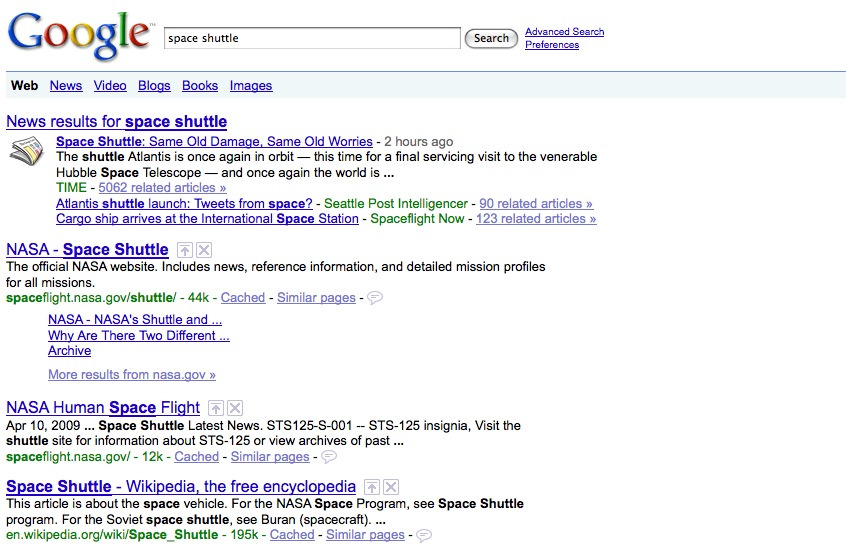
1. Google: The top result was from a Google News story about the shuttle damage. That’s good, that’s what I was looking for. The rest was historical information I didn’t want or need. Sure, I could have used a Google News search, which would have no doubt returned more relevant results (but maybe not that relevant), but most people still use just regular old Google.com, so that’s what I did.
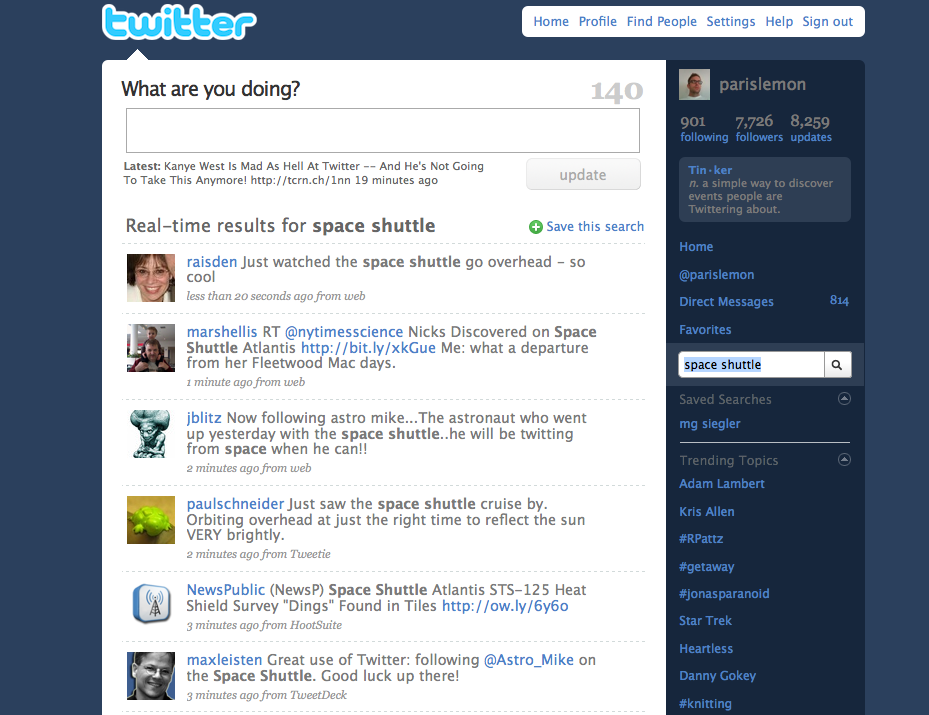
2. Twitter Search: The first result is pretty telling: “Just watched the space shuttle go overhead — so cool” That’s nice, but gives me absolutely nothing in terms of what I’m looking for. The second and fourth results were good and gave me links for more info — now you see why Twitter wants to (and should) get into the business of crawling links for its search results.
3. FriendFeed: The top two results are good, but the rest are just general information about the launch. This is an interesting set of results because unlike Twitter Search results, FriendFeed filters everything through my friends by default. That’s good for certain searches, but maybe not so good for big, meaningful searches when you’re frantically looking for information.

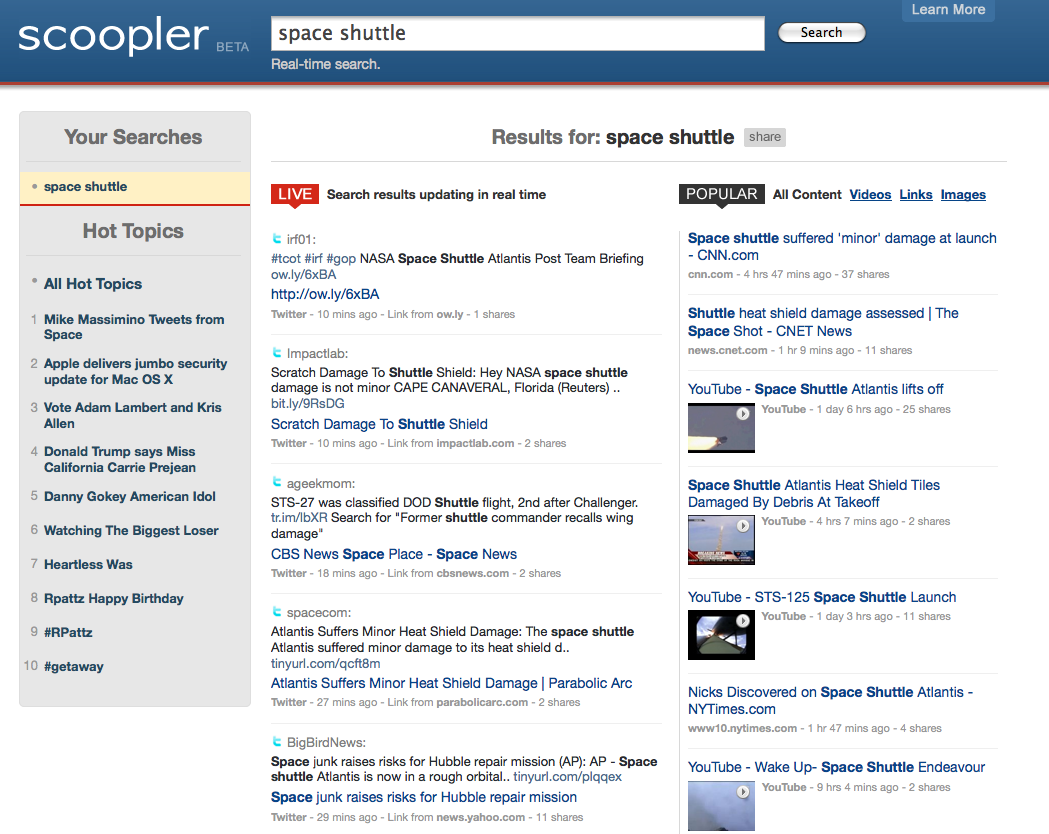
4. Scoopler: With its mixture of live tweets coming in and popular content, Scoopler gives me some pretty solid results for what I’m looking for. And it’s presented in a way that’s pretty easy to follow. I like this one, a lot.
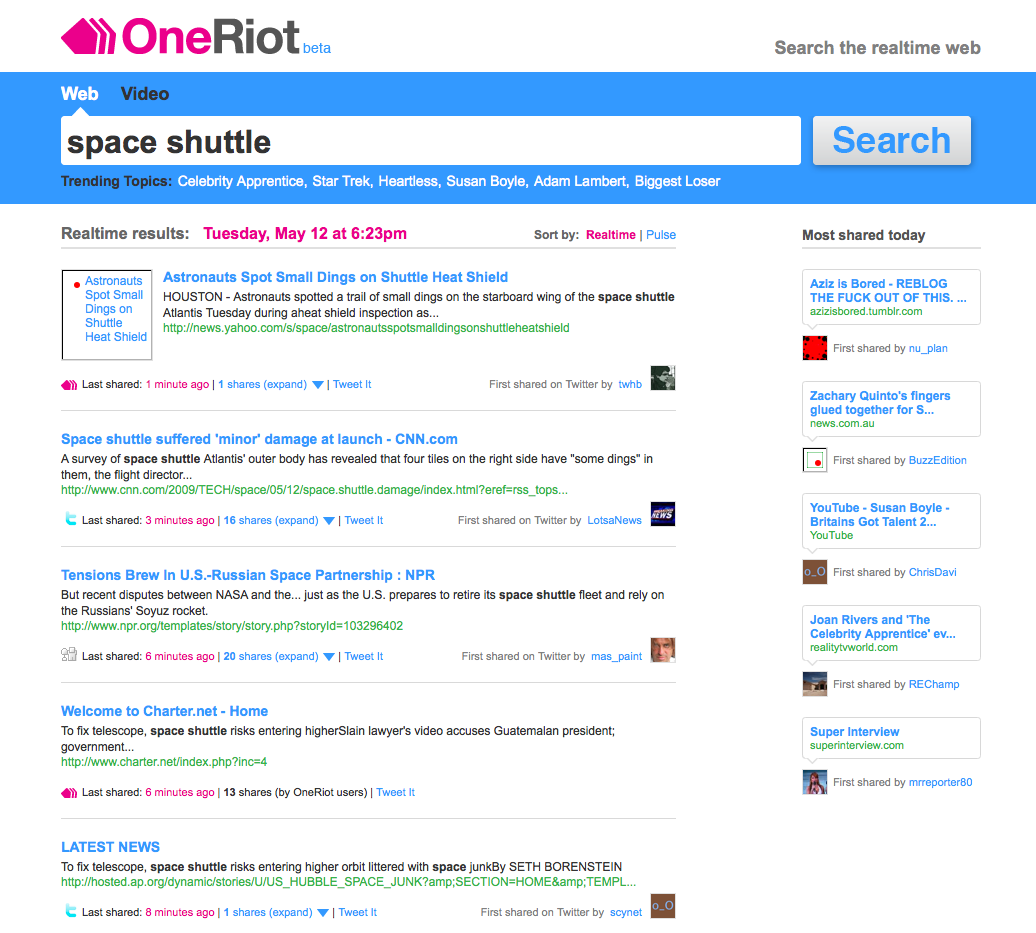
5. OneRiot: The top two results in the “Realtime” view are good, but the others aren’t what I’m looking for. The Pulse view isn’t much better. The relevant results come from Twitter or OneRiot itself. There’s nothing from Digg in terms of what I’m looking for. (OneRiot scans Twitter and Digg.)
6. Tweetmeme: Tweetmeme’s search defaults to the “Best Match” area which gives you a solid result for the number one and three items. When sorted by “Age,” the results are all over the place.
Second test: For a second test (not pictured), I did a query for “Miss California” — another hot topic on the web right now. Being as this one is a little less time-sensitive, the results were better across the board. OneRiot showed quite a few Digg results this time around, and even Google had some relevevant links beyond its Google News top area hits. Scoopler had some good popular results, but its Live area was dominated by tweets mostly making jokes to friends about the beauty queen. Tweetmeme’s “Highest Tweets” area really shined here.
Conclusion: It’s hard to declare one single winner because results vary based on how fresh the topic being queried is. Scoopler seems to work very nicely for breaking news as it mixes in an auto-refreshing Twitter search stream (as I keep going back to, it’s dominated by tweets) with popular items. Tweetmeme seems to work very well for slightly older items that have been retweeted a lot. OneRiot is nice in that it crawls the individual pages to get better content, but for breaking news, I’m not sure that it actually works better than a quick topical scan of a bunch of items. And FriendFeed’s search is great if you want to see what your friends are saying about something, but trickier if you go outside your social circle.
It seems pretty clear why Google is interested in adding a real-time layer to its search capabilites, while Twitter wants to crawl pages with its engine — the combo is pretty killer.


Any business with “meme” in its named is doomed to failure.
LOL
You may also want to incude Yauba, which is like a combination of Google an Twitter search
http://www.yaub...&target=all
Is that some sort of meme?
That’s absolutely true for Turkey, because meme means “breast or ti*” in Turkish.
Here we go again. Realtime is cool, realtime is sexy, realtime is not what normal people care about. The entire discipline of SEO is based on the fact that normal people never go past the first page of Google results. If that is true, how many of them are going to spend time staring at search results stream by in realtime? I do, and that is how I know it won’t become mainstream.
Years ago, I bet everyone said that normal people wouldn’t be able to use a website complex as Facebook and other modern social media stuff but today they can and they do.
People are constantly evolving and the line between power user and normal user is becoming thinner and thinner every day.
I wonder if it’s not a good thing that some of these sites give you varied results, as long as you also find what you’re looking for.
For instance, oneriot’s third link is to another current events story about space shuttles. Especially in cases where there are several popular stories about a topic, I think this is the best scenario, no?
Did you do any Wolfram Alpha real time search examples?
No, that’s not exactly WA’s thing.
Thanks for the writeup MG. We’re glad you liked Scoopler!
I would have searched for “Space Shuttle Damage” if you’re going to comment on how valid all the results you see are. If you don’t provide enough information for the search to tell what you’re looking for and then complaining the results aren’t relevant, doesn’t make sense. There are plenty of other items of interest happening about the space shuttle right now.
Real-time search isn’t a solution to finding *relevant* information, it’s a solution to find *timely* information.
I don’t agree with you. We are talking about “Real Time Search.” So, searching for “Space Shuttle” should still lead you to news on the shuttle damage, because that’s the most important current news about any space shuttles.
MG,
I thought the article was interesting, but you are comparing apples to oranges. People search with Friendfeed to see what their friends think about something, not for news briefings on current events. The big idea behind live search is to get individuals gut reaction to something as it happens. Did people like the android operating system 48 hours after being launched, for example. Everything else isn’t as relevant for live search.
You say “most people still use just regular old Google.com, so that’s what I did”.
In that case Google wins, because “most people” haven’t heard of the other services, let alone use them so they should score a big fat zero.
Seriously, use the Google News search.
Agreed. The kind of person who just uses regular old Google.com is unlikely to know of or switch to the other services, so Google News is the better comparison here.
try http://space-shuttle.love.com and see how it compares.
Real-time search is getting better with all these new players; take a look at our new tool for realtimeness, where you can search Twitter, Google, Friendfeed, Scoopler, OneRiot and Tweetmeme from one single location:
Space Shuttle: http://realtime...s=space+shuttle
Miss California:
http://realtime...Miss+California
http://search.popurls.com -> content + twitter + results as rss. I like it.
itpints ( http://www.itpints.com ) lets you grab the rss of your search
Good Job MG. Testing SEs for their value on real time information. Google will survive with Google news but the others need to improve. From what you say, Scoopler seems to be good, but we can say anything only in course of time. Real time search is really getting hot.
Cool test. The lesson here is that search can’t (yet) read your mind. The historical information you don’t want or need may be exactly what half the other searchers are looking for, so I think Google is doing it’s job here.
If I want to find out about something current, I search Google News followed by Google Blog Search. This rarely fails me. If the topic is so niche (or, often the case, “too local”) that it’s not on either of these I check search.twitter.com. Maybe a split view of the 3 would be helpful but you’re talking about a few seconds max spent skimming each page.
Reality – unless any of Google’s entrepreneurial competitors have a plan for mass adoption around a compelling differentiator, then this is an interesting lab test, but not more.
The TC test highlights scramble for 1st2market with nuances to search. Compelling differences will break into mass market; nuances have no barrier to entry or defensibility. (Same with every biz)
Twitter has brand awareness, which gives them a chance. Will be harder for them to move into Google’s space than the converse.
Perhaps mobile surfing habits will open up opportunities for compelling differences.
Personally like Browsys, but a) masses have no way of learning about them and b) will soon add RT search and then what is compelling?
Compelling competition would be a good thing, so wishing all of them luck.
I’d love to see some competition but in this case I’d say even without real-time search Google still has the better results. Their universal search (which is now 2 years old) putting the news results at the top should satisfy users who go straight to Google.com for current events.
In the end, it’s always a battle for relevancy.
Hi MG, we’ve been doing real-time search in links shared on twitter for a while, check the results for space shuttle :
http://micropla...q=space+shuttle
and for miss california :
http://micropla...miss+california
Results are sorted on a good mix of time based hotness and number of retweets.
A prediction re: MG’s last sentence: Twitter’s move into search will prompt a Google buy. Google cannot afford for Twitter to capture any significant portion of search market, as any later search engine acquisition (vs RT comment engine) will face regulatory scrutiny. Thoughts?
Beginning to think the same thing. Google has a good 80% of what I’m searching for, but can they risk the remaining 20%? On the other hand, a Froogle-style aggregation of real-time social chatter could also address these needs without a buyout.
MG, I believe your reasoning is flawed when it comes to real-time “search”. By definition, when something happens (in real-time), you don’t know it happened at that point. So you can’t search for it.
At twitscoop, we’re don’t believe in real-time search. You can’t be searching for something you don’t know happened. What we believe in, is real-time DISCOVERY.
Search is not applicable to the real-time web, DISCOVERY is. That’s what we do with twitscoop, we help you discover news items in real-time. Just look at our tag cloud. We’re not the only ones in that space, my point is just that real-time search is over hyped, and that discovery is the real deal.
What do you think ?
its so nice but also awkward to see everyone copying each other.is that fair?yes it is !
To be honest I wasn’t even aware of any space shuttle take off let alone that it received some damage today!
Google has a product in its Labs called the Google News Timeline, which may be relevant to the real-time search.
http://newstime...googlelabs.com/
It is a useful way of visualizing news stories on a time-line.
It’s interesting that you didn’t include dailyRT in your testing. I guess since we don’t include “Googlesque” searches in our results we don’t consider ourselves a search engine, but you would have gotten quality results for news articles and tweets by simply clicking on 24 hours and searching space shuttle. In my opinion, probably better results than any of the places you listed above. And if you’re interested in true real time searches you can click on live tweets and get real time tweets coming in based on your search term without having to refresh, which I’m not sure any of the places above do any better than us.
Interested In Your Feedback,
Chris
Ok, here’s what i don’t get. You use services like Scoopler to get the most timely information about an immediate event. Since Tweets are the quickest method of getting information on the internet, they should have the most up to date information. But with most tweets saying something along the lines of “Just heard about the space shuttle damage – WOWSER!”, the only tweets that actually contain any useful information are the ones linking to sites that contain full information on the event. This means that the only valuable tweets are the ones that appear after someone has written a traditional article about it.
The tweets are worthless if their only value is bringing information online faster than other media, if the only useful ones most wait for these other “slower” media. Scoopler is nothing but a real-time search of exclamations and links to articles that have little to do with Twitter and nothing to do with it’s supposed timeliness advantage.
I wont be the first to say this, but have not seen it yet here. The value of Tweet search is more akin to Nielsen than to Google. They measure the buzz and interest factor, which would be more useful in the form of stats analysis and would be very useful for businesses measuring effectiveness of campaigns or media measuring penetration in vertical markets (ie whether they vs other outlets are the chief link creator for a story). Otherwise, Iliksute is correct.
That said, most great ideas are not the ones on which the business is founded. They are the ones that are discovered once you get into the market pool and start to swim around. These search engine aggregators are doing just that, and my hope is that they will use their initial platforms to springboard into something more innovative. Smart guys, fast moving development, real market experience = innovation +/- profit (ah, the key!)
There is certainly value in real-time search but Twitter and Google will still dominate when all is said and done. These other players can only hope to be bought out for the technology they have created.
http://search.y...b-top&sao=1
check out topic suggestions
maybe this helps
http://sonicgle.../keepitreal.htm
Technorati has had the combination of real-time and crawling what people are paying attention to for a long time. Making real-time work is very complex at scale. The volume of data presents a couple challenges: the data becomes nearly irrelevant shortly after it appears (within weeks); it’s much easier to spam; and it’s hard to balance recency and relevancy together.
I think you should give a try at itpints ( http://www.itpints.com ). it’s another real time search engine which have a good quantity of sources
MG: well I like OneRiot, but I’m not sure how to save searches, or create RSS feeds. When I tried to submit feedback, I got a 403 error.
Real time search is about finding out what people are saying about your topic right now, and that search brings up the latest and not the most relevant. Google is great for historical searches, but there are many real time search engines that are worth looking up.
Monika Lorincz
monika@surchur.com
http://surchur.com/
Blog: http://blog.surchur.com/
Twitter: @surchur
There is certainly value in real-time search but Twitter and Google will still dominate when all is said and done. These other players can only hope to be bought out for the technology they have created.
I don’t get the case study in this article. Why would anyone searching for news type “space shuttle” since they wouldn’t know breaking news until it happened. This type of search might be useful for current news where events are unfolding, e.g. Iranian election, Obama healthcare. But I think most people are passive consumers of news information, and when are searching or investigating a new topic, they are not looking for real-time information as much as deeper, more detailed, and contextual information.