 Social interaction is one of the driving forces behind the web right now, with Twitter and Facebook both growing at phenomenal rates. But outside of social networks, advertisers have largely failed to get in on the action – on most web pages, banner ads usually consist of a flashy logo and maybe some clever text, without any content that is actually personalized to you.
SocialMedia, an advertising company that has largely concentrated on social network advertising until now, is looking to change this. The company is releasing a suite of new interactive advertising products, collectively being called “People Powered Ads” that look to help brands create more engaging ads by tapping into the social power of the web. Alongside the launch the company has announced that publishing giant IDG is its first partner, and that IDG will be rolling out advertising campaigns and selling customized versions of ‘People Powered Ads’ under its own Amplify banner.
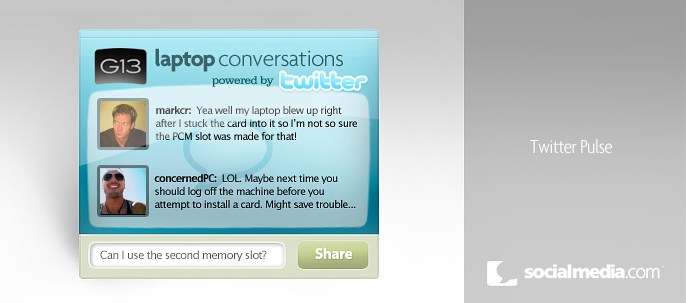
The first set of People Power Ads revolves around Twitter – a platform that is at once very appealing and terrifying to most brands. The flagship ad unit is ‘Twitter Pulse’, which will display some of the most recent Tweets highlighting a company’s product or brand name (it’s essentially a custom emeddable Twitter Search). For example, Apple could create an ad unit for the iPhone, presenting the five most recent tweets that mention the popular device. This kind of ad can be quite engaging, but it is also scary for brands, as it could potentially display a tweet that is deriding the product. To compensate for this SocialMedia will allow brands to create their own filters to weed out profanity or negative remarks, or to only show tweets from selected users.
SocialMedia is also offering a product called ‘Twitter MegaPulse’ that allows brands to create entire microsites dedicated to their customized feeds. And finally there’s ‘Twitter Sparq’, which allows brands to syndicate ads to Twitter clients, inviting users to tweet about a particular product (which would then likely show up in their Twitter Pulse).
The second set of new ad units is called ‘Friend to Friend’. SocialMedia rolled out a similar product called “Word of Mouth” ads in March, inviting inviting users to interact with ads, which would then be customized with their responses when they were shown to friends. This product does essentially the same thing, but also allows brands to tap into content on their Facebook fan pages. And if a user grants SocialMedia permission though Facebook Connect, customized ads could appear on sites outside of the social network.
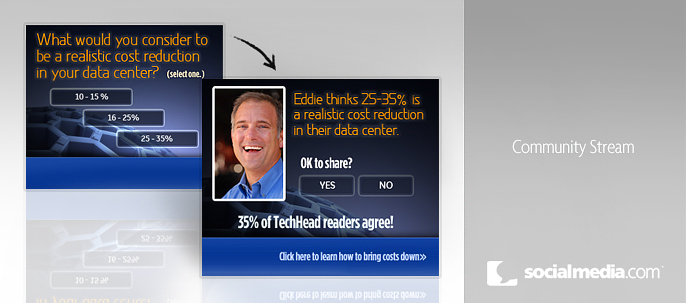
Finally, there are community products, which aren’t reliant on any outside social networks. An ad unit called the ‘Community Poll’ asks users for input on a topic, and then presents the current results to other visitors. The last product is the ‘Community Stream’, which allows users to leave comments about a certain product or brand (it’s similar to the Twitter Pulse above, but allows visitors who don’t use Twitter to leave remarks.
It seems inevitable that the majority of online ads will eventually be customized to suit your personal preferences and those of your friends, and SocialMedia seems to be ahead of the curve in this respect. That said, even with the filter options it will likely still take many brands far longer than it should to warm up to the idea of ads customized with user-input, so it may still be a while before this becomes widespread. And while SocialMedia asks users for permission before sharing their input, I wouldn’t be surprised if there is also some initial backlash as users begin to see their friends pop up more often in ad units.