
With retail spending at all-time lows thanks to the current recession, stores are looking for ways to provide deals, sales and discounts for consumers. Some stores are even letting consumers haggle for prices. NetHaggler is hoping to woo both consumers and online retailers by providing a service that lets users track and negotiate prices online. Free for consumers, NetHaggler has enlisted retailers to participate in its service through affiliate marketing services, like LinkShare.
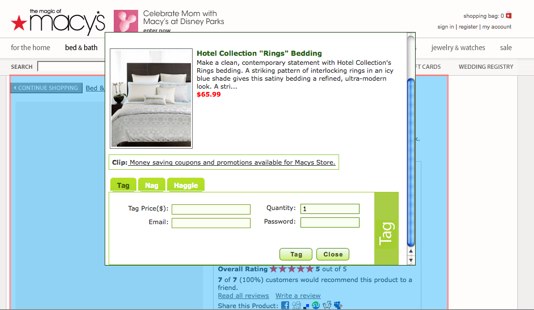
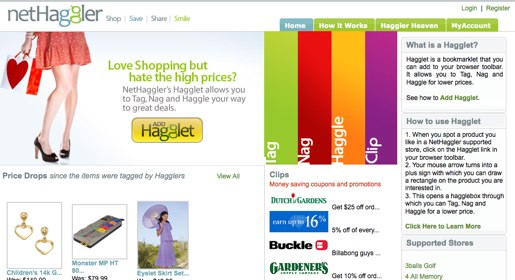
After installing a simple and secure bookmarklet (called the “Hagglet”), users can click on the link on the link in your bookmarks bar and draw a box with a cropping tool around any product that is from an affiliate NetHaggler Store. This lets NetHaggler capture and store the product and price information so the site can work its negotiation magic. The site will then let you choose whether you want to Tag, Nag or Haggle a product.
Tagging an item lets you enter a specific price and then get updates via email with price reductions that occur over the next few weeks or months. Nagging, which is NetHaggler’s flagship offering, enlists NetHaggler to determine whether consumers are eligible for an immediate discount on the list price. Consumers can submit a price that they are willing to pay and then NetHaggler will return with an yes, no or counteroffer from the retailer. NetHaggler’s founder, Satya Iluri, says that the site employs an algorithm to determine how much of a discount the retailer is willing to negotiate (if any) and also takes into account the consumers behavior in the site.
Haggling lets you do something similar to nagging, because you still can request a discount and indicate how much you are willing to spend. But if the item you haggle happens to be a popular item amongst other NetHaggler users, then NetHaggler will negotiate a volume pricing or bulk deal that will produce a steeper discount, says Iluri.
Its important to note that the discount a consumer receives through NetHaggler will not be deducted from the price of the product (you have the pay the full price). You will instead be issued payment of the discount through PayPal or a check. NetHaggler only makes money if the consumer buys a product; the company receives a small commission on each sale.
The ability to track the price fluctuation of a product isn’t new—tracking sites like Trackle and Notify.Me also let you track the prices of retail goods. Aroxo is doing this for eBay and Fididel also has a haggling site.
The haggling part of the site may be attractive in the current spending market. NetHaggler has a roster of big names affiliate retailers on the site, including Macy’s, Wal-Mart, BestBuy, and Nordstrom but when I tried to sign up to “Nag” a retailer for a shirt on Abercrombie & Fitch.com, I was only able to Tag or Haggle, the nagging feature wasn’t available for A&F although it is a supported retailer. I also tried to “Nag” a product at Macy’s and was unable to do so. Illuri says that some retail sites don’t have the necessary data feed connectivity and web services to work for the Nag function, which is a shame because that is the feature I would use most.


Ok, so they’re making a couple bets here that I can see:
1. That people want to haggle to get a better deal
2. People are going to be willing to wait to hear back on a deal
3. People are going to do these things online
4. People are willing to accept that the money comes back via paypal or check
(Those four are just me trying to differentiate what they’re doing, makes it easier to analyze if everything is separated)
If a company sees that there are 10,000 people looking to buy a jacket that they aren’t able to move, this could potentially be a good option for them. The other choice for them is to sell it all to a company like Overstock. If they can move all that inventory by meeting the price nethaggler shows, then that is a possibility.
I don’t want to sound like I’m entirely negative about this, because it will help companies get a lot more data on what the consumer wants and is or isn’t willing to pay for. The power of it might be in either market, I’m not really sure.
nethaggler may already be worth $750 million. It’s thriving in this mental recession because consumers feel compelled to save money by comparison shopping. No recession htp://iamned.com/blog/ in web 2.0.
good luck getting big name retailers to participate in the ‘nag’ process. Sure, it’s easy for this site to join retailer affiliate programs (most are set to ‘auto-approve’ publishers), but I don’t see big name retailers (Macy’s, Gap, etc) actively haggling with anyone (it’s just not worth their time). The bulk buy concept is interesting, but there are tons of sites that have tried this concept and failed. I’m betting that the demand is spread to thin among too many products, which means they never reach the ‘critical mass’ necessary to peak the interest of retailers (e.g. 4 people want X, 5 people want Y, 9 people want Z, etc)
Amazon actually stopped affiliate accounts for discount deal sites because it cut into their margin too much, they probably wouldn’t like this if it caught on a lot.
I don’t know if we can expect this to work a lot on large volume products… Sites like Amazon are already operating on something like a 22% profit margin, that’s even lower than the 25% Wal*Mart gets. Are other sellers really going to be able to beat that?
Sounds interesting. We ShoppingNotes.com specialize in price alerts (that is, the “Tag” feature). Our bookmarklet works with any merchant sites, not just some affiliate sites, and does not require user cropping. Check it out!
http://www.neth...cripts/x54ui.js
http://www.neth...ripts/x54htm.js
I really can’t be bothered checked if they are cooking stuffing of not…. ?
I see this one as a better bet for those intelligent buyers who are not influenced by usual promotions. On an individual basis it’s more about getting a right deal and not about paycheck reduction due to recession.
Wish you good luck !!!!
Many merchants/retailers may not be able to support this. Its not that they dont want to give a consumer a “good deal”. As many know there’s so much retailers can do due to margin, inventory & IT boundaries. In addition it can take away from the value of a brand or product. Though it’s a very innovative idea but wont be efficient for all merchants. Even outside of a recession consumers will always be looking for a better deal…what they may not realize is that they already might be getting the best deal there is on a product – without having to “haggle”.
Something like ShoppingNotes.com which notifies me of price drops for items I’m interested in – on any website – sounds like a lot more practical.
This reminds me of priceline and i have met the founder and was thinking about why it failed, and just like ebay, people value their time and these haggling sites and auction sites make people wait to see if their deal was approved. We are too busy with work or looking for work to waste time guessing on prices. If it is a big ticket item then maybe, but people use the internet and amazon.com for the convenience.
Good idea, but I’m with the majority of these comments, it might take too long…people don’t have the time to devote to a website. I feel like barter might even be a better bet… http://www.tradeaway.com has enough items listed to fill anybody’s wish list, and they don’t cost a thing. One mans trash is another mans treasure!
Learn the english language please – “barter” does not mean “haggle”!!!!!