
Mint Turns Personal Finance Into A Game. It’s Better Than It Sounds
by Jason Kincaid on April 28, 2009

Mint, the popular personal finance site that won 2007’s TechCrunch40, is launching a new feature called “Financial Fitness” which, strange as it may sound, adds an element of gaming to the service. Yes, it may sound like a bizarre combination at first – personal finance and fun aren’t exactly two things that go hand in hand. But it’s also a smart move on Mint’s part, as it looks to turn the mundane and often confusing activity of getting your financial affairs in order into something a bit more tolerable while increasing Mint’s engagement in the process. Mint is running the new feature in a private beta for a few weeks, and the first 500 TechCrunch readers to Email techcrunch-getfit@mint.com with the Email address they use on Mint.com will gain access.

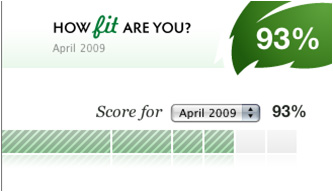
The game itself is fairly simple. It outlines five main principles that users should focus on on the road to financial fitness, including ’spend less than you earn’, ‘manage credit and debt wisely’, and so on. Each of these core principles has a number of tasks associated with it, like ‘Avoid Bank Fees’ and ‘Come in under budget’. As you complete tasks, you are rewarded with points. Over time, you can earn merit badges for completing more difficult tasks, like being named as a “Financial Guru” for maintaining a 100% health status for an extended period of time. And then there’s the more tangible bonus of likely having more money than you started with.
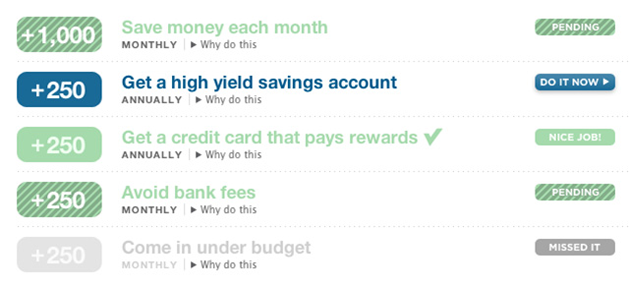
Mint has studied the reward systems of games including Wii Fit, Warcraft, and Nike Fit as they built the game, looking to turn their virtual financial advisor into something a little more interesting than a wall of text. Of course, solving each of these tasks often involves the user interacting with a Mint feature or a referral to a partner site, which means Mint can effectively monetize the game as well.

I’m sure many people will initially react to the game with skepticism, as it isn’t exactly the first thing you’d expect at a finance site. But seemingly pointless gaming elements can be useful nonetheless: one need only take a look at foursquare, a fairly new application that is quite addictive because of its game-like nature. That said, these kind of point systems tend to work best when there is some kind of social element involved – be it through a rivalry with friends or an aggregated leader board. As a financial site Mint doesn’t seem well suited for this kind of competition (it would be a bit strange to make fun of my friends for having a poorer financial health than me), but I think the gaming aspect should work nonetheless.


Advertisement

Responses

Comments rss icon

  • That’s a good feature. Can no wait to get on the beta.

  • How would they make this game fair?

    In most cases, “financial fitness” is much harder to achieve for people making $50K than for those making $150K. Will the Financial Gurus be the wealthiest people with the highest cash flow?

    Will Mint end up giving away points and prizes to its wealthiest members? A case could be made for that, but how would that help everyone else?

    • Your Financial Fitness score has absolutely nothing to do with your income, net worth, performance as an investor, or how much debt you might have. It’s really a measure of are you doing everything in your power right now to improve your financial situation.

      For example, you’re not penalized for having debt – so long as the balance of your credit cards, student loans, and mortgage goes down (even by a small amount) each month.

      You’re not rewarded for how much you have lying around in your bank account – but you are rewarded for avoiding bank fees (overdraft charges, late fees, etc.).

      Aaron Patzer
      Founder & CEO, Mint.com

      • Hello,

        I’ve been a longtime user of mint. I know you just said it does not matter the amount one has in their savings or bank accounts but is savings rewarded at all? Putting money away in an IRA should be a commendable effort. Yes this does depend on the level of income but if savings goes up and discretionary spending goes down as well as credit card debt, then i think a case should be made for rewarding that player.

        just some thoughts.

        Thanks,

        Juan

      • Hey Aaron,

        Big fan of the mint.com site. Keep up the good work. Def looking forward to giving the game a try. Also I’d like to see Mint continue to try and find ways to monetize. Many of us are looking for ways to be more financially savvy and if Mint can benefit from helping facilitate then I think it’s a win win for everyone.

        I track my financial fitness through the net cash flow graph. It’s the most comprehensive way for me to tell if I’ve improved my financial situation or need to make small adjustments.

        Mike

  • Given the lack of personal financial education in the country, we found that our users desperately want to improve their financial situations, but often don’t know what actions to take next. Financial Fitness is a step-by-step plan for going from financial visibility to financial improvement. By improvement, I mean a better credit score, reduced debt, and increased long term prosperity through savings and investment.

    It is a “game” in a sense, as well, in that Mint gives you credit for all your good financial habits, and lets you know what the next most important step is on the road to improving your finances. The most basic tasks (pay down your debt, check your credit report for errors, ensure you have a three month emergency fund) are introduced in the first month, with more nuanced tasks (put your excess cash into a CD, for example) introduced in months 3 or 4 of the system. In that sense, each month is like a “level”.

    It’s serious stuff – the 5 principles underlying the system, along with the associated tactical steps, were developed in conjunction with a number of financial advisors.

    Taking the step from visibility into your finances to direct improvements is something that really hasn’t been the domain of personal finance tools to date. Typically, people rely on a financial advisor. Unfortunately, most people don’t do that, and for those who do, it’s expensive and you likely only meet your advisor once a month or once a quarter. Mint now has a free system to get you financial fit with daily and weekly feedback.

    It’s a little experimental (hench the beta and gathered as much user feedback for the next few weeks as possible). I’m really interested to see what TechCrunch readers think.

    Aaron Patzer
    Founder & CEO, Mint.com

    • Aaron, doing more to give your customers feedback on their financial solvency is great. Have you considered bringing the Consumer Credit Counseling Service as a partner for your service? For customers with low cash balances and large credit card balances with high interest rates, it could be extremely helpful. CCCS helped me eliminate $13k of credit card debt 30% interest rates in 3 years, and saved my financial fututre.

    • Aaron said…
      The most basic tasks (pay down your debt, check your credit report for errors, ensure you have a three month emergency fund) are introduced in the first month, with more nuanced tasks (put your excess cash into a CD, for example) introduced in months 3 or 4 of the system. In that sense, each month is like a “level”.

      I am no accountant but that looks like a perfect application of Operations Research (OR) type problems, ie, optimizing of resources via minimization or maximization of the objectives.

      This is a powerful feature (ie, OR) if implemented Aaron to allow your users to do optimized budget allocations. I have seen some Excel OR plugins but I am not aware of any financial/accounting software that implements OR, even a lot of financial advisers haven’t heard of it, let alone know what it is. Here is some useful links about the application of OR in the efficient capital/budget allocations, which you can find here and here.

      There are some OR APIs already available on the internet in various languages such as Java, C++, Matlab, etc, you just basically Google for them.

      • Oops, I forgot the second link on efficient capital/budget allocations. It is here.

        I also forgot to mention that the best OR API that is commercially available today is from ILOG, but I think that it is very expensive per developer’s license, something like $ 10, 000 to $ 20, 000. Their CPLEX API is quite popular both in academic as well as in industry.

    • Aaron, I have to say I disagree with Jason’s final remarks in the article:

      “As a financial site Mint doesn’t seem well suited for this kind of competition (it would be a bit strange to make fun of my friends for having a poorer financial health than me)”

      In the US at least, one of our worst traits is financial responsibility. I read recently more people would publicly talk about their sex life than their credit score. That must change. A game, exposing/rewarding our financial lives is a great start.

      • I agree with Ian, I healthy conversation starter like Mint could help us all deal with our financial situations good or bad. Maybe this is an opt in feature to share your score with others? Maybe users can share personal experiences such as the user that saved money consolidating debt?

  • My bank is based in sweden, and thus it seems I cannot set up my profile on mint… no dice?

  • Does K.K. Slider come out and sing me a song if I get a perfect score for the month?

    A surprisingly clever way to use the culture’s gaming gene as an incentive towards financial sanity.

  • Cute.

    But games have never worked as a part of a serious financial service—outside of pure stock investing. Money just aint that much fun.

    • I disagree, I played Cashflow from Robert Kiyosaki and a lot of financial ideas and processes started to make real sense.

      I wouldn’t recommend living your life by monopoly or hungry hungry hippos but this could be a very interesting approach.

  • Brilliant. You turn something that’s really hard to do because there is no instant gratification in compound interest into something with instant gratification.

    It goes from a nice site for the financially savvy to something every personal finance instructor at every high school tells their students to sign up for.

  • P.S.: Now if you could just add the one feature people have been asking for since launch – the ability to manually enter entries into one account. Everybody has one account somewhere that doesn’t plug into mint. I notice from you boards you’ve been saying this will come since 2007, so getting that in there would cover all the “edge cases” until you can get around to plugging them in.

  • Aaron, a version of this which was suitable for younger school age people (11-18) would go down very well with our users. There is a big need for better financial education in UK schools and I can see this fitting in perfectly with our system Vivomiles.com . Vivo Miles replicates a real bank account and is based on rewards for doing good things in school. Let me know if this is of interest?

  • I don’t fault mint for focusing on features that help drive revenue (which this surely is, just see the screenshot), but I’d like to at least see the basic budgeting feature work well before adding stuff like this. I think budgeting is one of the most important user features and its pretty poorly done at this point.

    • Baconner, thanks for the feedback. Improved budgeting, which includes allowing for non-monthly (semi-annual, annual) expenses, is our top priority for our next release (due out in 6 weeks) – we’ve been interviewing dozens of people on their methods for budgeting to come up with the best fit for a broad range of styles.

      Aaron Patzer
      Founder & CEO, Mint.com

  • Their software doesn’t work in Canada, despite hundreds on posts on their forums asking for support of the mere 6 banking institutions.

    Nice idea, but I’ll stick to Wesabe.com, thanks!

  • What RealAge.com is for my health, i feel like mint.com is for my money.

    I think these guys have got a great core brand and business. This advent into gaming is just the beginning of what they can do now to build personal relevance. Gaming (even w/out the social component… yet) is an easy point of entry that tells me more about me and creates more personal commitment.

    I love the business model too. I can see a stage later where someone like GoodHousekeeping.com has Mint co-branded quizzes that profile you (please, tell me more about me…) and lead you gently into mint’s money management.

    And from that profiled info, both parties can then point you to much more relevant information, lead generation and social connectivity. Curated content and the whole semantic vision is where a lot of exciting organic (and organized, marketing friendly) growth is happening.

    No I don’t want my friends to know where I’m at on my grocery budget, but I wouldn’t mind making connections based on my shopping profile, and enter into an answers dialogue on where to find the best priced beef tenderloin in my zip code. Or sharing tips on mutual funds. Whatever.

    Culturally we’re only beginning to rediscover the benefits of community. For those of us in this space for years, it’s hard to comprehend that we’re a very small % of the pop. I think Mint.com has the potential to be a very big player on many levels, especially if they can indeed find their way to a relevant social/community connection.

  • In that case I’ll shut my yap and check out the new features on release. Glad to see you guys are activly taking feedback.

    … Well ill shut my yap after this thread anyway…

    In my case everthing budget wise is centered around savings goals which means the most important number is income left for savings per month. So just being able to easily see complete outgoing cash vs income for the month would solve a lot. Being able to roll budget overflow in a category out of funds available for the next months budget would help a lot too.

    I’ve been right on the fence about just writing my own budgeting software for months now. Hopefully your changes will let me spend my weekends writing something more fun instead!

  • The concerns about this not being a “game” aside, how do you avoid making this a token economy?

    To provide some of the psych background, in a token economy, people start taking actions so that they can gain “points”, or whatever the token is, instead of because the action itself is enjoyable or worthwhile. This actually works tremendously well at getting people to do things…until you take away the tokens. The moment you stop “paying” people for their behavior, they stop engaging in the behavior, because the tokens were the reasons they started behaving in the first place.

    That is the reason we didn’t do this sort of thing in Thrive, though we’re glad to see that Mint has learned from our site’s Financial Health score in creating their “Financial Fitness” criteria: imitation is certainly the greatest form of flattery.

    Thrive (www.justthrive.com) displays your Financial Health as a way of helping you track how you are doing, and to help users understand how various financial health elements can affect their lives. We’re doing more to expand it and make it a better educational tool that helps you sum up at a glance how your behaviors are affecting your life. But – and this is important – it isn’t used extensively as a motivator.

    People already have the motivation: they have dreams, wants, and desires, and many of those require money to accomplish. What they need is not simply temporary reinforcement that works only as long as they stay with the program (i.e., “points”), but rather practical, quality advice that helps them achieve those goals and continue to grow financially, even when they aren’t online. And that is what Thrive seeks to enable by providing easy-to-understand, easy-to-use financial advice that actually helps people change.

    But don’t take my word for it. I’m commenting here because I think people need to be able to compare for themselves, and it is important to understand not only where the ideas are coming from, but how they are being implemented by different sites. We invite people to see for themselves why Thrive created Financial Health and how we are using it at http://www.justthrive.com.

    And as always, feel free to give us your feedback by e-mail at feedback@justthrive.com. Or you can grab me at matt@justthrive.com or call us with specific questions – you’ll get one of our team. Who knows, you might even talk to me! =]

    • here’s some feedback: go away, your product is inferior, and you look pathetic every time you comment in a mint thread. do something original and then maybe get some press of your own. there’s a novel idea!

    • Hi Matt,

      Sure, I’ll explain.

      I already responded to the nearly identical comment here: http://news.cne...10228634-2.html

      I don’t want to repeat too much, but Fitness is not a token economy, you can’t redeem points for anything, and we have no plans of taking it away. It’s more like points in a game, achieve-mints if you will where the larger point items have a greater impact on your long-term health.

      If someone stopped using Mint.com, I sincerely believe they would still be interested in making money, and hopefully the habits stick. I guess we just differ there. I respect your approach but we took one that we feel is most helpful to our users– we will listen to them during the beta to see if we’re right.

      There’s irony in your imitation comment, but it honestly was on our roadmap before you launched.

      Jason Putorti
      Lead Designer, mint.com

      • Hey Jason-

        We keep commenting in opposite threads – my reply is up at CNET to your comment, so like you, I’ll try to avoid repeating too much of it here.

        I think the key point is the one you put forth: we have a difference in approaches and I appreciate that both of us can respect those differences. I’m raising a cautionary flag that comes not from Thrive’s research but from decades of psychological work, not because I want to say that Mint will fail but because I’d like to see you succeed. We all need to do more and be better to serve those that rely on us.

        I am nothing but glad that Mint is finally starting to talk about financial education, as it is clearly something that matters in the world today. And I’m glad that Mint has learned from Thrive and moved towards giving advice. People need all the help they can get right now and I hope that Mint can join us in providing it.

        Matt Wallaert
        Behavioral Psychologist, justthrive.com

  • Seems like I am part of the beta anyway!

  • Greg mentioned cashflow and for all its insipid design its premise was exceedingly compeling and made for a great deal of financial thinking on my part. But its the only game like environment I have ever seen for realworld financial. I welcome Mints intentions as well as their implimentation for one very good reason … when you play with what is really yours … you play for keeps. I just wish all those fictional portfolios I had over the years could have been stocked with real shares! I want to see how this evolves, good luck to you Aaron!

  • Aaron – The key aspect of games which keeps me coming back is a public acknowledgment of accomplishment.

    I love kongregate.com for it’s public badges which, while seemingly pointless, make me play a game on kongregate vs competitor sites.

    To help people show that satisfaction, public badges or accomplishments could greatly help this spread & open up the conversation in the US around finance by making people proud to share their finances instead of it being a taboo topic.

    • i love kongregate. nice comparison. i wasted a good 2 months playing various DTD games there. if mint can get me to do that, they win :)

  • Hi Aaron,

    The budget feature I’d most like to see is the ability split a bill that I pay once or twice per year into a monthly budget item. For example the $240 gym membership fee that I pay once per year I would like to record as a $20 per month budget item.

    So few budgeting programs allow me to do this that I stick with using excel.

    - Joe

  • Until Mint allows me to enter cash transactions manually, it is of little use to me. My bank website has more up to date information (pending transactions are shown, whereas they aren’t always included in Mint), and if I can’t enter cash transactions, all the nifty budgeting features that Mint offers are simply inaccurate for me.

  • I am becoming a fan of the foursquare application which does this really well. They give out badges as you use the service more and get more sophisticated.

    This is a good idea

  • Mint.com is possibly worth $10 billion. NO recession for web 2.0 and Silicon Valley. http://iamned.com/blog/ keep buying stocks

  • I just saw their FINOVATE presentation. It was quite impressive.

  • Loved this last phrase lol:
    (it would be a bit strange to make fun of my friends for having a poorer financial health than me),

  • If anyone’s interested in taking game mechanics and applying them to their own online property, you should check out our Nitro platform: http://wiki.bunchball.com – provides all the mechanics for incenting and motivating user behavior as a service.

    - rajat

  • I have been using Desktop Budget from http://Spryka.com to manage my personal finances for a few months now. Its the easiest to use free, offline personal finance software I have seen so far.

  • There’s one thing that drives me crazy about Mint. Whenever I try to connect my Everbank account to it, the security questions I’m asked are completely different to those that Everbank has on file, so it’s always rejected. Anyone knows why that is?
    thanks.

    • We’re working on handling extra security questions in a more elegant way via “interactive mode” where we’ll only ask you the questions that appear live on Everbank, as opposed to all the questions they could ask you. Should be out in early June.

      Until then, just answer only the questions that you answered on Everbank and it should go through.

      Aaron Patzer
      Founder & CEO, Mint.com

      • Great post, Jason. We couldn’t agree more that a little friendly competition can help spur investors to change their financial habits for the better.

        The TradeKing Leaderboard works much the same way for active investors. Members of our Trader Network can opt to publish their performance stats from trades placed in their TradeKing accounts. The resulting stats generate a game-like ranking of our active investors that’s constantly changing for various timeframes. Not only is this a fun way to motivate one towards better returns, it helps our members identify the best traders in our midst to swap ideas and strategies with.

        Experienced traders realize that smart investing isn’t merely about chasing huge rewards, either. Success is ultimately about exercising discipline and knowing when not to put capital at risk – just as much as it is about landing that big trade. Public performance stats like the TradeKing Leaderboard help investors balance risks against rewards more intelligently. Friendly competition, we believe, produces smarter, more successful active investors as a result.

        Be Good,
        Don Montanaro
        Chairman & CEO
        TradeKing
        http://www.tradeking.com

  • I like Mint’s idea.
    I’m a great fan of utilising games to help people to learn about finance and investing. It is the principle behind the Texas Holdem Investing program that I am developing.
    The Financial Times have developed a similar idea with their new Money Gym concept, although I have to say that I’m not that impressed by it.
    Trent at The Simple Dollar blogged about this yesterday on his site when he talked about ways to make financial education more interesting.

Leave Comment

Commenting Options

Enter your personal information to the left, or sign in with your Facebook account by clicking the button below.

Alternatively, you can create an avatar that will appear whenever you leave a comment on a Gravatar-enabled blog.

Trackback URL
Short URL
bugbugbugbug
Techcrunch on Facebook