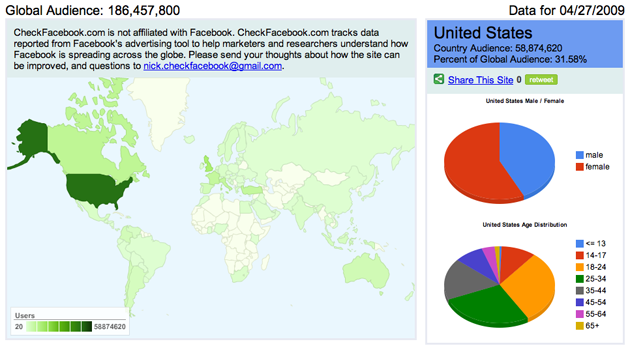
We all know that Facebook is growing like a weed, especially internationally, but which countries are really seeing the most growth? TechCrunch alum Nick Gonzalez has put together a new tool called CheckFacebook designed to help users do exactly that. The site is primarily meant for advertisers, who can use it to gauge where to deploy campaigns, but it also offers an interesting look at each nation’s basic demographic information in an easily digestible format. The site pulls from data that Facebook publicly discloses to advertisers, but isn’t normally readily available because it’s tucked away into the ad signup process.
Each country on the map is shaded according to how popular it is on Facebook, with the darkest shades of green representing the most popular countries (unsurprisingly, the United States is by far the most popular single country, though it only accounts for around 30% of Facebook’s total audience). You can also see some basic demographic information, including gender and age distributions in each nation.
The site is still pretty basic at this point – I’d like to see some more in depth trend analysis and historical data – but it shows potential. Gonzalez says that the data indicates that there’s a youth trend as Facebook first penetrates a country, with the 18-24 and 25-34 demographics stabilizing at around 33% each as the country’s userbase grows.
Also interesting to note is that according to the system, Facebook’s total reach is around 186 million – shy of the 200 million figure it announced earlier this month. This isn’t terribly surprising, as Facebook regards these numbers as ‘estimates’ (which is a bit odd given that they have the exact data). Gonzalez believes that the data could be a few weeks out of date, or that Facebook may not be able to sell ad inventory in some regions which would cut back on the total number of users reported.
Also worth noting are Inside Facebook’s premium reports, which analyze similar demographic data.


First. Facebook can do no wrong.
What are you 12? Did you have to ask your mum for permission to use the family computer?
I couldn’t agree with you more Larry.
More females than males. What a service.
I find the coloured map confusing as its measuring the total for each country. I would like to see the colouring by density, ie % of users per population size.
Thanks for the feedback. Yeah, the map is currently based on a lowest to highest measurement. Mashing it with internet and general population data would be interesting to help track audience penetration.
Would be great to know the top languages on FB, for us app developers who are looking at expanding into other languages. Do you have this info? It would be greatly appreciated as there are many english speaking users in both France and Spain for example.
sure.
A month ago, I made a calculation of worldwide Facebook-penetration, by hand that was though:
http://www.davi...ander-der-welt/
Iceland is the first country to have more than half of its population on Facebook.
Would be great to have a tool to track this kind of data automatically.
I agree with Al: the map should show Facebook penetration as a % of total population.
These numbers are only dwarfed by their level of “Lord of the Flies” hubris…
Just an FYI. You may have caught this already, but when I did some similar analysis a while back one ‘gotcha’ was that users at that time have to select your sex (that may have changed – haven’t checked).
So, the split of sexes wasn’t a simple female=total-male, it was actually complicated by a largeish number of people being of indeterminate sex (in Facebook terms!).
Net effect of not taking that into account was that it skewed the numbers to a much larger % of females, whereas in fact I couldn’t be 100% sure that was the case given the ‘didn’t choose their sex’ group.
Hope that makes sense!
Sorry, I meant ‘didn’t have to select their sex’
While the m/f split suffers from people not listing their sex, the “total user” numbers leave male or female unchecked in order to capture people who simply don’t list the data.
First rule of face-club. Don’t talk about face-club.
i thought facebook was already 200 million users strong. am i missing something? your tool reports 185 millions or 7.5% of facebook’s user base not exposed to ads?
the United States is by far the most popular single country, though it only accounts for around 30% of Facebook’s total audience
the other 70% will be very hard to monetize
Seriously? Believe it or not there are companies outside of the US that spend money on online advertising.
you haven’t been following along, have you? While you fell asleep, the rest of the class moved on to chapter 12.
Google earns 40% of its revenue internationally. With global audience I don’t see where the difficulty of monetizing internationally becomes distinct from the difficulty of monetizing full stop.
Hence the reason MySpace has focused on the US market. My plan is working! I have and will continue to crush Facebook when it comes to revenue!
In a few years, nobody will remember what Facebook was!
Great job with the site Nick and thanks, Jason. Facebook’s international growth is really astounding.
The main reason this data is just estimates is technical.
Facebook allows advertisers to slice the number of unique users based on many criteria (such as demographic and interest) in real time.
Doing this is almost impossible if not impossible to do on a database. So these numbers are just statistics Facebook is calculating based on sample audience data they gather for this purpose.
Some more granularity could make this infographic much more interesting. (Eg – Representing ages, genders, usage metrics)
To bad you cant select Hong Kong on this map. Especially since FB is the number one social network here.
Facebook is going gun! By the way, is there anyway to find out how many are using FB in your country/region? It would be awesome if Nick develops the tool a bit.
And what is the source of data for this tool? How do you know it is authentic?
Facebook has the upper hand worldwide but in some regions other network rule the zone and they are working hard to keep up. Like in France where the number one network is Netlog and in South America and East Europe where Hi5 still refusing to go away.
Would be great to know the top languages on FB, for us app developers who are looking at expanding into other languages. Do you have this info? It would be greatly appreciated as there are many english speaking users in both France and Spain for example.
Well if you don’t want to translate you should definitely go with english.
I like Facebook.
To see where businesses are using twitter globally here’s a google map mashup: http://bit.ly/5EZHG
I alot of this also maybe because facebook is not in the local languages of the some of the shaded white countries.
What a great tool!