Google Now Charts Unemployment And Other Public Data In Search Results
by Erick Schonfeld on April 28, 2009

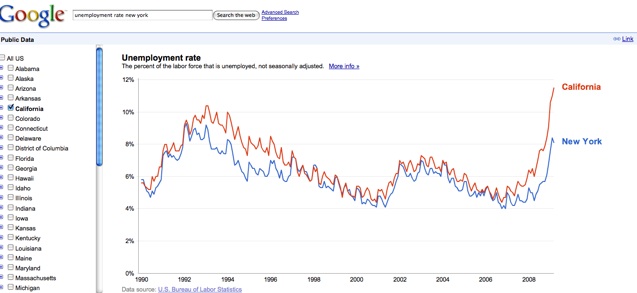
Google is getting fancy with public data in search results. If you search for “unemployment rate New York” or for any other state or county in the U.S., the first result will be the latest data from the U.S. Bureau of Labor Statistics along with a chart. If you click on the link or image it will take you to an interactive chart where you can compare the unemployment rate to other states or counties. For instance, here is New York (8.1%) vs. California (11.5%).

Try it with “population New York” or the name of another state or city, and it will give you the same thing. Google gets that data straight from the U.S. Census Bureau’s Population Division. On the Google Blog, product manager Ola Rosling writes:

The data we’re including in this first launch represents just a small fraction of all the interesting public data available on the web. There are statistics for prices of cookies, CO2 emissions, asthma frequency, high school graduation rates, bakers’ salaries, number of wildfires, and the list goes on. Reliable information about these kinds of things exists thanks to the hard work of data collectors gathering countless survey forms, and of careful statisticians estimating meaningful indicators that make hidden patterns of the world visible to the eye.

So expect to see more data visualizations appearing in search results. The technology behind this comes from Google’s acquisition of Trendalyzer from Gapminder a few years back (this is the same technology that powers the motion charts in Google Analytics, by the way). Here is a video with a demo:

Advertisement

Responses

Comments rss icon

  • Thanks for posting on this. Analysis and visualization of data is tremendously helpful. Hopefully they take the data back to the 70’s and earlier if available.

    Another good source of historical unemployment data is http://www.bls....eb/lauhsthl.htm

    Look at the early 80’s for more perspective on current unemployment numbers. Michigan unemployment was 16.9% in November 1982.

    • This is huge.

      Google has the potential to really open up and make use of public data. I can’t tell you how many times I’ve wasted time digging around government sites for simple data sets.

      I wonder how this will affect libraries?

      I wonder how this will affect people like the Sunlight Foundation, whose main charge has been to make government data that’s publicly available easier to access through sites like http://opencongress.org ? Will this help or hurt them?

  • Definite preemptive strike against wolfram alpha.

  • “population Seattle” brings up no such chart

  • Another useful resource delivered by Google and further establishing themselves as the modern equivalent to the encyclopedia.

    Combined with it’s common usage as an alternative for many, to tying in a URL, you can quickly see that a world without Google would be a dark and cold place :)

    However despite its encyclopedic status and its ability to be the Internet telephone directory, when I am seeking an important service and forming a buying decision I still ask people that I trust rather than “asking Google”.

    Maybe I am the only person in the world that does not equate a Google ranking to quality or competence as a service provider for a given service?

  • Maybe Google should start including a searchable database of credit card numbers and or personal incomes for households via Google maps. Same for marital status, criminal history or anything else that can be indexed. No recession http://iamned.com/blof in the Silicon Valley.

  • I’d like to see comparative tax rates for states and counties.

  • It’s amazing how useless public data is if one can’t find it or search for it. Plus for G…

  • Does not seem to work out side of the US (Even when searching for the term you used).

  • Yes but site like this doesnt take into account freelancers working off the network of sites like elance.com or vois.com

  • The power of this application illustrates how hard it is for users today to make use of data, even when its available publicly for use.

    In times ahead, we will certainly see more and more applications that understand the structure of data available on the Web.

    At Cazoodle, we are using such technology to build structured vertical search engines. Our first product Apartment Search allows renters to search for apartments and houses from everywhere on the Web, in a precise way.

    http://www.cazoodle.com

  • Bad bad economy, evil bankers.

  • This is some pretty cool technology, though I don’t know if the topic is best for Google to use to show it off. Mapping recession data is not very helpful, and only goes to fuel the panic of such economic times. Who is going to use this?

  • searching data is difficult.

    google has two possibilities.

    a, trying to index as many datasets as possible. Difficult, as they do not have a unified metadata architecture, unlike, say, books, scientific papers or blog posts (where google books, scholar and blogsearch really shine). But not impossible as data gets published in an increasingly formal way.
    The advantage is that this will help people answer questions about data.

    b, index a few datasets that they like for some arbitrary reason, but with nice feature like dynamic charts or maps.
    advantage: people will talk about it. but it won’t be useful to anyone.

    I’m sorry to see that google pursues option b. Hope someone really tries to solve the data search problem one day.

  • I think this is great and they should track more trends… think of how businesses could use this data to satisfy demand for goods and services in different geographic locations.

  • It’s amazing how useless public data is if one can’t find it or search for it.

Leave Comment

Commenting Options

Enter your personal information to the left, or sign in with your Facebook account by clicking the button below.

Alternatively, you can create an avatar that will appear whenever you leave a comment on a Gravatar-enabled blog.

Trackback URL
Short URL
bugbugbugbug
Techcrunch on Facebook