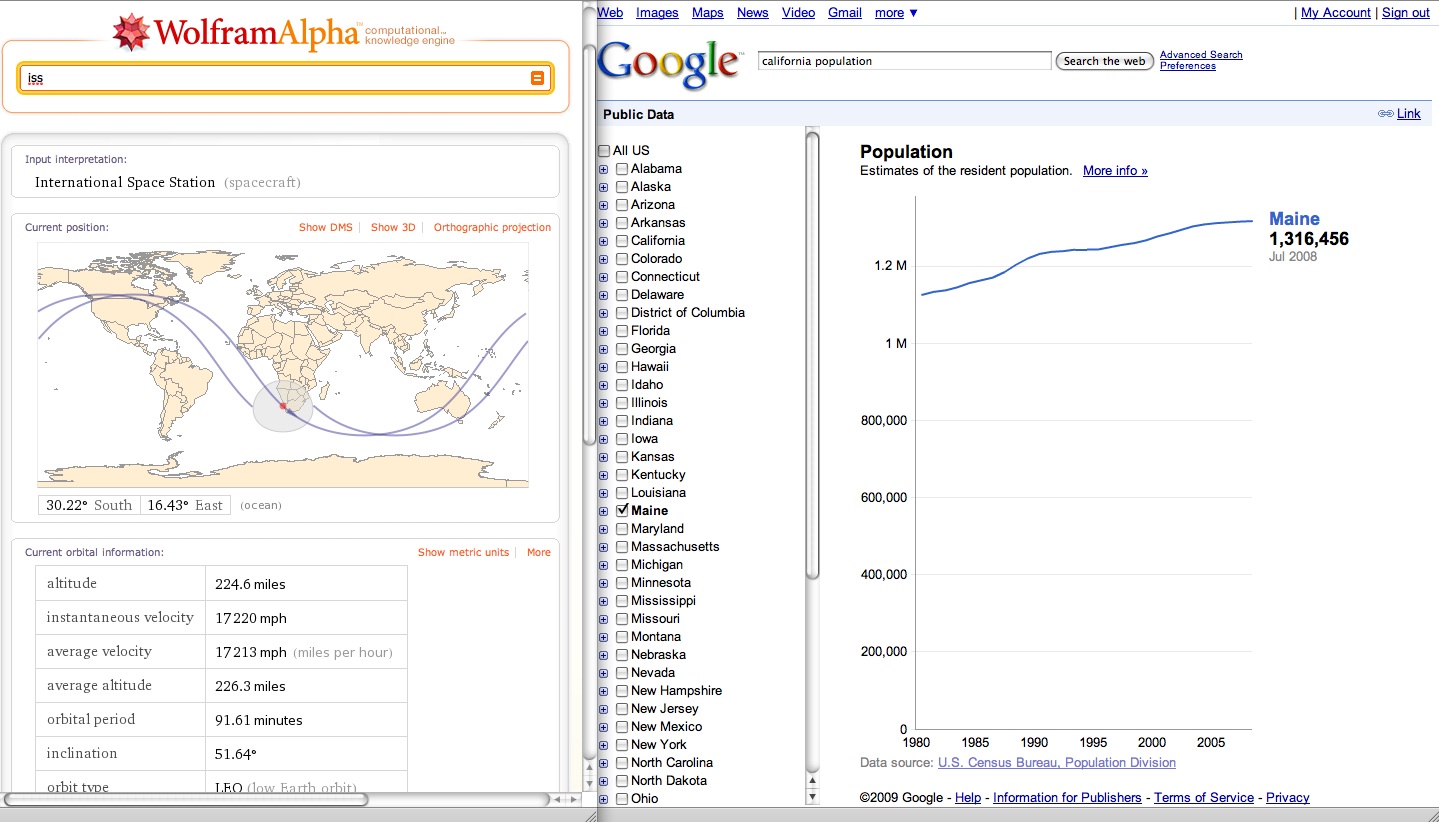
Today was supposed to be a big coming out party for stealthy search engine Wolfram Alpha. Computer scientist Stephen Wolfram gave the first public demonstration of his knowledge mining search engine at Harvard. But to be honest, not too many people were paying attention because A) who wants to sit through a two-hour Webcast and B) Google decided to tease its own efforts at adding structured data to search during the demo.
Not long after that, we received the screenshot above from an anonymous “benefactor” of Wolfram Alpha asking “which one is computing about the future?” The Wolfram screenshot shows a search for “ISS” and the results show the flight path and current position of the International Space Station, along with its altitude, velocity, inclination, orbit type, and other useful stats. Google population search, in contrast, plots basically one data point over time (although, you can easily add others). The suggestion is that Google quickly ginned up its public data search feature to undermine Wolfram’s debut. And it worked. Nobody really paid attention to the two hour snorecast (except Larry Dignan at Cnet—thank you Larry for sitting through it so the rest of us didn’t have to).
To be fair, some people who have seen it are very excited about the Wolfram search engine (Nova Spivack, for one, argues persuasively that it is going to be big). But it is hard to get excited about canned demos and promises of computer science breakthroughs. Google’s structured data search might be relatively simplistic but at least it isn’t vaporware. Google actually launched it. Anyone can try it out. When will Wolfram do the same and let people actually play with his vaunted search engine? It is going to take more than a leaked screenshot to convince anyone that Wolfram has something Google doesn’t or can’t build in a year.


This should be his first clue that he’s overmatched if he wants to compete against Google. Time to get a real business person involved.
Looks like another new technology is over-hyped…yet again.
Will it have Cuil’s fate?
Why they don’t wait until they actually HAVE something under their belt? By talking too much they actually give other established competitors clues…and those competitors can start faster.
Exactly. Mr. Wolf should shut his stupid face and finish the gizmo, ok? These academics always try to win peer approval, as they throw the value out the window. Mr. Wolf, please meet my friend “ms. stealth”. Such is the word of Sanjay Sharma.
Sad google. Why they take on startups, especially in publicity?
Google doesn’t take on just start-ups.
Google bulldozes ANYthing in their way.
Good luck with “competition” or “choice”.
Googl is not the ” king of organization.” wolfgangs results appear highly structured. G style algorithim garbled search results will not be around in 5 years. we are advancing at a rapid pace. humans they are much smarter than computers ever gave them credit for. its easy to predict the future when your busy creating it.
CreatorLocator.com – make yourself
Google is a huge company and therefore moves slow as shit. They don’t react to things like this. Likely this has been in development for 2+ years. Sure, maybe they released it earlier than they might have in reaction to Wolfram, but they did not *develop* AND release it in reaction to them. No fucking way. Corporations do not move that fast, period.
Completely agree, but I am skeptic to the capabilities of Wolfram Alfa, it seems just to have a good name ( a chemical and a Greek letter), could have done better tough .
Google can release an inferior product and still win in the marketplace using their momentum from regular search. They can keep it in beta while Wolfram is fine-tuning its own and it will still do well.
Sounds like Microsoft in its good old days.
Dunno… I was at the live presentation at Harvard today. I went in a skeptic, but Wolfram Alpha is very impressive. Far from a canned demo, the assembled crowd was calling out random searches and the site was giving meaningful answers you couldn’t easily find elsewhere. I don’t know whether or not Google will be able to match Alpha’s features in a year, but I do know that what I saw was a significant leap forward and a tool that I could see myself using regularly.
The feeling today’s presentation was most reminiscent of for me? When I first used Google back in 1996 and thought, “Wow, I can see how I’d use this times when Altavista is inadequate.”
A skeptic is never convinced, so I will have to see it when it comes out.
But taking the crown of Googles head, I don’t think so.
Thanks for the comment, it contained more info than the post. Shoney once again shows that he knows nothing about technology. He can’t even concentrate his mind long enough to watch the demo which he then criticized. Totally bush league, shoney to deadpool!
Honestly, it’s hard to compete with and against Google. Even(?) Microsoft fails here
Ok, great. Google makes public data…err…public. But what surprises me is that Google hasn’t marked theirs as “beta” as they tend to do with new feature releases. The google.com/publicdata currently doesn’t even work properly (which is why it should be in beta). E.g. a search from FF’s search box didn’t get me the same result as a search from google.com and my local country’s Google web search page didn’t get me there either.
BTW, http://www.goog....com/publicdata defaults to Google web search, which they could’ve done better by showing a particular page dedicated to public data.
Finally, Google’s public data currently seems to be US only. So the value for the rest of us is not good enough at this stage.
Where did you see that?
bet someone said the same thing about google and yahoo… how did that turn out? just curious…
Love it!
ty
Well, Mr. Cats, Google got a business person, ok? Maybe you heard of him? I should snocolate you in the neck.
Somebody said about the same about Cuil ….how did THAT turned out?
Why are you obsessed with Cuil and biased against Wolfram ? Seems unwarranted. What basis are you making your comments on ?
Cuil was different. Wolfram is different. If your advice would be taken, I would be riding on donkeys today, and not cars.
And brain behind WOlfram > ALmost everything else in this world. Do some research.
It’s exciting to see real innovation in search. They can stay under the covers for a little longer if it eventually delivers, IMO
looks like much ado about nothing on both sides… i searched for “exchange rate dollars” and got mostly ads from google, no chart. so i guess the “unemployment rate new york” thing is a canned demo. as for wolfram, his dogs always bark louder than bite…
“It is going to take more than a leaked screenshot to convince anyone that Wolfram has something Google doesn’t or can’t build in a year.”
Very good point. also the technology might be impressive but to impress over what Google has to offer in terms of brand awareness etc. a two hour ’snorecast’ is a very poor choice as a first appearance. Should have put a few braincells into how to give this thing some splash.
Actually it’s a very surprising point for a blog about startups to make…
There are few things Google couldn’t duplicate in a year if they dedicated enough resources to it. The question is whether Google can afford to be a year behind, considering the value of bringing something to market immediately, as well as actually innovating for that year rather than coming up to speed.
Wolfram Alpha hasn’t launched anything yet, so Google isn’t behind yet. Still, I think it’s disappointing that people aren’t a more hopeful about competition for Google or other big players.
Alternately, if you’re looking to analyze YOUR OWN data versus data from public sources and/or others, you should check out Timetric.
http://timetric.com
They’re a MiniSeedcamp London finalist, and were founded by some wicked-smart statisticians. (Though the site doesn’t look like it was designed by statisticians.) Disclosure: they’re friends of mine.
Either way, it’s another option to those above.
Its about positioning, he should avoid claiming hes directly competing with the ‘giant of search’ and just focus on what he does better than google. At this point (not having anything live) its pretty pointless to say he’s going to directly compete, just setting the table for failure…even when the service may be better.
This look innovative! Looks like a charts and graphs wikipedia in real time!
Yes.
People should realize that it is more a competitor of Wikipedia and Knol
Knol? ROFL
The think I like most in google is speed! Hopefully wolfram has good infrastructure behind and won’t collapse in first days out (like twitter did – many times)
And hopefully this is not just some generated fuss like it was for quil
Oh, and does anyone remember Cuil?
Apparently, not
…
What is cuil or quil?
http://www.cuil.com – an over-hyped search engine …which crashed right after the launch…and wasn’t better than Google (not even close) although many named it the Google killer…
If a search for “ISS” means you want orbital tracking, I guess Wolfram wins. But that’s pretty open to intepretation. People may want a variety of things — including a variety of stats that aren’t about tracking — when they do that search. Guess what we really want is the US population data side-by-side. Guess we’ll have to wait for that screen shot to be leaked
And “iss tracking” brings me to this page via Google easily enough, where I get the same type of plot:
http://spacefli...ldata/tracking/
I was thinking on the same lines. Maybe wolfram alpha’s page is the first result on Google.
Its not a search engine. Its a knowledge engine. It can synthesize *new* information. Can google do that?
Yes, I get that it is a “knowledge engine” or whatever term people want to assign to it, to distinguish it from a typical search engine. And I recognize the value in being able to search through facts and statistics.
But what did it synthesize in the screenshot above? It pulled data from a web page that had it already?
Danny Sullivan said…
Yes, I get that it is a “knowledge engine”
No, it is obvious that you have no clue to what knowledge engine is. You should find out of what it is before making that uninformed comment above. No one knows what is the underlying techniques that WA is using, so only Stephen Wolfram and his team know. It could be some type of superior expert system that retrieves information via some sophisticated back-chaining or forward-chaining mechanisms. May be it involves (either partly or fully) some types of sophisticated Automated Theorem Prover system that the Wolfram team had developed or perhaps it is some new complex PNL (Precisiated Natural Language) they have invented. I am not aware of any commercial system that is based on PNL, since it is still regarded as relatively new. The fact that we don’t know what the underlying technique/s of WA engine is , we cannot simply dismiss it as another Cuil. This is a wrong comparison or completely unfair.
As Alex Li said in his one of his message below:
Alex Li said…
…in front of a distinguished group of scientists and experts at one of the foremost academic institutions of the world…
I suspect that this was done intentionally by Stephen not to hype, but to show an audience that really understand the subject of his demo.
Danny Sullivan said…
And “iss tracking” brings me to this page via Google easily enough, where I get the same type of plot:
How about you try, “tracking iss” on Google ?
Yep, it gives you the same link, doesn’t it? Now can you tell me what’s the difference between the following 2 phrases ?
“iss tracking” and “tracking iss”
Can you see that you (as a human) need knowledge (as a priori) to be able to say, that the 2 phrases contain exactly the same bag of words but they have different contexts? Google cannot tell the difference between the 2 phrases and that the order of the terms are not important, since its PageRank computation engine doesn’t bases on prior knowledge? Google treats them as the same while a knowledge engine treats them as (either slightly or completely) different things?
Please, you have no idea what you are talking about. Google does not treat queries as a bag of words. Try “new york” and “york new” for example. If Google gives the same results for different term orders, it’s because it has deduced that term order is not of importance given the user’s typical intent. It has nothing to do with your claim that “PageRank computation engine doesn’t bases on prior knowledge” (whatever that means.)
I think *you* should find out what Alpha is all about before defending it so vehemently. There is so much skepticism towards Wolfram Alpha because Stephen Wolfram has a long history of hyping nonsense. “A new kind of science” anyone? What little of substance that could be found in that book was taken without attribution from others. A big dose of skepticism is in order here.
Arrogant Googler said…
Please, you have no idea what you are talking about.
And that’s mean you have an idea, while I don’t ? Ok, let me give you some hints on the subject of matrix decomposition (ie, matrix factorisation). It has been reported here, that Google has included LSI (Latent Semantic Indexing) in its search retrieval (in combination with PageRank). I don’t know the detail of how Google is using LSI & PageRank to work together, but there is no escaping the fact that LSI works primarily on bag of words, just Google for it. I can cite you relevant papers on LSI that you can dig further for learning if you have no clue to what it is. The order of terms in LSI is not important, ie, you can switch the terms around and the end result of the search is always the same.
Now, here is the original paper by Page & Brin on PageRank (PR), just read it, which is freely downloadable.
The Anatomy of a Large-Scale Hyper-textual Web Search Engine
Ok, here is a fact. PR & LSI don’t find knowledge from the data. They can be used to extract patterns and then load these into a knowledge engine for doing back-chaining/forward-chaining inferencing but they don’t do that. Google uses an matrix algebra factorization algorithm called the Power Method, which is fast. According to the literatures, Google adopted this method after they learnt about it when the authors (Prof. Amy N. Langville and Prof. Carl D. Meyer) published their papers on the method .
There is no doubt that , Google uses non-mathematical “metrics” when Google responds to a query, so the results seen by a user are in fact PageRank tempered by other metrics, but it wouldn’t change the fact that it is not a knowledge retrieval at all. The retrieval doesn’t involve any inferencing , where things are synthesize on the fly (rules) based on prior facts (ie, knowledge nuggets). Also, PR has no idea about the content of the documents, all it cares about is the links. Document contents is where LSI comes into play.
ArrogantGoogler said…
If Google gives the same results for different term orders, it’s because it has deduced that term order is not of importance given the user’s typical intent.
In other words, you’re implying that Google is a psychic engine that reads the intent (or the mind) of the user? How stupid is your claim here? I won’t waste my time debunking your claim, but you need to learn about the subject (in depth) before you try to tell me that I don’t know what I am talking about.
GoogleArrogant said…
t has nothing to do with your claim that “PageRank computation engine doesn’t bases on prior knowledge” (whatever that means.)
I stated that as a fact, and you said that it is non-sense. Look, what I said is fact and if you think otherwise, then go into detail of how Google does it.
GoogleArrogant said…
Try “new york” and “york new” for example.
If it gives a slightly different result, it is because Google is using both PageRank and LSI. These algorithms are completely different from each other, so one would expect that the retrieval result would be slightly different.
ArrogantGoogler said…
There is so much skepticism towards Wolfram Alpha because Stephen Wolfram has a long history of hyping nonsense.
Yes, I am skeptic on most things, but the anti-WA crowd just based theirs on past history, Cuil, Powerset, blah, blah, blah, especially they haven’t got a clue to the subject of search or expert system.
Besides, why do you say that the book “A New Kind of Science”, is a hype? Have you read the book? The reason you called it hype is that because you didn’t understand the concept described in the book, did you? Be honest and say you didn’t understand the book at all , therefore it was hype? If you’re not a physicist, then you’re lying. It meant that you didn’t read the book or even if you read it, you didn’t understand what the book was talking about, therefore with your limited knowledge , you thought the book was hype.
Let me quiz you on a few concepts from the book.
- Did you understand Rieman Tensor?
- Did you understand Non-linear Wave Equations?
- Did you understand fluid flow (fluid dynamics) ?
- Did you understand soliton?
- Did you understand Feynman QED (Quantum-Electro-Dynamic)?
If you answer NO to all, then it means that the book is no hype at all. If your only opinion was that the book was hype, because some illiterate book reviewers out there said so, then it means that those reviewers didn’t comprehend the concepts in the book. If you answer YES to one or ALL, the state here why you think it was hype. For example, you think that the book was hyping on the topic of soliton. Tell me why Wolfram was hyping on soliton? Elaborate a bit more on the hype. The book was intended for those in the know (Physicists & Mathematicians and those likeminded).
Before you accuse me that I don’t know what I am talking about, perhaps you could do some self-eduction on the subject of search engine, before you throw accusations around.
It does show promise, but needs a better name and branding.
Stephen Wolfram, If you’re reading this, contact me for help.
Sean
I saw it and cried. Those of you who haven’t seen it already are seriously missing out on a breakthrough service that will change your life. Keep your eyes peeled for their launch.
Mr. Scrable, didn’t you cry when you saw Microsoft’s World Wide Telescope? You are so sensitive! Ok? Such is the word of Sanjay Sharma.
Robert, kind of hard to see if you were truthful or just sarcastic on this comment.
Damn, way to give Wolfram a dose of Haterade. I bet Berners-Lee’s first demo of HTTP was pretty boring too.
-D
You appear to be arguing Wolfram’s semantic search engine/database is going to be as historically significant as HTTP.
Can you summarize why you believe this?
I believe it too and yes I can summarise it
+1.
Google is great, but why hack the newcomer?
Why not he focus on his field? He might be a bit fame-hungry and a showman, but if he can deliver that product that he talks of, you can pardon him the theatrics – he’s doing the job.
Sanjay said…
This should be his first clue that he’s overmatched if he wants to compete against Google.
WolframAlpha (WA) is not a Google competitor. They’re different. Google search engine operates on unstructured data (unsupervised self-discovery process) while WA operates knowledge nuggets (ie, bits & pieces of knowledge) as a priori.
The WA system is being debated here on this thread at ReadWriteWeb.
There are lots of uninformed commentators on the web making comments about WA.
Eric said…
It is going to take more than a leaked screenshot to convince anyone that Wolfram has something Google doesn’t or can’t build in a year.
That’s true, but that only applies to the likes of Facebook, MySpace, Twitter because you don’t need a brain to replicate those web apps. Search engines? Uh! That’s a different story. It is not the domain of hackers, it is the domain of people who’s got brains. Dr. Wolfram’s and his team has got that. Remember Dr. Wolfram is a physicist first and foremost. Computing is his second love. Things that Physicists are doing (algorithmic-wise) is much much more complex than what computer scientists are doing and that’s a fact. Actually lots of cutting-edge stuff we see today in computing their origins can be traced back to Physics. This comes back to my point. There are certain things that Google can do because they have an army of PhDs, but also there are certain things that physicists can see where others (mathematicians, engineers, computer scientists) can’t or even thought off before, so don’t write off WA yet.
I for one welcome our Wolfram physicist overlord.
Anyone who can decipher shit like Feynman diagrams deserves respect.
There is a Wolfram Mathematica sub-package in the following link available to be downloaded (if you have Mathematica already) on Feynman-diagram expressions.
Automatic Analytical Computation of Feynman Diagram Expressions
Econo-physicists have also applied Feynman Path Integral to the valuation of stock market option pricing (financial derivative) which first appear in the title “A Path Integral Way to Option Pricing” by G. Montagna, O. Nicrosini, N. Moreni.
Wolfram? I always preferred Tungsten.
And once again… Internet Security Systems loses top ranking to some silly trillion dollar space toy.
IBM will have its revenge!
That was a good one
…
Yes, you search for “ISS”…how Wolfram will know you wanted the space station and not IBM’s stuff? Or maybe other stuff with the same initials?
I guess not search technology is fool proof…in the end, the human will decide…the search engine will just present the options (more or less)…
i’m just stoked that Maine is highlighted in the screenshot. LOL
Cuil and Powerset were supposed to be impressive, look how that turned out. Show us something real, a screenshot is a joke.
Yawn, shut-up about Cuil. Some ex-Google loosers isn’t the same thing as Wolfram, not even close.
Did you see this Seth Godin post?
http://sethgodi...-of-change.html
The problem is that people don’t need to choose a search engine since the ones out there are good enough.
Do people need more info with their searches, or just find that one blog post with the right search?
I want to purchase mathematics but it’s too expensive and I’m not sure if I would use the software to its ful potential. No recession http://iamned.com/blog/ Swine flu fears overblown.
“When will Wolfram do the same and let people actually play with his vaunted search engine?”
How funny. Look just a couple inches lower then that text in your article and you’ll find your answer…
How funny that only a few hand-selected people have seen it. By “people” I mean the general populace, not Robert Scoble.
You are my density.
The answer is May 2009. Look at the Wolfram Alpha company profile, “a couple inches” below your question:
“Wolfram Alpha is building a computational knowledge engine for the web to be launched in May 2009.”
Agreed with Rob. Existing search engines largely get me where I want to go. Could they be incrementally better? Sure. Am I sitting on the edge of my seat awaiting a revolution? No.
Plus, its about more than just search. I use Google and Yahoo for a variety of things, including mail, hosting, IM etc etc. Not saying that I can’t ever be convinced to make a switch (especially if they don’t respect privacy better), but it’ll take far more than a screenshot and buzz for me to jump on board a new search bandwagon.
The only “alternative” search engine I use is Yauba, and that’s only for the naughty searches that I don’t want Google to track and archive on their servers for all eternity, wink wink
btw, I’m not the snarky Sarah above. Different person. Which sucks, because I’m normally snarky. Although not as snarky as sarahcuda. She beats me.
Eric, i liked your post on this leaked screenshot and canned, controlled demos that no one can test drive. If WA’s knowledge mining search engine is not competing or positioned against Google then why would a “benefactor” of Wolfram Alpha bother at all to leak a screenshot with the goal of trying to compare Goog’s US population data screenshot with their canned screenshot? Just my 2 cents on what is unfolding here.
If W/A can match Google’s speed, I think it will be amazing.
That said, the name always makes me think of the law firm on Angel.
Let me get this straight, you are blasting Wolfram Alpha’s capabilities because…you haven’t been able to use it yet?
The ignorance in this post is staggering. Maybe you should actually watch the presentation before giving an assessment of how Alpha will fare? It is clear that not only have you not seen the demo, you have no clue what Wolfram Alpha even does. Comparing it to a search engine is ludicrous.
I was at the presentation today. To be fair, there are legitimate concerns to be raised over the product, such as the openness of the platform, the way sources are acquired and used by Wolfram, etc. But comparing it to a search engine like Google is the last thing on the mind of anyone who’s seen the demo.
Raising skepticism over a product that’s yet to be released is fair, but attacking the product when you not only have not used it, but don’t even know what it’s about, is incredibly cruddy journalism.
Well, I tried, but it was too long-winded. And then there was that Google post I had to write. I am easily distracted.
What was your rationale for writing this article, then? So you found a picture putting Wolfram Alpha and Google side-by-side. You have no idea what Wolfram Alpha does. So you proceed to…write a post criticizing it? Is this the sort of thing that bloggers who want to be taken seriously should be doing?
You sound surprised by this Alex? TC editorial went down the toilet beginning of last year, I just come back for the amusing comments now.
ooh, +1 for calling Erick out on this one. especially because in TC’s first post about WA some time ago, they were all giddy about it using really complex terms like “cellular automata” – haha.
Sarah, I am with you! Just realised that’s what I do…
+1.
People should not criticize things they are cannot own up to.
So, atleast be a Physicist or Mathematician before you criticize Wolfram or his efforts.
The post is not criticizing WA’s capabilities, it’s criticizing the communications plan surrounding its launch. No matter how revolutionary a product is, it can still be poorly launched. That is what Wolfram is doing right now. It’s not particularly surprising since he is data guy 1st, software entrepreneur 2nd.
Wolfram is falling down the classic trap of undercutting his own launch with leaks. This is a lesson that Apple (the current master of launching new products) learned the hard way with the Newton among others. #1 job of a new product launch is to control expectations. Wolfram has allowed expectations to spiral out of control because of the lag between the initial disclosure, elite previews, and actual public launch. The lag has been so long that now Google has even had time to throw up a smokescreen to further undercut the launch.
Regardless of how brilliant your maths are, and how well you understand the difference in background processing, the market sees any information search service as a competitor to Google, and so does Google. That’s not a knock on the actual product of WA. It’s a knock on Jeff Wolfram for not realizing that and being more careful with his product launch.
or Wolfram can just sell it to Google and they can brand it. Seems like something like this should ultimately fall under the umbrella of Google or Yahoo.
It will be interesting if this can get beyond being an almanac/encyclopedia. So I could type in “what should I have for dinner tonight?” or “where should I go on vacation?” and it would send me a bunch of different ideas and ways to make it happen. So it’s a service that doesn’t just give you information, but it helps you think. That way we can all get just a little bit lazier. Maybe this is what Hunch is trying to do.
Wolfram Alpha is ahead of its time. We dont need such complex semantic inferencing. At this point, many useful applications can already be built simply using structure of Web data, as is clearly illustrated by Google’s application here.
Even more useful structured search applications can be built when we start to model semantic structure of the semistructured web pages.
At Cazoodle, we tried to do this for Rental search by providing structured search over apartments and houses for rent from everywhere on the Web.
http://www.cazoodle.com
In the words of Jay-Z “Real G’s don’t send off warning shots.”
When will I get a useful search engine? I suspect Google will come out with a new advance/super advanced search engine soon. I suspect they have been fine tuning it for the past 5 years.
Wolfram looks like a dynamic wikipedia. If so, it will have extremely high SEO for topics and it will be frequently among the top results alongside its static counterpart.
Obviously not ready for even ‘beta’ prime time since all Google software is always Beta. C’mon, let it out of the bag completely!
PeopleSearches.com
It would be nice to see someone give Google a run for their money. In the mean time, thanks for keeping me informed so I can continue to provide good advice to my business clients who want to leverage the Internet to improve their companies. So far that means focusing almost exclusively on what keeps Google happy.
Patrick O’Brien
POB Marketing
Cooooooooooooolllllllll
GooglePublicData.com
If that screenshot was not enough for you to realise this is more of a competition for Wiki products than search engines, you shouldn’t be commenting at all. It’s a real-time Wiki with fantastic presentation.
To be honest, your coming off like a hyped up school boy looking for attention. For shame.
Keeping in mind this is not being billed as a ‘Google Killer’, Wolfram could be very exciting technology. It is serving a huge need in a space that Google does not currently inhabit.
Is there a physical search engine? I mean i have lost my car keys, now i want someone to ’search’ my car keys.
Can wolfram or google do it?
If not when will we get a tool for that.
However, http://chacha.com or http://aafter.com
may come close to that. Both have live phone supports. I do not know how it can scale though.
By the way, the personal attacks to Wolfram or to Google are both sad. My hats off to both of them.
Looks like a serious version of cuil.
You obviously didn’t watch the demo.
snarky sarah, have you ever considered being constructive?
I am glad to read about Wolfram|Alpha and I am a bit more than just “excited” to have made hands on it, wondering how its concept of “computational knowledge engine” will impact data mining and management in complex and multifaceted science like medicine and law…
But I would really love to express a complaint: yesterday Wolfram has launched its new thematic blog and they are unbelievably doing a hard censorships of public comment, even mine which was basically entusiastic plus un question about the time of public release… A very sad presentation for the scientific community, at least for that at my reach…
That, I presume, is the purpose of this post.
They dont censor nothin over here.
Very good point. also the technology might be impressive but to impress over what Google has to offer in terms of brand awareness etc. a two hour is a very poor choice as a first appearance. Should have put a few braincells into how to give this thing some splash.
I am amazed at some of the poorly formed comments people are making here about Wolfram Alpha when they haven’t even used it!
Statements about getting a business person involved similarly are somewhat naive – Wolfram Research has been in business for over 20 years.
Haha.. ask Stephen Wolfram to be a little less narcisist and change the name of this search engine first. I can’t imagine poor end users trying to go to wolframalpha.com to do a search vs something as simple as google.com.
Quality of results come later.. I suspect with the current name, there wouldn’t be enough eyeballs to judge the quality.
This article is not fair. snorecast? please, entertain our bored tech writer. substance? how boooring
I am disappointed in all of you. Why can’t we just see Wolfram|Alpha for what it is and not how it compares to a search engine. Apples and oranges.
Think about scalability in terms of the scope of queries. Sure, you can find information on google which may parallel what is given from current public examples of W|A, but these are just tiny bits of the NKS which we will be conducting in May.
If Wolfram has anything that Google would need a whole year to replicate, that can be pretty big in the hands of any of Google’s competitors.
But, since it is still vaporware, I think it is getting too much attention. Wait till it launches and then cover it from all possible angles!
bye
Andraz Tori
After following the comments for this article for a while, I must say, I’m even more dismayed by the comments some have left than by the abysmal article itself.
These comments highlight quite disturbingly the worst side of entrepreneurship: greed, wanton consumerism, deception.
Here we have the presentation of a potentially revolutionary tool for synthesizing and accessing knowledge, in front of a distinguished group of scientists and experts at one of the foremost academic institutions of the world, and all some of you could think about is how the brand name sucks, or how the marketing was not good, or how the average person can’t spell the name, or how it doesn’t appear impressive or entertaining to the average user.
People leaving those kind of comments give your profession a bad name. Please, for the sake of yourselves, learn to recognize that somethings are beyond your petty sphere of avarice and consumption.
They don’t get it…
Nice Post
a) another low blow from google
b) they do not have the moral right to steal this man’s research direction. they have been upstaged, let them live with it like everyone else.
Jeez, talk about short attention span.
When a respectable computer scientist tells you that he’s built a next-gen search engine, you DO sit through a two-hour webcast.
The dismissal of Wolfram is pathetic. He’s trying. When did it suddenly become a crime to attempt to do something new?
Where does this orthodoxy come from that says
1. No one should bother trying to do anything new in search
2. If they do they should be a killer on Day 1. No sense that time is needed to develop a product.
Oh and I saw structured data on Cuil weeks ago.
When You Eric not see the 2 hour presentation why the hell did you write this stupid stuff, wire about twitter thats all whar you can here in TC lol