
Should Ad Networks Pay Publishers For Stolen Content? The Fair Syndication Consortium Thinks So.
by Erick Schonfeld on April 21, 2009

As newspapers and other publishers watch their revenues diminish, one common refrain among them is that maybe they should somehow go after Google or Yahoo for aiding and abetting the destruction of their businesses and sometimes the wholesale theft of their content. We’ve seen how the Associated Press wants to handle this: by aggressively going after anyone who even borrows a headline. Today, a consortium of other publishers including Reuters, the Magazine Publishers of America, and Politico are taking a more measured approach, but one which will no doubt still be controversial. They are forming the Fair Syndication Consortium, which is the brainchild of Attributor, the startup which tracks the reuse of text and images across the Web for many of these same publishers.

The Fair Syndication Consortium is initially trying to address a legitimate problem on the Web: the proliferation of splogs (spam blogs) and other sites which do nothing more than republish the entire feed of news sites and blogs, often without attribution or links. There are tens of thousands of these sites, perhaps more. Rather than go after these sites one at a time, the Fair Syndication Consortium wants to negotiate directly with the ad networks which serve ads on these sites: DoubleClick, Google’s AdSense, and Yahoo primarily. For any post or page which takes a full copy of a publisher’s work, the Fair Syndication Consortium thinks the ad networks should pay a portion of the ad revenues being generated by those sites.

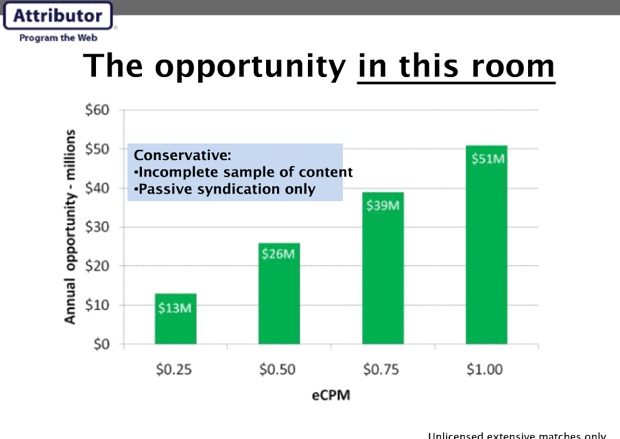
I know a little bit about this because in January I was invited to a meeting at the A.P.’s headquarters with about two dozen other publishers, most of them from the print world, to discuss the formation of the consortium. TechCrunch has not joined at this time. Ironically, neither has the A.P., which has apparently decided to go its own way and fight the encroachments of the Web more aggressively (although, to my knowledge, it still uses Attributor’s technology). But at that meeting, which was organized by Attributor, a couple slides were shown that really brought home the point to everyone in the room. One showed a series of bar graphs estimating how much ad revenues splogs were making simply from the feeds of everyone in the room. (Note that this was just for sites taking extensive copies of articles, not simply quoting). The numbers ranged from $13 million (assuming a $.25 effective CPM) to $51 million (assuming a $1.00 eCPM).
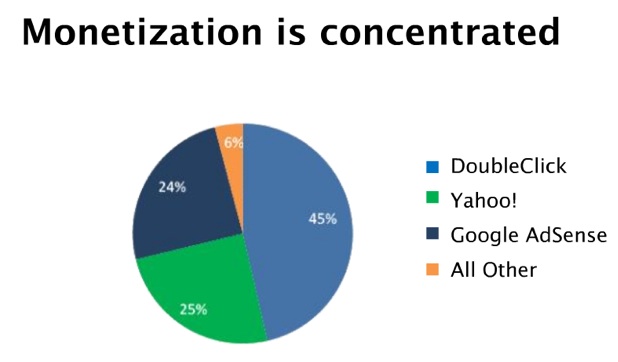
Then they put up a slide with a pie chart showing which ad networks were serving ads on all of the abusive sites. It turns out a full 94 percent of the sites in question were serving ads from three ad networks: DoubleClick (45 percent), Google AdSense (24 percent), and Yahoo (24 percent).
Go after those three ad networks, and the majority of the problem could be solved. There is certainly precedent for this type of approach. Look at YouTube’s Content ID program, which splits revenues between YouTube and the media companies whose videos are being reused online. Except this proposal would take money that would otherwise be distributed to the splog sites themselves, and give a portion of it to the publisher as an automatic syndication fee without the consent of the site owner.

How would the ad networks know that the content in question belongs to the publisher? Attributor would keep track of it all and manage the requests for payment. The consortium is open to any publisher to join, including bloggers. (Attributor runs a free version of its service called FairShare to give publishers a sense of how much of their stuff is being copied without attribution). It is certainly better than sending out thousands of takedown notices, but many issues still need to be worked out.

I’ve seen some of the data for TechCrunch, and there is no doubt that Attributor catches a lot of abuse, not fair use. But some of the sites that fall within Attributors net might still fall within fair use. For instance, I can imagine, a short post two or three paragraphs long being copied in its entirety and being surrounded by commentary. (Although, a minimum 125-word-count limit and exclusion of content clearly in quotes is meant to address such a scenario). Also, I am not sure that demanding payment is the way to go. For the most part, a link and attribution is good enough for us. But if the Fair Syndication consortium gets the ad networks on board and they take a conservative approach to asserting copyright, we might take another look. What do you think, should we join?

Advertisement

Responses

Comments rss icon

  • I think the behavioral targeting hijacking is even higher than this. Nobody seems to clamp down on those companies, probably because nobody knows what is really going on there. However these guys have built a big business by ripping off publishers and advertisers

  • You can’t stop the splogs & aggregators. lawsuits are futile.

  • By the time the consortium will yield a face off with google & yahoo other current enemies, their business will be struck down by services like Twitter & Blogs….:) Lolz.

    game’s over for oldies!

    marvin
    http://yousuggest.us

  • attributator.com may be worth $500 million

  • I hate to be a stickler, but DoubleClick isn’t exactly an Ad Network, it’s an Ad Server… there is a difference. Attributor and the Author of this article should know that…

  • Might as well. If your content is on someone else’s site and that page draws a lot of hits, then it’s partially due to your content, so you should receive a partial payment as well.

  • How did they quantify the traffic splogs have? $51mm at $1 CPM would indicate 51 billion impressions per year (130 million per day) across all splogs copying content from the 24 publishers. I’m highly skeptical.

  • To clarify one of Erick’s concerns: To qualify for revenue share payment, the amount reused would have to be above a minimum word count threshold. Of course, any quotes would be automatically excluded.

    @Vlad – It is not all splogs. To come up with the audience and revenue estimates, we used page level traffic provided by compete.com.

    btw, anyone who publishes can join the Fair Syndication Consortium at http://www.fairsyndication.org, regardless of your size.

  • but how will the attributor model even work? sploggers will automatically inject extra words or phrases in the text to make it undetectable. it’s way too easy. why don’t they just create a consortium to promote exclusion of sploggers from the big advertising companies [so that they won't be able to generate revenue in the first place] ?

  • As the commenter Isaac mentioned, I would question Doubleclick and perhaps Yahoo’s classification as ad networks. Doubleclick is used in a serving capacity by advertisers who work with sites directly as well as via ad networks. And Yahoo’s Right Media platform brings into question what network is responsible for serving the ad (Yahoo, or one of their many exchange participants).

  • @Isaac, @ Eric – Ad Servers are indeed the correct term. You can view more about Attributor’s ad server research and methodology here: http://www.attr...5-market-share/

  • The “original” content that the old paradigmers claim as their own is often re-hashed press releases that some lazy reporter posted after adding one comment from a source. They need to be careful what they wish for here or their whole existence could be in jeopardy.

    Instead of whining about how everybody is stealing “their” stuff, thy need to realize that others have figured out the new revenue models that are available — and start figuring out how to replicate them.

  • Hey Rich Pearson the article you reference http://www.attr...5-market-share/) has nothing to do with the report that Attributor put out.

    I think there needs to be some accountability for true and accurate reporting here. DoubleClick is not a Network and Yahoo may or may not be selling ads on the “splogger” sites. Two of the three legs of this article are crumbling…

    No one is arguing that this isn’t as issue, but I think that TechCrunch can do a better job of researching and providing a factual story that we can all sink our teeth into.

  • A week after the newspaper/Eric Schmidt meltdown in San Diego, we’re starting to see several different pieces of new news industry strategy re web distribution. We heard in San Diego about “copyright infringement,” better deals with Google, making the readers pay! and anti-piracy. Now, as the smoke — and the hubris — clears, we’re seeing distinct moves. Paid content initiatives — Journalism Online, LLC jumps into the game. Anti-piracy. Attributor is first to make a move. What I like about the Attributor plan is that it doesn’t restrict news flow — letting the web be the web — by putting an ad rev share overlay on it. Seems fair, but will need real scale to be successful and to bring the ad servers to the table.

  • Mike always says the cost of distribution is free for music and therefore the cost of buying music should be zero, so why the difference for the written words? Should I not be able to take Techcrunch posts and re-publish in their entirety with or without attribution and not pay a fee? The new publisher gets the ad dollars and Techcrunch nothing. Lots of revenue leakage but you build the profile of the writer up so they can charge fees for public performance like artists.

    Then you can sell Techcrunch t-shirts, tickets to your conferences and other revenue streams (I want a mug personally). Of course, you would have to want to perform publicly and do lots of it to make it pay. After the spitting incident, Mike might not be so keen to venture out.

    Techcrunch joining this would be an interesting position to take.

  • or they can just tell google someone jacked their content and is say making money with adsense and get the offending site’s Adsense account killed andt he domain banned from the network

  • Therre alot of content scrapers online..LOL

  • This is a bit like the RIAA centering its digital music strat around suing old bitties who download Perry Como tracks.

    So now the publishers are have wheezed out of the Barcaloungers and are hollering at the sploggers to get off their lawn. Nice plan.

    You can’t have it both ways: if you want SEO, you gotta put your stuff out there. If it’s out there, someone’s going to play with it. Deal with it.

    BTW – want the Wall St. Journal for free? Fire up this search:
    http://www.goog...esearch=wsj.com

  • if the ad networks abide by it, huge win-win. Let the content owners (that’s TC, too) determine what they want — share of ads, “ad block” so that site gets no ad served on purloined content; simple, prominent attribution, or a revenue share. Likewise, they could just serve (like youtube does) a truncated or blank box where their content appears, with link home. Nifty

    • >> if the ad networks abide by it, huge win-win

      How is it a huge win-win? This is an extortion racket and a derailment of resources from productive activities to unproductive ones. This the equivalent of using violence to force people to buy buggy whips when Henry Ford is building a car for a tenth of the price right down the street.

  • One question for Rich Pearson.

    1) Do Fairshare or Attributor take into account press releases or public information available to anybody (awards results like the Oscars, Grammys, etc. that anyone can watch live on TV) for content big media companies can reclaim as theirs?

    In an example… Oscar night… one as a little publisher is watching and live blogging the awards… then at the end of night publish the full awards results, perhaps even faster than big newspapers and agencies… but minutes later those ones publish their “own” scoop of results. As they are the big guys that have personnel on site at the Kodak Theater… HOW do you manage those cases. Content can be really similar for those ones, but the little publisher did nothing wrong.

  • I forgot… In my above example… add this.

    Asuming the little publisher join to the Fair Syndication Consortium and get online the Oscar or Grammy results FIRST, do AP, REUTERS, Newspapers and anybody else that publish later the same matched content will pay that little guy?

    It has to work both ways I guess… or am I dreaming?

  • @engel – yes, there will be a set of measures to avoid claiming of content that is considered public domain. And yes, it will work both ways. Any size publisher can join the consortium.

  • Author of this article needs to catch on to today…. In case you haven’t noticed Google owns double click as of what a year or more ago… Time to update diagrams pal. :)

  • The same can be said towards Attributor.com, i firewalled all their bots/IP’s from my server because of the volume of requests i was getting from them.

    Why should they just take my bandwidth and not pay for it to boost their $22 Million venture?

    To me they are worse than the splogs, at least the majority of splogs link back to me and provide a little something in return. Attributor just steals what i pay for and their bots don’t obey robots.txt or provide an easy means to exclude them.

    Attributor.com = Scumbags, and they have a real hide trying to preach the moral high ground when they are helping themselves to my content to profit.

  • I really hate to be a stickler, but Double Click isn’t exactly an Ad Network, it is an Ad Server there is a difference

  • This style of syndication fees represents an overhead on all net publishing, so why would you sign up for higher overheads? While you may profit initially, but overall efficency of the media (net) must be impaired. No net publisher should sign up for this.

  • This all sounds confusing to me but I haven’t heard one peep about the auto rewriters for content… hmmm… is everybody just too plain lazy to come up with their own content?

    After all can’t we all just “Get Along”?

  • Here goes the pendulum swinging always to much in either direction when if first starts off,

    for outright stolen content I can understand

    this is going to be an interesting battle

    internettoolsu.com

  • Stolen by who? That is the crux of the matter!

  • “The Fair Syndication Consortium is for anyone who is passionate about fully compensating those who create valuable content”. That’s VALUABLE content, which automatically rules out most blogs and newspapers joining.
    http://www.fair...org/drill1.html

  • Interesting reading. Something tells me that Attributor will soon stop being an independent co and will be swallowed by one of the big guys. Small problematic companies tend to do so…. Good job guy, I love fairshare and now fairsyndication.

  • cut off the source of the revenue and the value of running and promoting a splog does away.

    seems like everyone but the bottom feeding scum wins

    just removing them from Google/Live and the other search engines would also help reduce the problem

    Of course there would need to be a “fairness” test – if the site is creating a significant portion of genuine content and re-publishing under fair use guidelines they shouldn’t be punished. If they’re just an automated scraper then they need to be stamped out (along with the domain squatters and search hijackers)

  • I don’t know what the Associated Press is talking about. If a website wanted to feature all its content, it would go to YouTube and copy ALL of its EMBEDDABLE stories.

    They should lose this case on that principle alone.

  • It’s your content, you have every right to be paid for it. TechCrunch hasn’t put up any barriers to general access and distribution of its content online, so the spam blogs are not providing consumers with any meaningful service. You should join the network and collect payments for those who steal your IP.

  • I think , many sites will lose
    But uniq content is the king

Leave Comment

Commenting Options

Enter your personal information to the left, or sign in with your Facebook account by clicking the button below.

Alternatively, you can create an avatar that will appear whenever you leave a comment on a Gravatar-enabled blog.

Trackback URL
Short URL
bugbugbug