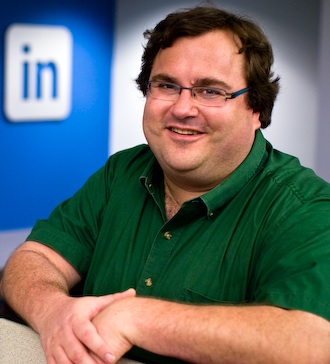
The guest post below was written by Reid Hoffman, CEO and Founder of LinkedIn. Reid, who’s been a prolific writer lately, is a strong advocate of entrepreneurism and the startup mentality. See his recent Washington Post article Let Our Start-Ups Bail Us Out, and the guest post he wrote here on TechCrunch, Stimulus 2.0: It’s The Startups, Stupid. Reid has recently appeared on Charlie Rose, and we had a chance to sit down with him earlier this year for a video interview as well. Reid is an investor in over 60 web ventures including Digg, Facebook, Flickr, Friendster, FunnyOrDie, Ning, Last.fm, Six Apart and Technorati. He is also a member of the nominating committee of our upcoming TechFellow Awards with Founders Fund.
TechCrunch and Founders Fund announced the first annual TechFellow Awards last week. This is a great time to stimulate investment and recognize and encourage tech entrepreneurs –starting up is cheaper, talent is more fluid, and people are more inclined to take calculated risks. If we can find more ways to spur investment, it will be good for the entrepreneur now and good for society later.
As a serial investor, I’ve enjoyed backing some good Web 2.0 companies, and it’s helped me develop a shortlist of criteria to cut the wheat from the chaff. After five minutes of a pitch, I know if I’m not going to invest, and after 30 minutes to an hour, I generally know if I will. Many entrepreneurs are product-focused, which leads them to pitch the brilliance of the product. Others are money-minded, so they can over think the business plan. But neither of these approaches answer the first few questions I want to know as an investor:
1. How will you reach a massive audience?
In real estate the wisdom says “location, location, location.” In consumer Internet, think “distribution, distribution, distribution.” Thousands of products launch every month on hundreds of thousands of new Web pages. How does a company rise above the noise to attract massive discovery and adoption? YouTube did it through existing channels like MySpace, which already reached millions. Yelp had strong SEO, which found them a mass audience searching for restaurants and nightlife. Facebook’s University-centric approach landed them 80% adoption across a campus within 60 days of launch. Every Net entrepreneur should answer these questions: How do we get to one million users? Then how do we get to 10 million users? Then how will you get deep engagement by your users.
2. What is your unique value proposition?
The Internet space is crowded. A product needs to be sufficiently innovative to distinguish itself from the pack, but not so forward thinking as to alienate the user. Many entrepreneurs create incremental improvements on existing products. This can be big – Google revolutionized search when AOL and Yahoo! were presumed to have it locked up – but more often, the pitch sounds like, “It’s a dating site, but for senior citizens…” I want to see innovation that is categorically distinct from existing propositions. Digg lets users decide which headlines are newsworthy. Last.fm tracks music listening with an iTunes plugin and buffer great music discovery. Flickr enables users to share and tag photos in new ways.
3. Will your business be capital efficient?
This may be the most important of the three. Even if you have a mass audience and unique value prop, a business fails without cash flow. An initial round of financing is important, but how reliable is later financing? Will investors see the right elements in the next stage? Your product must scale intelligently – this is why I like software. A well-coded site can adapt to mass demand without its capital expenditures scaling out of control. A product like TypePad can grow to 10 million users without half the growing pains of a service like WebVan, the Web 1.0 startup that attempted to deliver groceries to users’ doorsteps. Try reaching Facebook scale with a service like that.
With these three elements in place – mass audience, unique value, stable funding – a startup has time to discover where it can make money. Few business plans ever pan out like their owners intend. PayPal started as a plan to beam payments between Palm Pilots. Google raised funds with a vision to capitalize on enterprise search and ended up in advertising. The formula is to build an audience with a great product – then secure enough funding to figure out how to make it pay.
Since I’m focused on building LinkedIn, I’m not currently investing in new projects, but I firmly believe now is the time to take smart risks as entrepreneurs and investors. I hope these criteria help startups make better pitches as they fundraise, and maybe even encourage others to take the plunge. Good ideas need good strategy to realize their potential, and if these criteria help a few more companies find capital, it’s a win for everyone.


Hi Reid,
We were going to use a $1500/month Gigabit burstable connection from Calpop here in LA for our west coast connection.
Would you be interested in letting us set up our SAN/Rackable systems array in SF for free as a 0.5% investment ???
We are only going to need 500mbit+ at any one time. I assume you all have a private room or cage over there so we could drive up our gear when we go to Google IO in late May.
You can contact me at soeet.com@gmail.com
Otherwise we will have to pay the $1500 a month.
You probably don’t use the extra bandwidth and 0.5% of our company will be worth a whole lot next year.
Thanks Reid.
Hold on, since when did Digg, Facebook, Flickr, Friendster, FunnyOrDie, Ning, Last.fm, Six Apart and Technorati satisfy rule 3. Will your business be capital efficient?
I think the post is great, but the authors investment history doesn’t follow the rules in the post.
lol..good catch. That is really funny. Wonder if Reid will respond to that statement?
Nor does his line about investing in new projects – he’s invested recently.
yeah, but the last thing you want is thousands of inbound requests to invest, followed by hate mail when you ignore it. easier this way.
Screw it, the offer is good to anybody with gigabit or higher bandwidth.
You have until the end of May early June.
Obviously we don’t want to pay cash for bandwidth unless we absolutely have to. $1500 a month can buy some really good pizza.
Thanks, appreciate the offers so far.
offers > 1Gbps ONLY please
“Screw it, the offer is good to anybody with gigabit or higher bandwidth.”
By the offer, I mean the offer to have us cart our gear to your data center and use your private cage at your data center for over 1 GBPS of bandwidth.
Not the offer for 0.5% equity in our company.
Public offers for private equity are illegal and that’s not what was offered in the post directly above this one, or the one below M. Arrington’s “yeah, but the last thing you want is thousands of inbound requests to invest, followed by hate mail when you ignore it. easier this way.” post.
If you take this offer by sending us an email you must be in California, you must have over 1GBPS to give us, you must have at least 2 large AC power plugs, and you must have building wide backup power.
A non-equity compensation can be discussed.
Again public the offer above was NOT for the 0.5% private equity but rather for a non-cash service trade.
Did you read the article? Here’s the key part: “The formula is to build an audience with a great product – then secure enough funding to figure out how to make it pay.”
Our gear is right here. It’s just 10 little 2Us plus a 2U 12 SATA SAN.
http://picasawe...e.com/soeet.com
No big deal. It only takes about a half rack worth of space. We can get you LLC shares out of our minute book for the 0.5% in exchange for never paying for bandwidth.
I hope you are technically compentent Chis, because your business and pitch skills suck.
Joe – this is the way deals get done…in the TC comments – you didn’t know that?
I’ve actually had talks with both Google and Yahoo via TC comments, amongst other well known companies.
I am technically competent. I am not so business competent, but hopefully, the combined skills of the members of this project will overcome our business short fallings.
We have a very elaborate plan to get people to use our new services which hasn’t been explored at all by Silicon Valley yet. We’re going to use the same technique as the credit card companies.
So we’re pretty good on everything except business skills right now.
Reid didn’t reply so I guess we’re going to host our west coast rig at CalPop in LA. Oh well, it could be worse. We have the cheapest bandwidth in the world here in LA. $1500 a month for burstable gigabit is nothing. We can operate for well over a year with no earnings at that cost.
What I mean to say is that via TC comments, people from either company emailed me privately.
@chris
Re-read the post and you will find that you fit into the “first five minutes” group. If you are lucky, you haven’t completely killed your company. But I seriously doubt it.
anon,
Users don’t care about Techcrunch. Our product is aimed at the MySpace crowd.
It is a utility and has very little to do with having a flawless ivory tower upstart image.
It’s like a door handle. If there were no door handles and the invetor of the door handle talked about his door handle business before launching it, would it really matter to the people who would buy and use door handles?
Of course not.
Our product is of the class of door handle.
Furthermore anon,
I could flat out spill the beans and tell everybody what it is and it still wouldn’t matter.
You know how a lot of people in the IT industry say, well, it’s all software, we can host 1M people with a 1U in colo…. ect….
It’s all about “the concept” or “the idea”
Well, this isn’t that. This requires pure band and storage and power. Like telecom. It’s a simple concept that just about anybody “could” implement but could never scale up to fast enough. At least not anybody smaller than Yahoo.
Elastic cloud computing wouldn’t scale on this either and would be just about impossible to set up without access to the hardware.
This is gonna rock when we have both coasts set up. I am going to blast some wicked heavy metal to our opening campaign. LOL.
Somebody googled “the staff of mr. ____” and I saw it on my referrer list. LOL. The people I work with are the same people I have always worked with. Searches on our project have become more and more retarded. I guess that means we’re going to have a big response.
Thanks for this great investment advice. Very helpful.
This is great insight, Reid. Thanks for sharing.
Thanks Reid for such a good evaluation of startups. But, I noticed that nowhere did you mention the latest fad Twitter. Dont you think that this Kutcher-promo was a great strategy in itself?
LinkedIn has always been scared of innovation. For the last 2 years, they have been busy attacking FB, claiming FBk is for kids. Ironically, FB crowd is maturing with more professionals than initially expected.
Regarding Twitter, probably Reid does not understand it since he himself is not actively using it.
“Networking is the thing of the past. Things are looking forward towards microblogging”
Microblogging is indeed the happening thing now. With your comment, Reid appears to look internet with previous-era’s glasses.
LinkedIn is very old compared to FB now. Same features and nothing innovative. Only professionals who want to hunt for business/professionals would enter it, that to compulsively. Now, the site looks very drab indeed.
You are nuts. Linkedin is ultimately the biggest threat to every job posting service.
No, that would be craigslist…And it’s winning by any measure.
I like the simplicity of this article. The only change I would have made is not to mention Facebook – a service which IS struggling with size now, and even worse, struggling to find a meaningful and profitable business model.
Yeah, Reid, leave out your, by far, best investment! Great advice, Pinky!
Dear sir,
Please consider this comment a kiss ass comment.
Thank you.
Great post Reid. My views: Should not Unique Value Proposition come first before talking about distribution? And when we think of a product as capital efficient, how long should we take into account? For instance, there are products which rise/fall like a wave or some which we sell to others. In that case, where is the question of “capital efficient”?
“This can be big – Google revolutionized search when AOL and Yahoo! were presumed to have it locked up – but more often, the pitch sounds like, “It’s a dating site, but for senior citizens…” I want to see innovation that is categorically distinct from existing propositions. ”
Umm…if I am correct LinkedIn is “It’s a networking site, but for professionals”
Plus, if I was him, instead of investing on other companies, I would pay more attention on LinkedIin. With the rise of Twitter and Facebook, linkedin is getting drowned. Not to mention, the Myspace-like website. If it is not for the economy and the job situation, LinkedIn would have been done.
I agree with you. Even I don’t find LinkedIn interesting anymore. Though you cannot expect it to come up with loads of applications like Facebook, there can be some that can “hook” us to the site. But for business networking, there is nothing special about it now.
You can as well use FB/MySpace for the same.
Right, they tried Applications and it flopped. For some reason, it just feels like LinkedIn time is done. They are very similar to Yahoo, especially with their innovation (extremely slow) and management.
LinkedIn has breen growing like crazy.
Actually, that is what I thought initially (LinkedIn is growing like crazy) but when you check the growth rate of Facebook and Twitter, you will see that they have a much larger, more significant growth rate since the slow down of the economy.
Naturally you would expect a larger growth rate from a professional networking site during the economic downturn. So there is a problem there. People are not returning to LinkedIn. That is why LinkedIn keeps marketing their “number of users” instead of “Active users” unlike Facebook who reports both.
True, Richard. LinkedIn is in a way going down. There has been no phenomenal improvement/no big change not even a buzz about something new in the site for a long time. Good for Reid to focus on LinkedIn first, instead of cuddling startups.
“This is a great time to stimulate investment and recognize and encourage tech entrepreneurs”
Is this the sentiment inside the Valley’s investment community overall or is this more of a feeling held by you and a select few? How do you see the overall temperature of the investment community evolving at this stage in the economic down turn, are investments loosening up?
PS Thanks for the really great advice, its helpful to have these defined points to focus on as we grow.
Dead on. Some of the clearest advice you could get on the subject. One important distinction.
I meet a lot of entrepreneurs looking to raise VC money when their business is never really a candidate for that type of investment. That’s what Reid’s advice speaks to so well, and you should consider it a check list, if you can’t meet all three criteria you’re not a great candidate.
But one point of distinction. Not every tech business has to be one that exponentially scales – most never will. There are billions of websites and maybe only 5-10K get over a million or more unique visitors a month.
Businesses that are capital efficient, and are differentiated, AND make money from day one are too often overlooked in the tech space. Think of a product, app, program, content you can build and sell through traditional or creative distribution. You may not be able to raise professional investment day one, but you may very likely see a greater return on your investment.
I do not understand why nobody gets interested in niche products or services. There are a lot of valuable propositions for smaller audiences!
People are interested in niche products. They’re called lifestyle businesses. People not interested in lifestyle businesses are VCs. VCs aren’t looking to own a stake in a small profitable company for the long haul. They’re interested in home runs where they can sell their stake in 10 years or less.
smart investors would spread their risk instead of betting on horses
Keep living that dream, the smart investors will pass.
Because they are…drum roll…niche! Small is *not* interesting. Sorry.
Excellent guest post with great advice for young entrepreneurs.
Nice. Sometimes it’s very hard to succeed in internet having less business capital…
Sometimes small capital can mean better product delivery. Don’t underestimate a business based on their business capital.
check, check, check
We would have expected that a Business Model that brings in money would be the first requirement.
Has any of the company that Mr. Hoffman invested in made any profits yet?
LinkedIn is an online phone book. So, it is not technology perse. It is just a website which is no difference from a website from pre-dot.com era. LinkedIn is one of those hypes that TC wants to promote.
Yes, that is exactly what we have been talking about so far. You dubbed it perfectly – it is an online “phone book”, maybe a business phone book.
Absolutely loved this post!!! Great no-nonsense plain English talk…
how capital efficient has facebook or ;linkedin been?
Very insightful, Reid. Thanks for writing the post!
Thanks for the great Post Reid,it’s very useful for people planing to invest, as well as for young entrepreneurs.
some of you folks are missing the conflict in what he writes. Few startups in history have raised MORE money than Facebook and Linkedin. While they both reach large audiences they are NOT capital efficient. In fact, there’s no end in sight for the capital needs of Facebook.
Everything about the post was very informative but one area that leaves me questioning is the comment; “The formula is to build an audience with a great product – then secure enough funding to figure out how to make it pay”.
I think it should be, build an audience with a great product – then secure enough funding WHILE making it pay, because if you have to “figure out how to make it pay”, then your business model is flawed from the outset.
Better to have 100 000 paid users than 1 000 000 free users during recession time. This speech is relevant for pre bubble time, no more…
If only all the so called young pseudo enterpreneurs of silicon valley do something worthwhile for the mankind rather than creating umpteen no. of soclal networks which have not found a way to monetise yet
A great primer for anyone creating a business plan for an internet business.
“How do we get to one million users? Then how do we get to 10 million users? Then how will you get deep engagement by your users.”
I note that at the forefront of Reid’s questions are users, not revenue. Interesting.
Hi Reid, this was the last article I read before going to bed last night, and it stayed with me all night. Great advice, simply and persuasively stated. Thanks very much for posting.
Reid Hoffman is brilliant. Please, more posts like this.
I Second that motion. As others have pointed out he contradicts himself frequently. This post seems more like an attempted justification for his efforts at Linkedin rather than usable advice.
Interesting advice but seems to contradict the advice we hear in the UK, which is to prove a revenue stream with your most basic product before you can get the funding you need to progress the company.
Users first, revenue second might just lead to more and more great iphone apps that have to be free to encourage critical mass and then dissapear when the funding runs out.
There seems to be such a big difference between a project and a business, with the people driving digital advancement tending to be technically minded the big news stories are always projects that then need some kind of business model. So really we are talking about investing in people and projects here not businesses.
Doug
I have always enjoyed articles on/by Reid Hoffman and it was an good piece of advice for start-ups.
I would have liked to ask Mr. Hoffmanif he ever made a decision to go for a start-up at the first 30 seconds?
Thanks for the straight shooting guide. Makes a lot of sense to focus on these three important elements. It is so easy as an entrepreneur to get blinded by details or lost in the vision. Using these three elements as anchors will definitely help keep me grounded.
First time some sensible advice from an investor. Great post.
Decent article and I’d say the same about any startup…however, I’d say that if you really want this kind of advice, don’t stick to blogs, get one of those “books” you know, dead tree media. I found Jim Collins book from good to great brilliant, insightful and incredibly helpful, along the same lines as Reid’s post but with more detail, history and case studies.
What’s interesting is the parallel between what Reid / Jim said, then the contrast between that and the Innovator’s Dillema, also a great book however, it uses some of the same companies as in from good to great to paint a different picture, imho, more rose colored glasses and silicon valley navel gazing (which happens here, all too often).
Per Google Analytics, our bootstrapped startup just crossed 4 million uniques over the last 31 days…it’s not the investment that makes the product work, it’s the vision and persistence in sticking to a formula, like Reid’s rule of three, that gets you where you’d like to be.
My only personal issue, here, is the “figure out how to make money” bit…in from Good to Great, the revenue model was a key part of the success of every company in their case studies…if, on the road to your destination, you’re not applying a revenue model, imho, you might win big in audience, but you won’t win big in business.
For all of you “Sky is Falling LinkedIn Naysayers” please digest this:
“Sign of the economic times: U.S. visitors to LinkedIn surpasses 8 million in March to reach new high (up 127% vs. year ago)”
http://twitter....atus/1535018496
Yes it is a downturn economy, but LInkedIn is hardly past its prime.
DBland,
You should report Facebook’s and Twitter’s figures as well during that same period (Sign of the Economic Times). Because their figures are a lot higher.
Considering Facebook has been attracting more users who are well within LinkedIn demographic that LinkedIn does, is it safe to say, more people flock to Facebook and Twitter during economic downturn?
that = than
But I would argue that users flock to LinkedIn to find a job… especially since sites like Dice are seeing 45%+ yoy decline in tech job postings.
LinkedIn Users hit up other people they know with their resume instead of being app #500 via an online job posting.
While FB and Twitter are growing, I don’t think job networking is #1 on their users minds.
Great insights in general. On the issue of reaching a massive audience, though, I don’t think the strategies mentioned (”Yelp had strong SEO”) looked so attractive on the investor pitch as they look now with hindsight. “We have strong SEO”, while maybe true, is not likely to win you any investment these days unless you can actually demonstrate it.
Exactly. Nobody is going to raise capital with the “Our SEO will get us to 1 million users” line…This article is completely self-serving and ridiculous.
Because you have built (and invested heavily in) “companies” that have shown growth without profitability does not mean it is the correct course of action for most. In fact, I think it could be argued that that game is over.
There may be some market bleed-through but LinkedIn is basically the new Monster IMO. FaceBook is great for business but not tuned for it like LinkedIn is. I like them separate. MySpace on the other hand is a cesspool. In marketing you spread a net and try to pull in leads from as many sources as possible. If you’re only marketing on FB because it’s the new “cool” then you should be fired. You should at least mirror your content so you don’t alienate your audience. The big social networking companies should allow its users to chain together their accounts. That’s called added value.
TC, great article. Best I’ve seen on TC in a long time!
Does anyone have a source for this stat? “Facebook’s University-centric approach landed them 80% adoption across a campus within 60 days of launch.”
I was having a conversation recently about Facebook’s ubiquity and this definitely backs up my argument.
I wouldn’t describe Digg as being categorically distinct from existing propositions. The whole “let users select the headlines thing” was being done back in 1999 by Kuro5hin.
Best Guest Post on TC in memory.
>>The formula is to build an audience with a great product – then secure enough funding to figure out how to make it pay.
There are a lot of folks who think this sounds reckless, as if to say “we’ll worry about money later.” I would love to hear more examples of sites that did just this: grew an audience and only then set about trying to monetize it – successful examples, of course
There are some iconic ones like Google, but not everyone is trying to reinvent the primary utility on the ‘net.
Hey Reid,
Great article but I disagree on this:
“With these three elements in place – mass audience, unique value, stable funding – a startup has time to discover where it can make money.”
Why on earth would someone invest on a company and focus on the most important part of it – making money – later?
Love the points you made but seriously, the business model is the most important element. Securing eyeballs is one thing. Making money is key. Cash is KING.
Constantine
Music.us (dotMusic/.Music Domain Extension)
Hi Reid:
Thanks for the excellent article. Straight to the point!
The way I see this article is that it’s not only meant for entrepreneurs but also for the VC’s who supposedly should be investing like mad in these down time but instead are holding tight to their cash wads.
I especially liked Sarah Lacy’s article:
http://www.tech...ecession-folks/
There are other articles too all around the web which shows that VC’s are NOT taking advantage of the common wisdom!
That’s why I was so glad to hear about the TechFellow Awards started by you and your colleagues at the Founders Fund. Kudos to all of you for doing the right thing at the right time!
So, to all ye VCs out there, venture out, invest now and let the American entrepreneurial spirit fly again!
For all of those attacking LI or Facebook, I’d say this: How many startups do you know of that are well north of 100 mil in revs and are GLOBAL brands in their respective categories? Please, name me ONE.
Yeah, that’s what I thought.
If the economy were anything resembling passable right now, BOTH LI and FB would be public, as they have both crossed over the threshholds that a pre-ipo company has to cross. And they crossed it a while ago.
As a point of comparision to recent tech IPOs (not much to compare to I know), Netsuite went public on, what, 65 mil in revenues (and they were losing money hand over fist)
So I would ask Richard Boyle, would you want your hands on some LinkedIn stock prior to an IPO?
If you say no, then we know you are little than a bitter hater.
Observation,
You are clearly missing the point here. I will invest in LinkedIn if the following happens:
1. Complete Management change
2. Disclosure of number or percentage of paying customers. (This is very important) Linkedin keep claiming they are profitable. Yet, a number of sources “inside” LinkedIn claimed that the “profitable” talk is all just marketing. They were close to breaking even last July 08 but that was how far they got before the economy turned sour.
But hey, I think i have a better chance of seeing a flying pig than the 2 points above fulfilling.
But there is one main thing to consider. The whole Networking site era is gone. It is now about microblogging. LinkedIn, MySpace and all other networking sites are pretty much on the downward slope now. Only Facebook will survive for the next 2 years, that if their userbase is maintained. Most Web 2.0 sites lifespan is only 5 years. It has been that way for a while. Instead of investing on LinkedIn, I might be more interested to invest on the next big thing – Microblogging
Very Good and Solid advise on startup…. I wish I heard it 3 years ago even though I had probably disregard it back then. People’s reasoning is quite different back then…
well it is still not too late yet…
Richard,
So according to you, Microblogging (and Twitter) will be extinct in about 3 years.
So why even start an internet company?
To say it’s “all in the microblogging” is pretty ridiculous. There is no proven revenue model. Nothing.
Neither LinkedIn or Facebook are going anywhere. The Diggs, Slides and Nings of the world will come and go. LI and FB are at a different level.
Didn’t this guy also develop Zynga and Mafia Wars?
great advice Reid. Now take some advice from me…
…lay off the Krispy Kremes.
Great post Reid. I’d like to hear more about how this advice can be modified for bootstrap startups. Same basic questions must be answered, but scale and trajectory are obviously impacted.