
There’s a huge difference between what venture capitalists say and what they do. For much of the last decade some of the same partners that keep saying Silicon Valley will never decline as the startup epicenter of the world are spending every month flying to China. And of course in the post-2000 years every partner said, “Oh we never really got into that whole dot com thing…” Huh. Wonder who did all those deals?
Another classic is this one: “Recessions are the best times to start companies! We always invest in downturns! There are fewer competitors, and you get a better caliber of entrepreneur! Dollars can stretch further because salaries and rents are lower! We’re not looking to take a company public for years, so why would we run our companies based on the public markets and macro economy?”
Bullshit. It fell off a cliff in 2001 and 2002 and it’s falling off a cliff now. (More on that in a second.) But there’s a difference: Funding levels, returns and the percentage of that money going to new ventures never got nearly as high as they did in the 1999-2000 years. So when we talk about steep drops, we’re talking about less of a bubble bursting and more of an industry correcting for more than a decade of scale and liquidity issues.
And make no mistake—it’s a steep drop. Venture funding fell by 50% nationally from the first quarter in 2008 to the first quarter of 2009, totaling to $3.9 billion, according to Dow Jones Venture Source. That’s the lowest total since 1998. PricewaterhouseCoopers and the National Venture Capital Association had it falling farther to $3 billion.
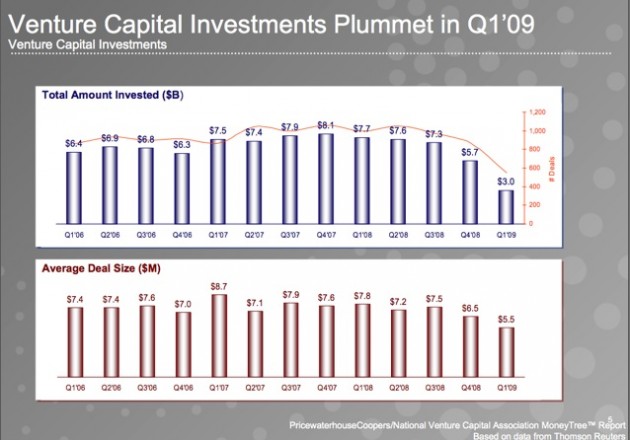
Information technology investments fell 53% year-over-year to $1.7 billion—the lowest since 1997, and the lowest volume of deals since 1995. And clean tech? Well so much for that being the future of the U.S. economy: It fell by 74% to a paltry $117 million. (These numbers according to Dow Jones, see the numbers from PWC/ NVCA in the chart below.)
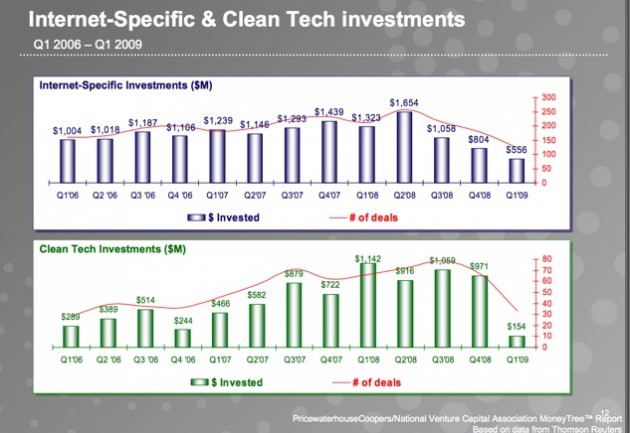
The results are so different than what we saw in the last downturn that I could spend eight posts writing about them. But I’ll distill my take-aways to three points for now.
1. Don’t be fooled: This is not just about the recession. Investments in startups declined in the last downturn, but investments in VC firms didn’t fall nearly as much. Mostly it was the firms themselves deciding to raise smaller funds. That means venture capital as an industry never had a shake-out from the go-go 1999-2000 era. It’s no secret and every VC will admit it: There are a lot of clowns still throwing around a lot of venture money that have no business doing it. (Of course, it’s a well-known industry joke that no one thinks he or she is the clown.)
Returns, on the other hand, did go down. And they never really got back up, given the amount invested. But the industry is graded on a ten-year time horizon so that didn’t matter much. Once returns from 1999 and 2000 fall off that scale, it will. Returns will look at or below the S&P 500 for what is supposed to be a niche, high-risk/high-reward asset class. It takes forever to correct because fund cylces are so long, and the asset class is so illiquid. But it won’t go uncorrected, and the witching hour is getting close.
What does this have to do with money going out to startups? VCs are scared for the first time in a long time. There’s no obvious high growth sector of the tech economy, and their investors are hit in nearly every nook and cranny of their portfolios. They’re not sure how to do their jobs anymore when nothing can go public and acquisitions are few and far between.
This is why the amount has fallen so precipitously, especially in Silicon Valley. In past cycles, VCs have pulled closer to home, and the percentage of money going to Valley startups has increased even as the volume of total deals has gone down. Not this time. According to Dow Jones, Bay Area deals fell by 57%– a faster rate than the rest of the country. In clean tech just one deal was done in the Valley.
Now, this could point to a savvier Valley entrepreneur who saw the downturn coming. After all, most of the well-known Web 2.0 names like Ning, Slide, Facebook and LinkedIn raised huge rounds just before the economic crisis hit, just in case. That could have artificially boosted the 2008 numbers and artificially lowered the 2009 numbers. We’ll have to see how the next two quarters shake out. I expect higher volume of deals in the next few quarters, but also a surge in recapitalizations.
More concerning is the free-fall in the percentage going to new deals. During the last downturn it fell to 24%– down from more than 50% during the go-go days and 33% historically. They never got much above that. In the first quarter only 18% of deals went to new companies, according to Dow Jones.
2. Revenge of the steady-eddy. What didn’t fall, comparatively? Health care and investments in New England. Both have become the reliable base hits of the venture business. When it comes to healthcare, the vast majority of exits are licensing deals with big pharma or IP acquisitions of device companies. There’s almost zero expectation of anyone going public–even in better days– because Sarbanes Oxley has cut off the ability for small market-cap companies to go out. The next Genentech? Don’t hold your breath.
Similarly, most Boston VCs never really got the consumer Web. Much of their expertise has remained in areas like telecom and healthcare, and many of their investors have morphed into more financial engineers than company builders. This meant that New England fell from the no. 2 region for venture investment for the first time in 2008, as Southern California and New York ascended. It’s now solidly back at no. 2 and investments fell a comparatively tiny 16% in the first quarter, according to Dow Jones.
3. Bye-bye Clean Tech Hyperbole. It’s not that clean tech isn’t a huge opportunity. It’s not that it isn’t an important opportunity. But I’ve never believed it was the next wave equivalent to the personal computer, as several VCs and even President Barack Obama said during the campaign. For one thing, there’s a lot of science that needs to be developed, huge amounts of money that need to be injected, and more government cooperation and subsidies than the US currently has. It’s just not the type of investing that most VCs addicted to the crack of quick-to-market, hyper-growth Internet companies can adjust to. Maybe in another ten years, but it’s not the venture guys’ salvation anytime soon.
Hang in there, startups. Take a hike, clowns.


Hasn’t this been said before? By bloggers/journalists, not named Sarah Lacy? Have you no references other than your own?
I disagree. This report by Sarah Lacy is really and excellent and honest report that rarely VC want to admit
Steve, I’m not sure what you disagree with. I agree that it is a well written article. But this isn’t the first time that the false perception of the VC industry as a successful one has been exposed. I’ll cite Adeo Ressi’s “Canary is Dead” presentation as one.
I don’t know why the author prefers to cite (link to) only references to her own work. But it’s become so frequent that you have to wonder if self-promotion is her only motive.
Now actually expenses reduced, cheap labor, rent and servers. So they dont need high investment.
Clean tech was actually econo-tech due to high oil prices :”D
you just don’t get it do you? For the last 7-10 years, credit was cheap, and easily accessible, so a lot of VCs chased what was ‘cool’, instead of what was ‘innovative’. And now we’re seeing a structural correction, back to value, and not ‘potential growth’, based on spurious unique visitor measurements.
twitter, facebook, digg aren’t innovative. They are companies iterating on a 1:M, and M:N communication paradigm. Basically, they are improving on the email paradigmn.
meh.
Thank you, itsbiscuits. This article makes some good points, but there are some key points that are missing. The causality was not a sudden “panic” about long-term returns, as point 1 would suggest. Here are the problems in Q1, 2009:
1. Major limited partners (LP), or investors in funds, asked their private equity partners (PE) to reduce the number of capital calls, since their equity to debt ratios were very bad (they essentially borrowed too much money). A lot of PE firms, which includes VCs, honored these requests and did not make investments as a result.
2. Limited partners asked their PE partners to comply with a mark-to-market accounting rule, FAS 157, forcing VCs to go through a time consuming exercise to value their portfolio. This distracted people working in venture capital from having as much time to review new deals.
3. Existing portfolio companies could not, as a result of the problems above, raise capital from new investors, yet many companies needed to raise capital. As a result, many of rounds completed in Q1 were “inside rounds,” where investors fund their own portfolio at lower valuations, some being dreaded cram down rounds. Without external validation of a valuation, existing investors generally take a conservative stance on valuation of existing businesses.
Things will get better now that the market has shot up, as it improves the equity to debt ratios of the LPs.
However, there is a MUCH bigger problem looming. The FAS 157 reporting coupled with poor 10 year returns puts the entire asset class of venture capital in jeopardy. Here is the really concerning fact:
Only 3 new venture funds were funded by LPs in Q1 2009. This is a BIG RED FLAG that the people with money are starting to be skeptical of the asset class. They continue to back “friends” in the industry for the time being, but “friends” that lose money don’t get backing for long…
“we are in the 3rd inning of a dot com crash. the bubble is bursting at the seams. the next 9 months are gonna be brutal on tech.” there i said it.
CapitalDomain.com – sound investments
We need to be careful what we wish for. While VC-bashing can be good fun, if we lose too much of this industry — and we just might — surely as a nation we will regret it. Just as we may well regret the death of journalism, the loss of large swaths of financial services, and pretty much everything else that isn’t Hollywood.
Perhaps State-sponsored full employment will bring us happiness, but I doubt it.
pyrrhic — I think the question is how big should VC be? Returns have been lackluster for a long time, and deadwood hurts everyone. The sooner we can get to reasonable levels, the better off all of us in the startup ecosystem will be.
IMO, VC needs to be fundamentally changed…There has become far too much of an emphasis on hiring associates and making partners with Harvard / Stanford Business School on there resumes and nothing more…More of an emphasis on the successful entrepreneur would go a long way.
@david, in an article, “A New Venture Animal” Paul Graham explains how this can be done. The idea is not to compete directly with VC’s but help hackers start their own companies instead of applying for jobs in someone else’s. Redefining “deal flow” by launching tech companies using “a small, furry steam catapult” ~ http://www.paul...combinator.html
Here is a scientific project done on the effect of the crisis on venture capital: http://papers.s...ract_id=1373723 – Rather interesting!!
Two years ago I sat in stunned silence as I listened to Loopt CEO Sam Altman talk about acquiring VC money as the end game play for all startups.
It aint.
Fast forward: Loopt running on fumes, his sleepy VC pals aren’t writing checks anymore, and people are losing their cushy jobs.
Why? Because kids think VC funding is the end game when it’s only the beginning. You are getting a loan and giving up a healthy portion of your startup in exchange.
And if said startup can’t generate enough revenues when the money runs out?
You lose.
Instead, why don’t you kids stay AWAY from VC money, come up with a revenue generating idea with an audience that will pay for your services.
Grow slowly, pay yourself slowly, and work hard.
Then, and only then, will you see the fruits of your labor.
L A B O R. Look it up Geeks.
Good thing we don’t need the capital. Bootstrap it if you can. Be creative in how you get things done.
“Bullshit. It fell off a cliff in 2001 and 2002 and it’s falling off a cliff now. (More on that in a second.) But there’s a difference: Funding levels, returns and the percentage of that money going to new ventures never got nearly as high as they did in the 1999-2000 years. So when we talk about steep drops—we’re talking about less of a bubble bursting and more of an industry correcting for more than a decade of scale and liquidity issues.”
What are you trying to say exactly? You should be saying WHY you claim the stuff before it to be bullshit. But instead you are talking about “industry correction” and “sale and liquidity issues.” Those two things are VERY specific issues and have NOTHING to do with the PHILOSOPHICAL argument that recessions/bad times are good times to start a company.
Please. I know you have points to make. If you had in SIMPLE words just provided your reasoning as to WHY it is not just the recession, this post would have been worth reading. Instead, we find bullshit like reason #1 it’s not the recession is….”Don’t be fooled: This is not just about the recession”. Hey you’ve already said that…tell me why! Please.
Your writing style is kind of IRRITATING
She did tell you: Though the recession is one reason, the overall returns over the past decade were anemic. Other than some big hits from 99-00, the asset class as a whole wasn’t able to produce reasonable returns from investments made during the good times.
very good article is this the same sarah no mention of your personal experience anywhere. keep up the good work.
love,
svd
And http://www.clasilistados.org ?!
“After all, most of the well-known Web 2.0 names like Ning, Slide, Facebook and LinkedIn raised huge rounds just before the economic crisis hit, just in case. That could have artificially boosted the 2008 numbers and artificially lowered the 2009 numbers. ”
Bingo. To make a safer assumption, we might have to wait for the next quarter.
I didn’t know “Ning” and “Slide” were well known names. Certainly not in the same vein as FB and LI.
The government needs to change their view on Sarbanes Oxley to allow smaller firms an opportunity to raise funds in the open market. This will create liquidity for VC’s and they will be more likely to place more bets and ultimately these bets will create more jobs.
In most cases you cannot trade derivatives around smaller and midcap stocks so there shouldn’t be a concern from the government there.
Where are the four horsemen when we need them! (http://www.info...ride-again.html)
I think this is your best post to this date. Great job.
finally, well said!
i’m sick of these menlo sand hill country club clowns ladeling hypocrisy on founders just to ferret out good information for the general partner meeting.
send the lot along with the other financial engineers to screw up china and breath polluted shitty air. lets get back to building real companies with real investors, not jelly kneed clowns.
A little bitter “clibou”? Now, can you enlighten us with who the “real investors” are and give some examples of who the successful “real companies” are???
sequioa, elevation partners, 3i
a123 systems, spaceX, ncipher
During a conference call, John Taylor, vp research NVCA, said venture investors are being selective right now, “and the best ideas are getting funded but the marginal ones aren’t.”
the us is in hellva mess; bear, lehman, aig
what are the vc’s doing…
patriots or ivyboys?
power supplies and conservation
pollution and recycling
alternative energy
electric grid
stem cells
mmo
my 0.02 + NYT
http://bit.ly/IDV5X
as founder i can say no, it IS easier to raise money these days. never got better deals offered from vcs than now.
thats not a bloggers theory, thats reality.
and i’m also sure that the “better founders” raise money now.
OMG now I’m really scared…. who’s going to fund all those dancing hamster “services” from YCombinator??
Long time reader, first comment. Good article.
Q1 ‘09: lowest total VC invested since 1998; lowest DJA since 1997; lowest S&P since 1996; NASDAQ just shy of the same. sorry that looks correlated to me.
p.s. your words say “worse than the ‘01!” but your pictures stop at Q1 ‘06.
Exactly what I was wondering about! Story mentions numbers going back to the mid-90’s but there is no supporting data in charts.
Would have been so nice to see how this downturn is different from the ‘00-’01 downturn with analytical comparison. Clearly the author is making decisions on data not presented here.
Would have been a much stronger piece with all the data going back to the mid-90’s.
Diddo. Would have been nice to have mentioned / linked too Adeo Ressi’s “Canary is Dead” presentation and post that Erick did on November 12, 2008.
http://www.tech...rossed-for-vcs/
Troubling trend. Ask any VC to defend the current venture model and their expressions tell the whole story. 10 year funds? 20-30% returns? 7000 “VCs” in the US ?… Everyone but new LPs know what is on the near horizon…
Unfortunately – commercial Real-estate and the venture capital are the next dominos…
Commercial real estate is next? Um, what do you mean by next? I hope by next you mean already fallen off a cliff
Part 2
Oh, what’s that ? You’re not a member of the mafia such as Alphons0 Gaglain0, minister of public works in G@tineau? Well then, perhaps you have a friend in the house of commons or know some exceptionally good looking h00kers.
At any rate, thank god we do not have the BDC in America. Thank god we are still not a socialist country. When govt controls the money, ex companies of the politicians get it. cough, Ben Mulroney, cough, Cheyney, cough, you know what I mean.
That TC article on the US government doing venture capital was very misplaced and wrongly though out.
If there is no venture capital in the US, then so be it. We have jobs, we can invest in our own projects.
We don’t need to hedge large funds. My recent VC investment was from a small corporation where I am the CTO in charge of the software and programming. Those are sane investments.
This link uses a cookie and user agent to see what referrer it came from so you have to visit the following page, THEN click on the link, but look at the broad powers that would be given in a govt run paradigm. Let me tell you there is NO checks and balances.
tinyurl.com/BDCCharter
we’re in a DEPRESSION, not a normal recession
I agree, this is more than just an average recession.
They are just want to ’save’ their money and wait for less ‘rainy’ day… not wise – but this is the game most of the VCs are now playing.
–
http://twitter-...zz.blogspot.com
It’s all going to come back in the end. The Internet is a medium that simply makes it too easy to reach and track the behavior of a large number of people. In the end, there will always be money in that. And if there is, the VCs will return. Just a question of how long we have to wait.
The last post was intended for @fooooo
My post is directed to the commenter above.
Sorry… could not read it. Saw the clown and ran in fear.
In 32 years in Silicon Valley, and many ups and downs, I have never seen VCs scared to invest almost anything here this year!
WE sould be able to put our act together, remember Small Biz is powerful in USA. Get Gov to help. And then we need next generations defined as a $ ROI! Not just some wiz bang technology!
WE need to RE-Invent ourselves (sorry HP I stole your logo).
The question to any biz plan has to be why the customer will pay $x to buy it from us, and not Chinese, French, etc?
We can have most fantastic technology, but if customer does not pay…then what?
And, I am not talking about fancy powerpoint Biz plans…I am talking something real with a real ROI in less than 12 months, or graduated ROI each quarter that can be modularly sold by VCs!
I spent a lot of blood sweat & tears in Exp.com, or others. Even the CFO could not clearly say “Where the money will come from” and why customer will pay $x for it!
What about international investment (esp Asia) I know it’s still accounting for small portion compared to the sand hill road folks. But growth rate is still okay there:
http://www.weal...-compared-2008/
Getting VC, scaling fast, then selling off, is NOT a business model! {seesmic_video:{”url_thumbnail”:{”value”:”http://t.seesmic.com/thumbnail/q5PMlLRVbX_th1.jpg”}”title”:{”value”:”Getting VC, scaling fast, then selling off, is NOT a business model! ”}”videoUri”:{”value”:”http://www.seesmic.com/video/vv4dhEszT1″}}}
Hey Nick,
Sorry I wanted to hear what you had to say but I could not help noticing that you seem to focus more on the looks that the content. Rule 1, do not look to your top left fishing for some intellectual content. Rule 2, stop posting video comments until 2010 at least when it’s cool.
Others have told me that I’m a little too animated and excitable sometimes.
Why aren’t video comments cool?
They’re just not cool when you do them.
Video comments are never cool. If you want your opinion known, use text posts on TC.
So nick, basically you are saying Flickr is a scam? You might want to share whatever you are smoking.
Your concept of business cannot be applied to internet startups. It might apply to mom and pop shoe or hot dog store. On the internet, things move fast and that is why it requires VC funding and scaling fast, because before you know it, the next big creeps from around the corner. You can’t wait for 10 years to get somewhere.
I knew someone would say this.
You’re absolutely right! I use Twitter, Seesmic, and lots of other services that are riding on VC money. They NEED that capital to scale and keep up with demand, and that’s fine.
What I’m arguing against are businesses that think they NEED venture capital just to get started, or businesses that start out with the intention of selling.
It’s not always possible to avoid VC, but there are plenty of cool ideas and profitable niches that don’t need that kind of money to get off the ground.
nomen est omen
@Nick: I think your point is well taken.
Although there are many scenarios where VC monies are required to launch and grow a high risk/high growth venture, entrepreneurs are becoming complacent when they believe there ‘business model’ is based purely on raising capital. You always should do something you love, but at the end of the day the bottom line is you have to run a sustainable business.
Too many start-ups today are blind to the concept of (positive) cashflow. Raising money and selling out to Google is an unsustainable ‘business model’. If VC money is not flowing, many businesses are forced to do a little introspection and realize they’re models are broken.
I would tend to agree, but I do have to wonder what is paying your bills while your start-up product only pays out in love.
My business partner and I both have day jobs as software engineers at another company. We use this money to fund our business. If you use your own computers, avoid renting office space, and optimize your code to scale well, you don’t need a ton of money.
There was an interesting Business Week article a few weeks back about the rather obvious downturn in CleanTech VC investment. They peg VC investment in North American, European, Chinese, and Indian cleantech markets at about $1bn in Q1 09. That’s the lowest since 2007, but still a lot of cash.
I can understand VC reticence here, even though I’m clearly a cheerleader for the sector. There’s just a ton of public money available right now. It’s not that the technologies are unproven — quite the opposite. Wind is so mature now that it’s time to build it at scale, and there are fewer opportunities for astronomical returns.
As the economy comes back, so will CleanTech VC. But the people who want to make bank in this area will have to look at the next wave of energy technologies: solar, in particular. That’s where the biggest risks and payoffs are, and that’s what VC is best at leveraging.
Remember this is the Sarah Lacy who’s proud of her lack of journalistic training.
If I see “takeaway” on techcrunch one more time, I’m going to eat a whole cow. Live. Hooves and horns and everything.
Looks like your job is in danger, honey. Better start practicing those pork-sausage-rolling skills again.
I may not be Steve but I can tell a good song from a shitty one. I am the snake of the latter.
Great stuff.
I would have to say that I agree with some of the comments here which suggest that VC funding is not the only way to get a startup concept or product off the ground. When VC’s are throwing cash around left, right, and center, it is all too easy for a startup to put out the hand and say “Yes, please”. Times such as the present are when we’ll start to see pragmatic and innovative founders launch products which have a firm business model and perceived 100% ROI within 12 months of launching.
It’s perhaps not the amount of money thrown at a startup that matters, but the value of the concept or product itself. The current economic climate of VC investment is nothing to be pessimistic or negative about. If you’re working on a startup idea, put your head down, choose rapid development languages/tools, and get cracking! The internet is a place where a good idea will catch on and spread like wildfire, we all know that.
Good luck to all those startups out there, beavering away in homes and offices around the globe on innovative and exciting concepts. I look forward to stumbling across your product in the near future!
Scott
Sarah,
I appreciate the sentiment in your article and hope you’re doing well. One thing I want to point out is that you’re talking about general trends and generalizing what VC’s you know say to all VC’s, then using the data that is from the entire industry to contrast with that. You speak to some of the top VC’s in the valley. Who’s to say they aren’t still investing. Maybe the deals that got done are being done by those same people who have told you they keep investing and that a downturn is a great time to start a company? I think there’s an error in calling “bullshit” by comparing what a select data sample of people say (the ‘top’ VC’s who you speak to in the Valley) and then what the industry is doing from a macro data set. Many of the middle tier VC’s, PE shops that like to say they do VC etc are going to do less deals. I do think you’re right that there are some cases where VC’s (probably not the top tier) are saying they’re investing, but then aren’t in reality because they’re scared, but the generalization that they’re full of S%@t I think goes a bit far.
The economy is in a “financial crisis”, and we are talking about venture “capital”. Of course VC funding is going to get hammered. Talk about discretionary investment for institutional investors. Companies have stopped giving dividends, and investment banking is extinct, sure VC is going to be hurting.
I don’t think it’s right to blame this on startups, lame as 90% of them may be. It’s the VCs job to cycle out of bets (categories) that are no longer looking likely to pay off, like green tech (medium term at least) and the (crazier) Web 2.0’s.
That’s a really different thing than saying “VC is dead”. Investment returns for many classes of assets over the past 10-12 years is absolute crap, especially in real terms. VC actually doesn’t look so bad compared to the Dow and the NASDAQ.
Cut us all some slack, Sarah. Don’t worry — be happy.
Hello Michael,
I have been trying to get in touch with your editorial team but there is absolutely no response. Have written twice before. Can you please help.
Regards,
Marvin/Arvind
http://latticepurple.com
Hi Michael,
I have been trying to get in touch with your editorial team, but there is no response. Can you please help???
Regards,
Marvin
Go to a first supermarket. Almost all goods have prices. Sometimes there are free samples. In Internet proportions are opposite. No wonder that VC industry is in decline.
Thank you.
Maybe VC people should learn what’s a good investment and what isn’t. Some of the things i’ve seen funded…lame.
You’re not telling a story in a blog post, you’re posting news. Please get to the point and stop with the multi-paragraph introductions.
Hi Sarah. Good information in this post. It seems the clown moniker is being assigned for going for the quick hits. I thought you would enjoy reading my related post on who is responsible for innovation which is the most recent post on my blog.
rob
I’m not exactly sure what the point of this post is. Is there supposed to be something in this post which is news?
That Venture Capital has been caught-up in the same meat grinder as every other asset class in the past year?
That VC’s say they are interested in investing in A and then go invest in B? That’s news?
That some VC’s have made some really stupid investments? That’s news? I’ve made some stupid investments, too.
That investment activity everywhere is down precipitously? Wow, news flash! I had no idea.
That getting sustainable returns for investors may require a different approach the next ten years than has been used in the past ten years? Another news flash – wow!
A partner in a venture fund has one job: fulfill his/her fiduciary responsibility to create a return for the LP’s who put money into the fund. That’s it.
I’m still reading this post, trying to figure out where the news is. I think the news is really that TechCrunch needs to leave reporting on financial markets to professionals.
http://www.nati....com/680263.bin
This is the face of government run VC, this is the face of MERX.com and the Canadian public works ministry’s contract and proposal unit which allots public money to the private sector.
This is also the face of organized crime and there are tens if not hundreds of more faces under the Harper/QEII parlaimentary monarcy.
The more the government helps, the worse it is in the long term, because after the initial problem is resolved, bad people will leverage these new platforms to their own gains. Just like Cheyney did.
This post is out of order it should be after the last post.
It’s all a big conspiracy!
It is not all VC’s faults. As someone pointed out on
SVCEF, 2000-2010 is a decade of innovation desert.
(In other words, there was not many good things to invest).
(http://groups.y...com/group/svcef),
It is not all VC’s fault.
As someone had pointed out on SVCEF, 2000-2010 is a decade of innovation desert.
Slowly but surely Sarah Lacy’s I’m starting to look forward to Sarah’s posts as much as Erik’s and Mike’s. TC, great hire!
Reader’s edit: Still waiting to be impressed with an SL interview, but I’m coming around.
>>More concerning is the free-fall in the percentage going to new deals. During the last downturn it fell to 24%– down from more than 50% during the go-go days and 33% historically. They never got much above that. In the first quarter only 18% of deals went to new companies, according to Dow Jones.
This is a little vague. Percentage of what? Deals or dollars going into deals? If it’s dollars, that would make sense it because of the trend towards larger Series C rounds due to the lack of IPOs.
VC’s need an exit strategy. How many web companies went public in the last year? Google, Microsoft and Yahoo are slowing down with their acquisitions. Even the top Web 2.0 companies like Facebook and Twitter are having great difficulty trying to monetize their sites. I’m not a fan of VC’s but I can’t say I blame them. They are in the business of making money and at least with the web there is very little money to be made right now.
I wish some of them got more daring with investing in artificial intelligence, nanotech etc. There is still the opportunity for people to make major breakthroughs in the world. I’m also hoping the whole green energy thing will take off. If it does it will be good for the U.S., good for the tech industry, good for Silicon Valley, and good for the VC’s.
You have to hand it to Sarah Lacy. Who can say so little of substance in such a long post? Okay, excluding Brian Solis.
Here’s the problem with Sarah’s apparent disdain for VCs: they fund all of the startups that she’s hyped over the years.
Just read her fluffy Web 2.0 book, “Once You’re Lucky, Twice You’re Good”, which puffs up Facebook, Digg, Slide, YouTube. Every single one of them venture-backed. Collectively, VCs have thrown around three-quarters of a billion dollars at these companies.
How exactly does Lacy think that these companies would have been financed if not for the VCs she refers to as “clowns”?
Was Mark Zuckerberg going to sell his collection of Adidas flip flops to buy servers? Was Kevin Rose going to pay employees with the paltry $10,000 in savings he had when he got the idea for Digg?
Obviously, you can’t have it both ways. If you’re going to make a career of hyping venture-backed companies, you probably shouldn’t think of the VCs who fund the party as “clowns.”
Without the VCs Lacy criticizes, the startups Lacy loves have nothing to hang on to. And without those startups, Sarah Lacy doesn’t have anything to write about. So who’s the clown here?
Bravo. Good point. Sarah Lacy *IS* a clown!
No kidding. This is coming from a half brained journalist who is best known for her train wreck interview skills. And now we get a dose of her writing…could it get worse?
Clowns? Really? People in glass houses shouldn’t throw stones. While we’re at it, aging pale women with fat thighs shouldn’t wear mini skirts whilst trying to humiliate one of the most influential 20 somethings of this decade.
Yes, VC is down. Like buyouts, PE deals and IPOs. How is this news? Oh, that’s right the clowns (low grade journalists) don’t know they are clowns.
VCs are clowns, Sara Lacy is a clown, the 2 are not mutually exclusive.
Love your written pieces, well researched…. a bit ego centric but thats ok… I call it character. While your interview pieces suck, your writing and written stuff is excellent and rounds out techcrunch in a much needed area… to do some f&cking research before writing stuff… well done. Rather read you then arrington…
so is the rumor true with you and arrington?
Huge innovations don’t happen year in, year out.
I think that it’s ‘OK’ that there are lulls in the cycle. Everyone is going to work harder for their funding and its good that VCs are having a rethink.
Genuine innovation will be a great catalyst for any economic recovery and it will happen again. Its just a question of when……
After the recession of the early eighties the IBM PC started the recovery.
Huge innovations don’t happen year in, year out.
I think that it’s ‘OK’ that there are lulls in the cycle. Everyone is going to work harder for their funding and its good that VCs are having a rethink.
Genuine innovation will be a great catalyst for any economic recovery and it will happen again. Its just a question of when……
I shall refrain from making a smart ass comment about the author of this piece, but instead focus on the obvious, which is to point out that Silicon Valley has reached the point where it is strip mining fools gold. For every good idea (gold) there are 10,000 other jokers with lousy ideas (fools gold).
For too long VC’s have spent too much on the latter, throwing money at “coolness and hipness” with dubious business models, and it’s time to return to start ups whose focus are on fundamentals such as long term growth, innovation, and disruptive markets.
BTW, the best article you guys posted this week was the Andrew Keen interview, which is spot on. Web 2.0 is a sham, as demonstrated by your focus all week on celebrities and Twitter. Oprah on TV and Oprah on Twitter. Yeah, that’s innovation.
Very nice information is comment above, thanks. Author did miss on a couple of these important points.
Adeo Ressi (@thefunded) – April 18th, 2009 at 10:42 am PDT