Once again, Google is the favorite bogeyman responsible for the rapid deterioration in the health of the news industry. This time it is Nick Carr doing the finger-pointing, describing Google as the most powerful middleman in news:
When a middleman controls a market, the supplier has no real choice but to work with the middleman – even if the middleman makes it impossible for the supplier to make money.
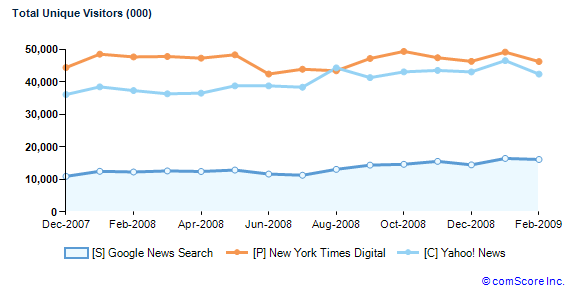
So how powerful is Google when it comes to parceling out traffic to news sites? If you are talking about Google News, the answer is that it is not quite as powerful as you might think. In the U.S., Google News is overshadowed by both Yahoo News and even the sites controlled by the New York Times (which includes NYTimes.com, Boston.com, HeraldTribune.com, and several other newspaper sites). According to comScore, Google News attracted 16.2 million unique visitors in the U.S. in February, compared to 42.3 million for Yahoo News and 46.2 million for the sites operated by New York Times Digital.
So Google News is not the middleman here. Let’s just put that notion to rest. Yahoo News is three times as large, and Yahoo sends even more traffic to newspaper sites from other parts of Yahoo through its online newspaper consortium.
The bigger question is whether Google as a search engine is controlling access to news sites. That really seems to be Carr’s main concern, although it is not clear because he uses a Google News search as his main example. Nevertheless, Google’s main search engine is certainly a major source of traffic to information sites of all stripes. At TechCrunch, for instance, it is the single largest source of traffic, accounting for about a third of the total. I have no idea whether this is representative of other news sites, but it wouldn’t surprise me. Google search is a very important middleman indeed.
Does that make Google like Wal-Mart, as Carr suggests, a middleman of such might that it squeezes everybody else’s margins? Does that give it “monopoly control over content distribution,” as Scott Karp tries to argue? Not exactly. Information economics work slightly differently than retail economics. Let me stick with the TechCrunch example. One third is a lot, but it is not a monopoly. Google sends us all of that traffic because many of our posts rank highly for the topics they cover. We don’t pay them for that traffic. We are not buying keywords.
Yes, Google makes money from other ads shown besides any searches where TechCrunch posts shows up as results. But the money Google makes from those ads does not detract from our revenues. Quite the opposite. Those searches send a considerable amount of traffic to our site, where we have our own ads. The more people who see those ads, the more we can charge for them. It’s all good.
Google does not control the news, it exposes it.
The retail/distributor analogy is all wrong. Information is not the same as a flat-screen TV or a blender. It does not become less valuable the more available it is because all news is not the same. Information dissemination is not a zero-sum game. Carr and Karp would have you believe otherwise. Karp writes:
The more content there is on the web, the less money every content creator makes, and the more money Google makes by taking a piece of that transaction.
Again, that is not how it works. Google doesn’t force suppliers of information to charge less for it as Wal-Mart does with suppliers of packaged goods. The money Google makes from its search ads is not necessarily money that would have otherwise gone to a “news” or content site. If Google didn’t exist, those ad dollars might have gone to an e-commerce site or a travel site or a real estate site or any number of other places. News sites have no claim to those search advertising dollars. It is incumbent upon each of us to attract an audience by having something original or interesting to say. When news sites do that, other sites link to them, and then they rank more highly in Google search results, which sends new readers their way.
And then once those readers do find a news source they trust, you know what? Some of them actually keep coming back on their own volition without Google telling them what to do. That is called direct traffic. Or they come through other sites. Google isn’t the only one who benefits from all those links. If you want to be known as an authoritative source of news, it is no longer good enough to simply proclaim yourself to be one.


im always skeptical of these techcrunch traffic comparisons because you forgot imageshack, the most popular one, when comparing photo hosts.
Newsportals yet to learn internet. They still have low res and high resolution version which is bad for seo. Also, newyorktimes.com/?mycity=XYZ permalink which will have city news box would be need of the hour.
In india, timesofindia.indiatimes.com news takes 50% traffic of parent indiatimes.com traffic, that is at rank 12 as per alexa.
indiatimes.com has a team of seo’ers that place many hundreds of links to its items in the wikipeadia.
Newspapers might hate google but most have no problems in using spamming seo. You either love the traffic or hate it.
http://www.clasilistados.org
or http://www.clasilistados.com
and im talking about this
http://www.tech...-from-the-pack/
yes i saw the updated post, but it doesnt matter
Um, that has nothing to do with this post. But Imageshack’s didn’t make that other chart because its U.S. traffic isn’t high enough.
alright
A couple things.
Google News is awesome. Why the hell would anyone use Yahoo News over Google News – oh oh oh I know, celeb gossips and glossy AP pics. Yay. (Actually, the glossy AP photos of fashion show catwalks are kinda worth looking at, but I digress.)
Also, when you speak of 1/3 of Crunch-traffic coming from Google are you also counting the feeling lucky redirects from url fields and such? [field] > techcrunch > [enter]?
Good article overall, I’m just wondering at what point the books stop blaming the card catalog for their own sad shelf-life.
(PS I heart the new twitter field… nicely done.)
I didn’t post my comment as a reply but it ended up as a reply… there is malfunction.
:/
i thought al gore control the news. he did invent the internet.
And yet his name is mysteriously missing from the United States CTO poll.
Sigh … that hatchet-job again. See the debunking:
Al Gore “invented the Internet” – resources
http://sethf.com/gore/
Yeah, everyone knows that it was really Bill Gates that invented the Internet.
I think Google definitely wants to get in to the news publishing industry and that may be one of the reasons why they showed interest in acquiring twitter — the king of real-time news. Google should focus on acquiring smaller players in this real-time news search market like http://www.boilingpage.com that does a great job in bringing the hottest pages on the web based on how popular they are in Twitter. If Google overlooks such companies, down the line, they may be a potential threat to Google’s core search engine. At least, I can see http://www.boilingpage.com has that potential to kill Digg and Google (that may look an overstatement now, but mark my words)
Not bad.
I think the Diggs of this world have had their day. A small clique probably in India is responsible for the homepage of Digg. The whole idea of voting is purile and so the content on digg has become the same.
I think sites like hookk http://hookk.com have a better model. Micro letters to the editor where the newspaper itself is the target.
No signup so the uptake will be quick and the comments live right next to the article in a sidebar rather having to sift through pages in a directory.
I got to this article from a Digg feed. And, micro letters to the editor the next big thing? Generally, I could care less what 99% of the people in the world think.
I actually read the article before I saw your post. And I must say that his angle makes sense and so does yours.
The truth is major news retailers have been thrown into the same level playing field as TechCrunch.
Its simple. The big guys don’t like it but the little guys welcome this.
great article. great points.
huh… Yahoo news is at the top of the chart? Good thing they fired Jerry and they had better sell ASAP or they are toast. At least that is what the anti-yahoo sheep were bleating a while back…. (where are they now?)
Pleasuring their little drone minds dreaming of retiring on Google, of course.
Still, their idea of SUCCESS if those horrid little fraud spots they call AdSense. All they do is sell them until we are sick of ‘em. The distended abdomens for that diet that Oprah supposedly supports yet thepictureswould seemingly embarrass and disgust her, if you believe her public persona at all.
The quack show moved from fleabag desperate AM radio to Clear Channel to Google and TV.
Good riddance to medium killing poison!
What most concerns me is whether Google is censoring what they are indexing. Do a search for a CNET post titled Google’s Schmidt: Brands to clean up Internet ‘cesspool’
What do YOU suppose Google plans to do? Did you read this quote:
“According to Google CEO Eric Schmidt, the Internet is a “cesspool” where false information thrives.”
Ask yourself what they plan to do about it. Quite a while back they dropped a lot of pages from the index. I wonder which sites or pages are not there any more?
That wouldn’t be nearly as large a concern if Google didn’t have a virtual monopoly on both organic and paid traffic. Read the post I’ll link to this comment for more details.
then use Yahoo
Already have for years. Graduate school?
3rd grade is where no Fox network show has gone. before.
Find a better answer.
well i know from experience when your signed into your google account the google news section learns from everything you click just like the search engine does
They plan to work for the gov., collect all information about you and supply you with desinformation, just because… drumbeat… it has a better ‘Page Rank’. Did you get it at last?
The internet is the great leveler. Scott is just saying that abundant content has brought the value of advertising down so much that it is not a sustainable business model.
Take a newspaper that was in a medium market and had a website that did three million page views a month. Can you get a CPM that is high enough to make advertising pay for all the journalism that a newsroom that size is producing? No.
Techcrunch is not typical, though if most newsrooms were as lean and agressive as you guys they would be better off.
Five reporters, a tech guy and a salesperson is what a typical local news organization will look likein the future.
Plus, TechCrunch gets revenues from events as well.
I correct myself. It’s not the value of advertising that is down, it’s the value of a pageview to an ad.
The value of an ad is not the problem, it’s the sheer number of garbage and quack brokered ads destroying the value of the page! If local advertisers then shun buying ads from, say The Podunk City Tribune on top of the regional buyers who have been hoodwinked elsewhere that is the moment the distribution cycle crumbles into a critical condition.
This has been a tragic mistake for publishers and site owners one and all. Local, hyperlocal and other buzzwords are all denial of the problem.
No, that’d be Yahoo!
No, that would be YOU! ;p
Erick,
Where’s an economics professor when you need one
Google doesn’t steal any revenue from TechCrunch directly — it’s all the other sites competing with TechCrunch that shrink your pie. So every time Google sends traffic to them, it’s not sending traffic to you.
But more importantly, Google makes it possible for so many other tech sites to have some meaningful amount of traffic, which helps drive the overabundance of tech content, which in turn drives down ad rates because there’s so much inventory.
The problem for content sites is that Google helps them all make SOME money but fundamentally limits the amount of money that all of them can make by ensuring that slices of the pie get thinner and thinner over time.
So it doesn’t matter if your Google referrals grow or your direct traffic grows if the your revenue per visitor is declining — or if it can never grow beyond a certain scale.
It’s also why the idea that subscriptions or paing for content doesn’t hold water.
If it’s easy to find a free alternative that is “good enough”, why pay?
Google doesn’t fundamentally limit the amount of money they can make. How a site’s content is received and valued by their audience is what limits the amount of money they can make (ideally, and possibly in a vaccum).
Maybe it’s not “fair”, but isn’t that what Google is going to say? Don’t we see examples of this in real life as well, where a viral YouTube vid gets millions of views out of nowhere?
That’s basically true, but most local new markets are not of interest to a large enough audience to monetize it through web ads.
That doesn’t mean there is no value in what they are providing the small group that is interested. Just that they need to either get a larger audience or a different business model.
Or they could film mentos in diet coke bottles and go viral. ; )
“But more importantly, Google makes it possible for so many other tech sites to have some meaningful amount of traffic, which helps drive the overabundance of tech content, which in turn drives down ad rates because there’s so much inventory.”
Scott,
I think you have a problem with the internet itself, not Google. Google doesn’t enable to competition to TechCrunch or any other information business. It’s the Internet, the low-cost of doing things, the ability for little man to have a chance. So, if you want to successful within this environment, all you’ve got to do is stand out.
If Google had gone into information publishing business and clearly favored their properties over others, only then one can talk about it being unfair.
As long as Google continues to rank their results based on relevance only, no one should cry foul of their service.
Yes, Scott’s right. The core economic problem facing the online businesses of traditional news organizations is the fragmentation of traffic among an overabundance of pages (too many stories chasing too few dollars), a situation that Google both supports and profits from. It’s not a matter of Google “controlling the news.” As I wrote in the conclusion to my post: “The fundamental problem facing the news business today does not lie in Google’s search engine. It lies in the structure of the news business itself.”
Nick
Well, that’s one thing we can agree on: the news business is the problem. But you also characterize Google as the “middleman” controlling supply, and that part of your thinking is flawed.
Scott, the amount of available inventory is only one factor that impacts how much a site can charge for advertising. If all a news site does is re-report what every other news site reports, then it is merely playing an eyeball game. If a news site can offer a different perspective, original reporting, or something else that actually builds a loyal audience, it can charge advertisers more for access to that audience.
Although the news often seems like it is a commodity, it doesn’t have to be. There could be a million other tech news sites out there, for instance, but our ad rates are not declining.
Ultimately, your argument rests on a false premise: that Google is a monopoly when it comes to the distribution of traffic to news sites. It is big, but it is nowhere near a monopoly in that regard.
Traffic comes from many places. The more links the better. Even if Google sends traffic to another tech site instead of to us, that site might send traffic back to TechCrunch if it links to us. When people read about news that interests them, they often seek other articles and points of view. It is not a zero-sum game.
How Google ranks each article is only a reflection of whether other sites feel it is worth linking to. So the more you rise above the noise, the better your news site will do all around.
Erick,
“In economics, a monopoly (from Greek monos , alone or single + polein , to sell) exists when a specific individual or enterprise has sufficient control over a particular product or service to determine significantly the terms on which other individuals shall have access to it.” (Wikipedia, of course)
Just because Google doesn’t control all of your page views doesn’t mean it does not have monopoly control over content distribution. Is there another single source that accounts for fully 1/3 of your traffic?
It’s not about Google having total and absolutely control — it’s about Google having orders of magnitude more impact over the marketplace for content than any other entity on the web.
Even if your ad rates are not falling, I’d wager they aren’t rising too much either — and that has a lot to do with Google helping make it possible for so many competing sites to take a slice of the pie, even if the strength of TechCrunch’s brand helps it command a larger slice. The great irony of the web is that Google has helped make TechCrunch a dominant news brand, but it also prevents TechCrunch from scaling revenue based on monopoly control over distribution. Google helps prevent TechCrunch from becoming the size of, for example, IDG at its height.
It’s not about whether Google prevents news content sites from being good business — clearly, it helps. It’s about whether the web content ecosystem that Google has defined prevents news content sites from being BIG business. That, I believe, was Nick’s point.
I am not disputing that Google has tremendous market power. What I am disputing is that it has monopoly power in this case, even as you define it.
One of the tests of a monopoly is whether it has pricing power, whether it can set prices. Yet Google doesn’t even set its own ad rates. Advertisers do that themselves through an auction mechanism. Even without Google, all that other ad inventory on news sites would be out there.
Both you and Nick are conflating the fact that there is too much ad inventory on news sites (a real problem, I’ll grant you) with Google’s influence over how many eyeballs see the ads on those sites. Google didn’t create the problem, and it doesn’t control the ad inventory or prices on those sites.
Most news sites resort to Google AdSense ads as a last resort because they tend to generate less revenue than targeted display ads from other ad networks or ads that the sites sell themselves (which usually bring in the most money). So it is not one big advertising pie shared across all sites, but rather many different pies.
Nick Carr said it best. “The problem with the news business doesn’t like with Google or its search engine. It lies with how the news business is structured.” If the AP, Wall Street Journal, or any other organization doesn’t want to be indexed by Google, it takes a couple of lines of code to opt out.
Personally, I worry about what’s going to happen with news because there’s a need for investigatory journalism, and what you hear news outlets and papers saying quite a bit these days is that “it’s very expensive to put the news together”. There can be a huge a difference in terms of quality and relevance between relying on professional journalists vs. bloggers for news. This, however, is not Google’s problem or responsibility.
Technology changes business all the time, and for years we’ve been warned about the Internet changing news. Well, it’s here. Newspapers and shutting down all over the country, and news outlets are getting aggressive about content ownership. The latter is a sign of old media not wanting their business model to change (because when, after all, was the last time that it did).
Great work, Erick.
I’ve been in the news industry my wholelife and I never understand what they are talking about when they say “it’s expensive to put news together.”
It’s certainly not the reporters salaries. ; )
It is expensive to put out a print product, and they think in terms of those numbers, not smaller internet numbers. Numbers that are a viable business for a small company like TechCrunch, but don’t impress executive types, because they can’t figure out how it will pay their ridiculous salaries.
not quite apples to apples but I’m the head of business for my college paper at a mid-sized university and in developing our site we realized how important increasing traffic was to our monetization efforts as a matter of course. I can’t understand how newspapers are overlooking the importance of SEO when it’s widely viewed as one of the major pillars of good internet marketing. google love = traffic = more visitors = more clicks/conversions = more advertising revenue. is there something I’m missing?
only that the advertising revenue you speak of is a drop in the bucket for a typical news organization
I realize that the obstacles for change are immense, but perhaps revenue is not the only part of the model that needs to be changed. organizations, especially in times of recession, should take the time to do a top down reevaluation of their cost structure. also, not sure if this is what you were getting at in terms of small revenue, but nytimes.com has no effective advertising on their home page, yet they’ll sell display ads on their print edition’s cover? click on an article and you’ll see just one obvious tile ad, which is fine, but it’s not contextually significant. before they gripe a lot they should look at how they can better themselves. it’s simply an external locus of control
I agree. But most top down reevaluations come from a top that doesn’t get what we are saying, and doesn’t want to get it.
Facebook user is right on point and a great example of the phenomena. It is ALL a national market now, of which Google is one large point of aggregation.
The idea that a college newspaper and techcrunch with their attendant cost structures compete for page views with the chicago tribune (or more to the point, the local paper in Cincinnati, OH with their legacy costs) is exactly the point. It’s either hyperlocal (college paper) or national (techcrunch). The protected city-sized market where the nationals couldn’t get to the protected paper business doesn’t exist online. That is the supply that will be going away.
some of the insult to injury the newspapers complain about is in addition to facilitating the spread of traffic, Google also has a product that helps the college newspaper sell national (internet) advertising. But it’s the structure of the internet which allows information to flow into the home outside of the controlled paper that’s really killing the papers.
This is not about google news. This is about the new york times not being able to tell google to fuck off and not index them because people use plain google for news and then the nyt dissapears.
Because people use a higher level mechanism (google) the ones who put in all the effort end up rewarded only for the effort and not for anything else. They’re effectively an employed person : you work you get paid, you don’t work you get nothing. Nobody likes this: before they had control, people came to them anyway. Today, people only come to google anyway.
The basic problem is that google extracts value very poorly. For every dollar they make they destroy 100$ of old value. People are right to not like this.
Apparently Goog is not a ‘higher level’ mechanism in terms of quality it only senses THE HERD, not the quality or the level of intellect necessary to present news in an unbiased way. Of course filthy herd with it’s ‘wisdom’ makes every reasonable person with a developed enough intellect plain sick.
Google is definitely evil, no matter what the fanboys say.
In what ways?
I already splained that in another thread, How Bad Was Google’s Quarter?
Erick, I have been on the other side of this issue, explicitly arguing that synergy between search and news is what bothers me about Google’s influence (http://www.tech...s_42716802.html) but I found your essay to be persuasive and thoughtful, especially in pointing out that Yahoo! News is more important than Google News.
Do you worry though that First Click Free makes it more difficult to charge for content? FCF doesn’t apply to purely ad-driven sites but I’m not sure there’s enough money in local advertising to support local reporting.
For our own reasons, Redfin works with plenty of neighborhood bloggers to help them figure out how to make money. It’s very difficult. Plenty of large-scale new-media businesses that rely on local advertisements have the same problem.
Maybe local news is something we can live without, or maybe social media will take its place. I don’t think anyone really believes the NYT or WSJ will cease to exist, but it’s hard to imagine how the local papers will make it.
I wish there was more room for folks to charge for content on the Internet. It’s not just a medium; it’s a marketplace.
Anyway, thanks for this essay. It really added something to a debate where much has already been said.
Local news is more difficult to monetize, you are right, because by definition the audience is more geographically limited. Not sure what the answer is there other than aggregation of many local sites under one business or network that can sell ads across them.
Erick, there is a truly easy and elegant answer here: Localize all news traffic. This is the solution the AP needs to adopt. If it does so local reporting online will thrive.
Simply put ALL the articles in the AP newspaper site online. And run all links thru a proxy, when you click on it, you read at Mercury News, when I click on it, I read at American-Statesman. Each user can over-ride their choice at the proxy service, but we nudge to local.
The next step is a little thing from pron industry. And techcrunch should lead the way here. All other articles online covering the same subject should be prominently displayed say here at Tech Crunch, removing the overt need to use a aggregator (put the aggregator at the article), and again weight the source article (often the AP).
Dude, I’ve been to AP. All the stories they publish are ALLTHERE, trust me. I think I might know what you’re trying to say but you have no ideahowtosayit right.
lol
Finally, got what I was looking for!! I definitely enjoying every little bit of it.
I believe that this guest author post corroborates and helps to explain Nick’s view extremely well:
http://www.tech...ight-look-like/
What I noticed about Google is that they do not reset the algoryhthms, and old stories wind up on the headline page, such as, for example, United airline stock plummeting. That was a story years ago, but when that old story surfaces on the headline page, now, panic spreads, and the market goes down further. If Google can’t fix THIS problem, then, NO, keep Google out of the media.
Search results on Google and Yahoo are too dominant for them not to be included in your comparison. So what your graph should show is the total visitors to Google news + news related search results compared to Yahoo (news + search) compared to all NY Times properties. Plot that out and let’s see what happens…I bet Google comes up first, Yahoo the distant second and NY Times the distant third. But maybe that sort of comparison won’t serve your purpose. It’s obvious you simply want to negate everything that supports news sites in any way whatsoever.
In my opinion, linking to specific articles on newspaper’s websites (which all types of aggregators do) is the same as linking to a single page within a book – maybe the last page, so you know how the book ends. If you do that, it should come as no surprise that people won’t buy the book! Search engines, Blogs and all other aggregators do this knowingly and then blame news sites for not adapting. It’s complete bull!
Newspapers never had a chance. The web came along with a demand for online news. At the time, it was impossible to charge for single articles because you couldn’t charge 2 cents, for example. So news sites split into those that charged for subscriptions and those that gave it all for free trying to live off adds. But then came the aggregators, split their bundles (bundles of articles) as they saw fit and destroyed the slim chances newspapers had of making a living off advertising. Absolute BS, in my opinion!
How are you going to compare a newspaper article to a page in a book?
One article in a newspaper has no relationship to another so you lose nothing by linking directly to an article.
Trying to replicate the experience of a physical newspaper makes no sense on the Internet.
You can’t sell a single page out of a book much like you can’t sell a single article out of a newspaper. You can only sell the whole book much like you can only sell the whole newspaper. This is true for online versions of newspapers as well because their model relies on making money selling adds (adds don’t make enough money on single pages).
So the comparison is valid only in the sense that taking single articles out of newspapers (which are actually bundles of articles) causes the newspapers to lose their value in much the same way as taking a meaningful page out of a book causes the book to lose its value. Give a page out a book for free and people won’t buy the book; give a meaningful article out of the paper for free and people won’t need to visit the newspapers homepage.
Why is this a problem? Because newspapers, currently, can only make money online by placing adds on their pages (subscriptions don’t really work and aren’t mainstream yet). In order for this approach to work, readers must read several articles at a time or at least view several pages while searching for what interests them. The more page views, the more add space and therefore a greater potential of making money off adds.
Linking to specific article pages enables readers to read an article and then leave the site – viewing only one page at a time. This reduces the number of pages viewed and therefore cuts deeply into add profits. This has been the trend so far and I think blogs and aggregators have adopted it knowingly. Users love it for the time being, but will they continue to love it after the NY Times dies?
All blogs and aggregators must be forced to link back to the paper’s homepage and not to specific article pages. I think this could really help newspapers out in a big way.
“Google does not control the news, it exposes it.”
“Walmart does not control the quality of toothpaste, it just steals the margin from toothpaste maker”
Stick to start-up reporting. Deep dive is not your forte!
sour grapes?
No, Ray but if deities ain’t got it figured out than help us.
Erik said…
Does Google Really Control The News?
Erik, Google controls of what they own (property rights), ie, the Google search engine. They can do whatever they wish to do with it. It is not a taxpayer funded company so that they can play darling to everybody (taxpayers). If they selectively de-ranked some sites for being web-farming or up-ranked some sites because they pay Google to do so, then it is Google’s decision and no one else. The market will decide of how Google should run its business, because at the end of the day, people (the market) are voluntarily using Google’s services. Google doesn’t come with a gun and force its users to use the Google search engine.
@Falafulu, it is still interesting to discuss the level of control they have
Google may not be the big driver of traffic but like many other services on the net they derive advertising dollars for hosting links to news services. They don’t report news in the same way a news service does but profit from it by not having to pay investigative or research journalists, no columnists, no editors, no stories. All Google and many parasites on the net do is recycle other peoples hard work. Google is like a librarian pretending to be a publisher when they aren’t even close. The important thing here is profit for nothing, the newspapers have a genuine concern and a right to be compensated out of Google’s advertising income stream. If they re making a advertising buck then they have to pay, this applies right across the net to anyone who is plagiarising.
Rob,
Google provides a service. One a lot of people find valuable, or else they wouldn’t use it.
Advertisers would rather be on Google than landing pages, because that is where the “intention” of the searcher is evident.
Google is not pretending o be a publisher unless you equate ad taking with publsihing, in which case they are a publisher, not pretending to be.
“Newspapers have a right to be compensated. . .”
CUCKOO!! CUCKOO!!
Plagiarism is a crime. I suggest you file a charge against Google.
I’ve found a lot of the newspapers have changed their editorial processes as a response to needing eyeballs, and with the oversupply of news sources for the same stories.
Articles seem more rushed and lack depth, and the papers have geared themselves to producing linkbait (e.g. poorly interpreted results of psychology studies, oddball stories or biased/polarizing ones) so that they get onto the front page of Digg. The Telegraph in the UK is an example of this. It was once considered a “broadsheet” i.e. a paper you would look at for depth to a story, but it feels it needs to be a different animal online.
I never used Google News per se through its red colored google news page. I use google news through the search and then go through there. I always thought google grouping algorithm is pretty weak and none of the grouped news are similar. I can definitely see that google news is much weaker than yahoo. Yahoo actually have solid articles and is clean and less. What do you guys think about the future of news, especially news presentation/delivery?
Activity streams like Twitter and Facebook are the current and future distribution of news.
A link within those streams will bring a user to a page with a story, video or other media object.
That will be how it is presented.
interesting article and charts you have displayed here but your right perception is key of course everyone assumes Google monopolizes everything but in reality there are other sources out there bigger. Nice flip side.
Yahoo is focusing on news and search engines from the very beginning, just see how they combined the news section with the search engine here http://www.yahoo.com
Yes, Google makes money from other ads shown besides any searches where TechCrunch posts shows up as results. But the money Google makes from those ads does not detract from our revenues. Quite the opposite. Those searches send a considerable amount of traffic to our site, where we have our own ads. The more people who see those ads, the more we can charge for them. It’s all good.
=====================
This isn’t generally how Google ads work. Google only gets paid if someone clicks on one of those ads on a search result page. If someone does that, they’re less likely to click on the organic search results, which would have taken the person to TechCrunch (in Erick’s case above). I fail to see how the money Google makes from those search ads is not potentially (and probably *actually*) detracting from the revenues of the sites in the organic search results (like TechCrunch).
The main problem with google search as news supplier is that it not working “online”. it takes about 48 hours to update the search results…
I am not sure if it takes 48hrs for google to update.. but it surely takes some time for google to update the news to its search result. Google news really needs improvement. I think, twitter news will be a great idea.
I thought the jews did. Now it’s Google?
Google do a great job of presenting the news in a very usable way. But of course Google have so many roles to play they don’t have the time or inclination to make sure that they are being viewed as completely fair by newspapers.
Some newspapers are experimenting and striving to adapt to the reality of the situation – http://uk.techc...ontrol-the-ads/
Other old news organisations are behaving in a more idiotic way and trying to stifle content -
http://www.tech...r-obama-poster/
Reminds me of some of the seriously moronic ways old media and corporations tried to dictate who could link to them in the early days of the internet. See http://www.dontlink.com/ to have a a good laugh.
google alerts. nuff said
The reason the chart above is invalid becuase it doesn’t indicate how much news is delivered by google.com and not news.google.com.
It’s interesting that no one has brought up the liberal bias. The NYT *chooses* to give the middle finger to the republican party and/or conservatives…and then bitches about loss of marketshare or their inability to monetize their content.
Memo to NYT: fellas…you just singlehandedly cut out roughly have the country as a potential target audience….intentionally. Do you understand this?
They don’t want to be “news”. They want to editorialize everything with a liberal slant. They have an agenda. That’s ok. That’s their prerogative. Just don’t cry when no one wants to read your shit.
So this is not even about paying for your “news”. It’s about desiring to read it.
You made your bed…now sleep in it.
I believe some critical information are missing to figure out if Google News is good or bad for a news site.
Ehm, who said that they would control the news?
Google is the greatest company in the world. It,s stock will go to 700 soon as the overhyped mental recession ends. http://iamned.com/blog/ All these google haters are bitter
We all know that web sites lift news content without paying for it. News organizations plan a critical role in our society, and if we let them disappear because some websites want cheap content, we will all be worse off.
Check this link: http://tr.im/iGqL
Earn a lot of money!
It would be a good idea for google to get into the news publishing industry but i don’t see them getting as big as The New York Times ::)
That doesn’t come as a surprise to me. Google is known mainly for search, not news.
The problem is not with Google, but with the user’s behavior online and a newspaper’s ability to monetize it.
In the old world, newspapers made money from subscriptions to the paper and from advertising local businesses when people read things. Today, given the web, when I am reading a news article, every ad is a nuisance… on top of that I don’t pay anything to read the article. If I want to find a local service provider, there are far more efficient ways of doing that (craigslist, local search etc.). Temporarily, the display ads are a stopgap, but the ROI of display ads for advertisers will continue to drop and as a result price.
The biggest problem is the death of good journalism because there are not enough returns.
This is here to stay – selective News Reading and profile based news reading. Why the newspaper do not understand it?
People will read stuff which they like and which they want to know about. Online news take over the news of print media. No question of about it. Like the way Internet has killed TV, literally.
Rather, the newspapers should come up with innovative ideas to cater to the end customers. The traditional way of reading newspaper is soon going to be extinct.
Bleh.
Interesting that a comparison to Wal-Mart is made.
Just as with Wal-Mart, where it is actually the people themselves (the customers) who are putting the small shops out of business, not Wal-Mart:
It is not Google putting newspapers out of business, but rather readers.
Just as no one is holding a gun to town-folk forcing them to betray their local-owned businesses and shop at Wal-Mart, no one is holding a gun to the heads of news consumers forcing them to get their news online instead of from the newspapers.
More information about this topic
Before jumping into this debate and as follow-up to “The Death Wheeze Of Newspapers”, I would recommend reading Nick Davies’ book titled “The Flat Earth News” to better understand the current state of news services. It better describes what has been happening in the industry.
This is an ongoing debate and how the ecosystem evolves is still to be seen. There is no doubt that the influx of online news has hit hard on the print medium, with the cost of paper going up and advertising revenues going south.
The observation about the middleman is very much pertinent. In fact, I read something very interesting on similar lines in the recent Harvard Business Review. You should look up the article ‘What’s Your Google Strategy’ (http://hbr.harv...e-strategy/ar/1) that has a commentary on multisided platforms.
On the whole, a comment from my colleague does provide a humorous twist to the debate: “I can never imagine myself sitting on the pot early morning with a laptop on my lap, reading news. I would always want a newspaper.”