VidPay: Dead Simple Sponsored Video Ad Platform
by Roi Carthy on April 10, 2009

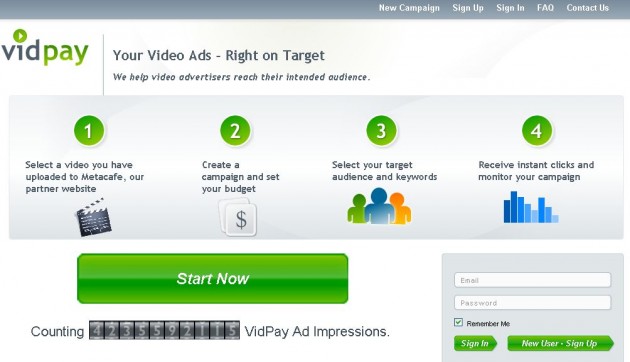
Straight out of the “why didn’t they think about this before” department, comes VidPay whose entire premise can be summed up in a single sentence: A white label platform for sponsored video campaigns. There must be more, right? Wrong. VidPay is as dead simple to use as it is to comprehend. One more thing… It started generating revenue from minute one. What more could you ask for in a startup?

To appreciate my gushing enthusiasm over VidPay you must understand that one of the occupational hazards of writing for TechCrunch requires the deciphering of what startups actually do. Increasingly rare are startups like VidPay that offer straightforward value for its customers and have a CEO that knows how to intelligently communicate what the product actually does without overselling it or using tiring hyperbole. So let’s dive in:

The problem VidPay set out to solve is allowing small/mid-sized advertisers to promote their videos on sites such as Metacafe, Dailymotion and Vimeo. These sites usually don’t have dedicated sales teams to support such advertisers because they focus on larger, more budget-laden campaigns.

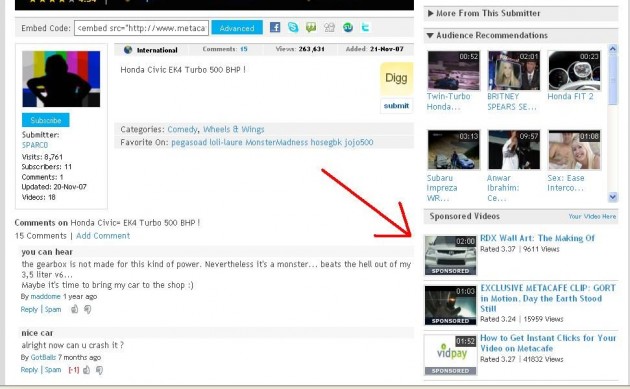
MetaCafe is VidPay’s pilot customer and through this partnership alone VidPay is serving ~50M sponsored video impressions per day, or ~1.4 billion per month. Current click-through rates are between 0.1% and 1%, depending on how many video ads are displayed in the sponsored video sections, and whether campaigns are targeted for specific keywords or not.

VidPay’s solution is a self-serve advertising platform for sponsored videos. It is similar in concept to YouTube’s “Promoted Videos” offering, differences being: 1) It allows campaigns to be built for multiple publishers (video sites), and 2) Its interface can be integrated right within the publisher site. The second point is important because it means that any video site can integrate a fully branded self-serve sponsored ad platform with zero investment, and begin reaping revenue it was previously unable to bring in.

For video sites, integrating VidPay functionality is a two step process. First, the video publishing site needs to send VidPay information such as visitor IP addresses, the category being visited, current item tags and the maximum number of sponsored videos to display. Second, the publisher site needs to receive a list of sponsored videos from VidPay and then display them of course. Completing these two steps should take no more than a few hours. Integrating the interface is optional and would require the use of an iFrame.

On each page view, the publisher site sends an HTTP request for sponsored videos to be displayed in pre-defined locations. VidPay returns the best-matching sponsored videos to display by taking into consideration the maximum cost-per-click, click-through rate and targeting parameters such as geo-location and language. The sponsored videos are all located within the publisher’s inventory so all traffic remains under its umbrella. Advertisers can choose the videos they want to promote manually, search for them through VidPay’s interface, or upload them to the publisher site right from the VidPay interface.
VidPay

VidPay

Advertisement

Comments rss icon

  • Great name, VidPay! — the name says it all!

    too often we see virus sounding names like joost or hebe and say what the heck do they do!?

  • It is a simple sponsored video indeed. As you’ve said it is very much straightforward. I’m sure that many advertisers will be attracted with this service.

    Can this be integrated on a blog? Thanks

  • seems interesting to me..not virus

  • bit simple..but looking good

  • Wow what a fantastic idea, can’t believe no one else had thought of this until now. Best of luck to the VidPay team!

  • Gmail showed me links to ZDNet breaking this story yesterday lol. It’s a great idea and probably will be successful, but I’m not sure it would have been such a big deal if TechCrunch hadn’t been the company behind it.

  • It good one,
    but really not a “why didn’t they think about this before” type of idea.
    It’s an old economy type of business.
    It’s not about technology but about business relationship.
    If I will build such service tomorrow I will have zero customers.
    Becoming MetaCafe partner, and get enough advertisers is the real deal.

  • I am having a hard time understanding why you would need (to pay) a third party company to place your Metacafe video upload around the Metacafe site.

    Shouldn’t Metacafe just build this feature and keep the money?

    • “Building” in many respects is easy part. The areas that demand human and capital resources are billing, settlement, support, etc. Areas which are not the core competency of video sites.

      This is why a 3rd party solution makes sense. The video site, in this case MetaCafe, can just get a cut of the revenue with practically zero work.

      • hehe. :) SELLING the result of your work and making a profit IS the core competence of every BUSINESS. :)

      • i don’t get it either. billing and what ever is all automatic. take a look at umakeitcool.com you have three bank accounts, royalties, commission, and advertising.

        it’s all automatic. we’re killing the human part, they’re too expensive; especially for low margin businesses.

        that’s why we outsourced everything… so i don’t get it.

    • Net… According to your logic, Adsense should never have been built, each website should have built its own advertising platform to save a few $ on commission… that’s pretty lame…

  • You know what’s really funny about this company, they have a ticker on their home page that is counting upwards, but when you refresh the website, it goes back to the original number, so they are essentially lying to the world about how many video ads they are serving. What a joke, not a good way to start out.

  • Roi, we appreciate the enthusiasm but you’ve got to be more critical of the start-ups you cover.

    • Mark, I have to agree. There are a million providers and aggregated providers that get video ads into videos on your site (for publishers) and allow advertisers to put them there.

      As the startup is not that unique to me, I don’t have too much time to research it, but frmo the TC screenshots their differentiating factor is that they put a box of multiple related videos in html format on a publisher’s site–useful (maybe done elsewhere), but not a big deal.

      COMPETITORS:
      adap.tv
      Bright Roll
      YuMe
      VideoEgg

      They probably do some cool stuff, but it’s too deep in the minutia to matter. E.g, my guess is their sponsored videos open up in the branded player of the publishers’ sites. That’s cool. How cool is it if it leads back to MetaCafe? I guess that depends on how much you’re getting paid.

  • Dude.. I don’t understand what this company does. Kind of annoying since the author runs on and on about how “dead simple” it is.

    They sell video ads on Metacafe? Ads for videos or pre-roll video ads? Only on Metacafe?

    If I had a video site they would sell ads for me? What kind of ads — ads for Metacafe videos or ads for my videos?

    I “dead simple” don’t get it…

    • I’m totally with you. This is dead simple… NOT!

      PayPal is dead simple. Ebay is dead simple. Twitter is dead simple.

      Either Roi is a lousy writer or the solution is NOT dead simple… cause I still don’t get it after reading it twice.

      • Roi, consider this your passage to entry at TC, but yea, these guys are correct, you didn’t make it sound Dead Simple at all.

        What would have made sense to me would have been this:

        “VidPay lets publishers embed a snippet of code on their site and show a box of featured videos from paid advertisers throughout pages on your site. And when each video thumbnail is clicked it opens up that video in a player on your site. For the Advertisers, they can browse the inventory of multiple publishers and their videos and place videos in these boxes. Advertisers are offered tools to make groups of videos they want to advertise on as well as create groups based on keywords. The videos ultimately appear with a pre-roll and in-video popup add of their choice. VidPay’s strategy is to resell MetaCafe’s inventory while offering the snippet of code to grow their inventory past MetaCafe.”

  • Just like adsense but for video….uuhhh…why didnt i think of that?

  • They let you promote your video ads, any video ads, which have already been uploaded to metacafe (by you or any other person). A video ad can be an actual ad or just about anything, important to you. Get it? now go to your room and weep for not thining of it yourself. :-)

    • no, i don’t get it. “They let you promote” why would i pay someone to let me “promote” when i can do it myself for free and get a better response because i know my target market better than some dweeb who doesn’t really understand or care.

  • What a load of crap !

  • Unless I misunderstood, VidPay buys ad-spaces on sites like MetaCafe and resells them to advertisers as video content ad-spaces.

    Given that AdSense already supports video ads, VidPay must have something extra they are offering.

Leave Comment

Commenting Options

Enter your personal information to the left, or sign in with your Facebook account by clicking the button below.

Alternatively, you can create an avatar that will appear whenever you leave a comment on a Gravatar-enabled blog.

Trackback URL
Short URL
bugbugbugbug
Techcrunch on Facebook