Have you nominated someone for a Crunchie today? »
Are URL Shorteners A Necessary Evil, Or Just Evil?
by Erick Schonfeld on April 6, 2009

One of the most viral activities on the Web is sharing links. It is fast and easy, and a good way to communicate ideas. What started out as something people did via e-mail and bookmark-sharing services like Delicious, is now moving to Facebook, Twitter, and other social broadcasting services. It is just so much more efficient to share a link once with all your friends and followers than to send it to each one individually.

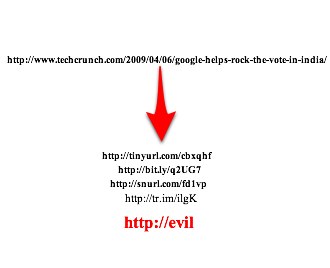
Twitter is especially suited to sharing quick links, but its 140-character limit has perhaps done more than anything else to propel forward the use of URL shorteners. These take long URLs and turn them into shorter ones that usually redirect people back to the original. So for instance, http://www.techcrunch.com/2009/04/06/revolution-money-raises-another-42-million-for-alternative-payment-service-nobody-is-using/ becomes http://tinyurl.com/coflho or http://bit.ly/q3Sl9 or http://digg.com/u1LRR.

There are more than a dozen such services, including TinyURL, bit.ly, Snurl, tr.im, is.gd, and the new Diggbar. The better ones offer tracking stats. One of them, bit.ly, just raised $2 million. Nobody really likes them, but they are a necessary evil. How else are you going to share links on Twitter without having the URL take up half the message?

It may be more complicated than that, however. Joshua Schachter, the founder of Delicious, thinks they are downright evil. Schachter writes, “The worst problem is that shortening services add another layer of indirection to an already creaky system.” In other words, they slow down the Web. He gives several other reasons why they are bad as well. They add a whole new slew of middlemen to the equation, and these links become dependent on the continued existence of these startups or even the whimsical changes in their terms of service. URL shorteners make links opaque, which spammers love.

They also add an unnecessary extra step to what should be a fairly simple message. Some, like Digg’s new Diggbar, also steal link juice from the original destination by wrapping the Website in a frame rather than redirecting to it. That just messes with the whole link structure of the Web. If I am linking to your story using a shortened Digg URL, Digg gets the credit, not your Website. Most URL shorteners don’t do this, but If Digg is successful with its new feature, they may follow suit. If that becomes an accepted practice on the Web, it would create all sorts of complications for the search engines in terms of duplication and making sure the underlying link gets the proper ranking.

There is a simple solution to all of this. Services like Twitter could simply do a better job of incorporating links into their design by allowing users to hyperlink existing words in their messages, without wasting space by displaying the actual URL. This is how FriendFeed handles the issue. Or it could carve out a separate place for links outside the message (perhaps through a “link” button at the bottom of each Tweet). The only reason to keep the URL within the message itself is for SMS messages, and for those perhaps Twitter would be better off creating its own URL shortening service that can become the standard, or buy one of the existing ones. If it ever does go the acquisition route, bit.ly might be a leading candidate. It was created by Betaworks, the main investor behind the startup Twitter purchased last year (Summize) when it realized it needed its own real-time search engine.

So are URL shorteners necessary or just evil?

Advertisement

Comments rss icon

  • Short URLs are both evil and good. They are evil in a sense that you can’t remember the random code they give you in your short url. This is not really a problem with tinyurl and some other ones because you can have a custom name but still it is a problem because most of the times you don’t get the name.

    They are good because they have made many people’s lives easier. People who social network really need them. I really love them because I use tinyurl.com for all of my links in my tweets.

    Mohammad Afaq
    Free Website Traffic

  • All this hype is rubbish.

    Good URL shortening services provide Content-Location headers to tribute any page rank to the originating URL, and others also add great features, such as social (digg it, stumbleupon, tweetmeme, etc) and I’ve seen many short URL services also actively removing any short URLs which are reported as SPAM, or even allow users to label it as such on an automated basis.

    Good services are fighting the good fight. Articles like this just blanket image the industry.

  • Is there an opportunity here, for an "open" URL shortener service, where the database is always publicly available, with a public API, etc?

  • I think Joshua hit it right on the head. It felt like I was the only one who seemed to raise an eyebrow when Digg introduced their Diggbar. It looks great on the surface, but instead of rewarding the actual content, Digg now gets some of that love.

    If Digg was trying to find another revenue stream, looks like they found it, albeit a shady one.

    Digg 1, Users 0.

  • We’re working on a new system that will solve all the URL shortening problems hopefully.

  • I really think that they are not that evil. I think it’s up to blogs and news sites themselves too make urls shorter or offer an alternative link for an article. I mean you guys know about the issue so why don’t you supply shortened urls yourself, then user’s will not need to use those evil other companies right?

    • Well, no. They will save themselves the cost of setting this up and just rely on URL shortening services, because it is convenient.

      However, they will also bring them hell, when it is convenient.

  • Regarding link juice left, my bet is that the occasions where url shorteners are used most coincide with areas where linkjuice is not an issue.

    Twitter does nofollows, and SMS/personal e-mails aren’t indexed by search engines.

  • Tinyurl.com claims to have over 200 million links and 1.8 billion hits per month.

    Obviously, they provide some value to some users, or those numbers would be closer to zero.

    Also, I note that there is no discussion of where long urls optimized for search engine keywords fall on the evil continuum.

  • I think they are really usefull to help share links….
    Even on emails the long urls are cut in half…

  • Those tool bars can be considered the new ‘Web 2.0 Tool Bars’ Eg: http://twitpic.com/2w7ji

  • Not sure this is a huge deal. Twitter already shows you the real link if you move your mouse over the short URL, others can do the same.

  • TinyURL has addressed a couple of concerns raised in the comments:

    http://preview....ort-url-preview

    You get to preview the URL and you can use your own customized and memorable url extension

    • I just noticed that tinyarro.ws has similar features: preview and custom urls.

      This whole subject is a moving target.

    • Another thought:
      URL shorteners are verboten on wikis because they are usually the work of spammers. Wikis have a problem keeping up with spammer tricks, so many just blacklist any url associated with url shortening service.

  • Short url’s are great for sharing and I really like tracking with bit.ly, but there is definitely room for abuse. Luckily I haven’t been rick-rolled, but I’ve sure appreciated being able to read an IM without having to scroll because of a ridiculously long amazon url. They are here to stay.

  • “How else are you going to share links on Twitter without having the URL take up half the message?”

    Post multiple messages. Geez. Is it really that hard to think outside 140 characters?

    Yes. URL shorteners are evil. Just imagine if tinyurl or bit.ly lost their database. A very large number of links would suddenly go dead.

  • We have a better solution on http://avoo.net. We provide you a FREE short URL plus a place to post a longer message with up to 250 characters, tagging and a link to the original URL. On top of that we provide a Digg type rating system. All this adds another place to promote your message with better SEO. Check it out.

  • zhengweius@gmail.com - April 6th, 2009 at 11:37 pm PDT

    ads, come on~
    zhengweius@gmail.com

  • Palo Alto Podcaster - April 6th, 2009 at 11:48 pm PDT

    #1 on my Twitter wish-list is some form of a REAL link (URL often contains useful info) that lets you HOVER to see a thumbnail before you commit to opening in new tab/page. URL shorteners are forestalling the day when my wish will come true.

  • We were at Startup Weekend this, well weekend, and we came up with a concept for barcodes along those lines called tinyUPC.com

    Was a fun event.

  • I would have thought the risk could be reduced by vetting the link before it’s shortened. Let’s face it the virus writer wants to make the link anonymous and shortening desensitises the risk assessment. Shortening services are an ideal place to hide a dropper (program which collects viruses) and infect a machine.

    Do we need an open source project to filter URL content before shortening or is this responsibility of the likes of Twitter?

  • Now this was one of the hardcore articles i even wanted to comment on: yes, this issue is evil, think about this problem after couple years, when the internet will be full of crappy unreadable links and big monsters like Digg will swallow traffic that YOU have earned.

  • URL shortner is a very good medium to spread news over web,specially on Twitter because the identity of the URL is hidden on the web and every URL contains its own importance. Thats why bigger website also use the URL shorten service. Also i am totally agree with Joshua Schachter that URL shortner introduces an extra layer on the web and total results in reduced speed, but the overall results conflict somewhere. It is a very good medium to spread news but with some compensation.

  • If the URL Shorteners go – so do the links ;)

  • Please raise your hand if you think that search engines will be unable to solve the problem of identifying a shortened url’s underlying link or framed page.

    Thank you.

  • Twitter does helped to evolve new URL shortner seriveces,wh gets profit URL Shortners or Twitter users.

  • 100% agree with ArringtonCrunch, Ernesto Glueckson and Tim Ferguson’s suggestions. Do that and nuff said.

  • I can’t live without URL Shortners. And this is not because of Twitter or social broadcasting. It is because these services provide me a way of creating customized short URLs I can speak over the phone to my friend and go directly where I want by remembering the shorter ones. http://bit.ly/mytodolist gets me to my google document based todo list which I made public and can check from anywhere. And many more uses.

    (and don’t worry, I did not share my actual short url here ;) )

  • You don’t quite get it here. While hyperlinking words would be great, the real value of the services like bit.ly or cli.gs is that they allow link tracking without having to go through something like Google Analytics.

    As more businesses invest in social media, they’re trying to figure out how to measure their investment. That’s the underlying value of many of these services. It’s not all about window dressing, it’s about value.

    And, how would that be evil?

  • I never clicked on one of these. You have no idea where it is going to take you to.

  • Useful but it is something used by spammers

  • She should be free to choose the pearls that appeal to her most in color, overtone and size as well,

  • I like this one http://sho.li , I guess tinyurl.com was the innovator of this right?

  • URL shorteners put an absurdly heavy reliance on a 3rd party functionality for a service that the web was supposed to be designed for. Now that twitter is on the cusp of becoming mainstream, they should actively try to stop this disappointing trend!

    I already worry that as links break over time, the value of archived web content (on say, blogs like this one) degrades. When the first URL shortener service goes out of business (and surely one of them), a huge number of links will break.

    If keeping SMS compatibility is a real concern, twitter could either:

    1. Shorten the URL for you when your tweet gets sent to SMS (and also provide an API for this)

    2. Decode shortened URLs when displaying tweets on the web (and once again provide an API).

    For the second option, you could even give users the option of seeing full length urls, or the shortened ones. Javascript could even be used to place ellipses at the end of long links to avoid on screen clutter.

  • I just laugh about this because I think the whole Twitter fad is silly. Go back to e-mail or any of the instant messaging services. You can still have your groups or buddies or casual acquantances or whatever. With e-mail or IM, you won’t have to worry about a ridiculously low 140 character message limit. (I guess you all got used to that with cell phone text messaging, another ’service’ I find absurd.)

  • the only way to let people link on twitter without url shorteners is to lengthen the limit.

    the limit puts sms users and other users on equal footing, and sms users wouldn’t be able to share urls from their phones anymore.

    i rarely use url shorteners. they’re very useful for writing down a url (who does that?) to share with the non-tech-oriented. go to this site: ittybittyurl.com/youcanpickname and then they can easily type that into their browser.

    the web at its best is about making things useful at a low-cost to users. short urls can be a problem, i don’t like opaque links and almost never click on them (i remember when ad sites had transparent links! in the 1900s…)

    but you can have long opaque links too, and short urls are GOOD (sometimes.) as a rule? we’re better off not using them, as an exception, meh.

  • I like the url shorteners. The different ones people use reflect their knowledge and personality. tinyurl.com is oldschool. is.gd is better. bit.ly and tr.im are new kids on the block and you know when you visit you are being counted. Then there are ones that frame like http://www.ow.ly and http://xr.com — which look like they do that for the link back to your Twitter page, and for you to place ads in the frame (so you can earn some coffee money?)

    Looks like the business model is a loss-leader for the other features that these url shorteners are tied into like their tweetdeck platforms. Personally, I like the ones that are thinking about how to help twitter users earn money on their tweets.

  • After trying to use several popular URL shorteners, I decided to make my own. It is fast and clean, with simple stats — http://go2.st

    Feel free to suggest new features and improvements (twitter: @haqu)

  • i am worried about that slowing down part, due to tiny urls

  • http://www.dark...url-shorteners/ My vote: Helpful.
    My advice: If you click on a link that sends you to a site that is totally unrelated to the tweet or brings up a lot of popups.
    A. You make a mental note of whose links aren’t worth clicking and. . .
    B. Don’t press cancel, do not click continue, just find the X button and exit. If you can’t find an exit button, ctrl alt del.

  • Hi, please try this multiple URL shortener:
    http://0xbb.us
    It’ll shorten many links into one page, and provide visit count!
    It will work perfectly when you want to share many links at once,
    especially for contents like news, pictures….

    I hope you find it useful! ^^

Leave Comment

Commenting Options

Enter your personal information to the left, or sign in with your Facebook account by clicking the button below.

Alternatively, you can create an avatar that will appear whenever you leave a comment on a Gravatar-enabled blog.

Trackback URL
Short URL
bugbugbugbug
Techcrunch on Facebook