Editor’s Note: Social networks are taking off in China. The following guest post by George Godula. David Li, and Richard Yu explores how Chinese social networks are pursuing different business models than their American counterparts, relying more on micropayments and the sale of virtual goods. George Godula is the co-founder of Web2Asia, an East Asian incubator and also a consultancy for Western startups trying to enter markets in China, Japan and Korea. David Li is a developer of social networking applications such as Growing Gifts, and he also was the developer of OnChat, an early in-browser graphical avatar chat system. Richard Yu is a Seattle native living in China, where he consults for Shanghai-based web startups while writing his blog.
Despite China’s massively growing internet market, international giants like Google and Facebook are having trouble making gains with the 300 million Chinese online users. China’s netizens are on average very young – 66.7 % of them are younger than 29 years old and 35.2 % of them are teenagers—with social networking and entertainment applications being the most popular.
While companies like Facebook struggle to conquer market share in China and to create viable business models everywhere, their Chinese clones have built lucrative cash machines literally earning billions of dollars a year. Unfortunately, adopting Chinese methods may not help American social networks due both to cultural differences in Chinese user behavior and industry practices. Below is our analysis of the Chinese social networking scene.
Chinese Social Networking is Dominated by Local Players
Bulletin Board Systems (BBS) have long played the dominating role in Chinese Internet life and still continue to be one of the most popular online platforms for social interaction. Registered user accounts, which are mostly anonymous, surpass 3 billion (users have multiple accounts) and 80% of Chinese sites run their own BBS. However in the last year social networking services, most of which require real name registrations, have shown explosive growth in China with 19.3% of netizens using them regularly.
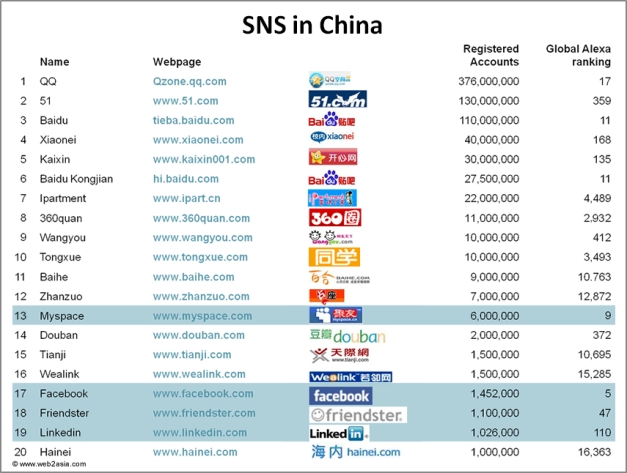
Despite the popularity of social networking in China, the social networking market is dominated by local Chinese players, and Western networks have trouble adapting to Chinese culture and user expectations. Facebook does not rank among the top 15 asocial networks in China while MySpace has only 6 million users (vs. the goal of 50 million users after 2 years initially proclaimed by Rupert Murdoch).
Meanwhile, China’s leading social network Qzone, which is targeted at teenagers, may even be the largest in the world. Tencent, Inc., the company that runs Qzone, recently announced group revenues of over $1 billion in 2008.
As ad sales slump in the recession, only approximately 12% of Qzone’s revenue stems from online advertising with the rest coming from virtual item sales such as applications and avatars. Internet ad spending in China is expected to reach $1.7 billion in 2009, which is about 4% of total ad spend. In comparison, the US is estimated to spend $25.7 billion reaching consumers online through advertising. These comparably low online budgets in China are largely spent at four large news portals, which earn the majority of online ad revenue. This forces most “smaller” portals to find more innovative ways to monetize their traffic.
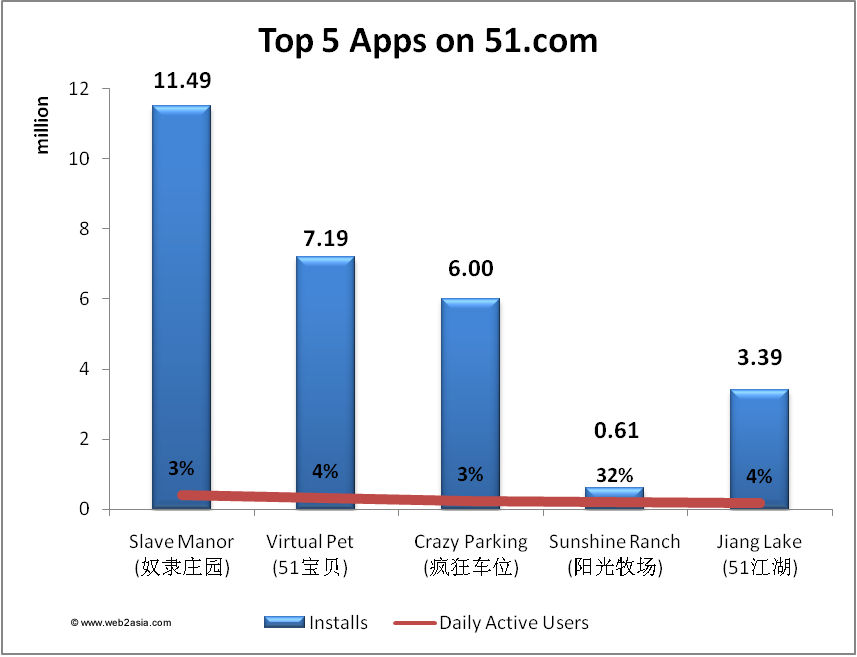
51.com, which targets working class adults from rural parts of China, is the second most popular social network in China with 130 million registered users. Concurrently, Chinese students flock to Xiaonei with approx. 40 million users. It is backed up with $430 million in funding from its parent company Oak Pacific Interactive and investors like Softbank. Kaixin001, which skyrocketed out of nowhere to 30 million registered users from the middle of last year, targets white collar workers in China’s largest cities by employing controversial invitation techniques and copying apps directly from Facebook.
Yet the astronomical growth of China’s social networks can be attributed as much to its massive market size as to its cultural norms and values. Social networking apps can hit hyper-viral levels in China due to a higher tolerance of intrusive app invitations. It is not uncommon for apps to essentially force new users to invite people and perform tasks before being able to join their friends online. Once friends have joined they are required to interact much more with the apps and advertisements than on Western applications. While this model is not replicable for the US market, certain aspects of this strategy/cultural mindset are necessary if companies like Facebook or Myspace want to compete in China.
Open Social Networks are Not So Open in China
In the middle of 2008, Myspace was the only social network to support OpenSocial in China. Despite Google’s effort, the adoption of OpenSocial was slow among the major social networks. Eventually, other platforms caved into the partnership with Google and gave half-hearted support to OpenSocial. Apart from some of the large social networks mentioned previously this included City!N, Yiqi.com as well as the business network Tianji and BBS Tianya. Other social networks such as Douban, Hainei or news portal Sohu had originally announced to join OpenSocial but then never implemented it, choosing an F8 style API instead. Today, only one of the top 50 apps in China’s social networks runs on OpenSocial despite the hard work put in by the Google team in China.
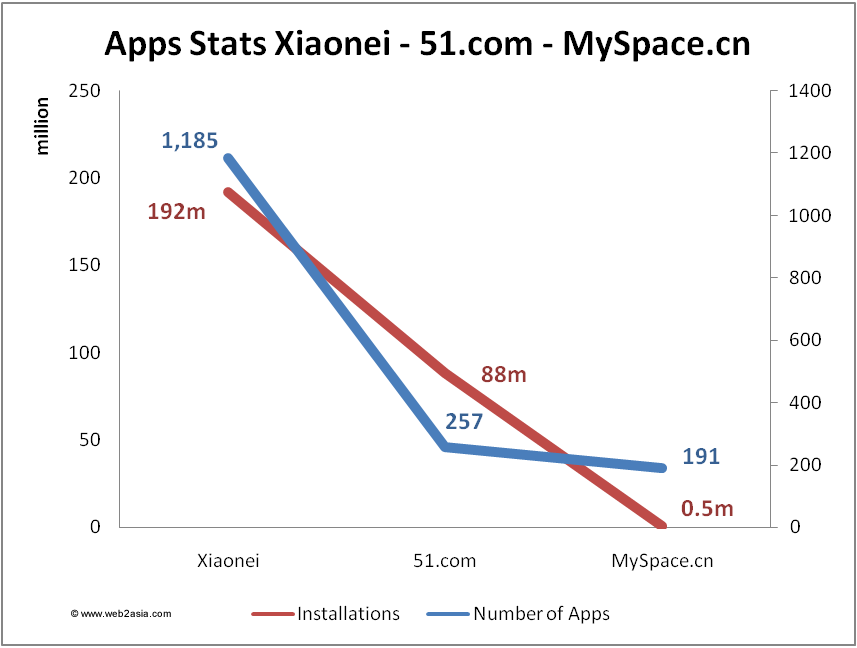
When Xiaonei and 51.com at first opened their own platforms, their terms of services outraged the developer community with clauses that practically blocked all monetization opportunities and a shared user base with their own websites. The developers launched several public protests against the social networks including the website www.anti-opensocial.com to rebel against hypocritical support for these “fake open” platforms. The executives from these social networks did respond quickly to the developers demands and changed the terms of service to more reasonable terms, allowing limited monetization opportunities for the developers.
Unfortunately, most social networks continue to ignore “Open Social” practices, opting for the more familiar “Guanxi paradigm” in business practices with third parties. The term ”Guānxi” describes the basic dynamic of gaining influence and receiving favors within social relationships, and is a central concept in Chinese society. For social networks, this means that rather than developing an open ecosystem, they focus on dealing with third parties individually and face to face. New Open Social Networking platforms (or better put, “selectively opened”) such as Yahoo’s Guanxi, Tencent’s Xiaoyou and Tianya court established third party app developers like Five Minutes while largely ignoring the wider developer community.
Additionally, ad sales are also strictly controlled by the social networks themselves even though 51.com set a threshold of a $35k fee to be paid for app developers to operate their own ad revenue -based applications (which until now no developer was willing to pay).
Keso, China’s most widely read tech blogger, who we asked to contribute to this article through China’s online expert panel BloggerInsight, summed up the situation by saying “Despite an open platform strategy, Chinese SNS are still competing with each other on the application level”.
Imitation of Facebook was only a Launching Point
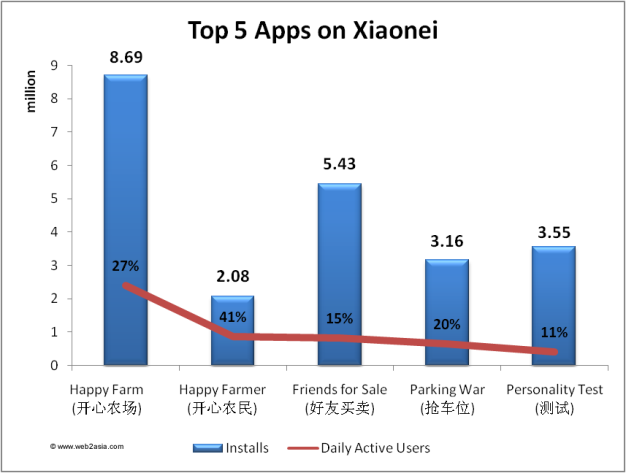
Chinese sites are notorious for their C2C strategy, or “Copy to China”. This applies to the app market in the same way as it did to the social networks and all other Web 2.0 and eCommerce services. A year after Facebook introduced the F8 open platform, Xiaonei.com followed suit and announced its open platform in July 2008. The developer group xCube on Xiaonei attracted individuals and companies interested in third-party apps. Yet Chinese outsourcing developers such as Apptz and Ismole armed with experience working on Facebook applications made significant inroads by launching several apps and attracting millions of users in just a few short months.
At about the same time, the apps space also felt the power of C2C with copies of popular apps on Facebook such as “Friends for Sale” and “Parking War” popping up on just about every social network in China. Other leading social networks such as 51.com and Comsenz!’s Ucenter Home (similar to Ning.com) launched their own open platform soon after Xiaonei’s effort.
Chinas 51.com first social network in the world to open up payment API
While Chinese social networks started out as mere clones of existing sites, they’ve managed to innovate the business models to create a very lucrative market by cementing the relationship between application developers and the site’s user base. Happy Farm, the most popular app in China reportedly collects well over $75k a month through installations on various platforms, and according to Chinese application tracker, Appleap, the value of the total social network’s apps install base is approx. $4.5 million.

Opening up the payment system was one of the most anticipated announcements from Facebook’s developer conference F8 2008 but the company failed to create an integrated ecosystem for users to buy and sell apps. China’s socail networks took the great leap forward in this area when 51.com became the first social network in the world opening up its payment system to third party developers in 2008. Users pay money to 51.com and receive virtual coins which they can then again spend on third party applications. The revenue is split 50/50 between the social network and the developer.
Facebook on the other hand currently does not offer developers access to its payment system. If a third party application redirects Facebook users to their own website and payment processor, they usually lose the advantage of Facebook’s trusted brand name and the majority of potential revenues.
At the same time, companies like Becomedia are cooperating with 51.com to bring OfferPal-style cost-per-click/cost-per-action (CPS/CPA) for virtual currency models to China. CPS/CPA is one of the fastest growing sectors of Internet ads in China. This means revenues for the developers by trading their virtual currency for hard cash.
Season Xu from Five Minutes, the maker of China’s most popular app, confirmed the three basic revenue models for apps in China: shared ad revenues, income through virtual currencies, and customized development for branded applications. However he and Herock, a leading figure in the Chinese tech blogosphere whom we also spoke to, expect a consolidation in the app development market soon with larger companies taking over and benefiting from effects of scale, rather than individual developers still being able to produce top apps.
What can Facebook and Western social networks learn, if anything?
If monetizing a social network is so easy, then why hasn’t Facebook opened up its payment API to third party developers? While the aggressive and intrusive hyper-viral aspects of the apps in China may not be replicable in a Western Market, the problems for creating a more viable business model run deeper. Western companies cannot innovate in the same way due to institutional problems stemming from their own struggle for an identity and revenue.
Facebook has just recently announced a “credits” system, but it seems to miss the mark. The new system demonstrates little incentive for users to shell over money, and does not speak to the same need as paying for a social application that all your friends are already on and talking about. Facebook may be afraid to become a marketplace for applications, because they are reluctant to be labeled as a social gaming network or a social app store. Instead, they are a self-styled guru of dynamic human interaction. If they opened up their platform to become an apps store, their major revenue streams would put them into a pigeonhole, calling their $15 billion valuation into question. They obviously don’t want to be labeled as a “gaming platform” either, and don’t want to fully depend on selling digital trinkets.
Like during the American gold rush in 1849, where Chinese merchants prospered while most prospectors went bust in search of striking gold, it appears that building viable, scalable businesses for Social Networking sites may still be an ancient Chinese secret for Westerners.


I am going to China at the end of this month. I will see for myself. Chinese people are vastly different than us.
Very solid point, please write a Blog post or something about what you see while you are there, and whatever you can find out about Social Networks in China. If you can email it to me that would be AWESOME. I will send a shot out for people to follow you on Twitter.
adrian@adrianeden.com
http://www.qq.com/ is the largest Chinese Social Networking website with WELL over 300 Million accounts.
Asia is where it is at. China and India are the future, and it would be good for more people in Silicon Valley to make some trips to Asia to see how much the epicentre of the global economy has shifted.
Anjali Sen
I agree wholeheartedly. China is the new Rome whether we in North America like to believe that or not. They have the largest cash reserves in the world, the highest population, and a booming tech industry. The future is exciting.
yeah, the future is exciting if you live in China…Kind of scary in socialist America right now
stop putting india and china in the same bucket. india has only 40 million people online vs china’s 300 million. and no indian app or social network has yet to earn even a single rupee from app sales/virtual goods etc
india has a ways to go before it can be mentioned in the same breath with china .. can start with sidewalks and electricity …
though your point about the future is right, just that india’s is far off, china’s is now …
India has full press freedom and democracy since more than 50 years.
In china is like bird in a golden cage.
So dont compare.
Guys, this is a very interesting post. I am originally from Miami, and I have actually been living in Shanghai for more than two years.
A lot of what you guys are saying is true, and a lot of what this post details is true.
The biggest thing about China that no one really mentions here are the invisible market barriers. IE Communism and the will of the government.
Case in point, I know of a company that posts event and party pictures. After only a few months they moved to the second position in the market, generating millions of hits a month – just for the city of Shanghai. A crucial component of this platform was its interaction with Facebook.
Guess what, Facebook is now blocked in China. When I say blocked, I mean it is impossible to get to it. A nationwide firewall prevents any user inside the country from accessing that domain. Same thing with youtube. I am sure I don’t have to tell you what happened to that company that so heavily depended on facebook. Almost overnight they went out of business. They did nothing wrong, they played by the rules, and when push came to shove, the received no warnings, no notifications. One day when they woke up, everything they had worked for and invested in was completely gone with no sign of ever returning.
This was in May, around the time of the riots in Xinjiang, and Facebook has yet to return.
From problems come opportunities and new businesses. 1/6 + 1/5 of the world’s population is in India and China. And most need services and products of many types. That one statistic cannot be ignored. Everything else is probably partly opinion, or at least, is changeable.
Oh yes, and in China corruption is punished quickly.
In India most of the “legacy” business community admires an effective (read $$) abuse of corruption.
Yes, in China corruption is punished quickly and brutally and sometimes without enough evidence. And it will not be published in news anywhere.
Clasilistados.cn
nice to see all those chinese companies using the Dot Com Ext. is the chinese market dominated by local players using US top level domain extensions? is dot com now the global top level standard?
When did dot com became US specific TLD? dot us is US TLD.
Go away spammer. Stop this bullshit.
btw, dot com was and is global standard TLD…
The com in .com stands for “company”.
The same naming convention is used in java package naming.
com.google.android.maps
for example is used in Android development.
an organization would use org
such as the original JDBC adapter
org.gjt.mm.mysql.Driver
http://www.yout...h?v=IIUAl8tyiLE
Above is a video everybody has to see at least once in their lifetime before they die. It’s that good.
The man in that video is a viral marketing genius. I applaud him.
@Chris,
.com — .commercial
close enough Sarah. Thanks for nit picking that.
Sarah is of course right about the .com in domains(not so sure about java packages)
http://en.wikip...a.org/wiki/.com
you don’t even know that .com is a GLOBAL tld and not a US one (.us is a US tld) and you’re supposed to have the next earthshattering idea?
Chinese sites are tacky…
I totally agree with you!
usa, credit card companies, visa and mastercard, are not helping, clutching on to their $.45 transaction fees, and blocking the introduction of micropayments ..
the entire western mindset has to change in myriad ways, very soon ..
very true. Interchange fees are ridiculous. Also, if you’ve ever tried to do anything with SMS, you have to split 40% of rev with carrier, plus pay about $2500 per month for a short code and aggregator.
Great article.. wonder if India can learn something from this..
Hmmm… I guess you haven’t followed the development of Indian social networking sites.
http://www.lifeblob.com/
http://www.bigadda.com/
http://www.fropper.com/
http://www.yaari.com/
True, but the leading social networking site in India is still orkut.
From India
Anjali Sen
lifeblob? seriously…… and like smart babes said – Orkut is the only one I know any Indian person using
I believe China’s internet penetration rate is way higher than India’s anyway.
For some reason unknown to me, my comment got deleted.
By the way, there are some good social networking sites in India such as LifeBlob, Bigadda, Fropper and Yaari. I guess you are just ignorant.
The India SNS can’t compare to China now.
You are just ignorant! Do a Google search for Indian social networking sites.
Oops! Posts reappeared!?!!
You are moron.
@Insider,
Thanks! It is most probably due to the Varnish reverse proxy that TechCrunch uses. I beleive I am not the only that is affected by this strange double-post/post-vanishing issues.
desis will learn nothing. india has first to come out of its ISO/COMM 5 etc etc certified global bodyshops. In some ways the wipro/infy/TCS juggernaut is killing the market by sucking all the talent into their manhour upselling empires.
And the people are too busy to notice anything beyond posting their fake resumes on naukri.com on client time to identify the next company to “jump” to with a 10% salary increase. If they get time from planning their next mall/big bazaar store to take pics at and post to orkut. LOL
So, what have YOU contributed? I guess you are not even IN India. You are in you-know-where for their lucrative salary.
you with the imitative name, learn something from these gentle criticisms of india, it is really important for us here to help us get over a near invisible hurdle that is truly a weight around our neck in india … one thing, it is simply too inward looking
actually I am not in you know where, but I was. now back in desh with a new perspective. But i guess that you probably are or trying to go to you know where LOL
couldn’t agree more…. and most expect more than a 10% jump (even in this economy)
Note to all Indians: no one outside India (and a few in the UK maybe) care about ISO certification or Level5 MM companies except in pure manufacturing. Certainly not in software.
And if you take a job at HP, Oracle or Google, you are the lowest run on the ladder. you are employee #54,223 and will be doing rote, boring work. All the really interesting R&D work is done at the main offices (in US or Europe). You’re just a number there. Stop being scared of working for “non-prestigious” companies and I 100% guarantee you you’ll learn a ton more.
“desis will learn nothing.”
“And if you take a job at HP, Oracle or Google, you [Indians] are the lowest run on the ladder”
Oh really?
Please, who is the current CEO of Motorola?
Who was the most recent CEO of Vodafone?
Who was CEO and founder of Tibco Software?
Who was founder and CEO of i2 Technologies, a B2B Supply Chain integrator
Who was founder and CEO of Juniper Networks?
Who was the longest running Managing Partner of McKinsey?
Who was CEO of Exodus Communications?
From which non-US country does the majority of top tier immigrant venture capitalists come from?
Yes, you are absolutely right, desis don’t know anything.
Or maybe the person that does not know anything is you?
Well said Anjali. The psuedo intellectual posters – like “sk” – here at TC are the ones that doesn’t anything.
It’s amazing that the Chinese if they can caught up in this competition for the race.Other social should watch their back
The power that is Asia:
http://www.adri...r-that-is-asia/
Adrian you smelly spammer, get lost, no one wants to read your lame as blog. Stop spamming techcrunch and go back to where you belong.
LOL I do not monetize my Blog in anyway, so you can read the content or not. The purpose of spam is to make money, I’m here to share knowledge, therefore it is not spam. I love unknown Blog commentors making thoughtless comments with no website linkage. Kind of reminds me of 4th grade when someone would throw a pencil from the back of the class and than no one could figure out who did it. Have a great week.
I don’t believe something can be considered spam only because there is a revenue source tied directly to it. From Wikipedia, “Spam is the abuse of electronic messaging systems (including most broadcast mediums, digital delivery systems) to send unsolicited bulk messages indiscriminately.”
I would say your messages fall under the definition of spam, though using such a word to define your comments, may be a bit harsh. Check out the crowd-sourced definition: http://en.wikip....org/wiki/Spam_(electronic)
I have answered and replied to comments with my own comments. Just because I have a Blog that I choose to link to with each one does not make me spam. If they want to remove the website link feature in the comment section here on TechCrunch they are more than welcome too. I enjoy being a part of the community here and speaking my mind while also trying to add value wherever I can. Thank you for approaching this in a professional manner, much appreciated.
F off with your crap blog, moron.
Nice post very well researched.
One thing about Chinese SNS is that the online ad market is too limited in China to make ads a viable revenue model. Online games and Tencent have been doing so well that even unimaginative Facebook copycats have understood the value of micro-payments and digital goods.
As pointed out, Chinese people and culture and very different than ours, so the differences in social sites aren’t that surprising.
I think it would be a lot more meaningful to me if I visited China, like many of my friends (Bill Hunt, Sebastian Wenzel, etc) have.
Personally, I think that as we move to other countries, it’s not just the language issue, but how a site is used, the way people use language, and what they expect.
For example, while at IBM (I left IBM in Jan 2008), I noticed a lot of Chinese sites had “numbers” in the url – they’re really into that stuff – more so than we are – AND ….. when I looked at how IBM’s homepage was used in various counties it operated in, using Heatmaps out of Coremetrics, I saw while Support was a small part of the US site, it was about 50% of what Chinese wanted – same navigation, same translated content – totally different use.
Based on experiences like that – I suspect Social Networks organized one way (say, Facebook is optimized for the US market) might not fare as well in, say, China – unless they were willing to change a lot more than the language.
Just a thought.
Yes you are definitely right. Take China, Korea and Russia for example. It is hard for many people in US to believe, but Google is NOT the top search engine in these places, indeed, they are not even a top 3 property. Simply taking a cookie cutter approach and exporting an American model does not work any more when you have very sophisticated local players.
Or take India, players such as http://www.zoho.com offer incredible products and services that are much better than Google docs, for example. Many people in the US have not heard of them, but players such as zoho, tencent in china, yandex in russia are quitely building incredible companies. How many pure play consumer Internet social network companies do you know in the US that made $1 billion in revenue and 50%+ profits? Tencent in China did that last year.
Yes, China and India have their share of problems. But to dismiss them because they are not in the Valley would be a bad mistake.
I have written an extended view on this called “Why India Will Replace Silicon Valley in the 21st Century” http://smartbab...con-valley.html
From India
Anjali Sen
stop dragging india into everything. news flash: no indian search site giving any meaningful competition to google. no social network has even made a single rupee from any app/good etc. worse, never even attempted to.
yes, but we have made many CMM 5 etc certified glorified bodyshops where employees download MMSes on client time and surf naukri.com to “jump” to another firm.
and yes, we also share a unanimous opinion that all westerners (client for the employee) is a stupid fool who can be overcharged for hours and delivered by last minute night work, and their currency is times 50-65 so we must be nice to them.
and that we must take all those rupees to shop at the next mall/big bazaar and then post their pics on orkut.
I have yet to come across any indian engineer who had genuine interest or bought a book to increase his knowledge in IT or whatever they do, they do it because there is nothing else which pays as much and because its “HOT”
with such an attitude in the mainstream, no wonder we have very small (even by indian standards innovation) at best.
I’ll hold off my criticism of your article until I read the part II, but so far not impressed.
The reason that India won in 2001 was because they had cheap labor (and fyi for anyone else thinking about outsourcing, that’s the only thing that’s cheap there – everything else (rent, utilities, office products, electronics) are same prices as abroad) and spoke English. Companies were decimated but IT pounded forward. Now every company is touched by technology in some capacity.
I agree more with “sk”. India has a long, long way to go with many problems. My bet is that as soon as this next generation of Chinese reaches work age (all being forced to learn english in school) they will blow India out of the water.
RE: numbers in the url
I think one other reason is is because it’s easier to remember.
The mainland Chinese use pinyin to type, so they are familiar with the English alphabet, but it’s still a bit awkward at times to remember.
Especially because multiple characters can have the same “spelling.”
And since Chinese-character domains aren’t that popular yet, having a simple name + numbers makes it easier to remember and type.
Numbers also carry symbolism in Chinese culture which also does explain why some urls would contain numbers. Numbers like 8, 88 etc..
You’d be surprised at how little numerology comes into play with URLs. Like the above poster said, they’re easier to remember then the Roman alphabet for people who grew up reading and writing Chinese characters. Also, several of the numbers are near-homophones for common Chinese words, which makes them even easier to remember. For example, 51 is written “wu yao” in pinyin (yao is an alternative reading for 1), which is very close to “wo yao” which means “I want”. This gives rise to sites like 51job.com, http://www.51che.sh.cn (motor vehicles), 51fang.net (real estate), and… 51.com.
reg. numbers in Chinese domain names: we had a blog post on this a while back http://www.web2...na-number-game/
btw: Vietnamese domains are also super interesting (& long): http://english....2008/06/786438/
This article is a bit biased towards the English speaking Chinese SNS. What is so controversial about Kaixin001.com’s invitation techniques vs others? They all copy each other in the cut throat market. In fact, all the xiaonei apps were first launched by Kaixin001 then copied; parking wars, friends for sale, slave and happy farmer. Ask the true locals and you’ll get a much clearer picture, though this article is a good start for the western world.
51.com is absolutely bluffing and it’s one of the malware & spam sites.
Yep! My PC got infected by nasty koobface virus when I visited 51.com.
I like your analogy of the chinese merchants during the gold rush
Great insight. Seriously, hope we see more of these guest posts with first hand insight from people living/working in foreign markets. It’s a good start in bridging the gap of understanding and bringing into reality that there’s a whole lot going on outside of Silicon Valley.
I DO have first hand experience with China. I wonder why none of the authors are benefiting from the hypothesized billions?
Beware that China does not have strict financial reporting like in the USA. Fraudulent schemes often inflate revenues to create hype. The last hype was SMS from web to phones where HongKong companies bought China Mobile cards at wholesale and spammed SMS messages at retail – making the margin that was overlooked by the blind China Mobile. The result was hundreds of millions of questionable revenues.
For China insiders, hundreds of stories of fraud is common among insiders. The authors don’t seem to have the first-hand information for this round of micropayment gold. I’d suggest any serious China investor or entrepreneur move with caution.
If you’ve got first hand insight on China, then you know personal relationships and reputation — oh ok, I’ll throw in the overused “guanxi” into the mix too — have weight in regards to the information you have access to.
I don’t know you. Perhaps when our paths cross in circles that will change and we’ll grab a coffee but in the meantime, I do know one of the guest posters very well. Let me know if you’re interested in connecting with Georg Godula and Web2Asia. Not in so much for an opportunity to filter whether his insight is authentic or not by comparison to yours, but because he and those in his network (including myself) are doing our best to move out of the vague positioning of self diagnosed China experts and sharing info that is much needed in bridging the gap.
Web2Asia was the co-organizer of the China 2.0 Tour we organized last November. We took 6 bloggers from Europe and US including TechCrunch to Beijing, Shanghai and Guangzhou where they had a chance to meet with Kaixin001, 51.com, Tudou, Youku and Google China just to name a few.
Helping to put together another one soon for VCs and tech entrepreneurs from the Valley. Happy to get your feedback and involvement if you’re interested in getting involved.
Cheers. =)
Christine
I applaud you guys for the efforts in attempting to bridge the gap and to be able to learn from different cultures and different models/ways of doing business. It’ll definitely be a vital learning experience and I wish I would be able to attend it. Unfortunately, I’m not really a blogger and I’m nowhere located in the Valley either. But in any case, good job! : )
you should speak to david li reg. the question if “some” of the authors are benefiting from the billions or not
>It is not uncommon for apps to essentially force new users to invite people and perform tasks before being able to join their friends online. Once friends have joined they are required to interact much more with the apps and advertisements than on Western applications.
Didn’t we learn in the last century that forced collectivization only benefits the one-party state?
>While this model is not replicable for the US market, certain aspects of this strategy/cultural mindset are necessary if companies like Facebook or Myspace want to compete in China.
Why? Nobody is going to start being obnoxious and force applications on friends to be able to use them, for forcibly collectivize every application. People respect the dignity of the individual too much in Western societies, and that’s ok. If the application isn’t persuasive on its own, it’s a no-sale.
Gregory Lent should change his own mindset because “the West” will not be changing its mindset over to a collectivist one any time soon, unless, of course he expects to forcibly install it.
> People respect the dignity of the individual too much in Western societies
Which is why the jocks beat up the nerds. Because they have “too little individuality.”
And let’s not talk about the goths, stoners, cheerleaders, etc..
yes, but jocks don’t force nerds to leave the city while they board up ugly construction sites to present a gleaming facade to the west
you might want to look up the downing effect, because you’re a victim of it.
“Facebook has just recently announced a “credits” system, but it seems to miss the mark. The new system demonstrates little incentive for users to shell over money, and does not speak to the same need as paying for a social application that all your friends are already on and talking about.”
Can someone expand on this more? What is the incentive for Chinese users to pay money for these third-party applications?
great post, wish it could encourage some ppl in the Valley but also in Europe to come to China.
Does this mean that Chinese people who are connected online are loyal on their local SNS?! Facebook and MySpace are the most popular and most visited SNS but Chinese people won’t care about that, I think.
Now that’s what I am talking about!
Thanks for sharing this great insight Georg, David and Richard! It’s of great value
Interesting, detailed and well presented, I admit I plan to read it several times as I am interested but can not really see the varied possible opositions and ramafactions expressed
I think those QZone numbers are likely inflated. Not that the users arent genuine, but they’re not exactly SNS users, i.e. they are just regular QQ Chat/Mail users who do not use QQ SNS (QZone) features. Similar to recent MSN making a SNS like “Network” out of MSN Messenger/Hotmail users contacts. I seem to remember my QQ account having an autogenerated QZone page, though have never really used it in any SNS sort of way.
This article makes no sense at all. It fails to identify at all what the local services do diferently from the outside services, other than probalby knowing who to bribe.
look
An excellent post! I agree that it’s all due to difference in cultural values and systems.
Qzone link, inside post, links to some stupid domain parking qzone.com
that’s spooky!
We will see what the Asians do regarding Virtual World applications. I do think they could come up with something great regarding mobile devices, as for MMORPG’s I don’t think they will be able to compete in a serious way with the USA based ones.
The link for qzone should be http://qzone.qq.com/ ( not qzone.com ).
“It is backed up with $430 million in funding from its parent company Oak Pacific Interactive and investors like Softbank”
Can anybody verify the total investment stated above? I cannot believe it that $430 million was invested in a Chinese start-up to garner mere 40 million users.
Good to see regional SNS are getting traction. Though WWW is more about internet working across the globe, meeting the expectation of regional community makes the real difference.
Well formulated report.
Targetting a particular country is a smart and successful way.
Very amazing report, thanks for sharing this great stats!
I’m now a heavy user of Xiaonei and Twitter
So I don’t think there’s really some “line” between eastern and western products but all it’s depend on the user him/herself.
Check out http://www.clasilistados.cn
Cool report. But I doubt whether 51.com really has so many users…
i work for a gambling company and a big part of our market is chinese clients. they use qq a lot so we have to set up a qq email whatever for them. even my co-workers who are chinese are obsessed with qq that it has to be blocked. the qq messenger is funny looking. ive seen my co-workers make it look transparent so it blends with their desktop. ha! baidu is also a very big network. i dont even understand the memory capacity it has, it’s just huge. this is why i am not surprised that piracy is such a hit in china, i think it’s because of how much their portals can store. they even have many alternatives to youtube like tudou and youku. the chinese know their shit when it comes to the internet.
Glad that you shed some more light on the Chinese social networking sites. For Western audiences it can be quite hard to find out what’s going on in the Far East. When one only visits Western blogs, it’s easy to completely miss what’s going on in China.
On my personal website I try to shed some light on what’s it like to work at Tencent and introduce some of Tencent’s products to the West:
http://www.star...tencent_qq.html
Needless to say, Tencent is a very cool place to work!
Well China does have much more people than we do in the US.
http://www.vidd...aster/videos/1/
Thanks, Captain Obvious.
Whoa!
Great information here! Most of my friends, here, in China have multiple accounts on all Social Media sites. For example, I know one guy with five accounts on XiaoNei, and he logs in one after the other just to get ahead in the Happy Farm game.
He’s in the mid-20s age bracket where most entry-level white collar workers spend half their day on social media sites at work.
I’d like to see breakdowns of shared social media (vs what appears to be unique users) and somehow know percentage of multiple accounts at each site (perhaps impossible to find).
Anyway, good info.
Steven
Interesting post! Social portal holders have been lucky or smart enough to introduce micropayments where possible. When users get used to it, then it is no problem paying for services that somewhere else might be completely free. Lots of money will come there.
For western networks, I guess the biggest problem is that they are not so popular and maybe won’t be at all. Too late market entry or too little adjustments for local market…
Thanks everyone for your comments! Hope we could shed some light on whats going on here in China. Be prepared to hear a lot more Web 2.0 & online gaming news out of East Asia in the future. At the same time I’m looking forward to see more guest posts on the social media/online gaming scenes in other exciting countries of the world.
Hey George,
You missed Tongxue.com in your article, which is another major SNS with global Alexa rank around 2000.
Alvin
thanks Alvin, will include it!
Eastern European SNS services are also using micropayments.
Its only poor old Head in the Ground Western SNS services that are clinging to the ad dollar.
And who did facebook recently appoint as CEO??
China is the Wild Wild East! I’ve been here for nearly two years working tons of projects including two social networks centered around expats and doing business in and with China.
http://www.expatacular.com is a social network I’ve been building based on Ning for Expats all over the world but the majority of it’s members are in China.
http://www.guanxi.me is a social network I’ve just launched for people doing business in and around China.
Both are growing quickly and the excitement is nothing to scoff at.
Guaranteed $125 Within 24 Hours of Starting, Don’t Miss This Opportunity
We are #1 in The World Leading Online Business
This is the most Effective Way to Make money Online in this Earth,
Just Follow The Step by Step That I’m Going to Give You, Click Now!
http://sites.go...oneyonlinesite/ or http://tinyurl.com/freedomx
Don’t spam
Nice job guys. A couple of things probably ought to be pointed out. Of the various Chinese social networks mentioned in the article or included on the rankings list, only a few are SNS in the sense that the Anglophone Internet typically thinks of them — sites like MySpace, Facebook, Friendster, Bebo, Orkut and the like. Tencent’s QZone certainly qualifies as a social network but it’s a very different critter than, say, Kaixin001 or Xiaonei, which are very much in the same vein as the familiar, globally-popular sites.
The other thing that bears mentioning is the tough position Facebook finds itself in with respect to China. It’s really caught between a rock and a hard place. FB is a real lightning rod, and its every flub (alas, there have been many!) draws a lot of gleeful ire all over the Net from bloggers and from MSM. Imagine the field day that human rights NGOs and other free speech advocates would have if, say, Facebook prevented users in China from joining groups with a political agenda that Beijing finds objectionable. We can all think of a half-dozen issue areas pretty easily, I’ll wager. FB would get a serious drubbing in the Western press, no doubt. But what if they do allow users in China to freely join such groups? Facebook would get blocked in China before you could say “Great Firewall.” Sure, there are easy ways for people to proxy around, but it would be inconvenient enough, a big enough drag on the user experience, to hurt ‘em badly.
This is of course only one of the many reasons why none of the big globally popular SNSs are going to have a significant presence in China in the near future. George, David and Richard do an excellent job here pointing out some of the other obstacles that they face. Their explication of revenue models that Chinese Internet companies are using is particularly interesting.
Full disclosure: I’ve been on Friendster’s advisory board since late 2007. But what I’ve said about Facebook applies as well to Friendster (granted, Friendster’s far less of a lightning rod and isn’t exactly notable as a gathering place for the politically active), and I’ve never hesitated to say the same to them.
Good analysis, thank you.
I’m not an expert in statistics, but I do question the numbers quoted in this article… 376 million Chinese users of QQ? The entire population of China is 1.3 billion people. Are we really saying that 25% of all people in China use QQ? I’ve read estimates that less than 11% of Chinese even have access to the internet. For this statistic to be true, each and every person in China who has access to the internet would have to be counted as around 2.5 users of QQ…
Its about 700 million QQ accounts, about 300 million being active. There should be about 360 million people with internet access in China if I remember the latest stats correctly. As they refer to accounts and not really users they probably have people having several accounts.
Friends of mine in China have an account for university, one for friends and one for work. I assume based on their feedback that there are a lot of people with several accounts for different purposes. Everyone I met in China had an account for QQ and it was on everyone´s business cards.
hi lawrence, good point! however the numbers are confirmed by tencent. the reason is that people have multiple (anonymous) accounts. but i agree it should say “registered accounts” in the graph instead of “users” – thanks.
I’m a chinese student.I got a QQ in 2000 when i am 12. You needn’t question the numbers quoted in this article about QQ. In china,if you have a computer for internet ,QQ is the sofware what you must intall(one joke is:QQ is internet ) , because all people who i know use it,form 9 to 63.When I type these words ,my QQ show that :the online number is 26,263,628 haha 太恐怖了.My english is poor , I can read but write is hard for me now.That’s shat i say,hope can help you.
I wonder when Facebook asks for their 50% of Zynga, Playfish, and SGNs revenue…That would make them profitable…
Social networks in the states rely on advertising combined with freemium “pro” memberships to drive revenue. Several are now adding credit systems for micro purchases, but it seems that Western culture doesn’t breed the euphoria over these sites as does the East.
I’d be very interested in hearing more about the business models of these portals to see what else they are doing to drive revenues.
a key site is missing in the analysis. There is a NING.COM clone in china:
http://www.3ren.com
http://www.3ren.com
very good !
3ren? I thought the first Ning clone was http://www.jujuya.com. Higher Alexa ranking too