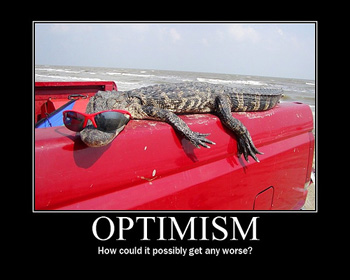
The Pew Research Center’s Project for Excellence in Journalism released a study today that claims bloggers and journalists have an “uneasy” optimism about the future of news media on the web. But, the study says, their optimism definitely trumps that of broadcast and print employees in traditional media industries.
According to the study, most journalists who work in the online news industry believe that the internet is having a negative impact on fundamental journalistic values, including a loosening of standards (45% of respondents felt this way), increased emphasis on speed (25%), and the addition of voices from outside the traditional media institutions (31%). While there’s no doubt that the internet is changing the way journalism is conducted and delivered, I’m hesitant to think that speed and increased diversity of viewpoints from outside the industry is detrimental to journalistic integrity.
Online journalists are cautiously optimistic that their publications have viable business models compared to traditional forms of media. Over 60 percent of respondents reported that their online news units were making a profit. But only four out of every ten online journalists are “very confident” that online news can find a profitable business model for journalism, and are worried about the money-making prospects of internet advertising. Roughly two-thirds of journalists surveyed predicted advertising would be the most important form of revenue for news websites in three years. That in itself might be an overly optimistic projection for online advertising revenues, which today only accounts for less than 10 percent of overall newspaper advertising dollars in the U.S., and actually showed a slight decline last year. Print advertising, however, is diving faster than anyone expected.
Photo attributed to Ken-ichi.


Losses, they have to move to the next step.
nlkuio]l;
Journalists have to stop seeing themselves as either print or online alone. Their credo should be about collecting, putting together, analysing and publishing the news.
Whether it is online or in print should not impact their basic competencies to be great journalists.
regards
Gautam
Well put. But to medium will always affect message to some degree. Newspapers that simply duplicate printed content to the web fail to use the medium properly, giving online-only publications an advantage.
The printed page, and arrangement of content on it, has shaped how articles are written, and the standard printed news story just doesn’t match the level of detail, or context, or even simply link to relevant sources like we’ve come to expect in online news.
*the medium
The problem with your perspective is that online journalism doesn’t pay equally to print, so you won’t see the quality of journalism you have with print. Is a public defender as good as a paid attorney? Possibly, but if you’re going to court, you’d surely pay for better representation. For example…
Ad dollars are going this way- of course they feel better.
“Speed” may in the long produce inaccurate information but “diversity of viewpoints” I would imagine could only be a good thing.
George – Agreed. “Speed” has proven to be a problem in the past as journalists skipped fact checking to get something published faster.
Hopefully InDenverTimes will prove to be a successful model to keep the “print” news alive.
That’s an awesome stock photo
Leena,
You might want to point out that the survey was conducted with the Online News Association and respondants were those who self-selected from among the 1,800 members of ONA.
Self-opinions without acknowledging economic facts blind traditional journalists. The facts are:
- Many writers have shifted from print to online. Why would integrity of content be an issue?
- There are more sources and opinions. Many filtering processes bubble the best, fastest to the top – like Techcrunch
- For newspapers, ad dollars has dropped below print costs – i.e. paper, print, distribute and associated labor. Regardless of customer preferences, there is no business model to support paper.
- The web business model is challenged by too much inventory. But low burn rates allow online publishers to sustain – until they find the right formula for profitability. Many are profitable, but not the print publishers who hold on to old models without listening to the new reality.
- Print publishers who FOLLOW the latest trends like adding social networking to emulate Facebook and Twitter – will fail. Take a look at http://media.tearn.com and compare the social awareness of old and new media personalities. Too little, too late.
Like our great leader says, Obama, it’s time to innovate and seek even more change. Publishers can only regain the spotlight if they embrace significant change of their own. Unfortunately, that’s not their nature. Sad as most print publishers will head into the deadpool.
The Optism picture above is very cool.
You’ve actually mischaracterized the results. Funny, in a sad sort of way, in an item about a study that includes criticism of decreasing accuracy in online journalism.
That number who said that “other voices” was a change to fundamental values includes both people who view that change as negative *and* people who view it as positive, not just people who view it as negative as you state here.
Doesn’t sound like anything too earth-shattering coming out of that pew study……mostly stuff we’ve been talking about for many months.
The reading fan in me hates that print media is dying, but the online journalist in me loves it. I feel pretty torn.
i like the stock photo too, but I don’t get it… It’s a dead alligator in a truck wearing sunglasses. If anything it is irony.
Ironic that they feel that the Internet has resulted in a negative impact on journalistic values. It is poor values and a lack of integrity which has driven their audience towards other information sources.
i created a news network with $50 and a bunch of extra time, and a CMS. had to learn a little css and php but the barriers to entry are so small that anyone can become a news source.
I think it’s interesting that we separate online journalists from print when, as an industry, we can’t afford to pick and choose. I consider myself to be both. If I want to survive the global meltdown of the media industry I have to adapt and change accordingly, and that means learning how to write for the web. It’s clear that the future of journalism will mean more online-only publications and of course it’s only natural that we feel uneasy about how this will work because no one (yet) has come up with a full-proof business model that will secure revenue that will support true journalism, and by that I mean indepth investigations and original articles rather than re-written press releases.
If all revenue comes from advertisers and not readers, who will journalists be writing for?