
Convincing people to pay for nothing, or rather for things with zero marginal cost to produce, is a great business model—in theory. In practice, there are so few examples to point to, and most of them are overseas, such as Helsinki-based teen virtual world Habbo. The virtual world’s parent company, Sulake, today reported some selective financial and user data for Habbo. In 2008, Habbo’s revenues rose 20 percent to $74 million (50 million Euros), and posted positive operating cash flow (EBITDA) of $7 million (4.8 million Euros). It was even slightly profitable on a net income basis as well, however the company chose not to disclose that exact amount.
Perhaps the bulk of revenues are being plowed back into global expansion or to pay the salaries of Habbo’s 300 employees (yes, 300). But its sub-10% margins so far are underwhelming. And Habbo is supposed to be one of the shining examples of a real business based on a virtual economy. It also makes money from advertising, but the vast majority of its revenues comes from in-world gifting and virtual vanity items.
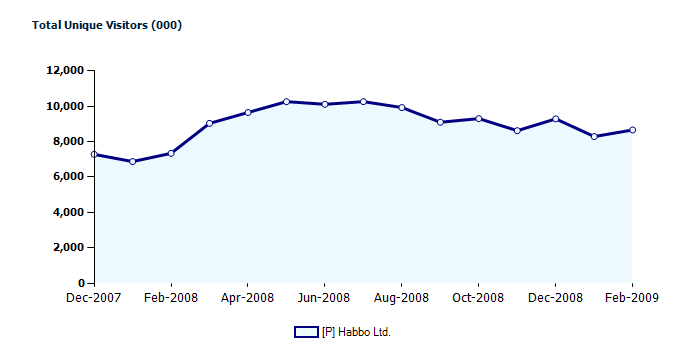
Habbo says it attracts 11.5 million unique visitors a month (based on internal Google Analytics data) and that more than 120 million Habbo characters have been created. How many have been abandoned, though, is unclear. ComScore estimates 8.7 million worldwide unique visitors in February, down from 9.3 million in December.
By year-end 2008, the global Habbo community had also grown in activity to 121 million Habbo characters with the number of returning visitors increased by more than 40 percent. Traffic to the teen virtual world also reached an all-time high in December, with more than 11.5 million unique visitors. Most of that is in other countries than the U.S., where interest seemed to peek in October with 2 million unique visitors. In February, the number of U.S. unique visitors was down to 1 million, according to comScore.


I suspect Habbo’s low margins are largely due to high marketing costs. People go to virtual worlds to interact with strangers, so there isn’t much potential for viral adoption, and the addressable user base isn’t terribly large (~100M, at most), so I bet the cost per paying user acquired is pretty high, and the lifetime value not much higher.
Where do you get this? Are you seriously saying that 12-15 year olds with internet connections are a
’small customer base’ and that they are non-viral?
Sounds like an online marketers wet dream to have 10s of millions of tweens talk about your product!
i agree with Vineet, and not just because he knows how Finns work… and if they wanted to turn marketing spigot off, those margins would be WoW-like.
First? Man haven’t these kids heard of WoW? Where you just pay a monthly subscription and you can find all the virtual goods you could ever want.
WoW has around 11m subscribers, Habbo has 70+ million subscribers.
11m subscribers paying $10+/mo. Do the math.
No matter how you slice it this is a great success story and a real company.
I am always stunned to see what people actually pay for. The margins are not fantastic yet but it seems they are on a good path.
I disagree with the “pay for nothing” characterization. Virtual goods are a service like any other, and they are becoming a great way to monetize websites and applications.
these revenues are staggering, though. well done guys
I love habbo
Hi Erick,
It would serve you well to stop thinking of digital goods as being ‘virtual’ or ‘nothing’ and having zero marginal costs to produce. I think it limits your perspective in reporting on their business or the future it represents.
He probably meant ‘…marginal cost to DUPLICATE…’
I have a few questions here.. I am defining virtual goods as things with “zero marginal cost to produce” as defined in the article. I understand that could be tricky with hosting cost etc.
1. is it legal in every country to sell virtual goods to teenagers or kids?
2. is it moral to sell virtual goods to anyone?
3. How will you feel if your son or daughter buying virtual goods with your money?
hey, its not different than putting quarters into a video arcade game – you are paying for the entertainment – just because they are called virtual goods doesnt mean they have to have long term tangible value
i would feel fine if my son bought $4 worth of goods that enabled them to play the game for 2 hours – thats cheaper than playing an arcade game at the movie theater!
Seriously?
The morality of virtual goods??
300 employees… that’s moderation for you.
I teach an Internet Business Models course at Full Sail University and the concept of virtual goods is intriguing. Online companies in South Korea have been incredibly successful at making money from virtual goods. They even tax them!
Hi Carol! It’s not just companies in Asia that have been putting up some big numbers in the microtransactions/virtual worlds – see Runes of Magic and Wizard 101.
There are people stupid enough to pay for eBooks by bloggers.
Selling virtual goods for a virtual world is not that hard.
This stuff is just amazing and the virtual economys out there… I guess it makes sense because the SIMS have always been so popular. Try the best home page
I thought we are on recession,wow, that impressive.
Nat
http://www.loopcity.com
The only problem with the ‘underwhealming’ earnings are of course that they IF they needed to, could strip the company down to 10 coders and 10 tech + Marketing and run on a low-growth plan with 70% margins!
Of course they are chasing growth! Know of any other company that chooses to just make a ‘little profit’ in these times? Pretty impressive in my book!
I have run a business for 2 years specializing in tools, architecture, and gadgets for use in Second Life. Basically, I am developing on the Second Life platform. It is best to consider it as software work which includes code development, design, and customer technical support. The work is complicated and takes time. There is competition, but there is also a steady flow of customers. productPM.com
The habbo guys are pros. Good stuff!
I was a member on Habbo when I was like 11, it took over my life! I don’t see how now that I look back on it but by god, if you have kids that are doing exams and what not, don’t let them on it! It will ruin their revision etc.
I won’t be going there again.
Yeah, it’s pretty much all about looting the kid’s pockets, not much more.
Having seen the growth and decline of Second Life I can tell you, that Virtual Goods model indeed HAS saturation/commoditization too.
That’s why the ‘next product’, mentioned in the article. People get tired of everything, including some new environment loaded with artifacts. They just leave at some point.
Sub-10% EBITDA margins are weak for a tech company – that’s discount retailer territory. To their credit, Habbo likely just passed zero on EBITDA (note very fast revenue growth in 4Q08) and will hopefully improve its margins in the future.
EBITDA is not the same as Operating Cash Flow. In almost all cases it’s higher than OCF. EBITDA ignores changes in working capital and taxes, which can be significant sources and uses of cash. As a business unit Habbo may still be losing money.
this is amazing, i would have never thought there would be cash flow like this, perhaps I dont know crap about tech biz
It might be good to mention in your post that Habbo Japan is shutting down.
Paying for cable TV or a movie ticket is also paying for virtual goods. It’s just flickering colors on a screen, if you want to be pedantic about it. But looking at it like that doesn’t make much sense.
Hmmm…I am going to throw up the red flag on this. $74M and minimal EBITDA. Clicking through their worldwide sites could not find one with more than couple thousand users on. Unless they are buying crack and trading it with their Habbo friends, I am dubious of the revs.
Anyone investing in Habbo better do some serious DD. I smell a rat.
Not much room for being fishy about the figures, as _all_ companies, no matter how big or small, whether listed on stock markets or not, are required by law to publish their audited financials and that data is public, by law. Here’s the drilldown for Sulake for previous years:
http://www.inoa...stiedot/332228/
…and their growth has been good, but not skyrocketing or “looking fishy”, if you analyze the historical data. Remember, this isn’t a startup launched in 2008.
Habbo is an extremely professional and well run site. It really stands out amongst the pre-teen dross on the net.
300+ staff is due to moderation as another commentator said.
Revenue model is absolutely spot-on. Not just virtual goods, but very sharp ideas about promoting real world products directly integrated into the user / player experience.
If only MySpace or Facebook could learn anythign from this.
Hey myspace- why don’t you allow people to block ads on their pages for – say $1 per month – then they could create super duper flash layouts??
IT is another innovations brought from the “ego”they selling “virtual respect here and I think as what happen in real world ,They need it ,that`s why they bought it,the convincing technique should be awesome and this what make them success
I have great respect for the Habbo team. A $74 million dollar reveue stream is not an easy task. Not so many teams have achieved that.
Keep on with your stellar work!
Those of you moaning about the morality of the business model for kids. Why do you buy Nintendo/games for your kids? Kids will waste their money one way or the other. Better stop being a moral apostel.
apologies, test comment
I agree with Dustin. Minimal EBITDA on $74mm in rev is nearly impossible with 300 employees.
At $100k per employee and modest expenses, they should be printing cash.
Convincing people to pay for nothing, or rather for things with zero marginal cost to produce, is a great business model—in theory.
You mean like the record industry?
They just re arrange some bytes on your disk, and
MUSIC, zero marginal cost.
Guess they are haveing trouble with their model also.
G
Anthropologist
Keys for MS Office have zero duplication cost but they sure sell for a lot. I’m not sure why it’s a surprise that people will pay for bits (unless you stuff your money in your mattress, your savings in a bank are just bits as well after all).
I used to be puzzled by the enormous snarkiness and vitriol poured on virtual worlds by Web 2.0 gurus like Techcrunch writers until I figured out that virtual worlds represent a terrible challenge to their power, not only as gurus about tech start-ups, and as API widgeteers, but gurus that sell their knowledge about start-ups and widgeteers that sell their APIs or consulting to…websites that depend on the clicky web advertising model for revenue.
Uh-oh, that professor from Wheaton is now telling us that model doesn’t really generate much, and least not *enough*, and even *he* had to mention sale of virtual goods in virtual worlds.
BTW, all the copyleftists and whatnot so overrepresented here are always telling us that giving away stuff and “selling nothing that has no marginal costs” i.e. musical downloads, etc. is a great thing. So, why the hating on “vanity” goods? Why is a music download from Magnitune “cool” or a freebie book of Cory Doctorow’s “cool” but some kid’s little furni “not cool”. The former don’t make money except for a few people at the top of the heap, and mainly from consulting and licensing fees, not from the sale of the thing itself. They are vanity items for the digerati, that’s all, it’s merely a different kind of virtuality.
Habbo has 11 million people and it makes money. It makes money out of *nothing*. It does great deals like the licensing of American Idol properties — everybody got paid on that one, Habbo sold little star stuff inworld, American Idol got its brand around. All those kids grow up and go somewhere and buy more stuff, this time not company generated but user-generated — Second Life? Blue Mars? Facebook if they put in Facebucks to buy stuff?
These are all places *where Techcrunch will not be and will be irrelevant* because they are user generated, whether amateur or professional. Tekkies hate users. They think users are “PICNIC”. They hate user-generated because they can’t control it. It profoundly challenges them.
Good!
Second Life is evidently more profitable than Habbo, but it, too, has 300 mouths to feed to keep the servers running, and only 1.5 million uniques in 60 days. But it turns over millions a week for other businesses who get paid running businesses inworld on this platform, and that income has to be factored in as well.
Then there’s Metaplace coming up to beta soon, which will also have a model for creators to sell wares and people to start businesses.
What on earth will Techcrunch *do* when no one needs it and its gurus anymore because they start start-ups themselves in virtual worlds, without even any VC cash needed, with *nothing* and they make money. Imagine!
thanks i will enjoy
thank you for it it will be great!
ok thank you so much
oi habbo
Prokofy Neva you’re quite an angry man? Nice to see a bit of passion but that was a very long rant and not very clear at that.
YOU SUCK PLAY RETROS NOT HABBO!
LARGER!!!!!!