iPhone Makes Up 50 Percent of Smartphone Web Traffic In U.S., Android Already 5 Percent
by Erick Schonfeld on March 24, 2009

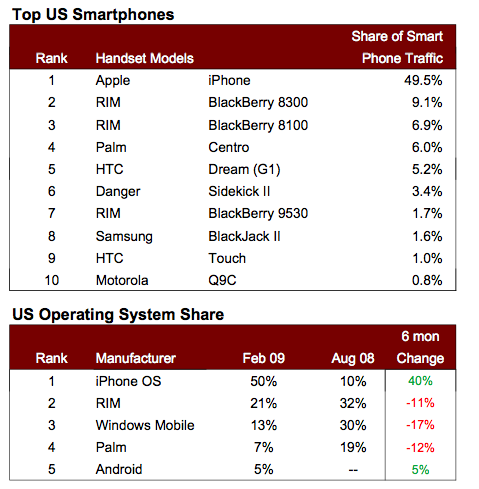
The iPhone now accounts for 50 percent of mobile Web traffic from smartphones in the U.S., according to an AdMob Mobile Metrics report released this morning. Over the past six months, the iPhone has taken share from Blackberry and Windows Mobile. In August 2008, the iPhone made up only 10 percent of mobile Web traffic from smartphones. During the same time, Blackberry’s share has gone from 32 percent to 21 percent (with the Curve and the Pearl coming in stronger than the Storm), while Windows Mobile has taken an even bigger hit, declining from 30 percent to 13 percent. Palm is also down to 7 percent from 19 percent six months ago.

The only other smartphone operating system that is showing gains in mobile Web usage is Android, which has captured a strong 5 percent share just three months after launch. And that is up from 3 percent in January. The gains shown by the iPhone and Android show what is possible when phones are built with fully capable browsers and support a rich array of Web apps.

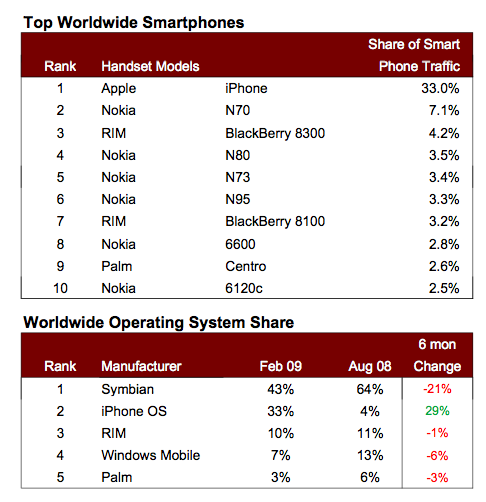
On a worldwide basis, smartphones running on the Symbian OS (mostly from Nokia) still dominate mobile Web traffic with a 43 percent share. But that is down from 64 percent in August. The iPhone has gone from 4 percent to 33 percent of mobile Web traffic on a worldwide basis. All the other mobile operating systems are down as well.

This data is extrapolated from AdMob’s mobile ad network and only looks at smartphone share. Overall, smartphones generated 33 percent of worldwide mobile Web traffic, up from 26 percent six months ago. The full report is embedded below.

Admob Mobile Metrics February 2009 – Get more Information Technology

Advertisement

Responses

Comments rss icon

  • I am not wondering. Everybody around me has one or wants to buy one.

  • This seems to be just data admob tracked. They can’t track where I go if an app or site doesn’t use admob, right? While I’ve no doubt there’s an upsurge in iPhone activity, the numbers seem a bit suspect. It may be skewed somewhat by the number of people trying to monetize iPhone apps with admob.

    • yes, it is based on data from the 1,000 apps and 6,000 publishers that use AdMob. It might be skewed, but it is a rather large sample. It gathers data from more than 7M iPhones, for instance.

      • Large samples don’t mean good samples!

        If I polled the dietary habits of all obese men who attend sporting events, I would have a large sample size (hundreds of thousands), and it might even give me a clue as to what obese sports fans eat, but I would not learn much about the overall population.

        All this says is that of the websites that use admob, many of the users happen to be accessing the site over the iphone.

      • Actually by that definition it’s way skewed, since many Blackberry and WM devices use the mobile version of sites vs the full or iphone specific version the iphone uses, you’re missing a big chuck of the smartphones that are out there.

        I mean think about it, do you really think there are more iphones out there then blackberry’s?

    • great point! definitely not a representative sample. still, its great PR for Admob and iPhone! more and more high end phones have great web access usability, and there are many thousands of mobile sites out there not using Admob to ‘monetize’. (in any case, publishers I’ve talked to have earned peanuts on Admob – literally a few bucks a month).

  • I assume WiFi traffic on the iPod Touch is rolled into the iPhone OS traffic? That’s not a trivial distinction: Apple is selling a ton of Touches, and they are surprisingly useful as mobile web devices.

  • IMPRESSIVE Apple. That blew my mind.

  • The apple part isn’t so surprising, but I’m surprised to see Android on the list. I wish they broke it don’t by connection type also (wifi, 3g, edge). Does this include the touch also?

    • I am disappointed that Android is still so weak!

      The iphone is basically the first mover in the new generation of smart phones. They are helping train the consumers. Android should have an easier time now gaining adoption than Apple did, but it seems to be floundering to this point. Lets hope the next wave of Android devices helps spur adoption beyond just the iphone.

  • As an iPhone user I’m not surprised. The thing is very convenient. I also carry a Sprint Centro because I need the IR connection, but the web access is not even remotely close to what the iPhone provides.

    It looks like this week our buyer’s brokerage is changing over to iPhones for everyone. (And to think how much I disliked AT&T 2 years ago!)

  • I am not surprised by Apple taking such a demanding lead. I was an iPhone user for about 1 year and loved it till my company switched to verizon and now I have a Blackberry Storm. Talk about a disappointment. Just wait till the new 3.0 OS for the iPhone comes out!

  • Can’t wait for the Nokia N97!

  • hmm, i take this with a huge spoon of salt. many windows mobile users i know change their browser’s user agent to a ie7 or mozilla compatible. which browsers are being tracked on windows mobile that has so many browsers available? are they tracking opera mini, skyfire, opera 9.5, IE mobile? or are they just tracking IEmobile?

    i can imagine that yes the iphone would have a high attachrate to the net, but 50%? this is saying that out of all the millons of peopke with smartphones that goes online the iphone is 50% of those millions…i dont buy it.

    this seems to be based on skewed data…what websites? you can put out “statistics” like this without telling the margin of error. i hate it when they do things like this which are not based on hard data but is based on just a fragment of the actual truth….

    i know its impossible to get all the data from all the websites on the net, but thats no excuse to fudge the data you’re actully basing your findings on or the presenting these findings. how about stating it like it actually is: “from the 190 websites that we monitor, the iphone accounts for 50%…”

    i hate exagerated claims…all these reporters needs to spend a week in the ani-hyperbolic chamber, damnit. it is then we can get some proper news.

  • This really doesn’t tell us anything at all about smartphone traffic on the Web. It just tells us about ad requests on AdMob’s network, which is heavily (and increasingly) biased toward the iPhone because of AdMob’s iPhone-specific ad inventory that will not work on other phones.

    No doubt there’s some directional accuracy to it — people keep buying more iPhones — but calling this anything other than a gauge of AdMob’s business is a stretch.

    • You are 110%correct. But don’t expect Techcrunch to care about this.
      Because the iPhone Iz Da Rulz. You know..

    • Absolutely correct! But, some numbers are better than no numbers. We have to keep in mind the source and the skewing of numbers, but they are nonetheless pretty interesting.

      We my not have any accuracy here, but we do have some trends.

    • Absolutely correct! But, some numbers are better than no numbers. We have to keep in mind the source and the skewing of numbers, but they are nonetheless pretty interesting.

      We my not have any accuracy here, but we do have some trends.

    • Actually, people keep buying fewer iPhones. The pattern of the sales figures is pretty clear, and they see a spike when they release a new iPhone, and then sales steadily decline the further you get from a new product launch.

      This is something that is consistently misrepresented because websites insist on showing the numbers of iPhones sold from the initial launch, which will of course be an ever increasing number, rather than comparing this quarter’s sales to last quarter’s sales. If you compare Q3 sales to Q4 sales, you will see an actual drop in demand, not an increase.

      Of course that looks bad for Apple, so let’s not look at the numbers that way.

      • Shhh the Apple fanboys can’t let anyone else realize that. It’s the BESTEST device out there. Others have notices on this and a large portion of 3G buyers were EDGE users. Sales after the launch have declined steadily and in most other countries they have severely cut the cost of the iPhone or give it away as there is no interest.

        The next spike will come in July and then fall again. Apple operates in their own little vacuum and their users like to shout how they are leading mobility but actual year over year shows they still have the same 8-11%

  • @dan frommer
    good point, by putting out news like they can only make more money…

  • Erick, it seems skewed towards iPhone ad inventory that cannot play on other handsets.

  • useless stats.

  • It’s too bad that the Blackberry Bold was released so late in the US (November 2008) otherwise I think that it would have had better results.

  • What AdMob gives you are trends and I can tell you real number are close to 50% of traffic generated comes from the iPhone.

    But more then that, you can see an overall increase in mobile Internet traffic. Even if RIM, WM or Symbian decrease in market share, their numbers are also going up. The iPhone is just going up faster.

    Also, if you specialized your development and build an iPhone specific mobile site, you will create a better user experience, users will stay longer and and do more clicks. When you know almost 50% of your traffic will come the iPhone it also make sense to build it.

    Those number are not telling the hole picture, the picture is not as far from the reality either.

  • Not exactly surprising that the former market leaders take a hit when a NEW OS enters the market and takes 50%.

    Still though, very impressive and I am surprised that Android is only 5%. Personally I think Android will take off when more apps and an organized ‘app store’ takes off (Together with a ‘killer phone’ of course).

    Plenty of people out there (including me) that would rather be part of the “Google Cult” Than the “Jobs Cult”.

  • I wonder if this was normalized to be by session as opposed to by payload whether the numbers would be set in context better.

  • Also, does anyone notice that the handset models are disaggregated for some of the brands but not others? Seems like this was intentional, but kind of glossed over by most readers.

  • Hm. Title should say,

    iPhone Makes Up 50 Percent of Smartphone Web Traffic on Admob Supported Sites In U.S., Android Already 5 Percent

    Don’t draw the wrong conclusion by false co-relation and over simplification.

  • Oh, I love the skew of bad metrics. In the very same period where Gartner shows sales slowing for the iPhone, and shows their worldwide share of the market as 8.2%, based on sales, another service comes out and says they account for 50% of all traffic.

    Here is what I want to know, who browses the web on their phone in the first place? I have had smartphones for years, as have just about everyone I’ve known, and on average I would say web browsing accounts for less than 10% of the actual use of the device.

    It seems to me that the vast majority of smartphone users spend most of their time in dedicated applications, not in a web browser. As others have stated, I suspect that what these figures really show is that iPhone is the only platform where AdMob provides in-application advertising, therefore it shows a disproportionately high iPhone usage.

  • Very low percentage for Android

  • Personally I would attribute marketshare units sold, not the web traffic or amounts of data. Given the iPhone is one of only a few phones that you would actually want to browse the web on, it’s not surprising it’s leading in that category.

  • I was shocked by the data (iPhone only 10x Android?!) until I realized it was from AdMob. IPhone apps don’t monetize as heavily via advertising because everyone wants to hit the 500,000 x $.99 jackpot. Android was about free apps til recently, so a much higher % is ad supported. Android is probably less than 1% of the market in actuality.

  • no wonder Iphone win the market with there “hyip and trends”I think there brands name is similar to twitter,where everyone love to “have it because it “Trends and popular”

  • This data is terribly skewed. AdMob is primarily an iPhone and Android advertising service, so it’s in their best interest to skew this data.

    I would take this report with a grain of salt.

    • You know very little of AdMob, they were doing advertising on mobile before the iPhone existed.

      You are also confusing Ad placement on native application (downloaded application) and mobile site.

      In these report, AdMob doesn’t give that granularity.

      But still, most of the trafic comes from mobile sites.

      If you choose to ignore their data, you may end up missing opportinuties, my advice, don’t. It shows market trends and that wave is as strong as it seems.

  • admob counts iPod Touch and and iPhones together in this report. That’s a bit misleading when the headline says smartphones.

  • I am confident that Android will be a good competitor to the iPhone in the next few years, especially now when Motorola released their new phone with the android os. Time will tell.

Leave Comment

Commenting Options

Enter your personal information to the left, or sign in with your Facebook account by clicking the button below.

Alternatively, you can create an avatar that will appear whenever you leave a comment on a Gravatar-enabled blog.

Trackback URL
Short URL
bugbugbug