
The Digital Divisions Are Dead At Big Media
by Erick Schonfeld on March 11, 2009

Big Media’s love affair with the Internet ebbs and flows with the markets. When they see money pouring into Web startups, they feel threatened and rush to do the same. They ramp up their digital divisions, which usually are no more than venture arms, and hope to strike it rich. When the markets are down, as they are now, their attention drifts elsewhere—exactly at the time when they can pick up innovation on the cheap.

“M&A is gone,” the digital media chief at one of the largest media companies tells me. Other than a few targeted acquisitions to fill out business or technology holes, “you look foolish making any purchases,” he says, “especially if prices are still going down.”

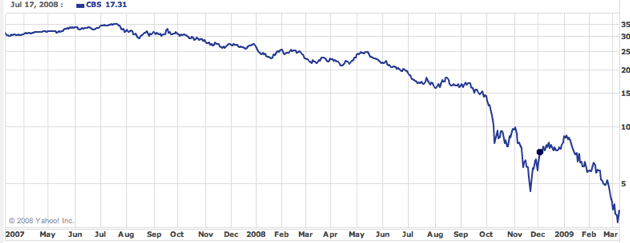
And those prices are way down. Consider, for example, that CBS’s entire market capitalization is now only $2.5 billion, which is not much more than the $2.1 billion its digital division CBS Interactive paid in cash over the past two years for Cnet ($1.8 billion) and Last.fm ($280 million). (It also made a number of other smaller acquisitions and investments). As of December 31, 2008, CBS only had $419 million in cash on its balance sheet.

When it bought Cnet last May, CBS’s market cap was $16.5 billion. If CBS had instead paid in stock for CNET, that stock would be worth only $273 million today—less than what CBS paid for Last.fm two years ago.

But the media company that went on the biggest buying spree was News Corp. Its digital division, Fox Interactive Media, was lucky enough to pick up MySpace, which paid for the rest of its acquisitions. Now that FIM doesn’t seem to be buying much anymore, it is not clear why it exists. Most of its properties could be integrated into other News Corp divisions or sold off. It does have some ad targeting technology and a budding ad network which is seeing some success, but that could be a stand-alone business or combined with MySpace.

And that is kind of the whole point. It is not clear why media companies even need separate digital divisions anymore. Even the digital media chief I spoke with thinks that “it is silly to have a separate division.” Disney, Viacom, NBC, and News Corp. each have digital revenues that are close to or are approaching $1 billion. But that revenue is typically spread across many different businesses. And, as big as it is, the digital side of the media business is still overshadowed by the many billions of dollars more brought in by the traditional side of the business—TV, movies, radio, even print.

The executives leading those businesses have too many other fundamental problems to deal with to worry too much about having a Facebook strategy or how to market their movies through Twitter. The last time the big media companies pulled back from the Web, it was because the Internet sector led the downturn. And every Web-related business became toxic. Now, it is more that the general economic crash is hurting overall revenues across the entire media landscape.

Media executives are going into self-preservation mode. They know that all media businesses are going digital, eventually. But right now, they are more concerned with sheltering their core business than with pushing forward a digital business that will leech attention and profits from the core business.

So the digital divisions have to transition from M&A mode to business-building mode. But without money or attention, the most talented executives in those divisions may not stick around for long. Mika Salmi, who sold Atom Entertainment to Viacom and then became the president of Global Digital Media at MTV Network, is already headed out the door. NBC lost its digital chief last November. And digital media executives with M&A backgrounds like Quincy Smith at CBS don’t have a lot of money to spend these days.

That leaves building the digital part of the media business to the old-school executives in charge of the other businesses. How many of them get it?

(Photo by atomicjeep).
Advertisement

Comments rss icon

  • I guess they have a whole lot of clever guys running their businesses. To bad those management boffins are as jumpy as the news that their companies produce. Good of them that they leave all the good stuff on the table for new startups to come and grab it :-) .

    • Honestly. Like what are the record companies going to do about sites like vastfm.com? It uses open music directory apis and the youtube api to provide free streaming music for every single song there is. And since they have no content, and only play hidden youtube videos, what can the record companies do?

      These huge companies cant fight the availability of their content any longer, they need to come up with solutions that are BETTER than the startups instead of trying to destroy the startups.

  • Your final paragraph points to precisely the catch-22 that these old time media companies are in.
    Why do they expect the old-school execs to be able to lead new digital properties?
    In the end, this will lead to higher costs than if they were to go the acquisition route now.
    They’ll likely continue to fail at a higher cost than if they were to continue with acquisitions.
    You’d think acquisition costs would come down near equal to the general market valuations, would you not?

  • “CBS’s entire market capitalization is now only $2.5 billion, which is not much more than the $2.1 billion its digital division CBS Interactive paid in cash over the past two years for Cnet ($1.8 billion) and Last.fm ($280 million)”

    wow.

  • It’s safer to follow the herd, less likely to get laughed at.

    Then again, that is how the financial crisis started….

    http://www.snazl.com

  • “So the digital divisions have to transition from M&A mode to business-building mode. ”

    Thank goodness. Social Media is NOT all about ROI, but it’s not about windfall profits either. For the large business space, Social Media is about being accountable and showing up at the table where your customers are and joining the conversation rather than attempting to “broadcast” it in old media think.

    Digital Media might best be championed by the business builders rather than the Zuckerbergs and Googles. Cause the tail and the niche are where the businesses are being built. Most BIG MEDIA have ideas like “American Idol/Facebook/Widget tie-in” and most of us could careless.

    Nobody clicks on the Facebook Ads because they are irrelevant when you are having a conversation with your friends. Can you imagine this call-waiting moment, “Oh, just a minute it’s State Farm on the other line wanting to quote me some auto insurance.”

    I will admit to having bought a Rushmore T-Shirt off Facebook, but hey that was kinda stylish. And T-Shirts are always cool.

    @jmacofearth

    • I click on facebook ads, which have been surprisingly relevant. I’ve got a batch of great-fitting pants, along with tips for events in my area that have been fun to check out. All in the advert sections… So, maybe you’re just unlucky vis a vis relevancy, or missing out on some new finds?

  • The market capitalization comment is interesting and fun, but let’s not confuse market cap with enterprise value. My guess is that CNET came to CBS without much in the way of cash or debt (i.e. purchase price equaled enterprise value). CBS, of course, has lots of debt and so its enterprise value far exceeds its market cap. Not that that debt is exactly a good thing right now, of course, but we shouldn’t overstate the amount by which the total value of CBS has fallen.

  • the only way these big media companies can compete in the future is to digitally innovate. my guess is they will purchase what they dont have sooner than later. they have too. same goes for the print industry. this digital revolution is relentless, takes no prisoners and waits for no one. only the “digitally strategically well positioned” will survive this tsunami.

    StrategyLocator.com – conspire yourself

  • Great article Eric!

    Well researched & written. Thanks!

  • At one point, I actually liked reading comments at techcrunch but now it seems like it’s 1 spam reply after the next.

  • Great article.

    What is wall street saying?

    1. Metro newspapers are under-water. Paper costs (paper + print + distribution + labor to handle paper) is greater than revenues. Who’s going to pay the editors, reps, and management?

    2. Is broadcasting going the same route? These executives bet $3 million per show. For $3 million, what can a savvy web company achieve? What about $150 million per year? Take a look at what we achieved with less than $500k http://s.tEarn.com .

    Yet, the same executives don’t have the experience to make the right decisions in technology. They bet on shows without proof, using their experience to guide them. Can they do the same with hi-tech?

    Is this why the market cap of these companies have dropped so low? Are they in danger of following newspapers down the tube?

    Investors seem to be saying yes.

  • bcasters need to show huuuggee booooobs

    • That’s actually… true! If the US went all European on our asses with what’s allowable, there’d be a brief firestorm, but then a huge resurgence in viewership, at least for a few years. Middle America isn’t going totally broadband anytime soon, and they’d eat those boobs right up!

  • “M&A is gone”….until it comes back again!

  • “It is not clear why media companies even need separate digital divisions anymore.”

    Because of AOL bringing down TimeWarner. Everyone else learned form that.

  • this was a good article until the last sentence..

    “how many of them get it?”

    there is NOTHING TO GET, there is no MONEY here.

    until the model gets shifted, or the consumer engages on a new order of magnitutde with digital platforms this shit is on hiatus.

    so wait another 20 years when the kid who is 0 now is 20 and can twit,fip,fb,txsms with his toes while sleeps , otherwise save your cash and use it wisely.

  • M&A is gone at both large and small scale, institutional and individual. I learned this in a hard way.

  • Hang on. You’re saying that Digital Divisions in big media companies are dead, because M&A’s have slowed? And you cant see a reason for them to exist without M&A tactics?
    Can you imagine if every division in CBS did its OWN new media? Can you imagine the duplication, cost inefficiencies, message dilution, internal fights over content rights…well its endless.

  • The core business in media is about the brand promise, not the channel of delivery. If you’re only around because you have access to a printing press, you’re in trouble.

Leave Comment

Commenting Options

Enter your personal information to the left, or sign in with your Facebook account by clicking the button below.

Alternatively, you can create an avatar that will appear whenever you leave a comment on a Gravatar-enabled blog.

Trackback URL
bugbugbugbug
Techcrunch on Facebook