
Google Now Lets You Target Ads At Yourself
by Erick Schonfeld on March 11, 2009

Google is wading into behavioral ad targeting in a big way today. It will start placing cookies on consumer’s browsers to collect information about their interests whenever they visit sites that show AdSense contextual ads. Then it will show ads targeted to those interests to the same person as he or she browses the Web on other sites that also serve AdSense ads (which is a large portion of all commercial sites).

Since Google already knows what each site or page is about, it will use this information to place each user in one of 600 subcategories of interest. If you visit tech blogs often, you are probably interested in technology. If you visit Trulia, you are probably in the market for real estate. Through AdSense, Google can now target ads not only based on the context of the page you are on, but also based on the context of the pages you have visited in the past, even if you are on a site that is completely unrelated. For instance, as a completely hypothetical example, it might show you a real estate ad targeted to the towns you were searching on Trulia when you visit a gadget blog.

Not only will Google now target ads at you based on your interest, but it will also let you target yourself. Anyone can go to Google’s Ad Preferences Manager and see exactly how Google is categorizing their interests. (Most people will probably see nothing right now, since this program is only being rolled out on a test basis and will gradually expand). Now, here’s the really smart part: Google lets you add or remove any interest. In effect, it is inviting you to declare what kind of ads you wan to see. You can also opt out of the program completely.

While most people will probably never bother to tweak their ad preferences or even be aware that they can, this represents an important new precedent in online advertising. Why should the ad networks be the only ones who can determine how to target ads at consumers? Why not let the consumers self-target if they care to do so?

Google knows that its interest-based targeting algorithms need a lot of work. Even if it can get just a small percentage of people to correct the algorithm, that data theoretically could be applied to other people with similar browsing patterns. Google gets to say that it is giving users more privacy and control, while collecting really valuable data that will help make its targeting more effective. In the online ad game, whoever can target the best can charge the most.
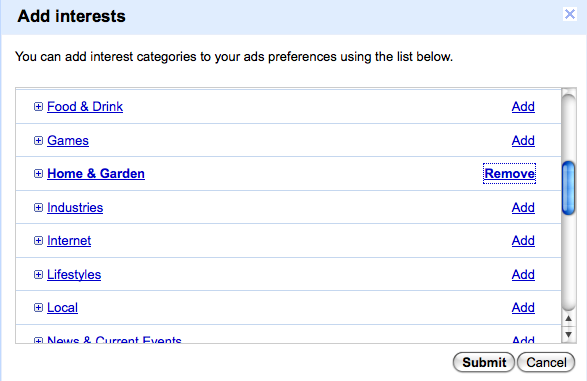
goog-add-interest

Advertisement

Responses

Comments rss icon

  • The problem with adsense is not that the ads are not relevant, it is the links they provide often go to really crappy sites so you lose confidence in the interface. Too often it is a waste of a click.

    • Worse still… Sometimes people will lead themselves to scams through some of the clicks…

      An example was a few years back when I was finding some ways of income through the internet, and I saw a link that was on No.1 like for so many terms I typed… I began researching on that and man, so many people complaint, and the link is still up there!!!

      Somehow I think it’s time someone innovates on advertisements… Text ads are getting old…

      • We’re launching our new interest advertising model tomorrow called Pay-Per-Chat.

      • I agree with the “waste-of-a-click” argument. The Adsense editorial review process is a joke. When the destination site is crap, it tells badly on the source site.

        Take Techcrunch as an example, I know implicitly that if I click on any of the square ads to my right, I’m not going to land in some pigs ear of a site, selling viagra or a “make money online” audiobook.

        My point is that serious sites tend to review their ads before they go live. Adsense unfortunately, doesn’t takes that control away from you.

        Shazwi, regarding more interesting ad formats, Facebook style “Text + Picture” Ads are available on Trafficspaces.

    • Gebadia: so ideally Google would use your behavior on the next page to determine whether the ad you clicked on was actually relevant to you?

  • That’s a great news, it just confirms the power of our technology. Let’s stop Google’s monopoly. Join Wozad. We do the same thing, but better. Investors can download our business plan at http://investors.wozad.com

    • Anyway, just to point it out, we are based on the same concept, exactely the same : leverage users browsing behavior to determine their interests and show more relevant ads.
      Some terminology found in the official google blog post about this new product really seem inspired on our text.
      But when we took contact with Techcrunch, they ignored us, when we posted our elevator pitch, they ignored us.
      I wonder what is the reason, is it Racism ? or maybe you are just well paid by Google ?
      Put it as you want, but this is biased information.
      Techcrunch is deviating slowly, from covering early stage startups, in need of mediatic coverage and some help to bootstrap, to a corrupted source, that only talks about those big companies with a lot of cash available. Of course, to buy advertisement on Techcrunch.

    • Information is power, the more that we give to Google, the more powerful they get. Don’t opt in.

  • I’m not sure how i feel about this. Most people share a PC, how can they target different users in the same household. They have no real way to tell users apart if they’re not logged in. Also, since they track the content of the pages you visit this raises some privacy issues, i wouldn’t want my sister seeing Viagra ads based on my surfing habits.

    (disclosure: i don’t have a sister nor do i need Viagra)

    • THE SOLUTION IS SIMPLE:

      Use Tor http://www.torproject.org and Yauba http://www.yauba.com

      No need to use Google or other “spyware”

    • When you log into a Google service you carry your browsing history with you. This seems like the best way for them to target ads that relate to your search trends.

      Why is it that you think Google puts all of these cool services online? They want you to create an account and use “Google’s” services such as mail, IM, and now even voice.

      Funny thing is that Google’s android phone is another way of them getting Google right in front of your face. Without a Google account you can’t use the phone.

      The funny thing is the only real disadvantage is it makes SEO harder. For the consumer it’s great.

      • Bryan Siegel said…
        Funny thing is that Google’s android phone is another way of them getting Google right in front of your face. Without a Google account you can’t use the phone.

        The solution is easy. Don’t use any of Google’s services, since they don’t a put a gun to your forehead and force you to use their services. Remember, the Google’s intellectual properties are entirely theirs which they can do whatever they like with those. Users or consumers have no legitimate right to demand they of what they can or can’t do with their properties. If you don’t like what they offer (which is free), then don’t use their services. You should find something else.

  • When I tried Ad Sense as a publisher I ended up with 1% of what I made with a boutique ad network. When I tried Ad Sense as an advertiser it took tons of time and I got zero results. With the same boutique ad network I got flooded with traffic.

    Google is a massive company so people stick with them, but they suck at being an ad network from both sides.

  • The problem id not so much about targetting…it’s the ad formats themselves.

    Most display ads completely suck and have NEVER worked. Existing online display formats are nothing more than a lazy attempt at monetising the internet. Wacking ‘print model’ ads onto the internet was doomed to fail. We’ve reached a stage where we think 0.2% CTR is good – in fact almost twice as good as average. Whilst this is an incredibly sad state of affairs – it does lend itself favorably to innovation. As the pressure continues to mount from above and budgets are squeezed, there will be a renewed vigour for accountability, performance and ROI. Let’s face it – online is the only channel with more than a modicum of accountability – it’s about time we used it. New online display models are in the works that are fit for purpose. Once usch format is the Open IMU. Among other marvellous things, it’s an ad fomrat that knows where it is and serves contextual to the placement and the user preference. There are a few other tricks to it – but the results are what counts. CTR rates on average of 10%+…this is just the beginning.

    • your exactly right. the gaggle addense display format is horrible. garbled ads with no uniform structure. where is the common sense classification system for search?
      you cant organize information if you dont have a backbone classification system. keyword search will die out as users will just navigate classification tab to classification tab.
      there is huge opportunity in this arena and this is G’s achilles heel.

      KillerLocator.com – easy prey

      • What is that Locator thing dude? It’s ugly as shit.

        • and fadbook,twibber, craigslust and bobo are beautiful? or maybe your talking about the locator diagram in the video. it does not need to be beautiful. it opitimizes the future of search. beauty and invention are in the eyes of the beholders.

          ListenLocator.com – pay attention

  • This is good! Now, I can control the ads which will appear on a web page I visit. Sometimes it’s annoying to see irrelevant advertisements posted.

  • I never surf the web logged on google accounts, and my Opera config drop cookies every time I close the browser. Sorry Google, not this time.

    Bye,
    http://twitter....om/alexnautilus

  • I’m not that excited about this. Although relevant ads on a page will be an improvement.

    • If your not that excited why are you commenting? If something is an improvement I would think you would get excited. I think your just trying to go with the mood of the other posts, don’t you?

  • $5 says they are beating Facebook to the punch with this announcement. (as in, Facebook will launch their behavioural ad network very soon)

  • Adsense is now forced to innovate since competitors like Chitika and Bizo are catching up and doing a better job. As you said, the targeting on Chitika and Bizo is much better than Adsense and so their performance is better.

    Google now has to go down the behavioral path to juice out performance. However, behavioral is evil and you can rest assured that the congress will step in – just like it did with NebuAd. Get ready for some big legal battles.

    • G can buy anything they dont have. they have proven to be terrible at innovation. there biggest mistake was to let fadbook and myspac run away with the social football like they have, once people fully integrate those social chains will be hard to break. still theres a huge opportunity for premium business social network ad dollar.

      • InnovationLocator said…
        they have proven to be terrible at innovation.

        Can you show some proof here? Tell us why Google is not innovating, ie, point to articles that describe the lack of innovation or point out to some functionalities where users want to see in Google’s services but are not available.

  • I’d love it if Google would just drop the “Get Your Obama Stimulus Check” “Lose Weight By Obeying This One Rule” and “Make Money Online” crap ads.

  • Hoping for a nice and effective result..

  • Well, I’m going to target my cookie blocking too.

  • I’m just surprised that it has taken this long for Google to move in this direction. It points to the fact that they really just don’t care about the consumer at all. As long as they are fulfilling their impression contacts for their advertisers (who continue to pay), why would they care?

    They try not to be “evil” at Google but brazenly ignoring website visitors and hitting them over the head with non-relevant ads time after time does, at the very least, show a casual disregard for us humans!

    At my company, EchoCurrent, we use behavior and contextual targeting to make affiliate product offers to site visitors. By focusing on the CPA (affiliate) market, we are not held accountable by brands and their contracts and so have the ability to truly attempt to show the best products at the best times to the right consumers. We need more competitors doing the same!

  • I wonder if I can now block all those belly fat ads that are showing up on pretty much EVERY site I visit these days …

  • Great feature added by Google.

    Will this mean that site about technology can show ads relevant to Mortgages if user preferences are set to finance and mortgages ?

  • I wonder how much of a backlash this may cause with publishers who are essentially providing behavioral retargeting info to Google for free.

    • I agree — Google should pay publishers who provide this data a % of the revenue that it generates, just like Tacoda and Revenue Science.

  • While applauding the effort to get media planners and brands interested in the adsense product our experience has always been frankly disappointing. Contextual targeting is nowhere near credible as a planning/buying driver for advertisers – reports I have seen are all ‘interesting but so what?’ – they don’t work any harder than informed context placement decisions. – ‘put my ad for my car in the motoring channel please’.

  • Another copy cat “innovation” from Google – Odd that Yahoo’s been doing behavioral targeting both on and off network for years and you haven’t seen the significance and value of it to Yahoo! – guess its Y! also rolled out this declared interests/user opt-out feature last year – its called Interest manager. You covered it but clearly its more interesting to view Y! from the lens of “beleagured company” rather than innovator

  • It is about time. My company, ListensToYou, launched last year to bring this ad choice to users [unfortunately, no coverage by techcrunch :) ]
    We have been talking about ad preferences and customer choice for a while now and are 1) excited that the market is being established and 2) optimistic that a third-party like ListensToYou can bring more value to customers and publishers who don’t want to use AdSense.

    We are implementing our first customer (web publisher) and launching publicly in a month.
    We’d love feedback on our concept – feel free to contact me.

    Thanks
    David Rostan
    Co-Founder; President
    ListensToYou
    david@listenstoyou.com

  • More Orwellian spying and phone home behavior from Google. Why am I not surprised? Well at least I got a heads up this time like I did with Google Chrome which has the same peek-a-boo like “features”.

  • If I were Google, I would use this set-your-own-ad-preferences feature to improve my algorithm which determines the users’ ad preferences automatically. What better way to evaluate the algorithm’s effectiveness than to ask the user himself what ads he is interested in seeing? :-)

  • Google’s new Behavioral Targeting: Looking Beyond Keywords – I’m writing a series of blog posts about the beginning of main stream network traffic mapping:

    The natural evolution of Search and Advertising is to move beyond keywords alone and to start using the preference data that emerges out of our individual decisions as we navigate through the gamut of media content. I think this will get really interesting.

    http://www.thin...beyond-keywords

  • This is very important step in right direction! However list of interest in Ads Preferences Manager is very primitive and does not reflect natural diversity of interest. For example it list only 3 hobbies!
    The next step will be using cross-reference of interests. Like if you are already indicated interest in X you should be also interested in Y. The only site that has a list of practically all interests and cross-reference of them is http://www.interestmatrix.com

  • Good to see Google realizing that opt-in advertising is a valid alternative to constantly mining the ever-expanding web. We have been experimenting with this for a while at prowebsurfer.com. It will be interesting to see how Microsoft, Yahoo and others respond to this announcement.

  • One thing to note – your ad preferences are only for the cookie, not associated with your Google Account. Setting your preferences would be a pain if you use multiple browsers and computers.

  • Does this only affect google content network not the search network?

  • Google’s announcement brings much needed attention to the importance of targeted advertising. It’ll be interesting to see how this evolves, but we need to remember that content still reigns supreme. Just showing display ads closely related to a general point of interest doesn’t automatically mean that it’s useful to them or a positive part of their online experience.

  • Honestly i thought they did this before, seems kind of obvious. I noticed it happening yesterday when I looked at a crazy Bollywood video advertising Israeli medium range missiles to the Indian govt (seriously) and a few minutes later I got a Gmail ad for the Syrian defense ministry in Arabic. Why are they advertising on gmail?! among other questions. Though i did click it…

  • Yes, self targeting needs more work. That’s why instead of being around for a while on sites like Myspace, it has not been officially promoted. Guess what google does contextual ads on the social networking giant too. There’s not only a lot relying on user adoption, but also on managing inventory for popular choices with the less flavored ones accordingly

  • Google does retarget ads on sensitivte data – they utilize your own search data, and I Have had this happen to me with a medical concern.

  • desqjockey, as Nice Affiliate Marketing said, hilarious!

    InnovationLocator.com, Google can’t innovate? Gmail has just outstripped youtube and is growing quicker than Facebook in some countries (e.g. UK) and is getting twice as much traffic from FB as a year ago: http://weblogs....s_youtub_1.html

    Also, Given that Google makes $1B per quarter in profit (!), gets a share of the search revenue from MySpace and that Facebook is still losing money I don’t see them panicking any time soon.

  • It will start placing cookies on consumer’s browsers to collect information about their interests whenever they visit sites that show AdSense contextual ads.

    DoubleClick has been doing this for eons (in internet-time): their ad network of tens of millions of sites knew when you’ve visited one or another DCLK network member. They target(ed) you accordingly. This was a large part of what spooked segments of citizens who used the web during the acquisition.

    Google now owns DoubleClick and, presumably, all the habitual data they’ve collected since ~1997. I, for one, welcome our proclivity-targeting overlords (for real! intelligently-selecting what I see is welcomed), but I can imagine the hubub will stir.

    The breathlessness with which this piece was written, too, may be a bit tone-deaf for TC’s audience. (I’m responding offline during the commute; surely 208 commentors before me will have rung the same bell).

    Ad Preferences Manager is a good touch: allowing me to opt for fewer Mr. Peanut Violations and more reverse osmosis water-treatment systems is a Good Thing.

  • I am disappointed with the media, and especially TechCrunch, for failing to point out that Google is being very misleading with this announcement. Their wording suggests that the interest tree has a one-to-one relationship with their behavioral targeting, but that is definitely not the case. Also, if you remove an item from your interests, they will not target any ads specifically targeting that interest to you on that basis, but that doesn’t mean they are going to erase the data or remove you from a more complex targeting rule. For example, you remove “auto” from your interests, so they don’t show you ads targeting auto, but that doesn’t mean they throw away the data you provided them and it doesn’t mean they don’t combine that with other data to put you in their “young male car enthusiast channel”. This is a case of very proactive, and slippery PR. I would like to see the fine print before we gush over them anymore.

  • It’s not that Facebook data is not good. It’s actually the richest data any one entity has about users. It’s the fact that targeting Facebook users ON FACEBOOK isn’t the optimal ad targeting scenario. People on Facebook are primarily engaged in social activities and thus tend to ignore ads. If you take Facebook’s knowledge about the user and use it to target ads OFF FACEBOOK (i.e. a FB ad network), especially in contexts where the user is at some point in the purchasing funnel (e.g. researching a product category, comparing products, etc), then those ads should theoretically perform much better than if they were ON Facebook. Combining user-supplied preference/interest data with social context, along with user behavior, demo, and geo data would give you the holy grail of ad targeting data (outside of search advertising).

  • Google should do away with the “smart pricing” BS if the ads are going to be so well targeted.

  • Great that Google is interested again in its’ core business: advertising.

  • I think that this new “feature” will KILL niche websites. Because if i have a website for health, i want health related ONLY ads to appear.

    If i get this right, the ads will be relevant to the users visits and not the website’s niche.

    BAD BAD BAD for adsense publishers

    • You’re missing the point. If you’re an owner of a niche health site, you don’t want health ads, you want clicks and money. Google is offering to make you more money. So what if it results in fewer health ads – it will result in more ads that are of more interest to your specific users and thus more money.

      • No i’m not missing any point. People who run high profile good paying niches, will get .01c clicks instead of 1$. For example.

        Google will control what ads will display to the user, ignoring our website theme / niche.

        Not good in my book and the results after a while will be a shock to all of us.

  • just got an email from google but didn’t understand pleace provide how to make privacy page

  • facebook is doing something similar with their ads. They let you tell them if an ad you see is not relevant.

  • Yeah facebook is a good traffic for your site. :)

    Until now adsense has issues with customer service..

    • Behavorial ad targeting has been around awhile, but as usual google is the first to take it to the next level. I stay up to date on the issues that test the limits on data privacy and security with This* digital security site.

  • My point is that serious sites tend to review their ads before they go live. Adsense unfortunately, doesn’t takes that control away from you. it will result in more ads that are of more interest to your specific users

  • With the massive power it has google is able to conduct these huge social experiments. Which is essentially what stuff like ad targeting on this scale is. No other company really has the resource to be able to test such ideas out.

  • Obviously Google is the ad god right now but I think there is another model that may be on the horizon that fully integrates brands into a person’s life. I have some additional thoughts on this point but will wait to see how it plays out in the advertising space.

Leave Comment

Commenting Options

Enter your personal information to the left, or sign in with your Facebook account by clicking the button below.

Alternatively, you can create an avatar that will appear whenever you leave a comment on a Gravatar-enabled blog.

Trackback URL
bugbugbugbug
Techcrunch on Facebook