
Google Health Now Lets You Share Your Medical History With Loved Ones
by Jason Kincaid on March 4, 2009

After months of rumors, Google Health finally launched last May, promising to store our medical records in a secure way that is more accessible, easier to understand, and useful than traditional paper records. Since then we haven’t heard too much about the service, which isn’t particularly surprising given the sensitive nature of the information involved (this isn’t a space where Google is going to take new feature additions lightly). Today, Google has announced that it has launched a significant new feature, giving users the ability to share their medical records with designated family or close friends.

The general idea behind the feature is that oftentimes during emergencies family members may not know the details of your medical history, like medical allergies. Such information can be lifesaving, but sharing extremely personal medical information is not something that should be taken lightly. Google is taking lengthy measures to ensure the security of the data, associating invite links to specific Email addresses and allowing users to track who has viewed their records. All shared records are also read-only.

One security measure that I don’t understand is the 30 day expiration Google Health is placing on each Shared link. Unless users resend their link every month, it sounds like this feature would be effectively useless in the event of an emergency. I’d prefer a system that allowed me grant permanent access to a close family member, which I could revoke at any time. Update: A commenter below points out that this expiration may only apply to the link itself, and that the sharing relationship remains in place indefinitely provided the link is used within 30 days. Google has confirmed that this is the case.

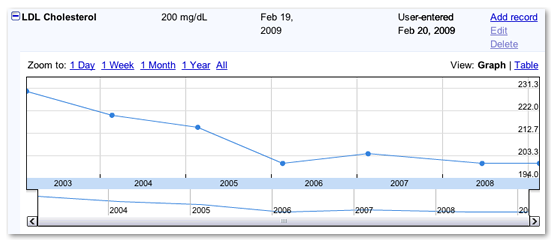
For those users who’d prefer to go the low-tech route, the site is also launching a new feature that makes it easy to print out wallet-sized snapshots of your medical profile, which you can distribute to close family or perhaps just keep in your own wallet. The site is also launching a new graphing feature, allowing users to visualize the progress of health-related metrics like their blood pressure or cholesterol.


Advertisement

Responses

Comments rss icon

  • Google Health is a great idea but useless until most major health care providers are partnered up for automatic syncing.

    • And until users have the ability to decide which info is revealed to which viewer (family, health care providers, etc.), per H. Wack’s comment below.

  • “Hey sis and bro. Checkout my emr. Yes, your reading it correctly. I have VD and Crabs. Please don’t tell mom and dad. okay”.

  • Wow a social network for my health records, why didn’t I think about it

  • Good lord, how much info about people is Google planning on gathering? Can’t wait for Google start targeting ads based on cholesterol levels or BMI…

    • Google has more information on people because all those “free services” that they provide are collecting data that cross pollinates with their own systems, other companies that they own as well as affiliates. Keep in mind that they own DoubleClick, PayPal, etc, They know your credit card numbers, bank accounts, who you know, what you say, where you go, where you live, what you like, what you dislike, and on and on. That’s why they are laughing all the way to the bank. By the way, drug companies already know what prescriptions you’ve had filled through your pharmacy.

      • Google doesn’t own PayPal…

      • they don’t own Paypal nub. eBay owns Paypal….that’s common knowledge even to normal people.

      • I would rather it be Google than the Gov’t (who def has ALOT more). At least Google is making useful applications that one utilize the data.

        The GoogHealth could be very useful for EMS and Emergencies, but as someone else mentioned, the providers need to implement synch or have some other access point.

        • Dude, wake up.

          Do you really think, the US gov’t doesn’t get a “privileged” access to the data of the World’s Biggest Data Hoover that happens to be in the same country ?

          Google knows everything about you.

          It’s getting sick.

  • yeah, re-inviting every month sounds a bit silly really. Who is going to remember to do that? A notification system where you choose which updates to send forward would be more practical. For example, you don’t want your peers to not be reminded that you have diabetes, but you may not wish to broadcast that you just had a pregnancy consultation

    • What if you have alzheimer’s? You might forget to invite them back …

    • If I’m reading their site correctly it’s just the link that expires after 30 days, not the actual sharing relationship.

      • Yeah, I think you might be right (I’m asking Google to clarify).

        It’s confusing because when you initially send the invite to your friend/family member, it actually says “Expires in 30 days” under their name. It doesn’t really make it clear if they have 30 days to accept the invite or if they have 30 days to look at your account.

  • It took them a while, I have both Google Health and HealthVault and HV was a little ahead there as you could create a family account and share between members, like mom sharing kids information with dad, etc. Google Health has done a bit more though with the medication data from the pharmacies though

  • I try to keep the PHR thing updated on my blog and have an entire section that is nothing but Google Health and HealthVault along with links to sign up http://ducknetw...ealth%20Records

  • I have enough going over there to be on the HealthVault "watched" list when it comes to PHRs, and admittedly there’s more on HV as they have devices that hook up to the PC and do blood pressure and insulin readings now too http://ducknetw...og-watches.html

  • How exactly is it “secure” when access is only a username/password?

  • I tried sharing my profile to dad’s (who is a doctor) work email and it required him to create an Google Account before viewing it.

    Why’d my dad or any other Doctor go through the pain of creating Google Account to view my health record?

    • So then the Doctor can organize all his patients using this same system.

      This system lets the patient revoke the access to the file at any time.

      It lets the patient ‘own’ the medical record, not the doctor (and his current paper un-updated copy) as is the current situation.

      Besides, it’s not good to have a ‘public’ view of your medical file. You should know who has access to it, and who viewed the file.

      Much better than the current situation where every doctor you ever went to has their own ’secret’ version of your medical history.

  • Great idea, but it should be the user to grant access to whom they want and without an expiration. It’ll be tough trying to access someone’s records and then the system tells you you’re expired.

    TechFilipino

  • The 30 day window is faulty. Especially if you have a degenerative brain disease. What’s next for Google? How about Google BS Meter? Although, I will still trust my gut, it will be cool to have a gadget that senses people’s “BS.”

  • PHRs have been notoriously low value, and Google’s is no exception. As a patient, your data is in your doctor’s office, and the vast majority of physicians are still practicing on paper. This means that Google will never be able to retrieve your health record. As a result, patients have to enter their data into Google Health themselves – the problem with this is that most patients do not know all of their chronic conditions, prescriptions, etc.
    The only way to provide a Personal Health Record of value is to have one that is natively connected to the physician’s office, where the patient’s record resides.

    This is the type of electronic health record platform that will be able to save lives and cut tremendous costs – and this is exactly what Practice Fusion is executing upon – We currently offer a free electronic health record for physicians – our PHR will soon be available and will allow you, the patient, direct access into your physician’s practice to retrieve your complete health record in the case of an emergency or referral.

    -Ryan Howard
    CEO, Practice Fusion
    http://www.practicefusion.com

    • Alfred Mazzei, MD - March 5th, 2009 at 2:07 pm PST

      @Ryan – Your likely demographics is middle-age to older adults, with possible vision problems — a piece of free advice: get rid of the black background on your site’s Home page. It is “cool” but blue text is unreadable and a turn-off for many visitors…

      You may get enough business to keep your company floating for a while, even considering advertising, after a great deal of back-breaking work. However, your approach, although original, will not be able to avoid the significant pitfalls of true “privacy” and “security.”
      Your premise is still taking sensitive and private medical information away from the naturally protected, tried-and-true environment of the medical office…

  • google seem to be in every arena . i wonder how long before they can this health project

  • It’s definitely useful to let your family (or other emergency contacts) have access to your records when they need them, but preventing curiosity snooping is tricky. Showing who has viewed the records is a good start, but this only prevents inappropriate snooping if the snooper knows you’ll see they viewed it.

    I’d rather see a more obvious mechanism that makes viewer think twice before needlessly viewing my records. For instance, maybe put up a big alert that says:

    “you should only read this record in case of emergencies. To view this record, enter a reason, and all emergency contacts will be notified of the situation”

    Using this approach, you can provide open access to the records to trusted individuals, but then there is a natural social pressure to only view it for good reason since you know other people will be notified that you are viewing it.

  • Would I want my medical history floating around on the web or with some billion dollar company? Not necessarily.

  • Google will be fighting an uphill battle here because in the end, healthcare has to be about the doctor-patient relationship and any technology that is applied to it has to enhance that relationship, not attack it. Practice Fusion and Mitochon Systems both are approaching this need for a PHR from the doctor’s side, not Google’s side.

    -Steve
    http://www.mitochonsystems.com

  • I love Google but I start to worry when they start to know more about me than my parents!!!

  • Alfred Mazzei, MD - March 5th, 2009 at 1:27 pm PST

    As I commented before, and agreeing with some comments here, MS Health Vault, Google Health and many others like them, are a dumb, dumb, useless. dangerous idea.
    There is no such a thing as “security” and “privacy” with these systems because all the records are seen by dozens of people unknown to the patients and their doctors.
    Once medical records leave the doctor’s office and the patient’s hands, it is all a “free for all” –anybody could use them for anything they could come up with. Those who believe otherwise are extremely naive or just plain stupid.
    Case in point: dozens of medical practices in the Washington DC area owned by doctors from India, at the end of the day fax all their patient’s medical records to India for processing. These records, of course, contain complete information on patient’s diseases, diagnostic tests results, prescribed medications, social security and driver’s license numbers, addresses, telephone numbers, date of birth, etc. –so much for “privacy.” Of course, by doing so. these Indian doctors violate federal HIPAA regulations, every single day.
    A group of colleagues and myself have reported this illegal activity to the Department of Health and Human Services [HHS] in washington DC repeatedly for about 5 years, and nothing has been done. Go figure, the federal government not protecting American citizens’ privacy…

    EHR, electronic health records are, in theory, a neat idea, but realistically useless. Even with them, medical practices are required by law to keep “hard copies” meaning paper copies of patient’s charts, for at least 7 years, Ideally, copies of these medical records should be kept away from the office in case of destruction by fire, etc.

    • ace bhattacharjya - March 6th, 2009 at 4:58 am PST

      Your statement that EHRs are “realistically useless” is fairly radical, even by techcrunch comment standards.

      The issues of privacy and security in medical records are still being worked out, but it’s hard to deny that their still elusive goals: better care through reduced errors and evidenced based medicine, cost savings across the system and MORE control over records for the individual.

      Given how HIPAA treats covered entities (neither MS Health Vault nor Google Health are covered) and the amended HIPAA privacy rules– I’m not sure that I’m waiting on the federal government to protect me. Mining prescription data is a multi-billion dollar legal business (with no opt-out). Scott McNealy was right

      There are many (including me) that believe Obama’s plan to spend on healthcare IT will dramatically increase the quality of care in America. EMRs are a definitely part of that solution. Good policy and strong enforcement of Privacy is our biggest impediment to this success. Good security is important, but less relevant to this discussion. We need a major reworking of how we think about privacy in this country.

      We also need the right incentives in place– right now, we ask doctors to pay for EMR systems– but it’s really the payers that benefit. The stimulus package helps somewhat, but we need a bigger more unified approach.

      Just as an aside– there has been a concerted attempt by right-wing lobbying groups to derail attempts to change the current healthcare system. Here’s a great example of how Rush, Drudge and Fox were involved in manipulating a story about Healthcare IT and making it about “healthcare socialism”:

      http://www.wash...9_02/016841.php

  • “Google Health Now Lets You Share Your Medical History With Loved Ones”
    Sure, like I want my aunt Sarah know about this weird-looking rash I have on my crotch…

    Are you f****ng insane?

  • nice to know that you can easily access health history of your love ones via internet but also scary for other people to know such information.

    http://www.heal...tedirectory.com

  • Sound like a bad idea. I won’t be using it and I doubt most of the people I know would want to either.

  • Would be interesting to hear how much usage this site/service is getting. We don’t hear much about it….

  • It’s going to be amusing when Obama simply comes out one day out of the blue and claims the medical system efficiency standards and electronic conversion is complete; thanks to Google and a large payout. I’d rather have Google do it than Congress any day though if it must be done. I’ll be checking This digital security site though to get an independent analysis.

  • This is all very disturbing. Our medical records should be kept strictly confidential.

Leave Comment

Commenting Options

Enter your personal information to the left, or sign in with your Facebook account by clicking the button below.

Alternatively, you can create an avatar that will appear whenever you leave a comment on a Gravatar-enabled blog.

Trackback URL
bugbugbugbug
Techcrunch on Facebook