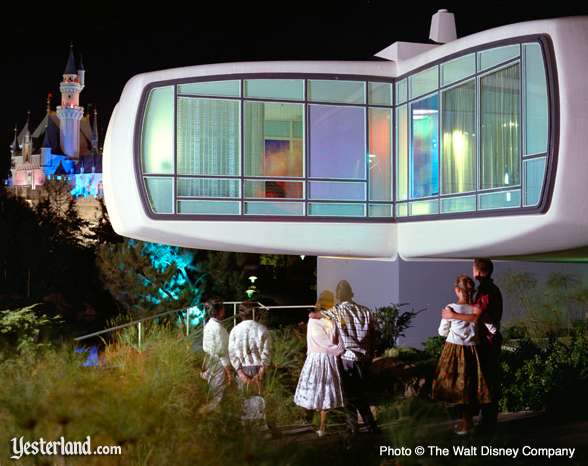
When I was a kid one of my favorite parts of Disney World was Tomorrowland’s Carousel of Progress. It was steeped in 1950’s futurism: Why, of course! Every family will have their own electric paint mixer in the future! And I only wish I’d been old enough to see this gem before it was torn down and replaced with a souvenir stand: The Monsanto House of the Future, a house built entirely of plastic.
Disney likes to talk up inventions the house featured that wound up becoming commonplace, like the microwave oven. What it leaves out are all the ones that never did. You know, the type of things we saw on the Jetsons: flying cars, our food in pill form, robot butlers and maids. Sadly, as it turns out the “future” looked a lot like the past, just more streamlined. Had Tomorrowland stayed in tact, it would have looked more like the Tomorrow-that-never-happened-land.
I’ve been thinking about Tomorrowland for about three days. It started when I read Farhad Manjoo’s excellent piece on Slate about the “Jurassic Web.” He painted a picture of what the Web was like in 1996. It was mostly a place you went and then thought, “OK, I’m here. Now what?” He reminded us of the sheer wonder the first time you could search on Amazon by author or browse through Yahoo’s hand built “directory” of Web pages.
The note Manjoo struck at the end of the piece was pure Silicon Valley: If all this happened in just 13 years, what will the next decade of the Internet hold? Will we look back on YouTube, Facebook, Hulu and iTunes as primitive?
This is where Tomorrowland and the Jetsons come in. There seems to be a pattern of diminishing innovation the longer a new technology is on the market. The early years—even decades— of, say, the plane, the car, the telephone, television, computers all saw rapid innovation, such rapid innovation that people would look back with the same kind of wonder that we do thinking of the Jurassic Web. “Can you believe you used to have to crank a car engine?” “What do you mean TV was only in black and white?”
But at some point, the innovation gets more evolutionary than revolutionary. Sure there are advancements in digital filmmaking and editing equipment but has anything in movies yet transformed the medium as much as the change from silent pictures to talkies? At some point, the technology stays the same while the cultural importance of it, or the way it is used is what changes. Put another way, the technology that was used to film a movie like “Deep Throat” wasn’t what changed society and the industry, it was the content of the movie itself.
I know it’s heresy to write this on a site that entrepreneurs and technologists read: But what if the bulk of technology innovation on the Internet is, well, done?
Already, if you think about Web 2.0, the successful companies are building off the technology that was pioneered before—whether it’s the browser, broadband, or the open source stack. Sites like YouTube and Twitter may be technically hard to scale, but are they really technical leaps in innovation, or more of a creative, cultural leap in how existing technology is being used?
Of course, the Internet is still very young. It certainly took technologies like the mobile phone more than 13 years to go from that embarrassing brick that took up half of a briefcase to the iPhone. Some could argue the mobile phone is still ripe for as much game changing innovation, as new models like the Palm Pre promise to integrate the browser experience throughout the user interface. Is it simply too early in the Internet’s lifecycle to even raise the question of whether Internet innovation has peaked?
As someone who writes about the Web for a living, I certainly hope so. But then again, everything has happened faster on the Web. No other technology has been so rapidly adopted by such a large number of people. Is it possible this is it?


Enjoyed your posts these last 2 weeks…is this your last one for TC?
Sarah,
First of all, we’ll miss you on Techcrunch. Best of luck to you in your future endeavours!
As for your article and the concerns that you raise, I think these are doubt that many people in the past and present have had when they looked at the world around them. Unfortunately, I think we can draw any lessons from these people, it is that we actually tend to underestimate the rate of technological progress.
I am sure you are well familiar with:
“Computers in the future may weigh no more than 1.5 tons.”
Popular Mechanics, forecasting the relentless march of science, 1949
“I think there is a world market for maybe five computers.”
Thomas Watson, chairman of IBM, 1943
“I have traveled the length and breadth of this country and talked with the best people, and I can assure you that data processing is a fad that won’t last out the year.”
The editor in charge of business books for Prentice Hall, 1957
“But what … is it good for?”
Engineer at the Advanced Computing Systems Division of IBM, 1968, commenting on the microchip.
“There is no reason anyone would want a computer in their home.”
Ken Olson, president, chairman and founder of Digital Equipment Corp., 1977
“This ‘telephone’ has too many shortcomings to be seriously considered as a means of communication. The device is inherently of no value to us.”
Western Union internal memo, 1876.
“The wireless music box has no imaginable commercial value. Who would pay for a message sent to nobody in particular?”
David Sarnoff’s associates in response to his urgings for investment in the radio in the 1920s.
The pace of human innovation and ingenuity will always surprise us. It may take different forms and take place in different locations than before, but humans are just very incredible creatures.
From India
Anjali Sen
Very nice quotes here and a good point.
I’d like to add my favorite:
“640K [of RAM] ought to be enough for anybody.”
- Bill Gates in 1981
He NEVER said that.
The most often quoted piece of made up nonsense.
LOL!
freefreebiefinder.com/
And I believe the CEO of Kodak somewhere in ‘88 or ‘89 said that Digital Photography is a passing fad…
Good article. But I think this thinking is like *my* favourite quote which was someone in the 1800s in London saying something like that the traffic couldn’t possibly grow because then the streets would get filled with horse shit.
Twitter is really starting to grow. But I read an article somewhere that the government tracked that Bin Laden was using twitter. That just goes to show that we are being spied on. Twitter is kind of boring to me. I just can’t get into it.
Leroy, is that you? Boy, you sure are pretty now that you’ve had your operation.
Excellent article. One of the things that I’ve noticed recently is that some of the web’s evolution has brought more of Desktop-platform de-evolution. Technologies like Adobe’s AIR have have tried top bring the technology of the web and media of the web onto the Desktop platform. What we should be doing is bringing Desktop-level user-experience and stability to the web. If websites in the future could take pieces of Mozilla’s XUL which runs in a web browser and has very sophisticated UI controls in combination with Google Gears, the line blending the Web and the Desktop will begin to fade. I’ve gone to Web 2.0 sites, and quite frequently said to myself, “Wow, I wish that they had used OS-native tabs or form controls like they have in XUL on this page; what they have now doesn’t really look stable, and more jury rigged.”
Who’s going to deliver the innovation? Well, imagine if W3 decided that they wanted to adopt the XUL technology in the future, and imagine how the line between Desktop and the Web could begin to disappear!
Interesting post, Sarah. Just one quibble. I think cell phones have spread to more people even faster. But they’re merging, so no big deal.
Great insight. In short, I think you’re correct. We’ve invented up to the point where a lot of “cool” things we would want could be created, but we’ve now decided we don’t want them as much as we thought. It turns out we like things pretty well just the way they are.
I think that the future imagined by the naifs of the 1950s and of the 1990s alike has always been stifled by the interests of large oligopolies.
We could have flying cars or, in the very least, high-speed mass transit. In the 1950s-1960s the major car companies, GM and Ford, convinced cities to tear up their urban rail to instead deploy buses and trolley buses. Those very same companies now want us to bail out all of their sins.
We could use the mobile phone in the same way we have used PCs, however wireless carriers are obsessed with walling the garden and caging 3rd party developers within an “App Store” or the utterly useless J2ME framework.
In that sense the future is almost always conditioned by the present — our imaginations and explorations are capped by short-term corporate interests rather than long-term public good.
THIS is the invisible hand that diverts revolution into evolution.
Right. If government planners were in charge of innovation instead of those damned capitalists imagine the future!
Actually Rankin….the government was in charge here in Korea, and in Japan, and is in charge in China…and yes….
innovation has accelerated when the government is involved.
and about the amazing ability of capitalists to innovate? sooo how do you like your *snicker* 12mbps “broadband”…you know the one where your capitalists essentially decided it wasn’t worth it to get any faster because it would do nothing for their earning in 6 months.
I guess the 100mbps VDSL lines I have been enjoying for the past 6 years…probably would have been built anyways right? You know even though everyone crucified then Pres. Kim DJ for proposing huge governmental investment in broadband about oh 10 years ago.
Yeah…unalduterated capitalism without government involvement is really innovative isn’t it? *rolls eyes* Especially when it comes to financial weapons of mass destruction.
Sarah: Nice piece. But we’re not done. Not nearly. Not by half. Don’t make me whip out the (apocryphal) 1899 Patent Office quote.
There may be a new platform in the offing (perhaps along the line of the Pre, as you note) — or maybe the Semantic Web will change everything.
It’s the timing of Farhad’s piece I take issue with:
Why now?
Not exactly Slate’s anniversary (and, even if it were, it’d only be the 13th, at that).
Otherwise, why choose 1996 and not 1994, or 1998?
‘96 wasn’t a particularly key year, but Josh Quittner’s Wired 2.10 story (1994) about cybersquatting McDonalds.com (http://snurl.com/crqmd) surely was.
You should know better than most that, in Internet time, what was true two years ago simply isn’t true anymore.
We’ll be somewhere two years from now that is barely imagined at the moment.
j.
Stunning new information:
“Of course, the Internet is still very young.”
“But then again, everything has happened faster on the Web. No other technology has been so rapidly adopted by such a large number of people. ”
Thanks captain obvious!
She could just have written the post in bullet points, too.
Excellent post Sarah. Constant connectivity is going to be the next internet-related phenomenon that will cause a new, rapid burst of information. Think augmented reality, via visual recognition, speech recognition, geolocation.
The app Shazam is just a start, as speech recognition and computer vision technologies get more and more advanced every day, and we become more dependent on the added richness of information provided by connectivity.
shesh, it is Disneyland not world that had the Carousel of Progress. Disney World still has their version of it and it is still working.
nope! it was at disneyland. they moved it to disney world in 1975, at the insistence of the sponsor GE who thought all californians had seen it and they wanted a new market.
I’m really impressed by the quality of your posts Sarah. Every time there’s a post that i read and think “damn that was a well thought piece” I look at the top and your name invariably comes up.
Great job!
I think a maturation of a segment, does not mean that it its innovations will stop!
While the Western civilization is may be already at a level, where new technologies are widely accepted – look at other regions, like India, Asia, Africa, South America.
Those regions are still years, years and years behind our penetration rates in terms of technology.
At us, the revolutions will happen in the future, but the people are not impressed anymore. They have seen so much, that they think it would be normal to double the CPU capacity every 2 years.
The only criteria you use to evaluate a change is if it also changes the society. But you forget, that many development, most people simply do not understand. If you read a medical journal, you will discover world changing innovations which are developed every year. But as long as you do not understand what they mean to you – you do not appreciate them.
The same is happening in the internet right now. Many new things come every day, but due to its high number and very low transparency, most people do not get the message and do not take them seriously.
I think, the future of internet will bring a variety of new society changing concepts, which need time, money and attention. In addition we forget to imagine, how the internet will look like in lets say 10 years from now on, if there are 5x more users than now… and most of them will be using it mobile
Future here we go
!
Dude, when was the last time you went to India or China or Singapore or Malaysia or Japan???
You might want to get asia off that list.
Or South Korea, which has the highest number of DSL connections per-head in the world. Plus, speeds of over 100mbps are pretty commonplace.
I think we are in the middle of a large cultural movement with technology at its heart having as big of an impact or bigger than other movements have had such as post modernism. I wrote a paper to that effect quite a few years ago. The other day I thought the future will all be about evolution and adaptation, that is how fast you can incorporate new technologies. Whether they change us or we see such drastic changes probably not so much as you have suggested but certainly how fast we absorb them will have an impact.
We aren’t even close to being done…too much going on to think otherwise.
Most of your readers seem so desperate to annoint the “next big thing”, they become bored and restless with the bulk of change: in the evolutionary growth of more “mundane” things.
The internet hasnt changed that much over the last 13 years. The trouble with technoligists is that they expect technology to evolve in leeps and bounds and it never does.
The internet today was available back 13 yrs ago. Only difference is we now have more bandwidth which allows nicer graphics but functionality wise nothing has changed. Yes we spend more time social networks or whatever these days but nothing revolutionairy.
The web 1.0 is exactly the same as web2.0 , its simply rebranding and so web9.0 will be exactly the same as web1.0
Really? Really. I don’t remember watching movies on my laptop thirteen years ago, or writing documents in a web browser, storing files in virtual online file systems, streaming free and legal music to my desktop, reading the New York Times online for free, or checking my email on my phone.
Also, these days there are spell checks and grammar guides available online.
I understood what he wrote. Who cares about grammar/spelling.
Wow , writing a document in your browser is a great innovation, music streaming could be done back in the early days just as reading newspapers online.
Then again you were probably still in primary school back in the late 90’s
I remember searching for MP3s on Altavista and viewing a clip from the movie Independence Day as an animated GIF. That was in 1996, 13 years ago.
a phone that was an “embarrassing brick that took up half of a briefcase”?
Embarrassing? Hell, I used to pick up girls with my bag phone. “Why yes, it *is* a phone.” It’s “cellular”.
They were very impressed.
Sarah, interesting and provoking thoughts –
1) As long as we as humans are here we will never stop technologically advancing. It’s designed into our core.
2) Technology advances are done in small pockets of true innovators that see things from a new/different paradigm. That said, things such as twitter, etc. (and most web 2.0 companies) are just creative and innovative ways )as you mentioned) of using current web technology.
3) Technology is a leapfrog concept. As banks, brands, government and other companies that effect our lives start using the web to the extent that us tech geeks do we will see things change dramatically. As those folks I mentioned begin to get mainstream with web technology us tech geeks and innovators (google, GE, amazon, web entrepreneurs, cell companies, satellite, web hardware companies, etc.) will be onto the next new advances and innovations and slowly the world will catch up again and the cycle will start over and over again. Before we know it our cell phones will have full size 20″+ touch screens via screen projector advancements and a horde of other crazy ideas.
Imagine telling people in the 1800’s that man would be walking on the moon by the 1960’s. That person who spoke such heresy may have been burned at the stake. But here we are for beyond the moon.
http://www.devinday.com
http://www.twit...er.com/devinday
Really enjoy your posts, you are AWESOME. Keep on writing.
I am into Tablet PC, I have a Motion LE1700 and a Toshiba M200 (because of the nVIdia). I also have an iPod-Touch. I really like this last one. The Touch turns on and off NOW! No waiting for the system to “boot up”! or go to sleep.
Why not a Tablet like that? Also clean design, just two buttons, that’s it.
My tablets have way too many buttons, conectors, and stuff. And all these new screens aspect ratios of 16:9 and somebody now talking about 21:9 ratio?!?
I like my 4:3 aspect ratio and the 1400×1050 display.
I would like to see a tablet with 8″ screen 4:3 aspect ratio, and with TWO screens, NO KEYBOARD. If you want and have to have a keyboard then the sofware creates a keyboard on one of the screens and it is touch sensitive like the screen on the iPod Touch.
You could open it like a book and have both screens to read, like a book, or read on the left side while you could take notes on the right side, with an ACTIVE digitizer.
Need USB? How about wireless to a small pod where you could connect all the needed USB, external monitor, printers, etc. What is name of that new wireless faster that Bluetooth… Jet-something?
Wow, a tablet with TWO screens????? Now that’s an idea. Why haven’t manufacters thought of that. Then one of the screens can be used as a touch keyboard IF AND WHEN the user chooses. I also see Erich’s point about having a 4:3 screen. 16:9’s or other variants of wide screens are not compatible with most webpages, which don’t take up the entire width of a typical wide screen.
Interesting questions posed and highly debatable. Off the top of my head, the Google “90% of search done” suggests it plausible that search anyway has come a long way already.
Mobile is going to be interesting, especially with the forecasted growth in developing countries that is still to take place.
My Grandpa who worked for the military said they used to sit and think of how big a building would have to be that it could hold a Gig’s worth of memory. They decided that it would have taken a building about the size of a airline hanger.
Good point. I really like Facebook, but I saw a piece awhile ago about how Geocities made it easy for a person to make a homepage on the Web in the late ’90’s, and now, ten years later, there is this hugely popular, new, cool Web application that…makes it easy for a person to make a homepage on the Web and stay in touch with their friends.
Except Facebook doesn’t actually let you create webpages.
A bunch of random world facts for 2008 presented in a few minutes, mostly having to do with technology, population growth, and job outlook. Ends with the question “What does this all mean?”
http://www.yout...h?v=jpEnFwiqdx8
Nice work. TechCrunch needs more writers of your skill level.
I think you are wrong this time. The reason being, our brains are built in a way to give less importance to probabilities of future. The future won’t be the same as past. Immediate changes that come to my mind which will change the future are, connecting every device to internet, i.e. your microwave, your refrigerator, your car, your shoes, your clothes will be connected to internet. There is a possibility of having some devices running in your body having IP addresses
. and if you ask specifically for the web, the next thing that can happen is 3-D displays for fully immersive gaming and social networking. Though the first change you will encounter is reading ‘NY Times’ on ‘PlasticLogic flexible display’.
Sarah, you are undoubtedly the woman more visionary of the world, making women oscarized by Hollywood a pale testimonys of our world which pains to be reinvented! You must receive the Oscar of the innovation and vision…Who is more important than the Oscar of the best actress in the world
I think there are very real and very revolutionary things still coming in the next years. Yes, the technology as you see it will basically stay the same, but the way we will use it could change drastically. New inventions will come.
I like your writing, but I’d have to say that you are way off on this one. The problem lies in many people’s inability to see anything in their current world that could possible progress any further. It’s incredibly common — living in the present tends to create two type of people; futurists who dream of a Tomorrowland that will never fully come to fruition, and those that truly can’t see beyond the present. Think it from an evolution standpoint, or even a geological standpoint — oftentimes the most significant progress is slow and thus hard to understand when you are in the now.
Great article. This is not at all about technological advance coming to a halt in general, it’s more about a particular area of technology maturing from cutting edge to commodity. Just think about it: Today, Twitter is used by people who considered someone using something like ICQ an accomplished nerd back in 1996.
Another interesting point about this is: The actual cycles between cutting edge and commodity tend to get shorter, so the singularity guy might still be right.
Yes , Mr. Ray Kurzweil may be right
Things haven’t peaked. For example, Amazon AWS is creating a wave of innovation in computer science that nobody is aware of yet — as developers finally have a chance to create and test new ideas at a scale that just wasn’t possible before. Although it seems like people are just throwing up LAMP stacks and serving web pages — some very, very serious algorithms/technologies are being developed in the cloud that will make a big impact.
I think you’re looking at it wrong. Your implication is that “the internet” is a final solution in and of it’s self.
If that were the case, then, yes, there is invariably a slowing of progress – just like with automobiles and travel – But, I think that’s an over-generalization.
The internet is the tool – the websites and services on the internet are their own solutions. So, it’s fair to say, “Will blogging reach an end to its innovation?,” or, “Will social networks level off?” – But, when you say “Will the internet reach it’s peak, and stop changing and innovating?” it’s similar to saying “Will we eventually stop finding new ways to use our thumbs? or fire? or internal combustion engines?”
You need to separate the tool from the product.
Sarah,
Let me provide you with a backhanded compliment. After seeing you massacre the interview with Mark Zuckerberg last year, I questioned your ability as a journalist.
But, I have to say, you are a great writer. Your posts these past couple of weeks have been – from a pure content standpoint – much better than anything on this site in years. You are talented and do great work.
Sorry if I joined the mob mentality and misjudged you
Let’s not forget that most of the world is still “in the dark” so to speak with web technologies. Introducing new cultures to this technology will give it some breathing room for innovation. It will need to be tailored to the needs of a people different than the needs of those who use it now. Yes, future needs could be more or less consistent with current needs, but we will never know until more of the world is “wired”.
Let’s not forget that most of the world is still “in the dark” so to speak with web technologies.
Interesting post. I think the next round of advances on the web will come when human/social development catches up with the technical development. The way the Obama campaign wove together meaningful online + offline experiences, I think that’s where interesting things will happen.
It is really astonishing that TC has been infiltrated by this pseudo-journalist jerkette and her ass-kisser from India, that “Anjali Sen” spammer –Sarah’s articles are a good fit for “Good Housekeeping” with all of that *personal* and *valuable* experiences… never for TC.
Please give me a break!
You will be missed only by the truly ignorant here, those who do not understand a bit about IT, entrepreneurship and hard work. I hope they follow the self-appointed Internet *oracle* and stop posting admiring [puke!!!] comments and leave TC.
dood, drop the cheuavanistic chip on your shoulder.
i’m still waiting for the internets to go 3-D. not only would that be fraking awesome to look at, i think it plays well to some of the key elements of today’s tubes: creating virtual communities and fostering better communication over significant distances. imagine participating in immersive virtual environments and talking to better-than-star-wars-holograms 3-D representations of people thousands of miles away. online business meetings would be so much more valuable. people could actually simulate and test 3-D versions of products they might like to buy.
that would be sexy.
Thanks Sarah for making my heart beat and my mind tick,
I like your approach to writing and in no way should you think that this site only appeals to entrepreneurs and technologists as you have to marry a philosophical edge to innovation.
The subject: The future of the web is a great way to practice the art of contrary thinking,
people tend to think of the future as some paradise, where all that is great and good resides.
The future of the internet can only be looked at from the future of the past, as you noted in your post nothing has really changed in terms of a major disruptive transition shift.
We have what we had only extrapolated to the web.
Take film for instance, a story is just a story, web or no web.
The future of the web lies in the abillity to change the bricks and morter world, already governments find it hard to hurd the people as they once did using propaganda, momentum, marketing and manipulation,.
Blogs align man to almost near truth!
To conclude, the lizard turned into a snake, the crocodile is smaller, deepsea fish have lights and Barak Obama is the first black president.
Check out myspace.com/blipd as a tool for creating sharable flash video ads for your video blog. It’s free, ads are flexible, interchangeable with measurement built-in without requiring a new uploaded video. NO, this is just the beginning!
@Ty Graham
Casing point…….
If you put lipstick on a pig, it’s still a pig!
We’re still at the late end of the embarassing brick stage. It’s a lot less interesting than it used to be, but there’s still some new stuff on the way.
One of the ossifying factors, though: the federal stimulus package mandates RSS/Atom feeds for government transparency. When something becomes mainstream enough that the government uses it, that slows down its speed of innovation.
Quite right
From a laymen’s point of view. There has been some incredible advancements in digital technology, that goes without saying but I have to mention graphics, talk about creative, just blows my mind what they come up with in such a short time. Those programmers should be cast in bronze. They are modern day artists.
When it comes to the Internet, it’s not just a world wide highway for users, it’s also an open throughway for technological change and anyone or Company with programing knowledge can jump in an attempt to change it for the good or bad. It’s very completive so not everything is thought out that well. The rush to get new digital products up and running on the Internet that in many cases are not compatable other programs or desireable, users do get very flustrated. When product quality isn’t there, it won’t last that long anyway including anything that isn’t user friendly.
Online users will except gradual change, in most cases welcome it. Constantly changing what’s in front of them, is unsettling to say the least. They want to have some control, become familiar with it, enjoy it and most of all trust it. Security is a big problem, although sites say they are secure, to many have proven not to be. Regardless of where we go on the Internet we pick up bits and bites of trash along the way. In a bad economy the Internet is going to become a scam haven, what security exists will be exploited from all over the world in ways we have never experienced. Get prepared the best you can.
“But at some point, the innovation gets more evolutionary than revolutionary. Sure there are advancements in digital filmmaking and editing equipment but has anything in movies yet transformed the medium as much as the change from silent pictures to talkies? At some point, the technology stays the same while the cultural importance of it, or the way it is used is what changes. Put another way, the technology that was used to film a movie like “Deep Throat” wasn’t what changed society and the industry, it was the content of the movie itself.”
When holographic movies arrive — and they will — both technology and cultural impact will take a far greater leap than anything in the 1920s.
i think we’ll go back to basics; since most of the people in the industry are basically retarded and can’t program.
all the start-ups do nothing but try to create the next “fuck around” at work app.
favebook == AOL, and twitter will die; both social networking and twittering, are nothing more than features.
real business. that’s where it’s at.
oh yeah… NONE OF YOU have even thought about the cool shit we’re developing. You’re stuck in tard land thing Twitter and Facebook are like the big deal.
like i said before, bidness baby, bidness.
I still turn on a computer, open a web browser, and think “now what”? Remember those commercials about reaching the end of the internet? These days, if I spend half an hour online a day, it’s a lot. There’s just nothing worthwhile or personally fulfilling left on line.
So Sarah, you enjoyed looking at FUTURISTIC displays at Disney World? Well what if I were to tell you that right now as I write this we are working with people in Las Vegas to complete my hero Walt Disney’s LAST dream for Disney World – EPCOT.
You see the CURRENT EPCOT is NOT what Walt intended. He envisioned a MILE wide DOMED city that was environmentally friendly and offered the latest in science and technology. He saw people coming from all over the world chosen through a lottery to live one year in the domed city.
At the time that I met his brother Roy and discussed EPCOT as they were breaking ground for Walt Disney World in Orlando, it might not have been possible to build a mile wide domed city. I was on assignment as a 23 year old TV reporter for Post Newsweek TV covering the ground breaking. That was 40 years ago!
Now with our advances in new building materials and techniques we believe we finally can do it! We are working with one of the premiere architectural firms in the USA.
Why Vegas? My crack team of meteorologists ran simulations for the SAFEST place weather wise and LV was the place.
If you want to keep updated on the progress of what will be called Walt Disney City then go to Facebook and put in Walt Disney City.
Thanks,
Hugh
I personally believe that the most major improvements to the web over the next ten years will be in the WAY it’s accessed as opposed to WHAT is being accessed. To be specific, there will be a massive shift to the mobile web and location based services.
If I had to predict the future of the web…In the year 2018…As mobile phones become faster and browsers more advanced, almost every website we know will develop a mobile component. And, as more and more sites have mobile components, the majority of them will develop location based functionality in order to take advantage of the fact that your mobile phone is always on you.
What is the web?
1. Email
2. Shopping (which is nothing more than glamorized mail order)
3. Porn
4. Oh, and of course, search engines to locate shopping and porn.
really great article.
Talking about disneyland :
in this article Techcrunch is using a STOLEN image copyrighted by Disney for which no licence nor agreement has been paid or made with the copyright holder.
their editor has not even the guts to masquerade or cutoff the original watermark, see the picture in full size and judge by yourself :
http://www.tech...ouse_disney.jpg
how fake anche cheap are techcrunch editors ?
it’s a fact this company hasn’t even a half dozen $ to pay for RF microstocks images !
is Sarah leaving? oh fuck, Mike, where are your brains for fuck’s sake, she is the only writer we really liked.
wow…. i hope you’re not a daily tc reader. it is sad when a “writer” with no idea of her audience and can’t write an interesting/entertaining piece is the most like writer.
sarah seems to write to herself… i wonder if she actually thinks this way to herself: “it would have looked more like the Tomorrow-that-never-happened-land.”