Mendeley, makers of a desktop and web application designed to make it easier for academics to manage and discover relevant research papers on any topic, has raised $2 million in early-stage funding from some high-profile investors, including Stefan Glänzer, early seed investor in and former Chairman of Last.fm, former Executive VP of Digital Strategy and Business Development for Warner Music Group Alex Zubillaga and ASI, the investment vehicle of Skype’s former founding engineers.
The connection with the popular social music network Last.fm doesn’t stop there, since the company is pushing to become the “Last.fm for research”, which means the startup essentially aims to enable academics to manage and sharing their research paper inventory and at the same time discover like-minded people and papers thanks to a recommendation and matching algorithm.
I registered for the service and downloaded the Windows version of the desktop app (it’s available for Mac OSX and Linux too) to give it a whirl. First thing I noticed is that you can easily invite fellow academics from your network to join Mendeley based on existing accounts for LinkedIn, Gmail, Windows Live, etc. I also took note of the fact that your profile settings, which include information about your field of research, a CV, etc. automatically has you signed up for the company newsletter, which I think should be optional. My entirely fake public profile can be located here.
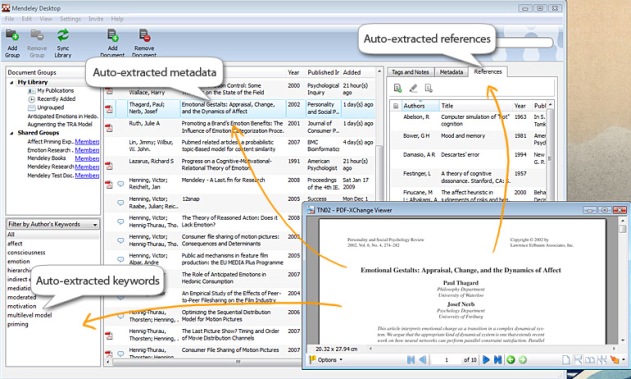
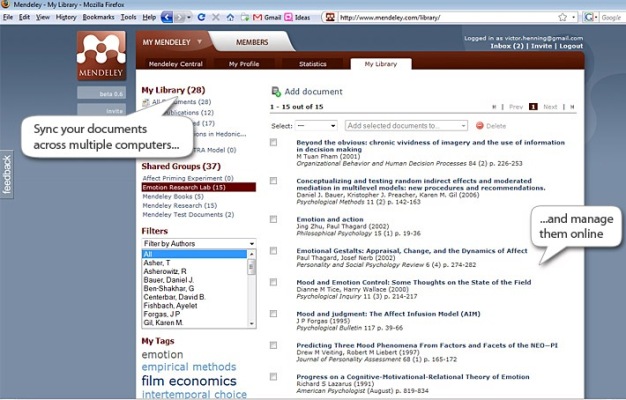
The desktop app is actually quite nice: after installation, you can import PDF files using the tool’s “Automatic Medata Extraction” or import your existing library from EndNote XML, BibTeX or RIS files. Mendeley also features a Word Plugin which lets you insert citations and create formatted bibliographies in documents using Microsoft Word 2003/2007. Academics can also upload their own research papers and syncing files and information with the web-based version with just one click of the mouse. Mendeley also boasts features that let members connect with their peers online, and – taking a page from Facebook – the tool also features a newsfeed that displays newly shared or uploaded documents etc.
Mendeley claims to have “scrobbled” data on almost 3 million research papers in just two months, so it’s likely to become one hell of a resource if growth continues and enough academics take notice.
Similar services include Labmeeting (which we likened to a “social network for scientists”), Academia.edu (which we likened to a “Geni for researchers”) and Questia.
If you know of any others, please share in comments.


Great potential and a great bunch of lads. All the best to them!
This is a really excellent idea, and the implementation seems to be very smooth.
I think it is a great service, but I’m not sure how it will make money. It would probably be better if someone like Harvard or MIT created something similar and kept on financing it as a nonprofit. Harvard and MIT would gain big time as they would essentially create a virtual online nexus of cutting edge research, and academics won’t have to worry about this company going bankrupt.
From India,
Anjali Sen
http://smartbab...xy.blogspot.com
That’s what Zotero effectively is.
this is great!
Another company that is related here is Biowizard. While it does not work within the context of a research paper for footnoting, there are a lot of Digg-like social features to help find the best and most relevant research. More importantly, it also includes proprietary data on research presented at conferences, which is usually 1-2 years ahead of when it gets formally published. As such, it is the only place to stay up to date on the most current happenings in biomedical research.
A non-software and download alternative is twidox. Focus is on documents rather than the social-networking and now has over 30.000 already.
(Disclaimer – CEO of twidox)
My favorite is scholarz.net which is also a German concept by the way.
For computer science, Eventseer (http://eventseer.net) provides an alternative take on social networking for researchers. We mine the web for existing relations between scientists and use the information to help users find upcoming conferences and events that are relevant for them, or even other researchers that they might be interested in following.
This kind of information is complementary to what you find on most other web sites for academics: It doesn’t tell you what has already happened, but it does let you know what is going to happen.
For the researcher, having tools that help you build a long-term publishing plan can be even more important than keeping track of what everybody else is doing.
(Disclaimer: I’m a co-founder of Eventseer)
CiteULike is similar; it’s a website that allows the building of collaborative bibliographies.
Thank you for the great write-up, Robin!
Amanda: We recently announced a collaboration between Mendeley and CiteULike – http://www.mend...ley-collaborate.
There are about one billion social networks for academics that have been set up in the last couple of years. Almost all of them are equally useless, since not many people have signed up for them and they don’t appear to do anything that would make an academic’s professional life any easier.
Social software that actually does something useful, e.g. reference management, looks much more promising. Of these, Mendeley looks like a strong contender, since it has the social features, but is also good for managing a local repository of pdfs (and most academics have 100s or 1000s of these). Unfortunately, the import feature was lousy the last time I looked at it, since it would not allow me to add a directory with loads of subdirectories full of pdfs all in one go. I have thousands of papers, so I’m not going to go through them one by one. This may have been fixed since I looked at it though.
Since we’re talking about Mendeley, it is also worth mentioning Papers, which attempts to be the iTunes of reference managers rather than the Last.fm. I’m using this at the moment, but it’s not without its problems, so I’m always looking for alternatives.
Other reference managers worthy of note are connotea (http://www.connotea.org/) and Zotero (http://www.zotero.org/).
Hi Matt,
yes, that’s been fixed. You can now import multiple PDFs, entire folders, or even continuously monitor folders and subfolders for new files which will then be added to your library automatically.
Best,
Victor
Thanks for the clear information. I was looking for a software to manage my pdf files in my disk. I was totally confused by the flood of webservices and social nets…I will download Mendeley;( I can’t use Papers in Windows)
I have 1000s of pdf files.
A related type of program is a research collaboration system. Laboratree (http://www.laboratree.org) is a system facilitates collaboration within and between organizations.
My personal favs are wePapers and Zotero.
Awesome app! Would be even more awesome if it enabled URL archiving + metadata (a la Reddit, Digg, etc.).
Check out ResearchGate.net, fast growing social network for scientists, strong especially life sciences.
I’m a humanities student, so tools with a heavy science focus are not often useful to me.
I also have many of the common problems shared by academics:
1. I have a number of PDFs that need to be managed, and linked to their metadata
2. I have to be able to easily insert metadata into work that I am writing,
3. I’d like to be able to grab citation information and PDFs from the web in only a few clicks.
None of the tools I have found really achieve all those, but Mendeley is the only one that plans to. Endnote, Zotero, and CiteULike are great for citation collection and management, but don’t really cut it when it comes to a large PDF library.
Papers is mac only.
Other features like social networking, sharing academic papers, archiving and annotating webpages are often useful, but are not really central to an academic.
Mendeley’s significance cannot be overstated, it is the only cross platform tool that intends to address all of an academics referencing and paper management problems.
Zotero does great academic document management in a Firefox plug in. They aren’t as savvy with the social networking but the integration into fire Fox makes it super easy to use. They recommend portable Firefox and file syncing to allow distributed access.
I could picture this being good for small groups to create knowledge repositories. Sort of like backpack but more optimized for research.
I think Mendeley is geared towards managing bibliographies, and less about organizing small research labs.
If you’re looking for a Basecamp/ Backpack for scientists, then Lab Engine (http://www.labenginehq.com) might be of interest to you. The first release just went out and we’re looking for beta testers!
Disclaimer: I’m the founder of Lab Engine.
We’re upstream from the research, helping researchers and their teams prepare and submit the federal research grant application to Grants.gov (for the federal dollars). Check out Cayuse and Subawards.com.
Definetely the best search engine for academics is to be found on http://www.researchgate.net. You can search more than 30.000.000 documents there, ten times as much as via Mendeley, and a semantic algorithm ensures that the results are exactly those you looked for. You can even upload a whole abstract to look for related papers. Furthermore ResearchGATE offers lots of cutting-edge tools to collaborate with co-researchers. Check it out!
if you are going to post a shameless plug at least preface it with : ’shameless plug’
What’s the business model here? How is Mendeley going to make money?
“Mendeley is free social software for managing and sharing research papers. ”
I´m a researcher myself. I can tell you from my experience that academic research is a pretty clandestine field. Nobody wants to share research results/research papers until the results of a study is finally published.
I see a big caveat here.
Hi Jessica,
we (the founders) are researchers too, so we appreciate your concern.
First, when using Mendeley, only you choose with whom you share information – sharing is not public by default (although you can elect to make your library public).
Second, Mendeley’s main purpose is managing research papers that have already been published, rather than managing your own work-in-progress.
Best wishes,
Victor
I have been tracking Mendeley for quite sometime, and I am not surprised at the speed with which they have come up. Congrats, guys!
Even before their major code rewrite, I was rooting for them, since they were the only cross-platform software which could auto-extract meta-data from PDFs. The shared libraries, the web-syncing of libraries, and other little goodies are just the icing on the cake.
Since then, they have gotten only better. I have been privileged to have been privy to some of their plans, and if they come through (which I am sure it will), Mendeley is going to be something that researchers can’t do without in the future!
You may be interested to have a look at WizFolio and compare the functionalities. WizFolio is skewed towards reference management and citations. It is completely web based using the latest Web 2.0 strategies. There are several time savers for researchers including locate PDFs, auto generation of bibliographic data after PDF upload, import references from clipboard and a powerful web clipper comparable to Evernote. http://www.wizfolio.com
Disclosure: I am a founder of WizFolio Web 2.0
Always nice to see more research tools being developed, but there is something very odd about that logo!!
There is also a (some what) similar site that allows strictly college students to share and compare documents on a web 2.0 platform.
http://www.isle...hroughclass.com
I hit upon mendeley couple of days back and found it extremely useful. Its really a very useful tool.
But I am having problems with the file import [I tried to import abt 350 PDFs, all text books organized in 15 folders ]. I tried uninstalling/installing couple of times, but the app hangs my IBM repeatedly!!
Problem occurs in startup when the app is trying to sync with web data server… and hang….
I am trying now to download a fresh copy but mendeley website is down!!
Victor. Advise please?? [I even increased physical memory to 1024]
Hi Mohammed,
thanks for the nice words and sorry to hear that you are having some problems with Mendeley. Could you please send an e-mail to support@mendeley.com with the error description and your e-mail address? We can then have a look at it and fix the problem.
Thank you
Jan
I’ve got a job interview with Mendeley and I’m rather excited as they seem like a good company to work for.
Wish me luck guys!