Have you nominated someone for a Crunchie today? »
Scout Labs Brand Tracker Now Generally Available
by Mark Hendrickson on February 18, 2009

The internet is full of all sorts of chatter. And some of that chatter might actually be about your brand. Wouldn’t you like to filter out the noise and hear what people are saying about it?

Enter Scout Labs, a SaaS dashboard that makes it easy to keep track of what people across the internet are saying about particular topics. The product, which we first reviewed in December 2007 while still in private beta, is now generally available.

CEO Jenny Zeszut says that most companies start off using Scout Labs – and similar products by competitors – to cover their asses, basically by discovering when bloggers and the Twitterati are complaining about their brands. But Zeszut says that over time companies tend to get more involved with the data that Scout Labs collects, reading through blog posts and studying the data to see just what can be learned from customers.

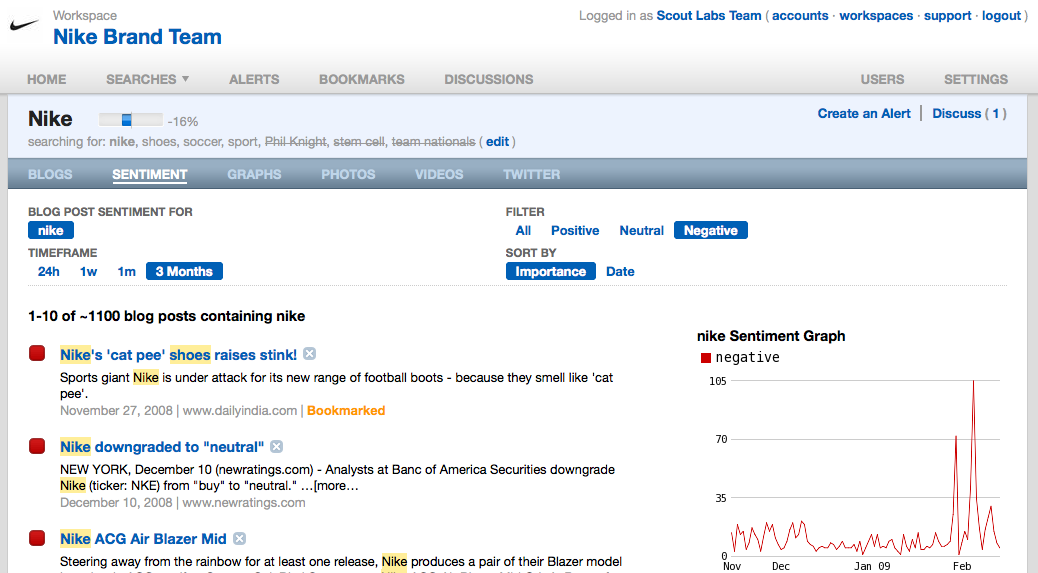
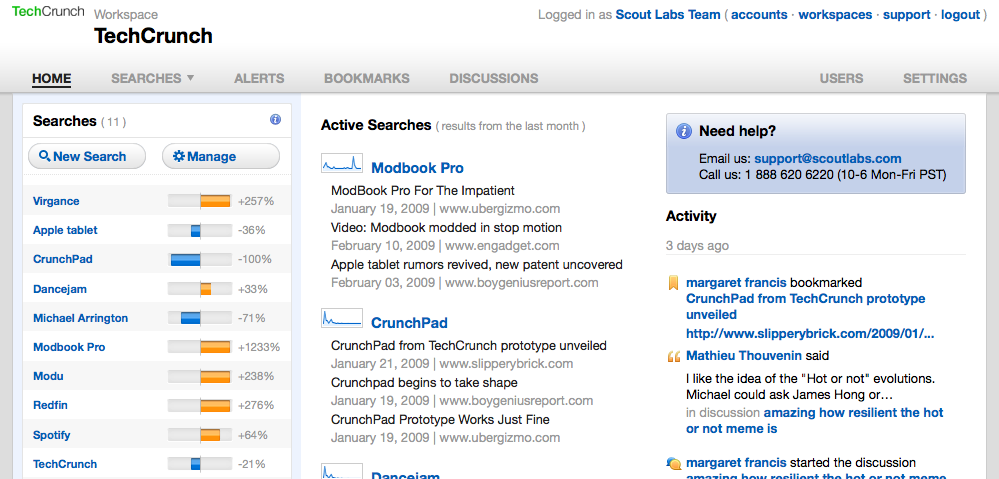
There are six main sections to the Scout Labs dashboard: Blogs, Sentiment, Graphs, Photos, Videos, and Twitter. The first displays all of the blog posts that have been indexed by Scout Labs related to a particular keyword or phrase. The Sentiment section breaks these blog posts down into positive, neutral and negative categories. Just which category Scout Labs puts a particular post into is determined by an algorithm, but you can always change a designation manually and this manual intervention actually improves the algorithm for going forward.

In the other sections, photos, videos and tweets related to your brand are collected for display as well. It’s understandable that Scout Labs doesn’t determine the sentiment for photos and videos, but it would be nice if you could filter tweets by those that are saying nice things about your brand and those that are saying not-so-nice things. Right now, it’s basically a replication of the functionality you’d get from Twitter’s own search engine.

The Scout Labs dashboard is designed for use by teams of brand managers. When you sign up for the service, you’re allowed to invite an unlimited number of colleagues into your workspace. But you’ll have to pony up more for every additional workspace you add. Each workspace costs $250 and lets you monitor 25 concurrent “searches” (aka keywords or phrases). As you buy more workspaces, the price of each incremental workspace does go down.

Zeszut says that 300 companies already use Scout Labs with 2,000 more on the waitlist. Starting today, all of those waiting (and more) will now have access to the entire dashboard.
Advertisement

Comments rss icon

  • Its pretty cool, but simplistic. A good friend of mine works as a Sales Director for Radian 6 (http://www.radian6.com) and they offer a much more powerful solution.

  • Looks cool and it’s free now..Gotta test it out for my blog.

    http://www.smartbloggerz.com

  • This is a very useful service and it can be very attractive for many companies. However, I am jus concerned about one thing. This is the time of economic recession and I wonder how many people will be interested about Brand Tracker.

    • Razib, you are right that the economic environment is causing all smart companies to rethink how they spend their money. We see a couple of shifts:
      1) A shift away from traditional advertising to more direct, tangible engagements with customers (as getting new ones gets harder)
      2) A desire to bring core capabilities in-house or to consolidate with a few number of strategic agency partners
      3) An increased interest in measuring the effects of campaigns and other marketing efforts.

      Scout Labs is a very inexpensive way for an entire organization (if you like) to tune in to the wants, needs and desires of customers out across the Internet and then do something about it.

  • Who said its free? After the 30 day trial, the cheapest plan is $99/month.

    If it was free then I would definitely use it, but I cant justify $99/month to monitor 5 key words. For now, I will stick to my RSS feeds (with blog search RSS results) and Google Alerts.

  • Hi all. If you need basic monitoring (someone said, “nike”) there are lots of free options and you should use them! But when the volume is high and you want help understanding what’s being said, things like real-time sentiment detection, the identification of new/emerging conversations, trending for buzz, sentiment and share of voice can be very helpful. For those companies, our price point in unbelievably low, actually.

    Listening and analyzing is important to companies of all sizes, and there is room for solutions at all price points and levels of analytical sophistication.

  • Wow, this service looks really cool(I think scoutlab will see this comment in their lab, right?). I’m looking for a tool to monitor the posts or tweets on Internet, maybe I’ll give it a try. It would be great if we can login with a test ID.

  • As former marketing guy for Techrigy, developers of SM2, a competitor, I can tell you that SM2 is pretty far ahead of these types of services, offering historical results, tracking and analyzing all sources in social media, doing sentiment with tone and emotive content analysis, full data export, extensive reporting, real time alerts, demographics including age, gender and mapping, workflow management and much more. They have a free version that is good for running tests and checking out the capabilities. It is by far the true ‘power tool’ among these services.

  • BTW, My name shouldn’t have’ Techrigy’ next to it- I do not work there nor am I paid to shill them. I just know the business pretty well. It autofilled and I didn’t notice…

  • Jennifer, the product looks solid. You’re right, this isn’t for most bloggers, but your product looks well suited for bigger brands that care very much about managing their brand and need powerful tools to do it.

    I look forward to trying it.

    Christian Anderson

  • Hi

    Nify Idea, Saas is ceratinly a tool that’s finding its footing

    I don’t think too many will find it as useful as it is novel.

    Certainly firms who can hire brand managers will rely on their agencies of record, as should, for managing their brand.

    The product suggests a hit and miss method of ascertaining brand relevance with its audience.

    You can field certain questions, heuristical equations to filter through posts, tweets, blogs, etc. Ok…, that’s nice.

    Without the context of the feed, you’re data is moot. Given the age of the info within the cloud, you’re asking quite a bit from users, for very little return. The equations would need to consider the age of the info, and if not noted, relevant and pertinent brand information involving larger firms rarely survives for any signification period of time without being surrounded by PR people blessing it with postive energy.

    White blood cells do the same thing.

    For smaller firms, forget it. Who has time to find, track, organize and implement containment strategies for negative feedback – if you’re a small to medium-size firm.

    To be usefull the assumption is that a brand has a heavy following providing tactical support as negative feedback surfaces.

    I’m certain users are being paid to do this, somewhere – but the assumption is dangerous.

    Nify toy, but it’s missing the batteries.

  • Hi all,
    We’ve been using Scout’s Beta for some time now and have found it incredibly useful in the last few months where our business has gone through some remarkable changes. As many of you have noted, there are other free alternatives out there that do similar things, but having the consolidated dashboard for a small company like ours has been extremely valuable. The team is incredibly responsive and fast and I expect a bunch of improvements soon off a product that is already fantastic at what it does.

    Great job and congrats to the ScoutLabs team.

  • You could use StepRep by MyFrontSteps for free :-)
    Significantly more cost effective…

  • This is cool news! Ive been beta testing scout for a bit now and ive been impressed with the results i’ve gotten so far. Ive been using it mostly to look up info and news on companies. The trackers have brought back a lot more useful info vs. the results google searches or standard rss feeds have given me. Some of the sentiment features are interesting but its the quality of the search results are really what ive liked. The twitter search functionality is a nice touch too.

  • This tool does look very attractive for any small, medium and even enterprise business out there. As a person who constantly watches out and defends our brand, I want to suggest for others out there to leverage and fully exhaust the free tools out there before moving onward to a commercial application.

    When any company commercializes their brand management and loses touch of the human connection that customers, prospects and “suspects” desire.

    Again, I’m not knocking the tool, but it’s just that a tool in an an array of tools out there. Always be aware of what your customers and prospects think of you. It would be prudent to blend 80% of your efforts into automated solutions and incorporate 20% of grassroots connecting with customers for their feedback.

    Ideally, companies ought to know their customer sentiment and always strive for customer satisfaction. :)

    –Joseph

    • Joseph, I’m so glad you raised this issue! TECHNOLOGY CAN NEVER REPLACE HUMANS, and shouldn’t. We let technology do what it does best, and the people do what they do best. Technology takes a stab at sentiment (and gets it right a lot of the time) but your team can override or change those values. Your team can add comments. Your team can be inspired by what customers are saying and make recommendations about new marketing campaigns or new product ideas.

      So insight still requires people. We just think it should be YOUR people (your own employees and existing brand agents) with the help of our software, not Scout Labs people :-)

  • Wow. What a cool tool. From an SEO perspective, we are always looking for ways to track brand name mentions etc.

    It was always hard to find a way to do that effectively. This tool seems to make it easy!

  • Hey guys. Congrats on the launch.

    I agree regarding sentiment.

    It’s best to approach the sentiment problem by using tons of content. This way you can get a general sends of direction by using lots of signal.

    Most of the sentiment companies out there are following this model.

    Onward!

Leave Comment

Commenting Options

Enter your personal information to the left, or sign in with your Facebook account by clicking the button below.

Alternatively, you can create an avatar that will appear whenever you leave a comment on a Gravatar-enabled blog.

Trackback URL
bugbugbugbug
Techcrunch on Facebook