Indeed’s New Industry Trends Point To Where The Jobs Are
by Erick Schonfeld on February 17, 2009

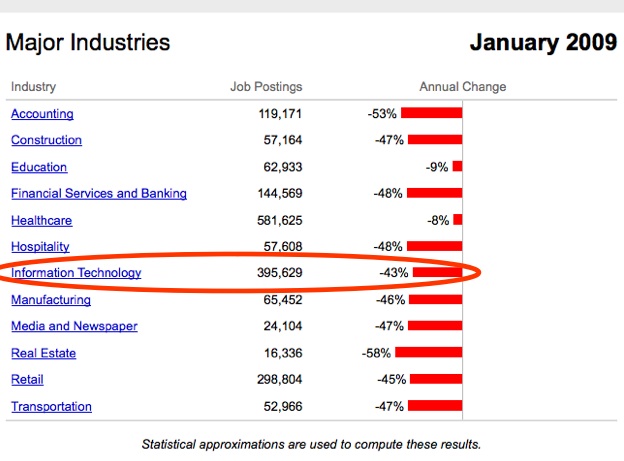
Tech layoffs may have hit 300,000 since the financial crisis began, but there are at least 395,629 job openings in information technology, enough to re-employ all of those now out of work. Job search engine Indeed this morning launched a new Industry Trends page filled with stats on job openings in the U.S. across major industries. Although there are more job openings in IT than in any other industry except healthcare (which has 581,625 job listings).
Even so, IT job listings are down 43 percent from a year ago. Again, healthcare is holding up the best with only an 8 percent decline. Job postings in banking and financial services are down 48 percent (to 144,569), and media and newspaper job listings are down 47 percent (with only 24,104 postings).

Indeed CEO Paul Forster explains why he is making these stats available (besides hoping to spur more job searches):

For people working in rapidly declining industries, it will help them identify industries in better shape to which they can try to transition.

Our data are an alternative to government payroll statistics, offering a more forward-looking insight into hiring activity. If government data show the job market in the rear-view mirror – jobs that have been created or lost – Indeed’s Industry Trends provide a view through the front windscreen: job openings that companies intend to fill.

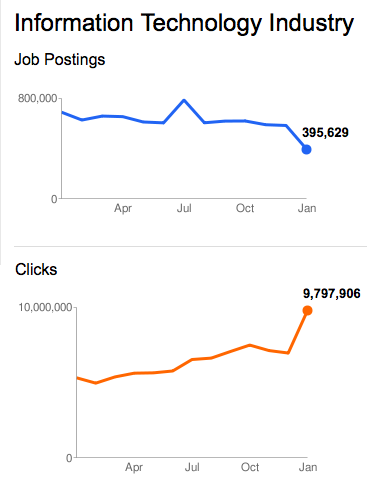
You can click on any industry to get more detail. For instance, in the IT industry, while job postings have decreased 43 percent, clicks on job postings have increased 84 percent to 9.8 million. The most clicks are coming from New York City (San Francisco is No. 7 in terms of clicks). Some of the most sought after jobs, as measured by the top keyword searches are project manager, business analyst, engineer, and graphic design.

Advertisement

Comments rss icon

  • Wouldn’t it be nice if job sites have the ability to allow users to specify granular level and infinite number of filters to refine their searches to find exactly what they are looking for?

    Like for instance, a user wants to find a Software Developer job in Banking industry where the job requires certifications in ABC and XYZ, programming skills proficiency such as C#, PHP, Java, knowledge in Linux OS, and so on and so forth up to an UNLIMITED number of criteria.

    That’s what we aim to do and more. Drop by our website to see what I mean if you are interested.

  • It would be interesting to see Interactive Media broken out from the IT and Media numbers. My impression is that Interactive Media has been picking up a lot of the slack for a while.

    Healthcare is of course large and holding up, but has to dip at some point as some run out of money or insurance policies don’t get renewed.

  • It’s very simple. The average pay for 300,000 layoff tech workers was $63,880. The average pay for 359,629 is probably $40,000 (US per capita income). If they lower their wages, they will get a job. The pay scale in US is too high compared to India and China. Equalization of wages will occur.

    • I agree with you there. There is a vast disparity between outsourcing costs and domestic wages. This equalization you speak of will only occur because wages in India will increase as US corporations cut staff and outsource a greater number of projects. US wages will see minimal declines and remain high for executive-level tech jobs.

    • This is not a good comparison. Education and living costs in India are much less than in the US. Imagine having to pay anywhere from $20-100k+ in loans after 4 years of graduating from a private school in CS (such as CMU or USC). Do you still expect them to survive on $40,000 after that?

    • Stupid people claim that outsourcing technology work is cheap and saves the company money.
      The pitfalls are numerous: Angry dissatisfied customers, lots of rework on work that needed to be completed by the overseas talent, communication issues (language), timezone differences, intellectual property theft from employees stealing all your ideas and going into business for themselves, cultural differences, etc. It’s a HUGE minefield that ends up being more expensive in goodwill and money than your original “expensive” employees.
      The reality is these outsourcing companies compete on cost not quality so when these morons run your business into the ground with their shoddy work did you really save any money?

  • complete BS – as is the 300,000 figure

  • I thought it might be interesting to examine trends and salaries of open source vs. closed source skills. The results are interesting: http://tinyurl.com/bajkjt

  • I guess its companies less the fat

  • Here is a thought to consider:

    How is the number of open jobs computed? Is it a metric that is based on the internet job postings? If so, how does it remove duplicate listings?

    There are likely more duplicate listings in I.T. job sites than in healthcare (note, I say “likely” only).

    Why are there duplicates? Because of scraper sites and job sites that are simply copying the Monster and Dice ads, in effort to display something that resembles a critical mass of data. I know this because the ads we post on Monster or Dice simply show up on other job sites without our permission.

    Anyhow, if the numbers are based on internet job sites, you have to wonder how accurate they are and if possibly they skew more toward an industry that uses online ads more than another.

    • You bring up a good point, Chris, but I think that Indeed takes care of this. They seem to be able identify duplicate jobs. I just did a search (http://www.inde...pringfield%2Cma) and they only show 1 result but they let me know that there were similar job postings that they had removed. One of these was another posting for the same job in a different city and the others were duplicates like you mentioned.

      If they can do that during a search, they can probably do the same for their metrics.

  • HMMMM, I hear what you’re saying. It is tough out there. Given the economic data, hiring the best fit for the job is more critical than ever. I am tired of old fashioned job sites. If you feel the same way, check out this cool recruiting tool called OneWire.com. This is the first site I’ve seen besides Match.com that uses proprietary matching technology to directly and confidentially connect finance professionals with financial firms.

    • Hey AB. Thanks for the lead. I created my profile today and I was very impressed by the site. I’ve been to a lot of places like glocap’s site – which didn’t do anything for me – linkedin which, well, I’m still unemployed.

      Thanks, take care.

  • OMG, Techcrunch has finally won.

    http://www.cnn....witter.surgery/

    Doctors are Twittering during surgery.

    I wonder who the first “Android inside” patient will be?

    Just like the Junior Mint fell into that guy getting surgery in that Seinfeld episode.

  • There has to be a change in mind set among job seekers in the technology field. We need to have a new breed of entrepreneurs like Bill Gates and Steve Jobs who would set up companies that would hire thousands of workers in the technology field. I think that it has not happened that much in the last 8 years (since the year 2000). Most people now dream of working for Microsoft or Google and get 50K+ salary per year. There is nothing wrong in having the dream. The only problem is that we have run out of people who can set up Google and Microsoft in 2009.

  • It is obvious that recession will make even job provider more traffic however yet I understand a reason what makes IT can hold position to welcome this people.yea they are talented but since not all of them is IT educated how could this facts help them get a new jobs should they learn the new stuff ,or wont it too late,and why rather then thinking do what boss say why they not think that it is time to be entrepreneur or is it that hard be leader to save from the recession?

  • This is rubbish because there are so many duplicates in the job sites. Why? Because so many recruitment agencies launched over the last few years to cash in on the good times. Now they are desperate. That’s why there are so many duplicates. There never used to be.

  • Now if you take away all the job postings for those poor companies that, unfortunately, cannot find any good software developers in US and have to lobby for more and more H1B visas while creating absurd requirements for job postings, the figure will probably deflate to about 20 – 30%.

  • The IT numbers are deceptive, I think, because many of those laid on in the financial sector are also IT workers (just for example). Pharmas have also laid off many IT workers, which in the above, are shown instead as Pharma workers.

    While there *are* still IT jobs available, the pay is low as comparied to the difficulty, skill, knowledge and training required to do those jobs.

    A person might be willing to accept $50k, or under, for less aggravating and tedious work, or if living in a lower-cost economy such as India. However, living here (esp. in the NE or west coast) is very expensive. Commutes are necessary, much training and education on ongoing learning is necessary, and wages are scarcely enough to make it worthwhile anymore.

    So for that money, people might as well (and will and do) just leave the profession.

    IT has been screwed since the .dotcom bust, in my opinion. I feel for the auto workers and all that, but IT workers have been screwed and screwed worse than anyone.

  • PGP is right. These numbers can be misleading if you confuse “industry” for “job type.” This isn’t saying that there are 395,629 jobs for IT workers — it’s saying that there are 395,629 jobs in the IT industry. Big difference. IT workers work in all those industries.

  • “Like for instance, a user wants to find a Software Developer job in Banking industry where the job requires certifications in ABC and XYZ, programming skills proficiency such as C#, PHP, Java, knowledge in Linux OS, and so on and so forth up to an UNLIMITED number of criteria.”

    That’s where we are, of course. Tech fields are so glutted with immigrants due to the business lobby/Congress complex that it is meaningless to say employers are looking for IT people, or programmers. They are looking for people with “programming skills proficiency such as C#, PHP, Java, knowledge in Linux OS, and so on and so forth up to an UNLIMITED number of criteria.”

    Healthcare is a good field because if you get sick they got you by the nuts. Mortician and embalming is steady work, but apparently somewhat glutted according to a co-worker who has the education, but can’t find a job in his field.

  • “Like for instance, a user wants to find a Software Developer… C#, PHP, Java, knowledge in Linux OS…”

    Just thought I would point out, this is what the “What” box if for on Indeed. You can add endless criteria to narrow a search, or use the more simplified advanced search option. Interesting comment from “Friz”, from Valnur. That “engine” doesn’t seem to have anything in it’s index.

    • If you read our “About” page, we are a bottom-up engine ala Wikipedia. :)

      • Correction. An engine is rather misleading. We are more of a repository, a universal one.

        Regarding your comment about Indeed’s “What” box, the disadvantage of that approach is that sometimes users do not know what to search for.

        Valnur, on the hand, allows structured filters and in some way guides the users as they refine their search.

        Here’s a link to an example ‘filteration’:

        http://tinyurl.com/d8zr46

  • Counties, states and federal government post jobs, but when you go to actually apply, they are for a standing register. They are taking resumes now in case any jobs open up later.

  • What kind of fool considers “clicks” to be a valuable metric?

    I’m no analytics expert but that’s just stoopid!

  • Here in the UK, employers looking to recruit have few places to advertise and often become slaves to expensive recruitment consultants.

    Where do you think we should post?? (In addition to the UK TechCruch job board, of course)

    Looking for entrepreneurial programmers to work on seriously brilliant SaaS stuff http://rurl.org/18g2

  • SUPER interesting article. We hear all the time that IT and HEALTHCARE are the two ‘bullet-proof’ jobs. That being said, unfortunately most people are taking pay cuts or working part time in almost all fields now, whether it’s a true company-in-trouble downsize or a fake one where the company decides to USE the recession to shed workers just because they can. Make sure you have plan B in place. Check out http://www.iget2work.com for professions lists, humor and stories about finding all kinds of work. Work takes up 80% of our lives … so make it good! GOOD LUCK EVERYONE!

Leave Comment

Commenting Options

Enter your personal information to the left, or sign in with your Facebook account by clicking the button below.

Alternatively, you can create an avatar that will appear whenever you leave a comment on a Gravatar-enabled blog.

Trackback URL
bugbugbugbug
Techcrunch on Facebook