
What if you could peer into the thoughts of millions of people as they were thinking those thoughts or shortly thereafter? And what if all of these thoughts were immediately available in a database that could be mined easily to tell you what people both individually and in aggregate are thinking right now about any imaginable subject or event? Well, then you’d have a different kind of search engine altogether. A real-time search engine. A what’s-happening-right-now search engine.
In fact, the crude beginnings of this “now” search engine already exists. It is called Twitter, and it is a big reason why new investors poured another $35 million into the two-year-old startup on Friday. Twitter is not the only company trying to solve this problem. Facebook, FriendFeed, and even Google are trying to crack it, but Twitter has a decided advantage in that it is capturing the vast majority of the real-time thought stream on the Web (because more people enter their thoughts directly into Twitter’s database than any other, and are doing so at an increasing rate).
What makes Google and other search engines so valuable is that they capture people’s intent—what they are looking for, what they desire, what they want to learn about. But they don’t do a great job at capturing what people are doing or what they are thinking about. For thoughts and events that are happening right now, searching Twitter increasingly brings up better results than searching Google.
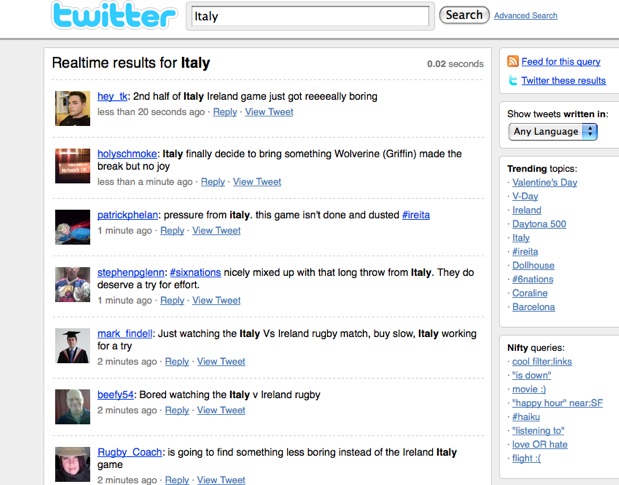
Whether you want to know how people are mentally gearing up for this week’s Mobile World Congress in Barcelona or what they are thinking about today’s Ireland vs. Italy rugby match, searching Twitter will give you a pretty good smattering of sentiment and opinion. It is also a lot faster at getting out the essential details about breaking news, such as the Mumbai attacks or the plane that landed on the Hudson.
Twitter’s search engine is powered by Summize, a startup it acquired last July. But it also developed a feature called Track, currently disabled but coming back soon, that allowed people to follow the mention of specified keywords. John Borthwick, an investor in Summize (and thus now an investor in Twitter), explained in a blog post earlier this month ago why he thinks that “Twitter search changes everything.” Excerpt:
Imagine you are in line waiting for coffee and you hear people chattering about a plane landing on the Hudson. You go back to your desk and search Google for plane on the Hudson — today — weeks after the event, Google is replete with results — but the DAY of the incident there was nothing on the topic to be found on Google. Yet at http://search.twitter.com the conversations are right there in front of you. The same holds for any topical issues — lipstick on pig? — for real time questions, real time branding analysis, tracking a new product launch — on pretty much any subject if you want to know whats happening now, search.twitter.com will come up with a superior result set.
. . . How is real time search different? History isn’t that relevant — relevancy is driven mostly by time. . . . This reformulation of search as navigation is, I think, a step into a very new and different future. Google.com has suddenly become the source for pages — not conversations, not the real time web. What comes next? I think context is the next hurdle. Social context and page based context. . . . Twitter search today is crude — but so was Google.com once upon a not so long time ago.
Twitter may just be a collection of inane thoughts, but in aggregate that is a valuable thing. In aggregate, what you get is a direct view into consumer sentiment, political sentiment, any kind of sentiment. For companies trying to figure out what people are thinking about their brands, searching Twitter is a good place to start. To get a sense of what I’m talking about, try searching for “iPhone,” “Zune,” or “Volvo wagon”.
Why can’t Google simply index Twitter? It does, but its search results give more weight to links than to time. It could create a new search product along the lines of Blog Search or News search that is geared more towards Micro-messaging services such as Twitter, FriendFeed, and the rest. But what it really needs to go beyond simply indexing Twitter after the fact. IVP partner, and Twitter investor, Todd Chaffee, suggests:
If they were really smart they could partner with Twitter and make Twitter their real-time feed.
Doing that would require Google to “affirm Twitter’s dominance in this category and the importance of the Twitter data stream,” contends Borthwick. But so far, Google has pretty much flubbed this opportunity to open up real-time search. It bought Twitter competitor Jaiku, only to shut it down. And now it is hoping to create a counterweight to Twitter’s growing strength in real-time data by open-sourcing Jaiku. Good luck with that one.
Listening to Twitter’s investors gives a good sense of how they think Twitter can become a game-changer in real-time search. While it is instructive, it is also important to note that much of this vision has yet to materialize. Twitter’s current search is extremely crude, as Borthwick readily admits. It simply brings up the most recent Tweets with the keyword you are looking for. There is no ranking or clustering beyond that.
An undifferentiated thought stream of the masses at some point becomes unwieldy. In order to truly mine that data, Twitter needs to figure out how to extract the common sentiments from the noise (something which Summize was originally designed to do, by the way, but it was putting the cart before the horse—you need to be able to do simple searches before you start looking for patterns). But what is the best way to rank real-time search results—by number of followers, retweets, some other variable? It is not exactly clear. But if Twitter doesn’t solve this problem, someone else will and they will make a lot of money if they do it right.
(Photo by Patrick Boury).


Mining the thoughtstream is cool, but making money off of it is the challenge. If twitter can figure it out, that would make it into a great business.
I have plenty of thoughts in my head, but most of it can’t be monetised.
Anjali Sen
Right… You can see things like micro blog that summarize the trends of twitter public view
(e.g twitter-1.blogspot.com)
However, to monitize it will be a different story.
Apparently, market research firms are paying lots of money for such thoughts.
Finally, an article on TechCrunch about… TWITTER!!!! Yes – finally!!
+1
+1
Seriously, we get it. Twitter is cool. And it’s ‘now’. Anything else happening the world?
Yes, I too was wondering why TC never covers this company …
Anjali
me too.. i understand that twitter is growing fast, etc.. but really it seems to me that TECHCRUNCH became an advertising blog for companies they have invested in.. I mean is there nothing else happening in the web world?
If nothing is happening –> then its really sad.. crisis..etc
Otherwise TECHCRUNCH is really really biaised…
In today’s age you have to ask one question.
Not :”is this useful”
You have to ask “is this useful enough”
(what would you do without __SERVICE__)
99% of new web startups pass the first question and fail the 2nd.
Twitter totally fails #2, but has the suits to sell it off and popularize it anyway. Twitter’s climb is brute force silicon valley.
Good job Techcrunch. You guys always cover start ups that cannot afford big time PR and press coverage, or are not silicon valley insiders.
This is why your blog rocks. Posts about fresh faced underdogs with relatively little funding and solid business models, like Twitter, Facebook and Friendfeed helps keep things new and interesting.
Next up, a post by shoney on watching paint dry, and how to follow all the action live on twitter!
lol
I made this video explaining my Twitter passion to our users on VloggerHeads. It’s long, but, hey, Twitter’s a lot more complicated than people think. http://www.vlog...35:Video:710773
I agree with Anjali Sen.
Some sort of analytics could be performed on the twitter data for any given product.
Like a Google analytics for websites except for peoples thoughts on a product or issue pulled from Twitter data with a time line.
EXCEPT
Google would do it on the scale of the internet, not on the scale of the Twitter website.
Because that’s what Google does. Google is a Universe company, not a microcosm company.
Interesting none the less. If an analytics tool was made for Twitter based on item opinions, restaurant thoughts, ect… It would be free, and subject to CPM, and worthless.
Would I pay a 80-120k a year valley developer to crunch this up??
No F’ing way. If I can’t license it for bucks, it’s mud. Take that Eric Schonfeld’s opinion.
Another reason why google doesn’t do that, and gives theirs away to open source…. common sense. Twitter into the pool of wasted vc money.
A few things Google could do:
1. Add a “what are you doing?” sidebar in their search page, search results page, igoogle home page, and on their mobile browser page(s). Yes, it’s a direct knock-off of twitter. So what? It would expose the idea of ‘real time thought logging – thlogging?’ – to tens of millions of people overnight. This would start capturing this information immediately.
2. Give people diary views of everything they’d thlogged (yeah, crappy word!). Part of the value in this information is simply what it does for me. Just like I can search my previous search history, being able to search and review my ‘thought diary’ – from anywhere I can get to google – would be a valuable service.
3. Introduce the idea of ‘following’ and ‘tracking’, but not from day one.
Rather than trying to compete head on with twitter/friendfeed/etc, Google has a chance to reshape the concept in to something which really is more ‘microblogging’ first, attract a larger audience of users who get hooked on the direct utility for themselves, then later add the social aspects which twitter and others have. Only a handful of other companies – likely MS and Yahoo – have large enough audiences to make an approach like this viable.
This comment would have been more interesting on twitter, or maybe a service that was limited to 2 or 3 characters. Zzzzz………
The problem you have isn’t monetizing the search, but creating a good enough filter for the noise. Real-time search is a big-time future market, but imagine if Google simply randomly listed their search results.
Just because you are getting a real-time feed of people’s thoughts on a keyword doesn’t mean you want to see every single one of those. Twitter is filled with data, but how much valuable information?
Adding http://twittersphere.com to the potential “now” dashboards.
Agree with commenter #1
“Twitter may just be a collection of inane thoughts, but in aggregate that is a valuable thing.”
Wondering how valid this will be once millions start using it. Will the noise outweigh the signal?
Anyway, a thought-provoking piece …
exactly. twitter is a bomb waiting to explode.
search for the next ‘big thing’ tc.
Great overview of google being a search of intent vs. twitter being a real time search of feelings.
Am not sure why google should even do anything about it. It works fine just as it is. But, one idea could be to make optional threaded views of any google search term from twitter search. Sort of like its done over at Friendfeed.
“Twitter may just be a collection of inane thoughts, but in aggregate that is a valuable thing” Maybe, but the result would be nothing but an aggregate of inane thoughts…
As it is, just quantity [of thoughts] does not mean anything, really. It is *quality* that counts, depth of thinking.
The instant knowledge of “news,” from anywhere, is of very limited, fleeting value in our personal lives, because in a few seconds/minutes we would get hit again, and again, and again — Yes, it is very addictive… but then what?
Not sure if you’ve used the google lately, but their search results are extremely timely.
Example: New York Times has an article on their front page marked as published 26 minutes ago entitled “Venezuelans Voting”.
Googling right now for “Venezualans Voting” provides the NY times article as the first and second search result (first being the “news” search result, second being the reguler google search result).
Twitter is only interesting to Twitterers (aka scatterbrains).
thanks for a the reality check. i as well see no shortage in timely information.
you can get more valuable timely thought provoking comment feed back from a search on BackType.com
http://www.back...omments?q=italy
MineLocator.com – pan yourself
I think you might be missing the point. Sure Google is fast at indexing articles published on the web, but those same articles are often hours or even days later than the event.
Whereas Twitter can and often does give you up to the minute coverage of events as they are happening. You can’t usually get that from any other source. Google may have indexed that NYT article very quickly and even ranked it highly, but how long did it take NYT to write and publish the article?
Twitter coverage may not be as accurate or as good as NYT coverage, but it’s “now” coverage rather than “later” coverage. And sometimes, for a breaking story, that is better than waiting for it to show up on News sites.
You guys are missing the point. The aggregation would not list thoughts as search results, it would count the instances of opinions and mentions and display them as graphs.
The people using the tool do not care what individual people think.
Still, there would be no monetization of this application. This would be something Yahoo or Google could ad as an extra. Not a stand alone concept for investment.
what was their “intent” when mentioning this X, Y, Z ?
What X is mentioned when Z is mentioned ?
The tool would answer statistical questions such as these, not be a search engine.
Google PWN3D you Schonfeld they built one at least 2 years ago.
http://code.goo...tentFilter.html
I think it’s crazy how everyone talks condescendingly about how Twitter isn’t making any money yet…how will they make any money…what’s their revenue model. Jeez.
When you have a service that so many people are passionate about and is growing so rapidly, monetization will happen.
Here’s how they are going to monetize their site. Ready? Wait for it….wait for it…
Advertising.
Thank you. Have a good day.
Why has Micheal Arrington been running Techcrunch out of his own house for 3 years when he has over 150k in advertising per month on the right side of this blog?
Micheal doesn’t pay Akamai fees.
HTTP/1.x 200 OK
Server: nginx/0.6.32
Content-Type: text/html; charset=UTF-8
X-Powered-By: PHP/5.2.6-1+lenny2
X-Pingback: http://www.tech....com/xmlrpc.php
Last-Modified: Sun, 15 Feb 2009 19:10:26 GMT
Content-Encoding: gzip
Vary: Accept-Encoding
Content-Length: 18940
Date: Sun, 15 Feb 2009 19:12:02 GMT
X-Varnish: 1139253817
Age: 0
Via: 1.1 varnish
Connection: keep-alive
He has a bunch of cheap rsynched Linux/PHP powered servers sitting behind a reverse proxy(Varnish).
The amount of money it costs to run a business in California is often times several times more than the CPM. Even for a huge service like Twitter. All the twitter stuff served via the API is untouchable.
They won’t be able to break even for a long time. Unless they do as Schonfeld suggests, and integrate some pay statistic data for corporate access behind a user/password control panel.
They *could* monetize, but they would have to venture in the land of Microsoft style evilness.
There is one key element missing in Twitter’s thought stream : the edition of the stream.
Twitter produces written thought at high speed, but this speed itself demonstrates the lack of organisation thought. It is still ok when you are dealing with a hot news, no more when its about building a meaningfull chain of content.
To really build something, a rough stream of thought would need the same as the Web itself: human edition.
Just because one is capable of collecting an endless amount of information, the quantity of all these tidbits combined does not necessarily lead to some inane form of usefulness. Structure is the key and also the ability to access relevant stuff on the fly.
Have not thought of Twitter quite like that. Good post and true about what is here and now!
“… more people enter their thoughts directly into Twitter’s database than any other, and are doing so at an increasing rate”
Really? Where are the stats to back that up?
Even though Flickr is more popular in the bubble world that is the blogosphere, Facebook trounces it.
I bet Twitter is exactly the same as Flickr, and is getting trounced. Facebook may not have the same update frequency per user, but they could easily make that up by sheer volume of users.
Oh another twitter post.
Twitter is completely useless.
it’s full of self-serving blah blah’s who have no friends or who think themselves to be some kind of freak geniuses challenged by 140 word sollouquies.
Geta a life people.
twitter = useless
twitter user = a waste of time
twitter follower = needs a hob= tc
frequent twitter poster = hopeless
Another hour, another post about Twitter. *sigh*
Sorry, but calling the brainfarts on Twitter a thoughtstream is nonsense. And I’m being polite when I say that. The real monetary value in Twitter is in the metadata of the user of the service. Then there is a social value in the sense that it enables everybody to become a broadcaster.
Twitter doesn’t always tell you what somebody is thinking, anymore than it answers it’s old non-answered question of “What are you doing right now?” More often than not, Twitterers tell you what they are *hearing and reading and linking*, which means what *other people told them to think*, people like Mike Arrington or Robert Scoble. So it is a gigantic amplifying echo chamber for the Twitterati, and the only solution to get it to break out of that totalitarian elite is for it to go on being basically free to all commentators and followers, with very little censorship, i.e. only removal of obvious advertising spam or automatic generated texts, and only “incitement of imminent violent action” as a very legal First Amendment Supreme Court ruling definition to replace the arbitrary removal of “trolls” which plagues most other social media run by geeks.
For the intentional posts and intentional search engine really to flow and fly, however, Track not only has to come back, “block Track” cannot be allowed — or if allowed, services have to spring up to undo its worst abuses. This is the essence of the war I had with Steve Gillmor of the aptly named News Gang last summer.
He wants to block Track, so that when he goes into his vanity feeds on Twitter search services to see what other people are saying either in response to him, or about him, he can eliminate critics of himself like me. (Track enables you to pick up in real time various keywords; you can also view them on a search engine later.) He feels that it is his “right” as a free netizen to be able to use “killfiles” that remove “idiots” — he’s an aggregator of news, and wants a “more pure” newstream in which he never has to look at the backchat from people following him and commenting on what he says.
But zoom out and see the consequences of that once you have a system where the top content-generators follow that awful practice, not just the rank and file members. If some sort of rough aggregate of Silicon Valley power Twitterers think Steve Gillmor is the ultimate arbiter of taste, news, information, and views, they won’t mind if he block-tracks people like me critical of technology policy — or even his fellow geeks he gets tired of like Scoble. They won’t care if their news is filtered out to contain only what they want to hear, when they want to hear it.
Yet if this becomes a tool of governance at the real-life national level, as these same geeks want it to do in trying to influence Obama’s technology and social media policies, then in defiance of elected officials and institutions with checks and balances and accountability, suddenly the President of the United States of America can only hear what News Gang sees fit to purvey, as it is a news stream created out of block-tracks, i.e. only tracking the things said back to it from people it wants to hear from. The Aggregator of Aggregators is then enabled by scores of block-track decisions to simply blot out anything he doesn’t like or don’t want to hear from. (Of course, the POTUS already does that on the Blackberry they didn’t take away from him.)
However good that sounds to tekkies who don’t like people who think differently than them, it’s a terrible idea in politics, where you have to hear a lot of different constituencies and try to find compromises among them.
Let’s say I live next to the Hudson River (I do). And News Gang has track-blocked me because it didn’t like what I said about, oh, Lessig or something.
I can’t help thinking that the makers of Twitter withdrew Track because they saw its awesome powers, and couldn’t make up their minds about Track Block (they did not take Gilmore’s sides in the huge fights that broke out about this also on the Get Satisfaction pages). Maybe they will ultimately put Track Block into the hands of “Thought Leaders” and news aggregators like News Gang, and we will all be the poorer as a result. There’s a theory that the Internet flows always go around blockages and find other outlets on other sites and blogs. Except when they don’t, because somebody is blocked on Twitter or doesn’t have followers because of the monkey behaviour of follower-collecting.
Real-time search indexing in a way can already be seen on Yahoo Answers. So you see that what is on the minds of the People are things like Spongebob and their cat’s barfing. These streams are great, but they do need editors. The problem with the Twitterati is that they are the unaccountable, unpaid, non-transparent editors of Twitter and we cannot vote them out of office because they use “block follower” — and will use block-track — to silence us.
I think twitter is just a small part of the realtime web. Just think of all the emails, chats, IMs, activity streams, comments, blogs, SMS text messages etc. and you get the picture. None of this is indexed and there is no good algorithm to rank it. There is room for another google in ths wide open field.
I wrote an expanded post on my blog.
Twitter will never make back the money that all the investors invested into it.
The whole web 2.0 business is to sell unprofitable businesses to larger businesses.
I think the investors will get their money back because they can sell the brand to other investors, and so on and so forth until they IPO or get Google to buy it. Facebook already put in a bid that was denied.
I just don’t think they can be in the black with pure revenue. I don’t think a single web 2.0 company has ever had advertising revenue as a real strategy. The strategy has always been the exit strategy.
This bad economy has been like a nun snapping a ruler on the fingers of these VCs.
Then we have bankruptcy laws. Look at Midway and XM/Sirius.
I don’t think Twitter will lose the upsell game like lesser offerings. Maybe next year when things get better.
Look at what happened to Identi.ca. Think of that the next time you want to clone functionality. The original has a hard time with rev streams, imagine the hard time you’re going to have.
http://siteanal...i.ca/?metric=uv
TechCrunch is very lame with these posts. They do whatever they want. Isn’t that when brands continue to fail? They fail when they hear their own voice rather that of their costumers?
Twitter-type search results in real-time will be especially powerful when advertisers can respond quickly to shifts in sentiment with targeted narrow focused advertising.
It’s hard enough for the Nytimes.com to monetise their website, and that is almost real time news with incredible amount of quality control and filtering.
Unless twitter comes up with something completely revolutionary, I don’t see how getting results on a bunch of tweens twittering inane comments about whether Jessica Simpsons look fat or not is going to result in a powerful advertising model.
And no, I do not want to see any more “Flat stomach one rule obey” ads on twitter either.
Anjali Sen
What we hope to see from twitter is not news articles or editorials from one or very few set of people (like we get from nytimes.com) – what we expect from twitter is common man thought trend. Those two are effectively different.
And just from your example, what people are thinking about Jessica Simpson’s may not make it to nytimes.com – it may be searchable on twitter and there would be some folks interested in it.
I beleive a greater challenge would be to build a powerful search capability and ability to mine the data and provide effective search results. They will have to sort this out way before they can think of riping results in the way of money from advertisers.
Punit Sethi
Maybe Twitter should make a play for social search.
Instead of using google, people could use a twitter search engine which would supply standard results, with those that follow you able to see the search and what links are clicked, and suggest alternative links/search arguments.
Add the option to search privately, with prompting to do so when certain words are used.
You could get tweets when certain search terms
are used and pay for the right to interact with people performing those searches.
Some sort of ability to categorize those who follow you and only let certain categories see your search activity.
And hire me already for RoR dev, Twitter!
Oh well, where else can you find real world people doing real world things but on Twitter? Let’s index them! Here’s Twitter explained in 25 seconds: http://www.tweetube.com/l9
whats twitter ?
You know… with the state of things as they are these days, you would think that services that actually fill a need would gain more traction than services like twitter – thought stream or otherwise.
What about services that offer real utility to people, like what we have at FreeVoiceLine.com? I’m a little unsure of TC when it continuously touts Twitter in place of other services that provide the ability to do things beyond “thought-streaming”.
Like other folks who’ve commented on this post, without the ability to organize and mine this “thought-stream” in realtime, Twitter is nothing more than a web based version of a pink noise generator.
Then again, these constant Twitter posts also enable TC (and possibly Twitter) to gain knowledge on what people want their service to do. If this is the case, it tells me that Twitter has a rather short roadmap and business plan… which makes me wonder (yet again) why or how Twitter managed to capture so much VC money.
Comment feed is not working:
http://www.tech...ht-stream/feed/
is empty.
Also with the favebook connect, older feeds are invalid: eg: http://feedvali...igirl%2Ffeed%2F
Two words: semantic web.
what if google started to get interested in status updates too?
It would have both classic search engine and real-time search engine, something that twitter can’t have.
the biggest problem is twitter wants ppl to participate…that is big difference from google and twitter
twitter will not jump out of the tech world anytime soon (5 to 10 yrs)…by that time who knows what ppl are passionate about
i am tech savvy, yet i post my status on facebook than twitter…only fanboys who wants to be followed post on twitter…it is just marketing tool, nothing else
I just pondered this while writing some Android code.
Why Twitter?
Erick is talking about pulling and collating statistical data from products out of garbage babble streams from Twitter users.
But you could do this with any website that has user generated content???
Why is this “mindstream” being mapped over Twitter’s service and not MySpace or some other website?
Sorting and collating data submitted from users into graphs is hardly Twitter specific???
Wouldn’t this be better accomplished with surveys where you are picking the exact information you want from users?
[ gags and vomits poison koolaid, medic ]
I’m not sure I agree with the statement above that “more people enter their thoughts directly into Twitter’s database than any other.” Twitter assigns sequential ID’s to all their posts. You can use those ID’s to estimate total updates per day. Over the last several weeks, Twitter has created an average of 3-4 million post ID’s each day, meaning they receive that many updates or less per day. Meanwhile, Facebook has publicly stated that “more than 15 million users update their statuses at least once each day”…
http://www.face....php?statistics
So, Facebook’s status update database is (conservatively) at least 5 times the size of Twitter’s.
The amount of hype here is insane. This real time search business is no different from the business plans/technology that blog search engines were shopping 3-4 years back (I know, I was one of them). Sure, Twitter’s got a different kind, more real-time content, but not really all that much if all you are looking for is general sentiment and extrapolating from statistics. Anyway, Facebook has much, much more realtime status information.
Your assertions that Google can’t deal with this kind of information is also ridiculous. Before blog search engines were around, Google treated a blog page the same as any other page. Since then, they’ve modified their ranking algorithm to push more recent content to the top of the results (yes, sometimes even minutes from the time of publishing). If Google wants to index this information, they will find a way.
There is a potential business model in licensing access to the database, refined by keywords. Twitter will have to invest in creating tools to help big brands understand the flow of data (Pepsi is not going to pay big bucks for an RSS feed of tweets). If they don’t create tools, their only customers will be market intelligence and PR agencies who will pay peanuts for a feed, which they will package up and resell marked up to their brand name clients, leaving Twitter without commercial relationships with big brands, enslaved to the PR world.
To become an effective search or analytic tool, Twitter will need to find a way to become an everyday tool of the masses. Google, Hotmail and facebook succeeded because they are simple enough for anyone to understand and use. Twitter is currently a toy for the early adapters and even the ‘experts’ say it takes a month or more to ‘get it’. It will be interesting to see if, and how, it spreads to the general public.
surveying the twitter stream introduces sample bias. it’s a demographic skew toward early-adopters, not a true random consumer sample. bad decisions will consequently be made from the biases therein.
Twitter is now currently the darling of the Web 2.0 world just because Facebook has peaked.
But where is the true value in trying to set up Sponsored Ads againgst ‘People’s Tweets’.
People search for products and information over the Internet, not people’s thoughts.
Twitter is an interesting Web Service, but it is not a true ground breaker.
So come on guys could you please stop wetting your pants over Twitter – and try in the future to give us a ‘Twitter Free Zone Week’, on TC.
Twitter is a Bubble, a giant machine growing bigger and bigger because it creates a giant eco-system around. Wanna invest? Yeah, but it will explode sonn or later…
the online advertising bubble will blow up at some time in the near future… the advertising itself is not good, does not reach the intended target well at all and new business models for social networks and social media will have to emerge… right now I think the best model is a premium service like linkedin offers… if someone can come up with a better model it will be HUGE… twitter needs to develop that
I monitor the Twitter stream via an RSS of Search/Summize for several of my brand clients names, and it has become indispensable to us and the brands. If Twitter turned it off and started charging for it, I would pay unhesitatingly, immediately. And lots.
It’s interesting I’ve been thinking and talking to friends about this concept over the past few days and started a decent conversation on Twitter today about it. Twitter’s value is the data that it is collecting from an exponentially growing number of diverse users each day. The data is the reason that Twitter raised an additional $35 million from an extremely intelligent and sucessful group of investors.
My original Tweet today was “I still think a viable business model for Twitter would be to charge me access to a non-production replicated database to write SQL against”
I have to disagree somewhat with John Borthwick though because I think partnering with Google would only expose Googles interpretation of the Twitter datastream, through Google’s algorithms and potentially reduce Twitter’s competitive advantage over Google in this category.
I say sell the data at a premium to companies who have figured out that the only way to understand our generation is to participate with us in the conversation.
The data in it’s purest form (directly from Twitter) is what I beleive will eventually lead to larger businesses wanting to license non-production, but replicated Twitter database instances for them to write their own custom queries against. No matter what UI you put on top of any data source, it still isn’t as powerful as being able to write SQL directly against a database. No APIs, Firehoses, whatever….just a datasource and a team of analytics guru’s finding trends by writing SQL.
As I pointed out to someone who replied to me today on Twitter “agree APIs are nice (free) but bigger companies have full analytics/reporting teams and money, want to sit on all of the data”. I know this because I’ve spent many years working with this contries largest provider of real estate data. Big companies want the data and they will pay big money for it. I think Twitter and it’s investors know this.
I think Twitter’s challenge is doing enough homework to show these bigger companies that the data that they have is valuable and will gain them access to our generation of consumers. Why? Because not all companies GET IT yet. They have to convince big companies that the data that they want is not only in their possesion but that it’s growing at unbeleivalbe rates. The second biggest challenge I think they have is how to handle the growth if unfiltered access to the data tips.
What about costs? Like I said on Twitter today, “Twitter should probably start at $100k/month to find the companies who were really serious about partnering with them IMO”
I beleive that the unpaid “product” ambassadors on Twitter are far better than the ranks of big corporate marketing and community departments. Eventually big companies will get it and join in. When that happens, Twitter will get to pay some investors.
Two years ago, it was YouTube. Then Facebook. Now, twitter. Seems like the dot.com overhang is yet to wear down. Honestly, how many of these will be stand alone businesses?? Apart from providing for some fleeting entertainment, will any of these sites really result in some *true value add*??? And we have VCs pouring $$$ on such useless waste_of_time_sites with the hope that some big company will buy them up. Why don’t people get the fact that Google was a one-off story of someone who built a useful service and then was able to monetize it effectively? If not for being bailed out by the likes of a goog or MS, these sites will die of starvation with time…
When things are newish I think it’s the funnest to mine. In all of twitter there is not a whole lot of song posting going on, but it’s fun to see things grow http://twitter.tastestalkr.com
Real time thoughts? I think this is a vast overstatement. Most of what I see are not the thoughts going on inside people’s minds (close your eyes and you’ll see thousands of thoughts inside a minute or two). No, most of these are just the back and forth of people casually speaking, some trying to sell you something or entice you to their blog. Or some people trying to honestly help others out. But real time thoughts? Come on
This whole web 2.0 business reminds me more and more of the people who register stupid domain names hoping they will one day be able to sell them for a lot of money. But just because a million years ago someone made a lot of money by registering sex.com or business.com, it doesn´t mean you can go and register sexforsingleguysinseattle.com and get your big payday (it´s almost as lame as what that “Locator” guy does).
Ahd yeah, there are of course the ones who -as Chris said- have only one strategy: selling to Google, Yahoo, Msft, etc…
its nice to know if twitter is going to make money. but its not good worrying twitter will be making money out of the users. what if someday, we have to pay to use this amazing tool.
Would there be enough resources to replicate twitter-like realtime keyword feeds for every domain google plugs into?
Google could use the API from Twitter or Friendfeed to connect their search engine.