Have you nominated someone for a Crunchie today? »
The Death Of “Web 2.0″
by Robin Wauters on February 14, 2009

I’m not going to discuss the economic meltdown and its devastating effect on technology companies and internet startups in this post, but rather something that crossed my mind earlier this morning: “Web 2.0″ seems to become more and more a void (and an avoided) term. Of course, that’s not necessarily a bad thing, but it is definitely apparent.

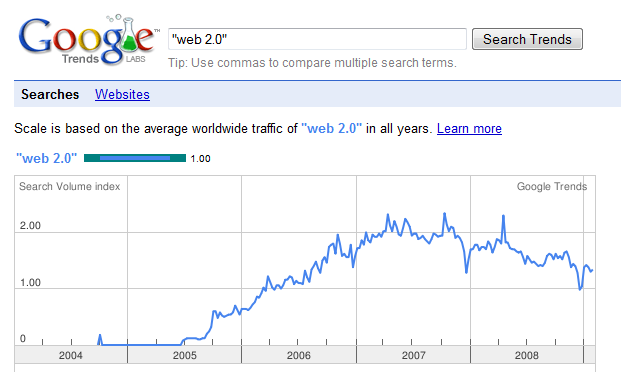
So why do I say it’s fading? For one, because the number of startups that contact us and include the term Web 2.0 in the subject line or message is visibly dropping (and that’s a good thing), and I hardly ever see it mentioned anymore on other technology blogs and news sites either. That’s not really tangible, so I took a look at the number of mentions of the phrase across the web, and they seem to be decreasing significantly, reflecting my feeling on this.

Judging by Google Trends, which shows how often a particular search term is entered relative to the total search volume across various regions of the world (and in various languages), the term started being used at the end of 2004 when Tim O’Reilly organized the first edition of the Web 2.0 Conference. Search queries for the term started picking up in the middle of 2005, when TechCrunch was started – with the tagline “Tracking Web 2.0″ by the way – and the number kept increasing until the end of 2007. After that, the trend is clearly downwards, falling back to the level it reached in early 2006 today. If the trend continues, there should only be a handful of people left who scour search engines for “Web 2.0″ by 2011.

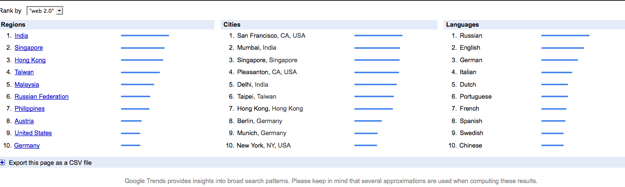
Also noteworthy: take a look at the geographic regions that have generated the highest volumes of worldwide search traffic for the term over the years – it’s Asia, with the top 5 regions being India, Singapore, Hong Kong, Taiwan and Malaysia (in that order). Furthermore, Google Trends pegs the number one language in which people search for stuff related to the topic of Web 2.0 to be Russian before English.
And just in case you’re curious: “Web 3.0″ doesn’t seem to picking up much.
Let’s all rejoice.

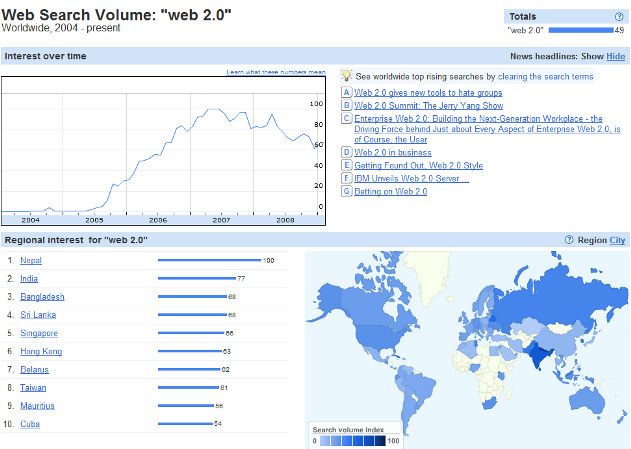
Google’s “Insights for Search”, a beta service that analyzes a portion of worldwide Google web searches from all Google domains to compute how many searches have been done for the terms you’ve entered – relative to the total number of searches done on Google over time – gives an even better overview:
I’ve never had anything against the phrase “Web 2.0″, but I wouldn’t miss it a bit if it were never used again.

How about you?

(Picture of Tim O’Reilly at Web 2.0 Expo 2007 by Scott Beale / Laughing Squid)

Advertisement

Responses

Comments rss icon

  • I have always despised the term “web 2.0″, which is why I called my blog web.2point1.com.

    • I also despise the term “widget” – it is a word that by definition describes something indescribable.

      • Widget has the benefit of having been around a long time – I first heard it in the 80s – whereas Web2.0 is pure marketing hype.

        • True, although I don’t see how that’s a benefit.

          A widget is also a small piece of plastic at the bottom of a beer can. http://en.wikip...rg/wiki/Widget_(beer)

        • I don’t mind widget at all because it really is an effective way of describing all these “little apps”. But you’re right web 2.0 is completely bullsh.

          If you’re a bizdev person please do not go into a meeting and say that you’re a “cutting edge, leader in class, social maven, web 2.0 company”.

        • Skip_taxes_work_for_obama - February 14th, 2009 at 6:05 pm PST

          Doesn’t everyone call the “death” of something when there is not much more to write about? Seems like writers need attention, so the “death” brings comments like this on here to make more money for the guys that started the perception there was a trend.

          whoa. I got suckered again.

        • I’m with @rikin…what else are you going to call them?

          And to REALLY send you into a tailspin, Tim, we have a slate of products and services that can only be described as Widget 2.0.

          No, really. :)

      • what about Software as a Service? or Cloud Computing?

        the biggest term that is on its death bed and nobody pays attention too is “search engine”.

        if the internet had started out with the term “location engine” everything would have made sense. people would have focused on what is important and we would not have the algorithm, dummy domain name era that has screwed everyone up for the last 15 years. yahwho is probably one the the most famous geriatric domain choices in the history of the internet. those dam radio and tv commercials were some of the most irritating you could ever listen too. yyyyaaaaaaaaaaahooooooooo! how many people want a social profile at yahope or geocites? proof dorky properties will get you nowhere.

        EngineLocator.com – position yourself

      • I’ve always hated the word widget. Especially in school when a finance professor or someone would say it. “Let’s say your company makes widgets.” What the hell is a widget? How totally uncreative are you that you can’t think up a fictional product? Gum. There. How hard was that?

        • @Millions: it’s a pre-emptive strike against the morons and clowns in the class who would ask seemingly-relevant but ultimately pointless questions about the business process that are specific to the product:

          * what if the ingredients go bad?
          * what if gum isn’t popular that year?
          * how many flavors of gum does the company make?

          There’s at least one person in every class that will derail the discussion this way. In certain classrooms, not responding to these questions (or calling them too specific to be useful to the discussion, which is true) will inevitably demonize you (the teacher) as someone who plays favorites, or who refuses to answer “perfectly good questions”, or something like that.

          Trust me… there’s a reason for being utterly vague and uncreative when speaking in the hypothetical.

          –Naomi

    • My use (and understanding) of Web2.0 was kind of ambiguous, but somewhat related to “user generated content” for the community.

      In other words, sites that went beyond brochureware to giving content to the community, from the community. Digg, Delicious… etc. Social networks provide content not from the sponsor or admin, but from the users.

      To me that is what web 2.0 is/was.

      In my product development we tag any new work orders that are based around user generated content as 2.0, simply because of that …

      am I missing other significant meanings of web 2.0?

      Jason Alba
      CEO – JibberJobber.com
      Career Management CRM

      • On the design side of things, it refers to the whole “glossy, simplistic, everything has a reflection on it” sort of look.

        The term itself can be pretty helpful. When a client calls me up and says “I want it to look very Web 2.0″ I know exactly the style they’re looking for.

        A fair amount of designers think it’s going out of style…but not from what I’ve seen…things seem to be evolving to be even glossier and more refined.

    • O’Reilly invented the term Web 2.0 around the same time the term SaaS took off in popularity because O’Reilly wanted to jump on the SaaS bandwagon but he was too late to own that term.

      It’s just like O’Reilly invented the term Open Source because he wanted to eclipse the term FOSS and it’s negative connotations and then own the new term.

      In both cases, O’Reilly quickly went off and created successful technical conferences around his new terms.

      So, if you have a great idea for a computing paradigm shift new term, go see O’Reilly first and ask him what he wants to call it. It will save you a lot of time and angst.

    • Usenet, Email, Web 2.0, and Abe Vigoda all have a few things in common. Besides being wildly popular in their time, they are a popular topic for ill informed predictions of death.

      Isn’t an archive and syndication of that archive just a means to partially extend the effective lifespan or viability of an asset?

      Is death really a completely accurate condition?

      [ insert Pythonesque "I'm not quite dead yet" ]

      What will happen is similar to how “World Wide Web” become deprecated in conversation, we’ll see Web 2.0 just fade into the background as some kind of legacy term.

      Over time, the Interweb and other terms of endearment or meme quality will ablate the Web 2.0 varnish covering the coverage itself.

      So, “the web” or “le web” (for those of you in France) will likely dominate for some time until mobile or smaller federated services like Facebook (see also: AOL Rainman) temporarily silo an amalgam of users of the time.

      Just as Facebook is not “the web” and not “the Interweb” there will be the various services that represent the islands of interest and congregation. For many, this silo will be all there is. Shock and dismay lead to acceptance as these silos are torn down (or fall down) and are replaced with shinier and more youthful alternative silos (some with VC funding perhaps?).

      Here’s to a time when the Internet buzz word du jour and related sources of frenzied coverage and predictive obituary are just as banal and commonplace as running water, that ancient concept known as broadcast analog Television, and re-runs of Barney Miller (now available on iTunes).

      • Ditto. What’s in a name? I love to talk, I love to read. But Farnham is a short speak freak. “Web 2.0″ costs a lot less in Twitter space than “Interactive Internet HTML and XML media utilizing Linux, Apache, MySQL, and PHP enabled Services in which Ajax, Java and other communications protocol enable effective multiple networking thereby encouraging the establishment of communities of online collaborators discussing issues of common interest…” Well, you get the idea. ;-)

    • Web 2.0 has included a series of “micro-innovations” for better or worse.

      The low barrier of entry for both technology & funding facilitated this environment.

      A start-up widget company has another start-up integrated on top of it and another start-up integrated on top of that, etc.

      Let us hope that in these dark economic times that the base level service that is the foundation for these start-ups upon start-ups does not crumble!

    • Kudos to Farnham…Web 2.0 beats the heck out of “New Web,”"Evolution(ary)Web,” or any number of colorful monikers. The decreased use of the “term,” only means that new developments, and the myriad of cool interactive functionality solutions are being adopted and accepted as “the norm.” Web2.0 will NOT go away, but only be replaced with “Web3.0″ or “VideoWeb” as the next evolution of customized, original, streaming video content, specifically scripted for the needs of clients… becomes the norm for websites. Static web is dead…or should be. Web2.0 and it’s incarnations are welcome…whatever you call them.

  • Wouldn’t miss it. It was just an online fad anyway.

    • The term was stupid and overused.

      That said it did represent a different way of thinking of online interactions, and this has now become pretty ubiquitious.

      As a result, it has become like another previous overused term e-commerce. Now very few people write about e-commerce since so much of commerce has simply BECOME e-commerce.

      Now almost every major site IS web 2.0 to a greater or lesser degree.

      That said, it seems to have been brilliant marketing for O’Riley and his conferences biz … one of the few web 2.0 businesses that actually seemed to make money.

      Anjali Sen

  • Web 3.0 will be kicked around after the economy picks up.

  • The web is so over-analyzed and riddled with terminology and trends that Its starting to reach a point of insanity.

    Who cares if its the end of “Web 2.0″ ? In my mind, it was never anything more than a meaningless buzzword

  • Web 2.0 has always been just a “marketing” term

  • I actually downloaded the leaked beta of Web 3.0 last night. Pretty sweet.

  • I think it’s normal, after so long.

    Afterall the term “web 2.0″ was just a term used to differenciate the new from the old.

    Today web 2.0 is kind of a standard so why include the term web 2.0 when it brings nothing new?

  • I like how Robin basicly writes about how one of their sponsors “Expo” is worthless and won’t exist in 2 years.

  • Finally! Thank god!

    Web 2.0 was always a bullshitting term and everybody who was frequently using it prooved what an idiot he was.

    • Ever notice that people who call other people “idiot” on the internet frequently display their own inadequacy?

      The word you were looking for is “proved”.

  • The drop is probably due to the rise in the term “social media”. Social media seems to be the new web 2.0 – every other article and discussion seems to be on about it. Business are all looking to ‘leverage’ it. Not sure which one’s worse. I think I preferred web 2.0 which was at least more tech web speak. Social media is pure marketing speak.

    Riza

    http://urbansur...ct.blogspot.org

    • Yep, now the new term is “social media”. But with every new and popular catch phrase it eventually gets used to death. It seems every random follower I get on Twitter is a “social media marketer”. I’ve gotten to the point where I don’t even follow these folks back. It seems if you want to get into online marketing you’ve got to proclaim yourself a social media marketer and join Twitter. Anyway, the Google trends for social media is much sharper than “web 2.0″ ever was:

      http://www.goog...ll&date=all

  • Web 2.0 is only a way to summarize an important makeover of WWW.

  • We have seen the same thing when companies submit their business plans to angels for investment. I think web 2.0 isn’t going away or dying, it just isn’t novel anymore. Companies aren’t using it to describe their companies because it as assumed they are integrating that functionality in any web design. Like not calling your company a dot.com company by year 2000. Not too long ago I posted on my angel investor blog how to make investment decisions in web 2.0 companies because so many, particularly on the east coast just didn’t get it, mostly because they didn’t have revenue models and just were creating ROI on perceived eyeball volume and future potential. Updated that blog with your findings: http://tinyurl.com/web20angel

  • Web 3.0: 3 is the perfect number for the Net.
    So: “web 2.0″ is only a therm, a buzzword. I think that are more important and considerable: “social media”, “internet of things”, “semantic web”.

  • But anyway. As we see the current bubble bursting I doubt we will see another bubble appearing in the internet in the near future.

    After the “new economy” and “web 2.0″ it should be become really hard to convince/cheat anymore clueless investors (better saying people giving the investors money) to invest in this field.

    I see a bubble coming in the “clean energy” sector. So if you’re good in bullshitting please leave the web and do what you can do best.

  • I was compelled to blog my reaction to this – And other terms I hate. http://web.2poi...eath-of-web-20/

  • Web 2.0 is not dead. Web 1.0 is dead… making the “2.0″ moniker extraneous.

    • Robin is declaring the death of the *term*, not the *thing*. Everything we assume the term to mean is alive and well.

    • Web 1.0 is not dead, it is just old fashioned. But, much like older actors, older comedians, old songs, and old cars, there is still a place for it. I started creating websites in 1995 and have created over 500 websites for myself since then, and I have not changed them much over the years. I have not found Web 1.0 sites necessarily make less money than Web 2.0 sites, what really matters is having good content. That being said, if I was talented at creating web 2.0 sites, then I would see no reason to keep creating web 1.0 sites. Web 1.0 is just what I know, and I am too lazy/unmotivated to learn all the new stuff.

  • I’m very much looking forward to Robin’s next article: “Man Lands on Moon”

  • u said its fading , i would appreciate if you aswell predict the reasons

  • Sad sad little men. Seriously is that also the death of America? The death of midgets? Or even looking at Google Trends… THE DEATH of the INTERNET Ohh noes!

    Seriously, maybe it is the death of the web in general :O Less users? Less searches? Pointless article once again on techcrunch. It’s sad to see so many people rely on your site for predictions.

  • It’s inevitable that the term Web 2.0 would fade in usage, isn’t it? It’s like naming operating systems or software, the numbers wears out, seems old, and needs to be replaced by the next number (Web 3.0? No, please, no.) or a name (Web Vista? No. Please, no.)

    I agree with the comment up above that the trend now seems to be toward “social media.”

    Sites, like the one I am product and designer manager for (http://www.updown.com), that have members and some social connections, are trying to figure out how to work in all of the other social tools, like Twitter, Facebook Connect, Google Friend Connect, etc., in a strategic way. It’s not easy.

  • What’s wrong with web versioning or naming conventions?

    I see hyperbolic phrasings as useful cultural/social indicators. This way vast groupings on the periphery can grasp the evolution of ideas/concepts on the time continuum which may empower them in some form.

    With one term (however numnut-sounding) granma gets the idea that the internet is something different today than it was eight years ago. And I like my granma mentally grasping, even abstractly and superficially, the changes that abound in current realities relating to technology.

    • Dipshit, there’s a “d” in granDma. If she’s as smart as you, I don’t care what she’s grasping. WTF are they teaching in schools now?

      ~sigh

      • FKYU! You rancid cloud of throne odor! If I prefer to spell granDma with a personal flair as in gran(minus d)ma then I shall do so in spite of the fact that a retard with a cranium full of crayons wanders about aimlessly about calling itself ‘dumbass’.

        Granma
        Granma
        Granma

        and… granma.!

        [wave] lovyu GRANMA.

        • Obviously, I am an idiot, or if you prefer, a “Douche Bag 2.0″
          The 3.0 version is equivalent to “retarded” which is coming up on my next comment….

        • Ok weirdo, you’ve firmly established that the word ‘granma’ and ‘web number.number’ unhinges your already tragically broken mind.

          Is it really necessary to accessorize your highlighted insanity by posting tripe and fiction under my moniker?

          Your loserhood is a disease- get some treatment.

        • Agile Cyborg aka Agile DoucheBag - February 14th, 2009 at 3:24 pm PST

          See? I told you…. Can’t keep up with myself!
          I suffer from wild oral diarrhea. Yikes!
          Got to clean the keyboard, again!

        • Agile Cyborg,

          I wonder what sewer lid they scraped this malformed parasite from? The thing is obviously famished for attention so deny it this single ray of hope and it will crawl back into its wasteland.

          -Filonov

        • What, Is everybody commenting on this article 12? Regardless, it’s been quite entertaining. I’ll have to stop by more often! LMAO!

  • I think that the death of “web 2.0″ as a term is probably more focused around a couple of things.

    1) Web 2.0 meant that there *needed* to be some sort of differentiation between what was being released and what was already out there. Aside from maybe a few things, the majority of “new” releases do not really contribute anything beyond what’s already available.

    2) In order to use the term “web 2.0″ and be taken seriously in the eyes of investors means that what you have to offer is *seriously* different than the school of goldfish that is available today. If what you’re trying to push doesn’t meet that goal, then you won’t be taken seriously.

    In short, versioning (in any aspect) is usually directly proportional to innovation, or at the minimum something new.

  • Agree.

    But then I never thought the term had much traction in any case.

  • Web2.0 is not dead as it has not fully matured. Matured in respect to innovators. It has nothing to do with popularity.

    The term marketing or not embodies the spirit of change and innovation within the last 10 or so years in respect to the web. Thus improvements. It has nothing really to do with specific type of company or product but more of a synergy.

    The article is misleading and total bull shit. Mike do not allow such shit on this site anymore :)

    • Mike allows anything that would entertain visitors. This “article” is less than useless and uninformative. The writer… seems to believe that these marginal topics are somehow relevant to… What? Although he is fairly consistent when it comes to post this kind of crapola.

  • well – The main reason is that Web2.0 is now :) It’s kind of the fad phenomenon – But for such technical paradigms, even after the buzz around that word dies down, there would still continue to be the effect on the area of science it affects. people are not much interested now inthe word ‘web2.0′ but more around what it signifies !

  • I don’t think that parameter is adequate to declare it dead, by this time most of people know what the word “web2.0″ means then why they will search for specific keywords.?

  • I also am glad that the incredible phenomenon known as “Tags” died along with it.

  • What kind of idiots said “I tweet therefore I am”

    Idiots.

    Tags are a way to organize, but people (including TC) got too excited. I don’t want to add a seesmic video comment, i dont want to facebook connect. This all slows down my life….

  • I don’t think it matters if we call it the social web, today’s Internet, Web 2.0, or anything else. It hasn’t died because of the depression we’re in. And Web 3.0–or whatever you want to call that–won’t emerge because of the depression.

    Web 2.0 will not ‘die’ until the underlying services that make it up are of lesser importance than the new services that compose the next hugely different use of the Internet.

  • #4 city: Pleasanton, CA, represent!

    You gotta figure either:

    a) There’s some large ISP interconnect for silicon valley in Pleasanton.

    b) Pleasanton’s population of 60K searches for “web 2.0″ over and over.

    c) John Madden is looking for a career change.

  • And now… what are we supossed to do with the Web 2.0 Expo wich is a Tc Sponsor?

    If i were an organizer of the event a would not like this post… While paying 10k a month.

  • I think web 2.0 is a buzzword and reflects the rebound of the internet sector after the 2001 dot com crash. It also reflects the growth of cheaper servers that support cloud computing and the growth of user generated content in the form of social networks with Photo and Video sharing. The decrease in usage is likely due to the new use of social media and the ubiquity of myspace and facebook as a product and platform. Investors are always seeking new technologies and products and with the recession and time, the phrase web 2.0 has been used enough.

  • I vomit in my mouth a little when I hear the term Web 2.0.

    When I first heard it used I immediately thought…”I better start planning for the release web 2.0.1″.

    Now I can remove the cheezy reflections from all of the logos I created during that period.

    Good riddance!

  • It’s good that it is fading away. We had Web 1.0 and the strong companies survived, Yahoo, Amazon, Ebay, Monster, WebMd etc. We had Web 2.0 and Youtube, Facebook, Twitter, Digg, Yelp and a few others will be around for a while (I like to leave out Myspace because it is so trashy).

    But I feel like web 2.0 is not fading away because there is a bad economy, but more because there is a web 3.0 emerging. Everyone thought it would be the semantic web, it turns out that web 3.0 is mobile applications. With iphone and android apps etc. you have a whole new platform for the web. I think it will get bigger, and it will make some companies some money. People are showing a willingness to pay money (ok, small amounts of money) to download some of these apps.

    I don’t like the whole web 1.0, 2.0, 3.0 label system, but if we are going to talk about it that way, let’s just say that mobile apps are web 3.0. Isn’t it obvious?

    • All these marketing terms are just used to simplify things some people don’t really understand. And of cause to make money.

      Bullshitter: “Hey. Can you give us founding for this cool internet company we’re planning?”

      Investor: “No way! You cheated me already with the new economy.”

      Bullshitter: “No wait! This is new! It’s the Web 2.0! Now everything is social, user-generated content, crowdsourcing, long-tail, viral, widgets, apps!!! Are you stupid not understanding this???”

      Investor: “Here’s the money!”

  • If web 2 projects all get launched as Beta, perhaps in web 3 we’ll be releasing Alpha versions?

  • We’re busy working on Web 4.0, which is twice as good as Web 2.0 (yup, just do the math! 2.0 + 2.0 = 4.0) Skipping Web 3.0 altogether…

  • Agreed. I’m using the ‘next web’ term at the moment as at better alternative. You never have to update it. Now lets hope Boris is easier than O’Reilly with that term :)

  • Amazing. Dozens of people answering, giving reasons, explanations, rants, raves and counterpoints. Through all that, no-one actually bothered to note that the data that is displayed here shows that while there’s been a dip in search volume, the search term is still more popular than it was in late 2005/early 2006, the height of its popularity.

  • I don’t care about Web 2.0. But if anyone creates another acronym with the word “oriented” in it, I’m going to feed them to the lions.

    Examples:

    Objected Oriented Programming
    Service Oriented Architecture

    I think you have to be British or something to appreciate the “oriented” nuance, because it’s so cool, clever, intellectual, and superior.

  • Agree with some others here. The term got annoying, but the phenomenon it was meant to define, namely a more interactive experience online, with users contributing to and improving the web as they went, was very real and paradigm-shifting (to use another slightly annoying term ).

  • I have been saying this Web 2.0 bubble for sometime now. Well, at least my view has been confirmed. There are too many “me-too”, duplicates, no-business-model, and crap-shoot startups funded apparently by some major VC firms. To make the situation worse, most of these Web 2.0 startups are not “IPOable”. Their only exit strategies are M&A by firms like Google. Yahoo. Ebay, and others are not in a position to acquire those startups. In this economic downturn which could last for many years, they are only zombies.

  • Lame post. web 2.0 is a great descriptor for everything that has happened since the dotcom crash, any 20 year-olds on here remember that? Oh, you were in 5th grade. Before you slam it why not come up with something to replace it instead of just whining and running around like a chicken with your head cut off.

  • You see that gigantic white spot on the third graphic? Ironically, that’s Africa for those who don’t know of it. It’s a market that to date has been completely ignored by the net due to paltry landline connectivity.

    Web 2.0 was bound to die off. I offer up Web Free as the next iteration and it will be a heavily mobile-driven web and include the African market of one billion people.

    http://www.mane...arts_in_africa/

    -miquel

  • Here’s another website that covers successful web 2.0 startups – http://www.iamweb2.com

  • Check out the trendlines for “web 2.0″ vs. “twitter”:

    http://www.goog...ll&date=all

  • This article is about calling a industry name dead because it isn’t used alot now, so is that like saying in 2007, that the afghan war was over as we had more search hits on iraq war. Lets just base all our decision making on a Search Engine/location engine.

    New apps developed with Ajax, Java…will continue, call them Web App, Web 2.0, Cloud App, Server based application…so what, it is this industry that keeps the blog site alive…so if no mentions of TechCrunch this year via search on Google, then this sites value to public is less, or worthless?

    • If there are no searches for TechCrunch this year via Google… yes, it probably would mean TechCrunch had become worthless and was no longer relevant to the world.

Leave Comment

Commenting Options

Enter your personal information to the left, or sign in with your Facebook account by clicking the button below.

Alternatively, you can create an avatar that will appear whenever you leave a comment on a Gravatar-enabled blog.

Trackback URL
bugbugbugbug
Techcrunch on Facebook