
WujWuj’s New Focus: Make Online Retail Go Viral
by Mark Hendrickson on February 11, 2009

When online retail service WujWuj first launched, it focused on helping people pool their money to buy gifts for friends and family. That never really took off, so the service was shut down and is now being reborn with new focus on so-called “group buys”.

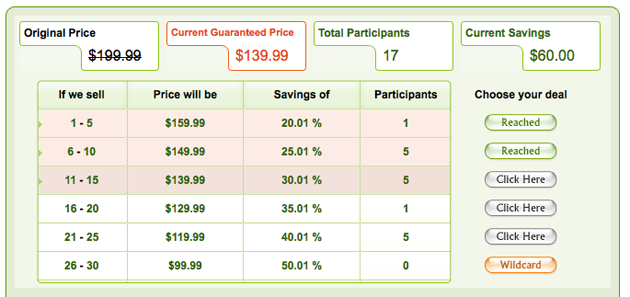
A group buy is a type of sale in which the price of an item drops as more people commit to purchasing it. Consumers benefit from lower prices as more people commit, and retailers benefit from an increase in sales volume. Essentially, it’s a way for retailers to incentivize their consumers to market their goods for them, because customers will be inclined to spread the word about deals.

WujWuj CEO Monti Majthoub tells me that most group buys are currently organized in online forums like FatWallet and AnandTech. His new GroupBuy system adds more structure and “viral” potential to the process by leveraging the power of widgets.
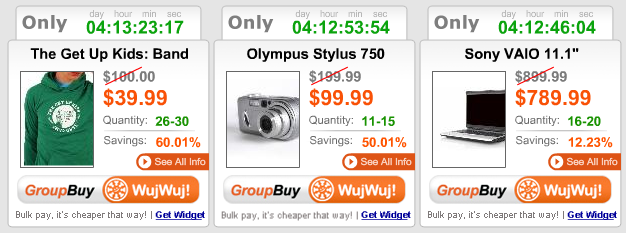
Here’s how it works. WujWuj’s retail partners enter their goods into the GroupBuy system and then embed special GroupBuy widgets on their websites. Each widget shows a photo of the item on sale and how much the price will drop as more people commit to buying. Consumers who have already committed to buying (after seeing the products on retailers’ sites) can grab the widgets and embed them on their own social networking profiles and websites, which will then lead their visitors back to the same WujWuj purchasing form.

Customers are guaranteed to pay no more than the maximum price they’ve indicated for a good, and once the time period is up for a particular group buy, all of those who have committed to purchasing will pay the lowest price reached. WujWuj lets retailers charge customers with their own payment gateways and it collects just 1.9% of all successful sales as a fee.

Will this system make online group buys more popular and viral? Majthoub is cautiously optimistic. He points out that several other companies (such as previously reviewed eSwarm) have tried to improve the group buy process and failed. But he also believes WujWuj may have finally devised a system that’s so simple for both retailers and consumers that it might actually work.
Advertisement

Comments rss icon

  • This is hilarious. See the TC post on eSwarm from 2007 (http://www.tech...-buying-online/), then look at the comments and note this one (credit Rob Leathorn):

    “Hmmm I wonder when you guys write some of these posts, whether you bother to research all the previous attempts at or (in many cases) flame outs regarding this idea. As Matt points out, that fact may be a “wow, we’re recycling old business models, this stuff isn’t really new” point to be made. This was indeed one of the big crazy ideas that was going to be difficult to make work, with such winners as Mercata ($89 million gone), Mobshop, actBIG, and many others. I feel some further context is justified, instead of another breathless TC puff piece.”

    Draw your own conclusion, TC reader.

  • I am checking the website and do not find any place to go and check the deals. It seems like no one has implemented the model yet.

    Buyers have to wait.

  • Hello Deano, This is monti from wujwuj wujwuj is different from other groupbuy sites in many ways, here are some.

    1- We are a portal/application that is branded to the retailers logo/name.
    2- We provide the payment gateway so the user pays the retailer directly (we do not facilitate groupbuys like eswarm, letsbuyit and others)
    3- User knows the complete deal prior to participating, they dont have to wait to find out what the terms/price is. We hope and believe we have addressed the reasons to why GroupBuying never took off.

    We want to change the way retailers might do a sale, why just do a sale, do a social sale were people have an incentive to share sales with their friends and family.

    • Hi Monti

      Came accross your interesting website and a funky name. But I did not understand your payment mechanism. Currently if I click on the participate, I get to a page hosted by WujWuj where I have to enter my details for payments. Then how is that I am paying directly to retailer just like I can do for instant buying from retailer’s site. Great to have your comments. Overall this thing rocks.

  • This is unintuitive, and took me awhile to get it. The concept is simple, right? The more that buys, the less it costs. The details is what kills you. Now that I think about it, I STILL do not know exactly how the guarantee, and locking in stuff works. If I lock in at the lowest price, it means I dunno if I’m gonna pay for it until the last day? What if everyone signs up for the lowest price? but wait… shouldn’t everyone just do that anyway? Why would anyone sign up for the highest price range? I think there should just be 1 button.. a button called “JOIN THIS GROUP”, none of this locking in different price range stuff. Make it SIMPLE. You want it to be mainstream, right?

    I dunno if the model is compelling enough for retailers to participate.. forget the buyers/shoppers, suppose they will eventually grasp everything.. sure, they’ll be enticed, but the retailers?

    One las thing… Google something called “Singapore shopping sprees”. There are many ppl in Asian countries that desire US goods, but shipping is too expensive, so they have something called “sprees” where ppl buy together so shipping costs go down. I dunno if this is worth checking out, but you guys should consider this.

  • My old neighbor back in 1999 was CEO of Letsbuyit.com – a first wave european .bomb which is dying a slow death. Same idea… group buying saves you money. Not sure why they ended up failing but part of my issue with it was they weren’t able to source the products I wanted to buy.

  • I checked the website, it seems they did the first launch now.

    Go to https://www.wuj...uy/default.aspx and those are dummy products i guess.

    The idea is great, amazing if stores stated to use it, as they say in two minutes stores can place their product and they can also place a button in there site then the idea is amazing.

    i can not wait for stores to start placing their products but it looks like a soft launch.

    This site got great potential.

    Good luck for them

  • Why buy something now if I can see how much lower I could pay for it?

    I don’t want to wait for a product to reach down to $99, I would want to buy the product for $99 now.

    Someone asked if we could create this model for digital retail and I really just don’t see the novelty of the model. If you sell 10 units of something at a lower price, who cares if the purchases are in a “group”, 10 unit sales is 10 unit sales.

  • Also, I think this concept will also suffer a chicken and egg problem. I dunno if retailers will want to ruin their ‘branding’ by directing users to WujWuj. You will need to build up your reputation AND also somehow attract lotsa consumers FIRST before you will sign up lotsa retailers. Otherwise, why would a retailer bother their time to sign up with you guys? They don’t have time to talk with unproven players.

  • This group buying system has been incorporated in the Netherlands for 4 years or so (without widgets though) and has been slightly successfull. Please note that these transactions are hosted by a non-profit organisation (samenkopen.net) and therefore make no profit at all. Also note that, with group-buying, customers are more than ever price focused and since it is virtually impossible to offer less than some products being produced in Asia… you’ll wind up with MP4 players for $ 30 and other niche stuff that nobody really needs.

    My opinion: it’s a nice gadget, but not a viable business model.

  • What is wrong with this model is that it is vendor driven. The only way this will work is if you leverage the real power of the number by starting from the intent, and taking it to the vendor from there. This way you can weigh on other aspects but the price, and you can define the rules as a community. There is a Belgian company called iChoosr (www.ichoosr.com) which is developing technology to do just that. In just three months, they have saved more than a quarter million euros for their users. If you want to do an article about that, I can get you in touch with the CEO.

  • Hi,

    I guess the stores can not sell the 10 products to 10 different people at the same time so he will stick to the agents.

    At this site i guess you can sell 10 people who wants this camera but you have to wait until the people gather themselves and Group Buy it.

    So getting a 99$ camera that is worth for example 130$ is impossible unless it is sold to an agent who will take the 10 items or the 10 different poeple who will wait till all the interested buyers place the purchase.

    I got the idea now, it is an amazing, i have worked on group buys on the net and it used to be placed on a forum for all of us to buy a product.

    Google Group Buy and you will find hundred of thousand of offers for group buying, all of them will love to use wujwuj.com to sell their products rather than doing it manually.

    So to get the best deal you need more people to bid on it, it is the contrary of ebay where you bid on something and the price goes up.

    Amazing system

  • silicon valley dropout - February 11th, 2009 at 11:17 am PST

    this is like a pyramid scheme for shopping

  • As a former founder and CEO of a group buying site during the .com crazy times, I learned firsthand, by being there, the weaknesses of the model. I believe that consumers buying power will only come when someone creates a model where you first aggregate the people and then you negotiate or wait for the supply to go and bid aggressively for your valuable leads. The WujWuj’s is the same business model as before, you just post a product and just pass the discount on the consumer for bulk buying. Reality is that Amazon or WalMart already do group buying for consumers. They sale and have so much power on behalf of clients, that they negotiate great deals that they pass onto customers. I bet no group buying site can beat any of this “real” group buying companies. I strongly recommend that WujWuj’s management finds a way to aggregate leads and then sale this leads to the best buyer. This will be real buying power.

    • That’s exactly what iChoosr.com is already doing (see comment above).

    • As they say, the devil is in the details. And I think Max has the right idea that you need to aggregate people and then go negotiate for deals with vendors and manufacturers based on what the members want.

      But you’d never be able to reach critical mass with just the promise of group buys off in the future, you need a way to draw them together in the first place with the added benefit of group buys later. Since people interested in group buys are typically people who like looking for deals and saving money, I think you’d need to build communities of thrifty people with something like Fatwallet or Slickdeals. Then provide the tools for the aggregate to easily hone in some items or vendors they’d like to group buy, discuss, vote, and then negotiate collectively. In effect, something of a Fatwallet-Meetup hybrid. In the meantime, while the group buy is forming, the members still have ways to stay engaged which helps them stay committed to the group buy. For example, build a micro-community around Nikon photography and equipment and then provide the tools for anyone to kick off a group buy to approach B&H with a large order for a brand new lens or camera body. The aggregate remains more committed because they’re part of a group that knows each other rather than anonymous buyers on a website.

      Without some type of buyer engagement and loyalty, I can’t imagine anyone would want to commit to a group buy with people they don’t know on the premise that they could save a few bucks. I’d much rather spend my money at Amazon or eBay knowing that I can buy it right away even if it’s slightly more expensive.

  • This is pretty neat. Perhaps we can introduce this to our webpage too to our viewers and help them out.

  • On first impression, it looks quite complex for main stream internet users. A nice site though but the idea will need to be refined I think if it’s to succeed.

  • Hello Alex,
    what you are looking at is what an interested retailers will see.
    You (the end consumer) will only see the deal page.

    Thanks.

  • Anyone remember Paul Allen’s mercata.com? It was also a group buying site. It went bye bye in 2001 after spending $30 mil. It’s a tough niche to carve out.

    • Hi Chris, good point! We did look at Mercata, and believe they failed because they were trying to be a destination site, and to do that, one must spend a ton on marketing.

      Rather, our widget resides on the online retailers site. We are not trying to take traffic away from their site, rather, we believe the widget will increase their traffic

  • I used group buying sites during the dot com boom. I saved money but the companies went under. I don’t think retail is the right business model, but it would make sense for specialty goods that have to be produced on demand. Of course that’s a much smaller market.

  • Hello Chris,
    We are trying it backwards (I *think* the first to do so).
    Our opinion Mercata and co failed because they were basically competing with walmart.

    another point I would like to make is that group buying is a big underground market and is waiting to be conquered.

    thanks.

  • This isn’t new, Japan online retailers have been doing this for years. Yawn

  • I’ve been using groupon.com, which is a chicago-based group site (Run by ThePoint, which has been featured on TC.)

    If enough people sign up, your credit card is charged and they e-mail you the coupon. Examples are $15 for a $30 restaurant voucher and 1/2 off massage. I’ve used them twice and love it. I guess I’m bringing this up because it’s a combination of the group-buy approach and woot. Both are clever models, and combined, seem quite powerful.

    I do have to say that one reason I like groupon is that it is ONE thing each day, a bite-sized offer to consume when I need a distraction from work. I can’t really imagine spending a lot of time possibly buying goods in the future.

  • incentivize?

    I’m glad you wroteized this article. Your ability to blogize your thoughts really helpizes us to understandize.

    How about “it incents the consumers…”?

    Incentivize is an Americanism – a crap madeup word in the 60s/70s by some illiterate MBA types. It’s a good idea to drop it from your vocabulary! (or dropize it)

    :-) otherwize I liked the article.

    • @ Arnie… ever wonder why people don’t speak the same way today as they did centuries ago? Language evolves! New words come up while some fall out of use. ‘Incentivize’ is here to stay. You understood what the speaker meant, hence the word has achieved its utilitarian mission. Ditch your puritanism and try to keep up.

  • “But he also believes WujWuj may have finally devised a system that’s so simple for both retailers and consumers that it might actually work.”

    I like that WujWuj is recognizing that previous endeavors have failed because they are not simple enough for BOTH retailers and consumers. It seems like they recognize that creating a seamless process will be important for success of the design (in an area as so many have pointed out that others have failed). Interesting concept but I withhold my opinion until I see some follow-through.

  • I think this is an old idea with a great new widget platform. I see a lot of negative comments from half empty users. There is a huge demand for saving money, especially now. With the standardization of many platforms such as facebook and myspace, This one has a big chance if done correctly. Facebook is naturally viral due to it’s newsfeed and Myspace is quietly moving that way too.

    My only complaints would be a) one target price to choose b) stay stealth until you have a working product.

    • well i see this as the main problem the only real thing they have come up with is the new widget which is not much considering how much material ( dead start ups) they could have worked with it , i mean just reading through the comments gives you number of ideas what the site should have done and it did not , i think this is a classic case of denial ( it will work for us ) before any real analysis has been done on the issue so they might capture a few cost sensitive people types but this has no chance of going main stream , people just dont shop that smart

  • Thanks Ryan
    We understand peoples skepticism, after all, this has been tried for almost 20 years.
    we obviously never claimed to have invented “group buying”. all we did was study why it failed.

    We also understand peoples confusion as they are looking at what an interested retailers would look at before signing up.
    You (the end consumer) will see the widget on the retailers website. (you will never even see our name)
    Its viral, it gets cheaper the more people participate which precisely why participants will share the widget.

    • Where is a retailer going to come up with the dollars to create these compelling quantity discounts? In case people hadn’t noticed, retailing is competitive and it’s hard.

      Let’s say I’m selling a plasma TV for $1200. Maybe I’m making a couple of points on this item when I sell them one at a time. If I sell 30 of them all at once, it doesn’t mean I can drop the price to $899.

      If I’m potterybarn.com and I’m selling a certain end table for $120, I’m not going to in essence compete with myself and drop the price to $80 to get 40 orders UNLESS the product is ready to be liquidated.

  • Hello Skeptic,

    You are absolutely right.
    The electronics market is a very tough market, although we believe that we can help you compete with the bigger boys via our application, chances are corporations like walmart and best buy will always be cheaper.

    however, there are markets were our application would compliment many products nicely.
    for example, travel, software, higher end electronics, custom auto parts, clothing, even music.

    We help retailers reach the *undecided shoppers* by enticing them into joining the cheapest phase (assuming its a good deal). these shoppers get to the deal via twitter, facebook ..etc
    P.S: The deal can not be longer than 10 days and as short as 1 day.
    Its a “short viral sale” I think if implemented correctly it is better than advertising.

    I would even suggest a retailer losing on “hot deal” would get his website more attention than advertising, so this “loss” is essentially an advertising cost.

    I am going to make this *untested* hypothetical, assuming you own a gaming retail website and offered 100 xbox 360s for $149.99 ($50 cheaper then anyone online) thats a $20- $30 per unit depending on the wholesale cost. thats around $2500 loss.
    I would wager that hundreds if not 1000s of gaming blogs and forums will be buzzing about this sweet deal and your shop for weeks.
    Blogs and forums as we all know are cached to be seen forever. Google ads are not.

    This has never been tested and it is completely my opinion.

    • It’s your company and the important thing is that you believe.

      However, let me point out some problems:
      1 – if I’m a small fry trying to compete in a price market with Best Buy and Walmart, this won’t help me. I’m going to take negative margin on hot product that I could sell for full price
      2 – I’m going to attract people to my site who have the expectation that I’m stupid enough to sell things below cost – so I’m not attracting a customer that will help me
      3 – all of the other crap in my store is still more expensive than Best Buy or Walmart
      4 – the fastest way for me to never get any more Xbox 360’s is to break price. There’s a reason why they generally sell for the same wherever you go

      So really, what you’re offering me the merchant is the potential for some SEO juice because I’m giving away product. I’m competing with full price sales on my own site (I’ve made it harder to sell Xbox 360’s at $199 on my site).

      If this is the core thesis, I continue to be very skeptical.

      Finally, it is still unproven that people will embed a widget that will drive their friends to a site like this. Or post to their feeds.

  • Hello Skeptic,

    The xbox 360 was a bad example, since the electronics market is a tough market.

    However, my above example used on various other markets would IMO do great.
    Heck, beef jerky online sellers can do wonders with this… selling jerky via widgets on facebook?? yum!

    thanks

  • Hello again skeptic,

    “Finally, it is still unproven that people will embed a widget that will drive their friends to a site like this. Or post to their feeds.”

    You are right. however, we have created a reason (the more the cheaper) for people to share them.

    Thats what we believe and hope it will happen.

  • Looks like a good idea. I find it rather surprising that all similar startups failed. Maybe with the development of social networks group-buying sites will get another life.

  • I don’t care that other startups fail. I could believe they were unlucky, or had bad judgement, or it was bad timing… but the reasons why I don’t think this will succeed are all based on logic.

    Do this:
    1. Be like Woot + FatWallet, but with “mobs” that people can job. A 20% off Zappos mob, a 20% nordstrom mob. You know how Zappos gives you 20% affiliate commission for every sale? Offer that plus a bit more (to differentiate from FatWallet and other rebate sites).

    Have comments and stuff…

  • I tell you that this business will go to Deadpool soon. It is the same idea as many sites during Web 1.0. I hope those bozos have money to burn.

  • Just because a certain idea or model had failed in the past, does not mean it can’t succeed in the present. An example from another area: VocalTech have practically invented Voice over IP (VoIP) in 1993, but were too early for the world to adopt it and have been a “dead company walking” for thelast decade – but other companies have adopted it and today this is a business field that generates Billions.

    Online Shopping in particular is an area where changes in the business, technology and mass psychology can cause old ideas to recreate themselves and succeed. The classical example is SmartShopper – a downloadable shopping assistand browser add-on. While previous attempts at such software have failed – from R-U-Sure to the Nextag toolbar – have either gone belly-up or turned into a pure-web initiative, SmartShopper was started as a spin-off out of Hotbar, later on acquired by Zango and to date is one of the most successful revenue-generating software tools in the field of online shopping assistance.

    So this initiative should be judged by its own merit, and in the current technology/business environment, and not just by identifying with similar initiatives that have failed before.

  • Once again I believe TC should open it’s eyes to Latin America… Compra3.com has been working in Brazil since 2008 and they’ve recently changed their business-model to something I think makes more sense…
    They have partnerships with important on-line and off-line retail stores who sell their products on Compra3’s website. People can buy the product there immediately (they don’t have to wait for the group to get enough people… the biggest downside of this model to the consumer).
    Later, Compra3.com gives the consumers discounts based on how many people bought the product. The more people buy that product, for a limited time period, the greater the discount they will receive. So, the viral effect is still there without the hassle of having to wait to get the product.

  • Hate the business name – how to you pronounce that? How do you type that?

    Love the concept. However, when I buy something online, 99% of the time, I want to buy & complete my purchase right away…..not wait to see if others will join the group. It’s definitely got potential.

  • at first Look I think it is like the one that build like shopzila,but I think this is completely different ,combination of social live and Low cost shopping,well for this shopping stop it will be really great for people who has many my space or facebook owner to build there own name of group ,rate one choice porduct ,chose what best buy this week and all the people happy with the lowest rate.well need a live experienced but for now,I will lead this intomy study,Hope I can also benefit from this

  • Interesting concept but the execution looks excruciatingly painful to do well. I would to try it before making concrete conclusions, but my assumption is when the group buy so to speak ends, what you end up paying, who you pay, and how you pay all seem vague. I’d have to double check this whole system with a site like this* one just to make sure the whole system is secure.

  • This business model works particularly well with T-shirts (as many may have already seen). For T-shirts, it doesn’t take much for the vendor to run another +x T-shirts after the first template is put together. Therefore, the price of each T-shirt can go down dramatically as sale numbers go up.

    If this model fails for some retail items, perhaps it will continue to work well for customized items, i.e. a thousand mugs with “Yes We Can!” on it…

  • Seems like this is going to be the year of team shopping sites.

    We have been heads down for sometime on building out a Facebook application, Twangu (http://fb.twangu.com) that does something very similar to eSwarm and others – and I just popped my head up to see chatter on wujwuj, etc.

    Looks like it will be a fun year of competition as we all look to on-board vendors and buyers for similar businesses.

    At Twangu, our focus is to allow buyers to leverage their social network to come together as a team for group purchases – even allowing teams to include multiple items or custom terms (i.e. We each want an Ipod Touch with the Applecare warranty, etc). And we facilitate the transaction from n buyers to a single vendor.

    Good luck to everyone…
    John O’Brien – Twangu – http://fb.twangu.comhttp://www.twangu.com

Leave Comment

Commenting Options

Enter your personal information to the left, or sign in with your Facebook account by clicking the button below.

Alternatively, you can create an avatar that will appear whenever you leave a comment on a Gravatar-enabled blog.

Trackback URL
bugbugbugbug
Techcrunch on Facebook